AI in Programmatic Advertising: How It Improves Targeting, Bidding, and Optimization
Sarah Moss
June 8, 2026
18
minutes read
Programmatic advertising now runs at a scale and speed that has long since left manual decisioning behind—billions of bid requests a day, dozens of channels, and auction windows measured in milliseconds. This article explains how AI is changing the mechanics of programmatic across targeting, bidding, optimization, and measurement, and what the shift means for advertisers building their stacks for the next phase of digital media.
The volume of decisions inside a single mid-sized programmatic campaign has crossed the threshold of human capacity. A campaign running across display, video, CTV, and audio in just five US states will process several million bid requests in a working day, each requiring a yes-or-no decision in under 200 milliseconds. Spreadsheets cannot do that. Trader-driven optimization cannot do that. The work has to be delegated to systems that can learn from outcomes faster than the auctions themselves move.
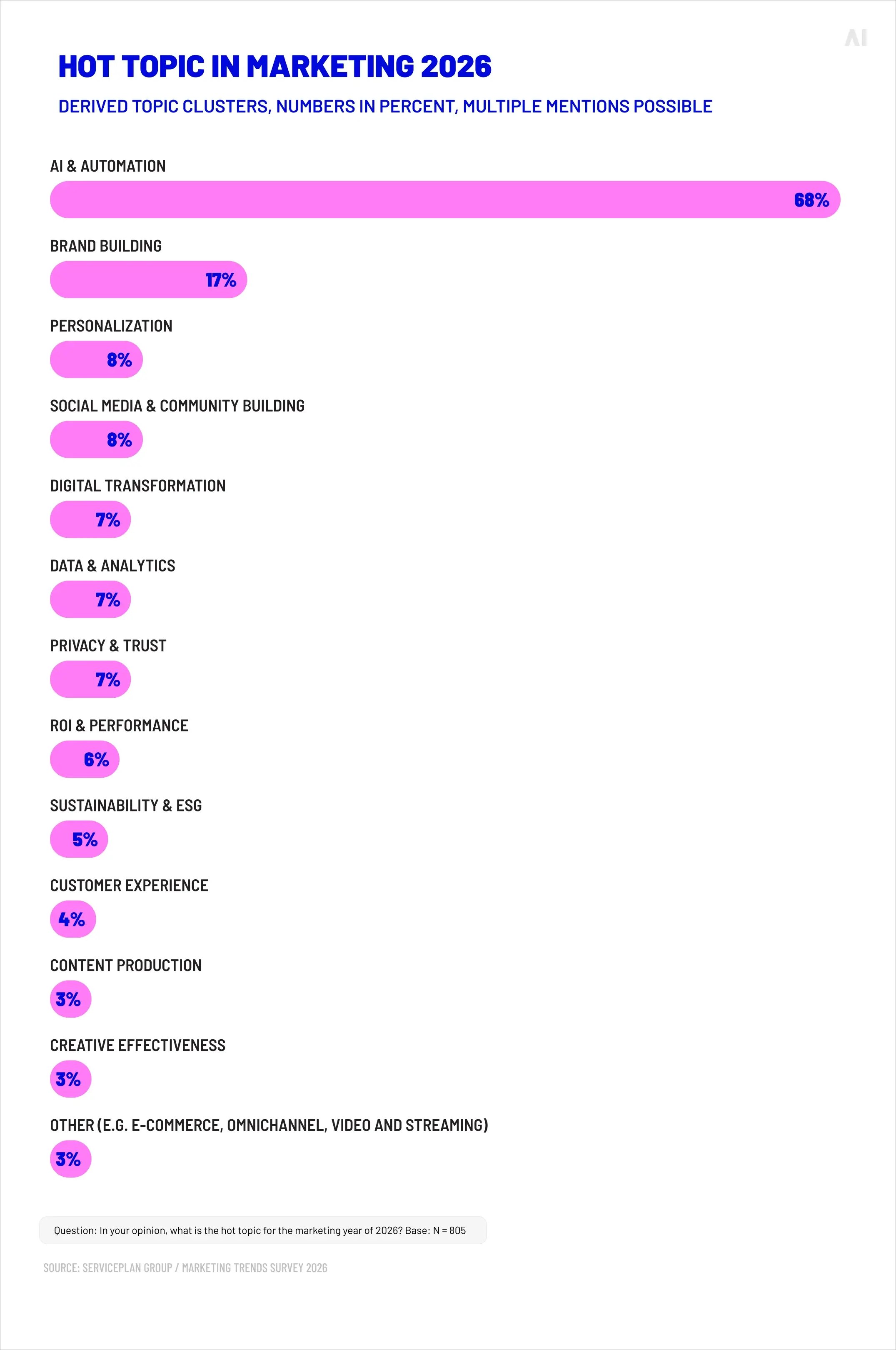
That is the practical reason AI in programmatic advertising has become foundational rather than experimental. According to the IAB's 2026 Outlook Study, surveying more than 200 brand and agency buyers, five of the six top areas of advertiser focus this year are tied directly to AI — including agentic and autonomous decisioning systems that plan, activate, and optimize campaigns with limited human intervention. Programmatic advertising AI is no longer a feature inside a DSP; it is the substrate on which modern media buying runs.
The implication is more demanding than the marketing copy suggests. Targeting, bidding, and creative delivery all become more accurate when AI is doing the work, but only if the data feeding the system is reliable, the KPIs are clearly defined, and the human strategists framing the brief know what they want the model to optimize for. The rest of this article walks through how AI changes each of those mechanics, where it pays back, and where it remains fragile.
Why AI is reshaping programmatic advertising
Modern programmatic advertising is a permanent state of negotiation between thousands of buyers and sellers, mediated by a stack of platforms that all generate data of their own. Display, video, CTV, audio, retail media, DOOH, social — each surface has its own bidding mechanics, identifier conventions, and measurement quirks. Tracking a single audience across that footprint, then making a coherent budget decision about it in real time, is a problem of combinatorial complexity. Manual playbooks were not built for it.
What AI introduces into this environment is not just speed. It is the ability to learn from outcomes continuously and to update the bidding, targeting, and frequency rules accordingly. A rule-based system can pause a campaign when CPA crosses a threshold; a model trained on historical campaign behavior can predict which segments, placements, and times of day will produce the best CPA before the spend happens, and reweight the buy in real time. The difference is the difference between reacting and forecasting.
The capability is being built into every layer of the pipeline — from creative generation through bid calculation to post-campaign reporting. The IAB State of Data 2025, drawing on a survey of more than 500 buy- and sell-side experts, found that only 30% of agencies, brands, and publishers have fully integrated AI across the campaign lifecycle. The headline number sounds modest, but the direction of travel is unambiguous: the rest of the market is in active build mode, and the leaders are pulling clear of the laggards on efficiency and measurement quality.
The distinction matters because both labels describe very different systems.
Traditional automation executes predefined rules. If a click-through rate drops below 0.1%, pause the line item. If a creative wins more than 70% of A/B impressions, allocate the rest of the budget to it. The logic is human-written; the machine just enforces it.
Amachine learning model starts at the other end. Shown the outcomes of prior campaigns — wins, losses, conversions, walk-aways — it infers which combinations of audience attributes, contextual signals, and time-of-day variables actually matter, and keeps refining those weights as new data arrives.
Most contemporary DSPs blend the two, often opaquely. Buyers should ask vendors what is actually doing the work — automation labeled as AI is one of the most common features of vendor copy in 2026.
On the demand side, it scores impressions, sets bids, and allocates budget across DSPs.
On the supply side, it ranks publisher inventory, filters bid requests, and curates deal IDs.
In the middle, where measurement and attribution sit, machine learning models reconcile cross-channel signals that no single platform sees in full.
op AI use cases in media campaign lifecycle, buy-side (Source)
Two patterns are worth highlighting.
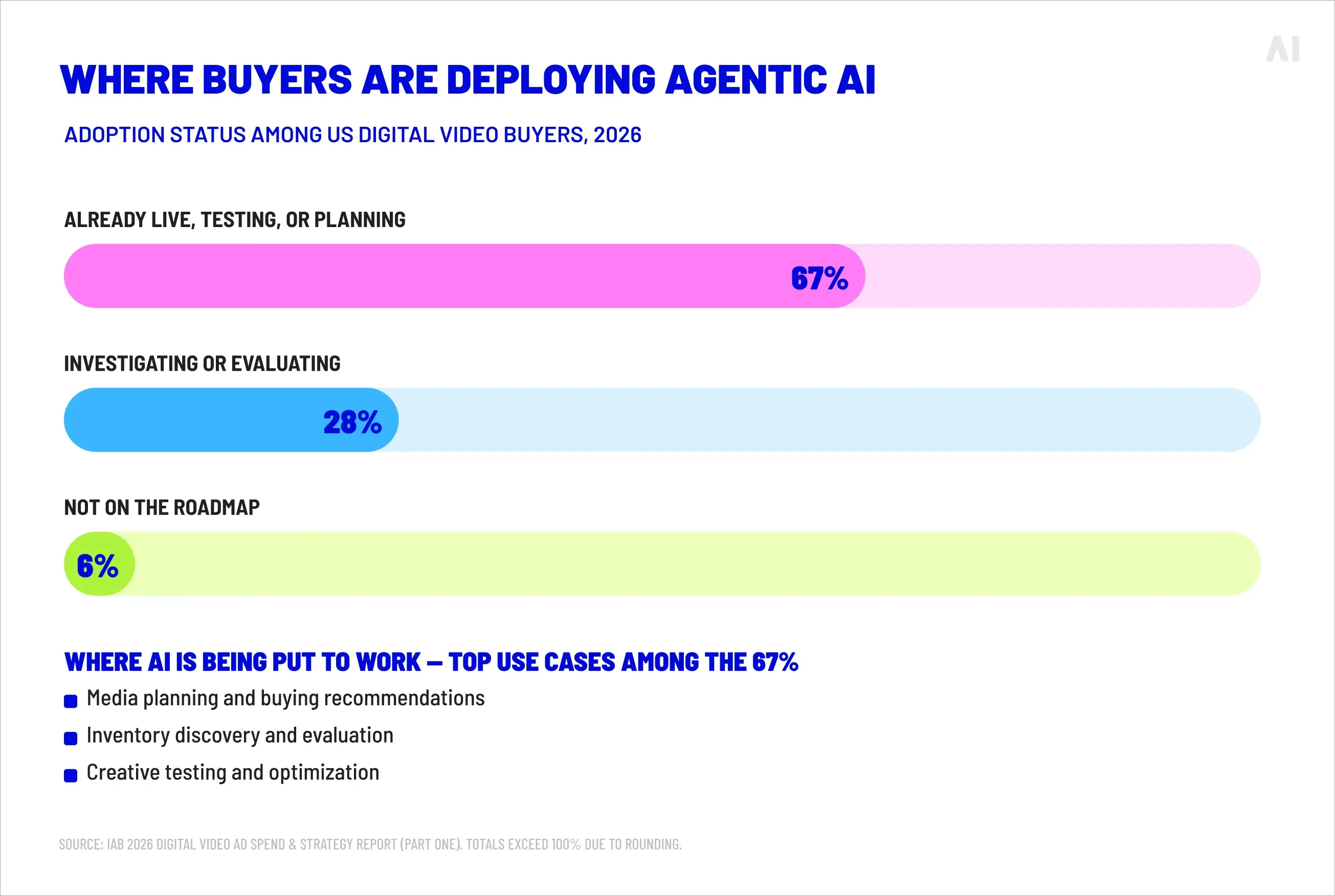
The first is that AI is concentrating in decision-support functions rather than final purchasing decisions — the IAB's 2026 Digital Video Ad Spend & Strategy Report found that two-thirds of buyers are already live, testing, or planning to use agentic AI for digital video campaigns this year, with media planning, inventory discovery, and creative testing as the most common use cases.
The second is that the value of AI rises sharply with the quality of upstream data. Models that learn from messy, fragmented campaign signals will produce confidently wrong recommendations. Models that learn from clean, unified data will produce results worth acting on.
Where buyers are deploying agentic AI.
Business benefits of AI in programmatic advertising
The business case for AI programmatic advertising is more concrete than the technology discussion sometimes suggests. What AI mostly does for marketing teams is remove operational drag. The shift shows up in four places where advertisers can measure the difference: media efficiency, decision speed, cross-channel coordination, and analyst time.
Media efficiency improves because AI bidding allocates spend toward impressions with a higher probability of converting and away from impressions that won't.
Decision speed improves because campaign reporting that previously took an analyst a day to assemble is generated continuously.
Cross-channel coordination improves because models can reconcile signals from CTV, search, social, and display in a way that no single dashboard does.
Analyst time improves because AI systems handle the repetitive parts of optimization — bid adjustments, frequency capping, audience refreshes — freeing human strategists to spend their time on the parts that need judgment.
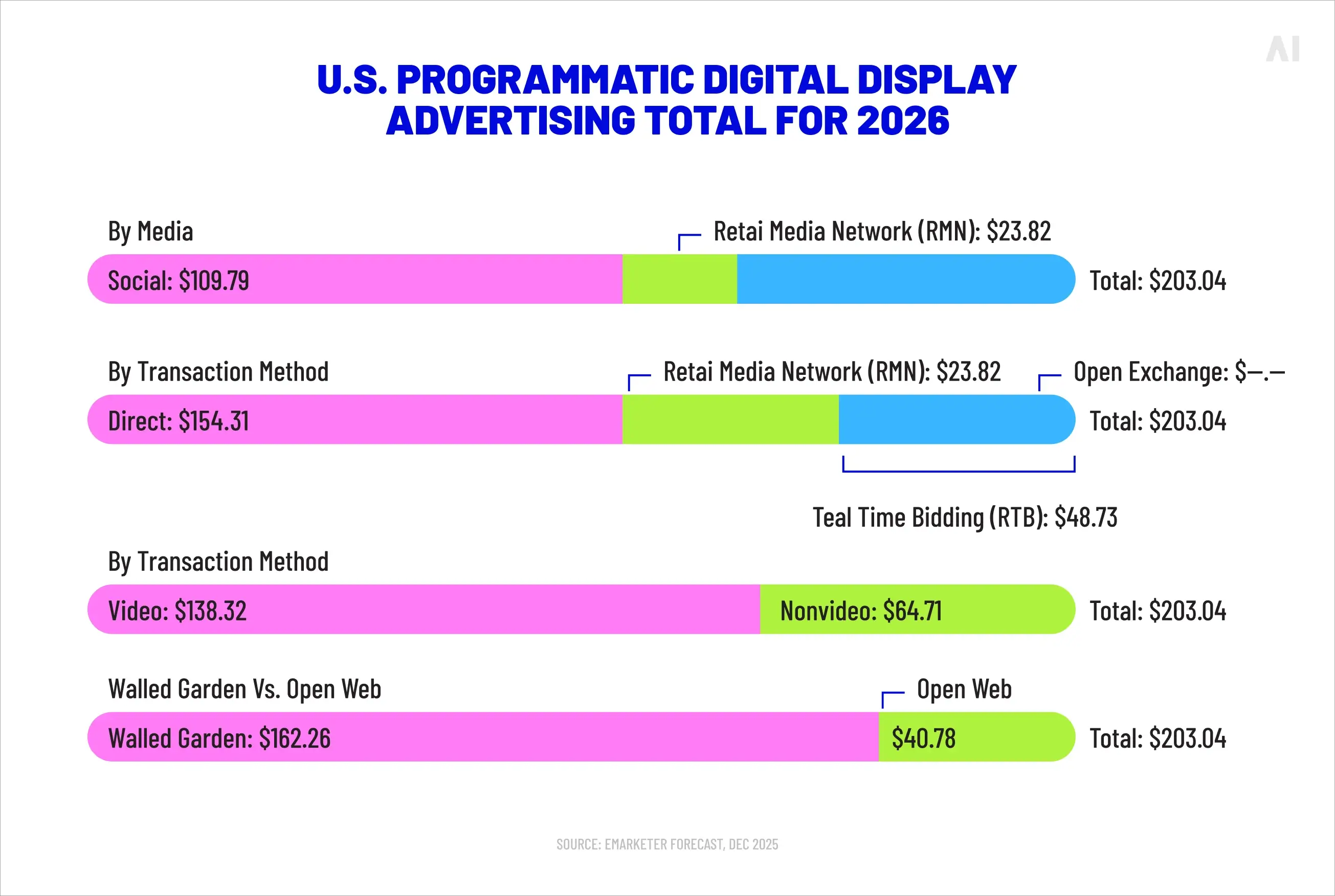
The same budget is now doing more work than it used to. According to eMarketer's January 2026 forecast, US programmatic ad spending will surpass $200 billion in 2026, accounting for the majority of US digital display spend. The story now is what that spend can produce per dollar, and AI is the largest single reason for the lift.
Programmatic advertisers are on track to surpass $200 billion in spending (Source).
⚡ The honest test of an AI-driven programmatic stack is whether a human strategist would defend the decisions it's making.
AI platforms for programmatic advertising
The AI capabilities described above are integrated into a stack of platforms that advertisers already use — DSPs, analytics suites, audience intelligence tools, and verification systems — and into a newer category of cross-channel intelligence platforms that sit above the buying layer. The split is worth understanding because it determines where advertisers should be evaluating AI capability, and where they should be holding existing vendors to a higher standard.
This is the layer where the most strategic AI work is happening. Audience intelligence platforms ingest first-party data, third-party signals, and observed campaign behavior to produce segments that can be activated across multiple DSPs and walled gardens. They are designed to answer two questions that matter before media is bought: who should we be targeting, and where do those people actually pay attention.
AI Digital's Elevate is positioned in this category. As a vendor-agnostic intelligence platform spanning research, planning, optimization, and reporting, Elevate analyzes more than a million audiences and 10,000 audience attributes against behavioral, interest, and customer signals to produce channel-specific segments and AI-built personas. The point is to compress the planning cycle and improve the quality of the assumptions feeding it; AI Audience Segments and Audience Personas reduce the manual effort behind audience definition by 90% or more, according to the platform's own benchmarks. The work the human team is left with becomes the strategic part rather than the assembly part.
AI-driven bidding and supply optimization
The buy-side intelligence layer matters less if the supply chain underneath it is leaking value. Programmatic auctions still route through complex chains of intermediaries; bid requests are duplicated, fees are stacked, and inventory quality varies sharply between paths. AI-driven supply optimization platforms address this by ranking supply paths in real time, routing bids through the cleanest available routes, and filtering placements before the buy side ever sees them.
AI Digital's Smart Supply operates as the supply-side counterpart in this stack — a curation framework that filters low-performing publishers using historical data and AI models, eliminates indirect bid hops that inflate cost without improving outcomes, and applies invalid traffic protection before impressions reach the buying side.
The framework is DSP-agnostic, deal-ID-led, and tuned to the buyer's KPI rather than to the SSP's preferred inventory. The practical effect is that more of the working media budget reaches the right inventory and less of it disappears into intermediation.
How AI improves audience targeting
Targeting is where the operational gains from AI compound first, because targeting drives every downstream decision the platform will make. A model that misidentifies the audience will misallocate the budget, mismeasure the campaign, and reinforce the wrong patterns in the next round. The AI layer above audience targeting matters more than any single optimization downstream.
AI-driven audience targeting
Modern AI targeting starts from observed behavior — site visits, content consumption, search queries, app activity, and conversion signals — and infers high-intent segments from the patterns that emerge across them. A finance brand looking for refinance-ready homeowners will not get there by buying "homeowners 35–54." It will get there by modeling sequences of behavior that correlate with refinance conversions, then scoring real-time bid requests against that model.
The advantage of this approach is its sensitivity to context. A user reading three mortgage explainers in a week behaves very differently from a user who spent 11 minutes on a rate-comparison page yesterday, and AI-driven targeted advertising treats them differently. The advantage is also the reason for caution: models trained on noisy or sparse first-party data will produce overconfident segment definitions. Targeting precision is a function of input quality first, model sophistication second.
Contextual targeting was for a long time the default fallback when behavioral signals were unavailable. The cookieless transition has changed its status entirely. Modern contextual systems use natural language and multimodal models to read page content semantically — not by keyword match, but by topic, sentiment, and brand-safety relevance — and to score inventory in real time against advertiser briefs.
The performance gap between contextual and behavioral targeting has narrowed sharply. Research from DoubleVerify and Integral Ad Science published in 2025 (cited in the IAB State of Data 2026 report) found contextual ads performing within 5–8% of behavioral targeting on click-through rates and within 10–12% on conversion quality, while outperforming behavioral on brand-safety metrics.
For advertisers operating in cookie-restricted environments — which now includes most browsers and a growing share of CTV inventory — AI-powered contextual targeting is becoming the primary signal rather than a fallback.
Cross-channel audience intelligence
The harder problem is identifying the same person across channels and devices when no persistent identifier exists. AI-powered cross-channel intelligence approaches this probabilistically: combining hashed first-party identifiers, deterministic platform IDs, contextual fingerprints, and modeled lookalike inferences to estimate audience overlap and frequency exposure.
The output is a set of probabilistic links accurate enough to support coordinated targeting, frequency capping, and attribution across channels that would otherwise be siloed. The cleanest implementations now feed this layer back into planning — so that media plans built in the morning reflect the actual reachable footprint of an audience by the afternoon.
According to the IAB Europe 2026 Attitudes to Digital Advertising Report, only 17% of advertisers currently activate the majority of their campaigns cross-channel — which is an indictment of execution, not a verdict on the strategy.
How AI improves bidding and media buying
Bidding is the most direct application of AI in programmatic and the one with the cleanest before-and-after metrics. Every bid request is a forced choice: bid, bid how much, or pass. The model that does that calculation well — at the speed the auction demands — is the difference between profitable scale and expensive learning.
Predictive bidding and spend optimization
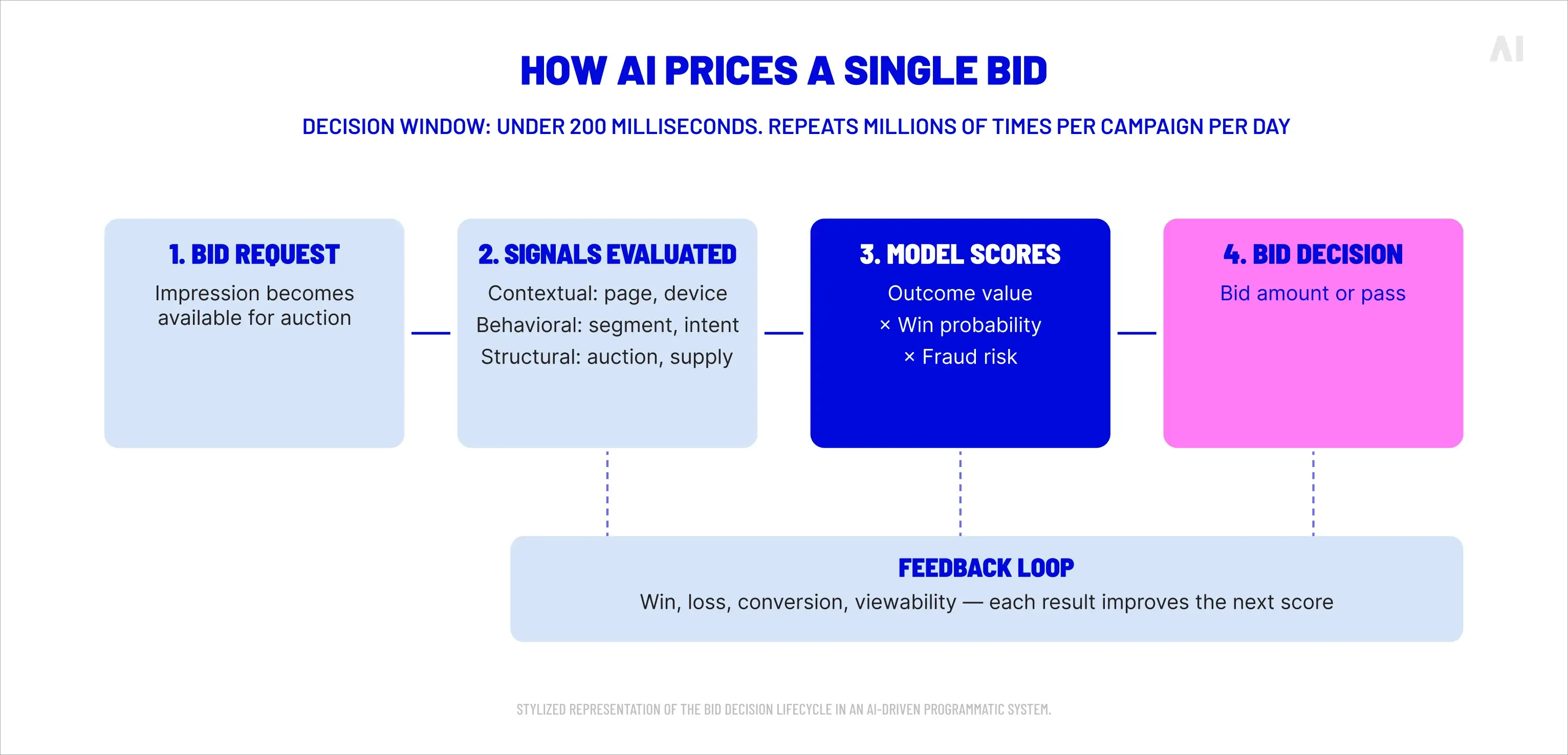
Predictive bidding models evaluate each available impression against a forecast of conversion probability, expected outcome value, and inventory quality. The inputs are contextual (page topic, device, geography), behavioral (audience segment, prior interactions), and structural (auction dynamics, bid floor, supply path). The model returns a bid price that reflects the impression's expected value to the campaign, not its average value to the inventory pool.
How AI prices a single bid
This logic dominates real-time bidding at scale because it produces compounding efficiency. Each won impression generates outcome data that improves the next bid; each lost impression contributes to the model's calibration of where to bid harder next time.
Over a campaign of meaningful length, the gap between a predictive bidding system and a rule-based one widens consistently — which is one of the structural reasons programmatic auctions have absorbed nearly all open-web display spend in the United States.
Even excellent bidding cannot rescue a campaign running through poor supply. Programmatic auctions still travel through long chains of resellers, exchanges, and intermediaries; according to eMarketer's recent FAQ, more than 91% of US programmatic display spend now flows through PMPs and programmatic direct, reflecting buyer demand for inventory quality and supply-path transparency over open-exchange savings.
Supply path optimization, or SPO, is where AI does some of its quietest but most consequential work. Models rank supply paths by performance, cost efficiency, fraud risk, and viewability, then route bids through the cleanest available route in real time.
Frameworks like Smart Supply combine this with curated deal IDs that pre-filter publishers by historical KPI performance — a model that pushes the inventory selection problem upstream of the buying decision rather than downstream of the analytics dashboard. The result is less waste, cleaner measurement signal, and a tighter feedback loop into the predictive bidding layer.
How AI improves campaign optimization
The optimization layer covers everything that happens after the audience is targeted and the bid is placed: how creatives are selected, how performance is measured, how fraud is detected, and how the system updates itself in light of what happened. This is where AI's continuous-learning advantage matters most, because the costs of getting any one of these wrong compound over the campaign.
Predictive optimization extends bidding logic forward in time. Where a bid model decides whether to buy a single impression, a predictive optimization layer forecasts what is likely to happen across the campaign in the next 24, 72, or 168 hours, based on current pacing and observed performance. Budget is reallocated toward placements, audiences, and times of day with the strongest predicted lift; underperforming combinations are pulled back before they accumulate cost.
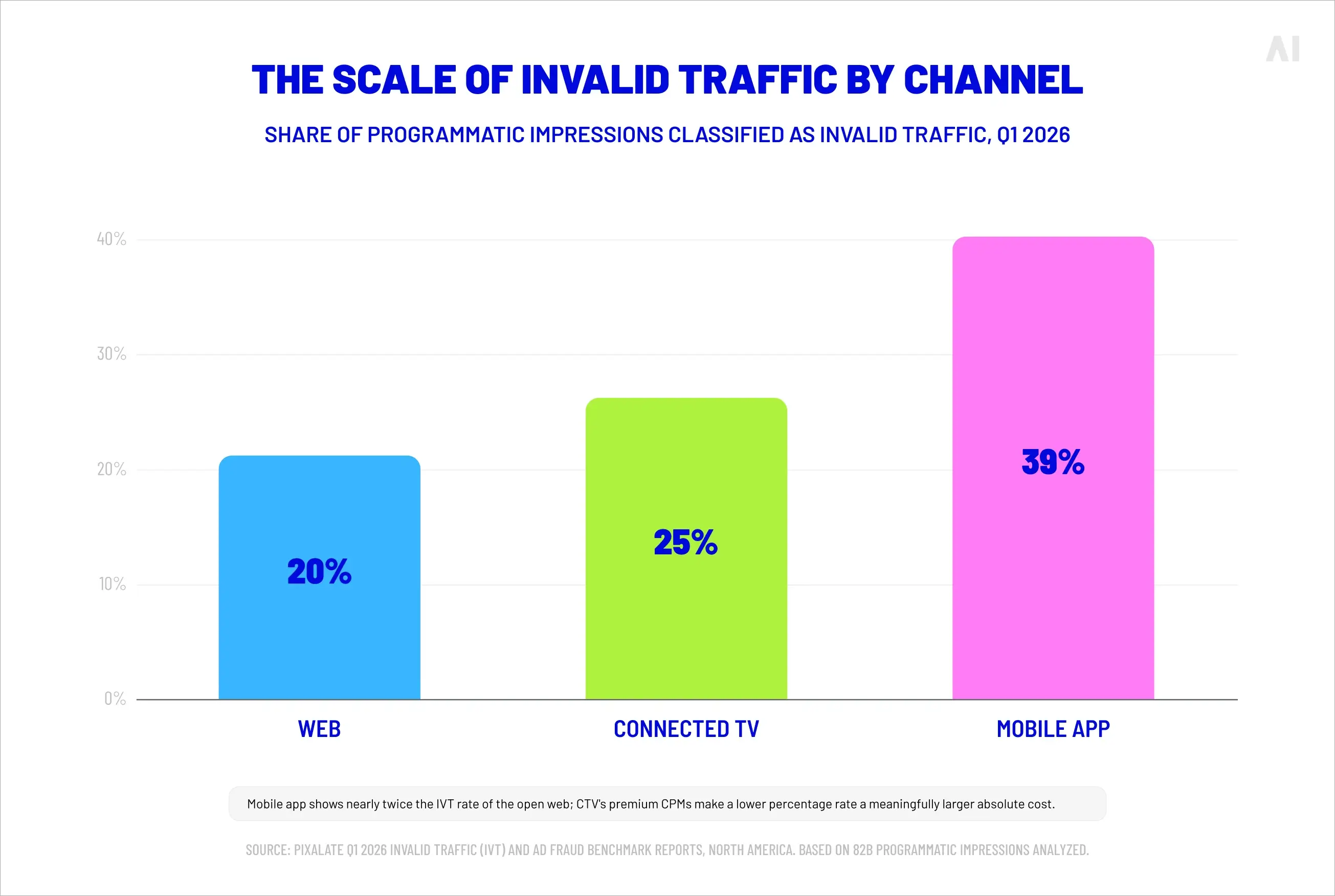
The scale of invalid traffic by channel.
Reporting becomes proactive rather than retrospective in the same move. Cross-platform measurement — the ability to read performance across multiple channels in a single coherent view — has risen to 72% of advertisers' priority list this year, up from 64% the prior year, according to the IAB's 2026 Outlook Study.
The shift reflects a recognition that AI-orchestrated campaigns require AI-orchestrated measurement; channel-by-channel dashboards cannot describe what an AI bidder is actually doing.
Creative ad personalization
Creative personalization is the most visible application of AI to most advertisers' day-to-day work. Dynamic creative optimization, or DCO, generates and serves creative variants in response to audience attributes, contextual signals, and engagement history — different headlines, different product imagery, different calls to action, different offers — and learns from the response which combinations work for which segments.
The benefit is straightforward: more relevant ads convert better. The risk is brand drift. Generative components that produce untested combinations at scale can produce off-strategy variants if the system is not constrained by clear creative rules and approved asset libraries.
The strongest implementations of AI-driven personalization treat the model as a junior copywriter — productive, fast, and in need of editorial oversight — rather than as a creative replacement.
Fraud prevention and frequency management
Programmatic fraud has not gone away. According to Pixalate's Q1 2026 Ad Fraud Benchmarks, invalid traffic rates across an analyzed 82 billion programmatic impressions ran at 20% on web, 39% on mobile app, and 25% on connected TV. AI is the only practical defense at the speeds and volumes involved. Detection systems learn to recognize patterns — bot signatures, anomalous click cadences, device fingerprint mismatches, supply path inconsistencies — and to filter affected impressions before they accumulate cost.
Frequency management is the same problem one layer up. Without coordination, an AI bidding system optimizing on each channel separately will overexpose the same audience across channels and underexpose users who appear infrequently in any single channel.
Cross-channel frequency models reconcile exposure at the user (or modeled user) level, capping repetition where it produces fatigue and rebalancing reach toward audiences who are still listening.
The cleanest implementations integrate this with CTV-specific fraud controls so that the same model handling exposure is also handling validation.
⚡ AI keeps you in the race against programmatic fraud. The race itself is permanent
AI use cases by industry
The mechanics of AI in programmatic are common across verticals. The applications differ. Different industries spend in different places, optimize for different outcomes, and tolerate different levels of automation, which means the practical shape of an AI-driven programmatic strategy varies considerably between an enterprise CPG and a B2B SaaS account.
Enterprise campaigns
Large organizations are the most advanced users of AI in programmatic, partly because they have the data depth to feed it well and partly because they cannot operate at their scale without it. Multinational FMCGs running campaigns across 20+ markets simultaneously rely on AI to coordinate audience definitions, budget weights, and creative variants across regions where the same brand may carry different positioning, regulatory constraints, and conversion behaviors. The model is what holds the strategy coherent at scale.
Retail personalization
Retail and ecommerce brands use AI in programmatic to close the loop between media exposure and on-site behavior. Audience signals captured on category pages, product pages, and abandoned carts feed real-time targeting for retargeting and prospecting; dynamic creative units pull current pricing and inventory data into the ad itself; post-purchase exclusion lists prevent budget waste on customers who have already converted. The result is media that reflects the live state of the store, not a snapshot from a week ago. For retail digital marketing teams, the shift is now baseline rather than emerging practice.
B2B targeting
B2B is where account-based targeting and programmatic intent meet. AI models score accounts by buying-stage probability based on observed signals — content engagement, intent platform data, attendance at industry events, hiring signals — and then activate campaigns against the accounts that show the strongest combination of fit and timing. The audience size is small relative to consumer programmatic; the precision required is much higher. AI is what makes a 200-account universe behave like a programmatic audience without falling apart.
Omnichannel optimization
True omnichannel optimization is still rare. As noted earlier, IAB Europe found that only 17% of advertisers currently activate the majority of their campaigns cross-channel, meaning the strategic ambition has run well ahead of the operational reality. AI's role in closing this gap is partly technical (reconciling signals across channels) and partly disciplinary (forcing a single set of KPIs and audience definitions across teams that previously operated in silos). The technology is ready; the organizational structure is what most teams are still working through.
Challenges of AI in programmatic advertising
For all its operational advantages, AI does not change the basic principle that bad inputs produce bad outputs. The risks of AI-powered advertising are concentrated in five places, each of which advertisers should evaluate before scaling investment.
AI models are entirely dependent on the data they learn from. Conversion-event tracking that misses signals, identifier coverage that breaks across browsers, and reporting that reconciles inconsistently between platforms will all produce models that confidently optimize toward the wrong things. The leading constraint on AI performance in most advertising stacks is not the sophistication of the model; it is the quality of the data feeding it.
Many AI-powered platforms are opaque about how decisions are made. Some of that opacity is competitive (vendors do not want to expose their models); some of it is technical (deep models are difficult to interpret). The practical problem for advertisers is that decisions made without explainability are decisions that cannot be defended to the CFO, the regulator, or the brand team when they go wrong. Explainable AI is not a luxury feature.
Privacy and compliance
The privacy environment continues to tighten. Third-party cookies have been deprecated across major browsers; consent frameworks like GDPR, CCPA, and CPRA limit the ways advertiser data can be used; and platform-level changes (Apple's ATT, Google's Privacy Sandbox) restrict the signals available to AI models. Targeting strategies that depended on cross-site behavioral tracking are being rebuilt on first-party data, contextual targeting, and modeled inferences. AI models trained on the old signal set will degrade rapidly if not retrained on the new one.
Over-automation
A widespread misreading of AI is that it removes the need for human strategy. The opposite is true. Models optimize toward whatever they are pointed at; if the KPI is defined badly, the model will pursue it efficiently and produce a worse outcome faster. Survey work this year underscores the point — more than 70% of marketers have already encountered an AI-related incident in their advertising work, including hallucinations, bias, or off-brand content, while fewer than 35% plan to increase investment in AI governance. That ratio is the over-automation risk in numerical form.
Fragmented martech stacks
Disconnected platforms produce disconnected reporting, which produces disconnected optimization. AI cannot reconcile signals from systems that do not talk to each other; it can only optimize each system in isolation. Most enterprise stacks still contain meaningful integration debt — separate identity graphs, parallel reporting environments, inconsistent taxonomies — and that debt sets a ceiling on what AI can do above it. Reducing that debt is a precondition for getting full value out of any AI investment downstream.
Practical preparation for AI in programmatic is less about adopting new tools and more about removing the blockers that prevent existing tools from working well together. The sequence below is the order most teams should approach the work.
The single biggest determinant of AI performance is the quality of the data feeding it. Customer data, campaign data, and conversion data should live in environments that talk to each other — ideally a unified customer data platform or warehouse that downstream tools query, rather than each tool maintaining its own copy. Until the data is centralized, AI models in different platforms will optimize toward different versions of the same customer.
2. Integrate CRM, analytics, and advertising platforms
Centralization is the precondition; integration is the work. CRM data should flow into ad platforms in usable form, analytics signals should reconcile against CRM events, and audience definitions should be portable between systems without manual rebuild. Where integration is missing, AI optimization stalls at the seams. This is the layer where most of the real engineering effort sits in any AI rollout.
Advertisers are moving toward DSP-agnostic, interoperable strategies because no single buying platform sees the full performance picture. AI Digital's Open Garden Framework is one expression of this approach: a KPI-first cross-channel model that connects 15+ DSPs, prioritizes inventory based on advertiser outcomes rather than platform preferences, and surfaces measurement in a single intelligence view. The principle behind it is straightforward — AI optimization is only as good as the visibility it has — and open-strategy approaches are increasingly producing measurable lift over closed alternatives.
4. Define clear business KPIs
AI models optimize toward whatever you point them at. Vague KPIs produce vague performance. The work here is not technical; it is editorial. What is the business actually trying to achieve — revenue, qualified pipeline, retention, share — and how does that translate into the proximate signals the platform can read in real time? KPI clarity is the single most underrated input to AI performance, and the cheapest fix when something is going wrong.
5. Evaluate AI platforms and strategic partners
Vendor evaluation should focus on three things: whether the platform's AI does what the marketing claims (or whether it is rule-based automation in fresh paint), whether the vendor will explain how decisions are made, and whether the integration with the rest of the stack is real or aspirational. Integrated programmatic capability matters too — AI Digital's services span CTV, live sports, search, paid social, DOOH, video, and cross-channel activation, with the AI layer running consistently across them rather than as a feature of any single channel.
6. Combine automation with human expertise
The strongest results in 2026 come from teams that treat AI as a force multiplier for human strategists rather than a replacement for them. Models execute the parts that humans cannot — speed, scale, real-time reaction — and humans handle the parts that models cannot — KPI definition, brand judgment, escalation when something looks wrong. Teams that remove human oversight to chase efficiency typically discover its value retrospectively. Humanity, occasionally, is still useful.
What’s next for AI in programmatic advertising
The direction of travel is clear, even if the timeline is not. Agentic AI — systems that can plan, decide, and act with minimal human prompting — is moving from research into production across media planning, audience activation, creative testing, and optimization. The IAB found that two-thirds of digital video buyers are already live, testing, or planning agentic AI use, with only 6% saying it is not on the roadmap. The buy side is committing.
Three structural changes follow from this.
First, generative creative will become a planning input rather than a production task; campaigns will be conceived as variant families from the start, with the model populating the matrix.
Second, first-party data will continue to gain value as the cookieless transition matures and alternatives to walled gardens prove out at scale. Advertisers who treat customer data as an owned asset rather than rented inventory will compound an advantage that did not exist a decade ago.
Third, measurement will catch up with execution; AI-driven attribution and incrementality testing will replace channel-level dashboards as the primary way performance is judged.
The risks scale with the opportunity. Agentic systems making more decisions per second mean more decisions to audit, more places for drift to compound, and more pressure on data quality and governance. The teams winning in 2027 and beyond will not be the ones with the most AI; they will be the ones with the best data, clearest KPIs, and most disciplined human oversight running on top of it.
Make AI your competitive edge in programmatic advertising
AI in programmatic has crossed the line from performance enhancement to competitive necessity. The advertisers producing the strongest results in 2026 are not those running the most AI; they are those running AI on top of high-quality data, clear business KPIs, transparent measurement, and strategic execution that knows what it wants the model to do. The combination is the advantage.
AI Digital's approach is built around that combination.
Elevate provides the marketing intelligence layer — research, planning, optimization, and reporting in one place.
Smart Supply provides the supply-side efficiency layer — premium curation, supply path optimization, and inventory quality controls.
TheOpen Garden Framework provides the interoperability that lets both work across 15+ DSPs and the channels advertisers actually use, without locking decisions inside any one walled environment.
If you are evaluating where AI fits into your programmatic strategy — or where it is already underperforming — we'd be glad to talk it through. The conversation usually starts with one question: what is the model actually being asked to optimize for, and is that the right answer for the business?
⚡ AI is now the baseline of programmatic capability. The advantage belongs to teams that know what to ask of it.
Blind spot
Key issues
Business impact
AI Digital solution
Lack of transparency in AI models
• Platforms own AI models and train on proprietary data • Brands have little visibility into decision-making • "Walled gardens" restrict data access
• Inefficient ad spend • Limited strategic control • Eroded consumer trust • Potential budget mismanagement
Open Garden framework providing: • Complete transparency • DSP-agnostic execution • Cross-platform data & insights
Optimizing ads vs. optimizing impact
• AI excels at short-term metrics but may struggle with brand building • Consumers can detect AI-generated content • Efficiency might come at cost of authenticity
• Short-term gains at expense of brand health • Potential loss of authentic connection • Reduced effectiveness in storytelling
Smart Supply offering: • Human oversight of AI recommendations • Custom KPI alignment beyond clicks • Brand-safe inventory verification
The illusion of personalization
• Segment optimization rebranded as personalization • First-party data infrastructure challenges • Personalization vs. surveillance concerns
• Potential mismatch between promise and reality • Privacy concerns affecting consumer trust • Cost barriers for smaller businesses
Elevate platform features: • Real-time AI + human intelligence • First-party data activation • Ethical personalization strategies
AI-Driven efficiency vs. decision-making
• AI shifting from tool to decision-maker • Black box optimization like Google Performance Max • Human oversight limitations
• Strategic control loss • Difficulty questioning AI outputs • Inability to measure granular impact • Potential brand damage from mistakes
Managed Service with: • Human strategists overseeing AI • Custom KPI optimization • Complete campaign transparency
Fig. 1. Summary of AI blind spots in advertising
Dimension
Walled garden advantage
Walled garden limitation
Strategic impact
Audience access
Massive, engaged user bases
Limited visibility beyond platform
Reach without understanding
Data control
Sophisticated targeting tools
Data remains siloed within platform
Fragmented customer view
Measurement
Detailed in-platform metrics
Inconsistent cross-platform standards
Difficult performance comparison
Intelligence
Platform-specific insights
Limited data portability
Restricted strategic learning
Optimization
Powerful automated tools
Black-box algorithms
Reduced marketer control
Fig. 2. Strategic trade-offs in walled garden advertising.
Core issue
Platform priority
Walled garden limitation
Real-world example
Attribution opacity
Claiming maximum credit for conversions
Limited visibility into true conversion paths
Meta and TikTok's conflicting attribution models after iOS privacy updates
Data restrictions
Maintaining proprietary data control
Inability to combine platform data with other sources
Amazon DSP's limitations on detailed performance data exports
Cross-channel blindspots
Keeping advertisers within ecosystem
Fragmented view of customer journey
YouTube/DV360 campaigns lacking integration with non-Google platforms
Black box algorithms
Optimizing for platform revenue
Reduced control over campaign execution
Self-serve platforms using opaque ML models with little advertiser input
Performance reporting
Presenting platform in best light
Discrepancies between platform-reported and independently measured results
Consistently higher performance metrics in platform reports vs. third-party measurement
Fig. 1. The Walled garden misalignment: Platform interests vs. advertiser needs.
Key dimension
Challenge
Strategic imperative
ROAS volatility
Softer returns across digital channels
Shift from soft KPIs to measurable revenue impact
Media planning
Static plans no longer effective
Develop agile, modular approaches adaptable to changing conditions
Brand/performance
Traditional division dissolving
Create full-funnel strategies balancing long-term equity with short-term conversion
Capability
Key features
Benefits
Performance data
Elevate forecasting tool
• Vertical-specific insights • Historical data from past economic turbulence • "Cascade planning" functionality • Real-time adaptation
• Provides agility to adjust campaign strategy based on performance • Shows which media channels work best to drive efficient and effective performance • Confident budget reallocation • Reduces reaction time to market shifts
• Dataset from 10,000+ campaigns • Cuts response time from weeks to minutes
• Reaches people most likely to buy • Avoids wasted impressions and budgets on poor-performing placements • Context-aligned messaging
• 25+ billion bid requests analyzed daily • 18% improvement in working media efficiency • 26% increase in engagement during recessions
Full-funnel accountability
• Links awareness campaigns to lower funnel outcomes • Tests if ads actually drive new business • Measures brand perception changes • "Ask Elevate" AI Chat Assistant
• Upper-funnel to outcome connection • Sentiment shift tracking • Personalized messaging • Helps balance immediate sales vs. long-term brand building
• Natural language data queries • True business impact measurement
Open Garden approach
• Cross-platform and channel planning • Not locked into specific platforms • Unified cross-platform reach • Shows exactly where money is spent
• Reduces complexity across channels • Performance-based ad placement • Rapid budget reallocation • Eliminates platform-specific commitments and provides platform-based optimization and agility
• Coverage across all inventory sources • Provides full visibility into spending • Avoids the inability to pivot across platform as you’re not in a singular platform
Fig. 1. How AI Digital helps during economic uncertainty.
Trend
What it means for marketers
Supply & demand lines are blurring
Platforms from Google (P-Max) to Microsoft are merging optimization and inventory in one opaque box. Expect more bundled “best available” media where the algorithm, not the trader, decides channel and publisher mix.
Walled gardens get taller
Microsoft’s O&O set now spans Bing, Xbox, Outlook, Edge and LinkedIn, which just launched revenue-sharing video programs to lure creators and ad dollars. (Business Insider)
Retail & commerce media shape strategy
Microsoft’s Curate lets retailers and data owners package first-party segments, an echo of Amazon’s and Walmart’s approaches. Agencies must master seller-defined audiences as well as buyer-side tactics.
AI oversight becomes critical
Closed AI bidding means fewer levers for traders. Independent verification, incrementality testing and commercial guardrails rise in importance.
Fig. 1. Platform trends and their implications.
Metric
Connected TV (CTV)
Linear TV
Video Completion Rate
94.5%
70%
Purchase Rate After Ad
23%
12%
Ad Attention Rate
57% (prefer CTV ads)
54.5%
Viewer Reach (U.S.)
85% of households
228 million viewers
Retail Media Trends 2025
Access Complete consumer behaviour analyses and competitor benchmarks.
Identify and categorize audience groups based on behaviors, preferences, and characteristics
Michaels Stores: Implemented a genAI platform that increased email personalization from 20% to 95%, leading to a 41% boost in SMS click through rates and a 25% increase in engagement.
Estée Lauder: Partnered with Google Cloud to leverage genAI technologies for real-time consumer feedback monitoring and analyzing consumer sentiment across various channels.
High
Medium
Automated ad campaigns
Automate ad creation, placement, and optimization across various platforms
Showmax: Partnered with AI firms toautomate ad creation and testing, reducing production time by 70% while streamlining their quality assurance process.
Headway: Employed AI tools for ad creation and optimization, boosting performance by 40% and reaching 3.3 billion impressions while incorporating AI-generated content in 20% of their paid campaigns.
High
High
Brand sentiment tracking
Monitor and analyze public opinion about a brand across multiple channels in real time
L’Oréal: Analyzed millions of online comments, images, and videos to identify potential product innovation opportunities, effectively tracking brand sentiment and consumer trends.
Kellogg Company: Used AI to scan trending recipes featuring cereal, leveraging this data to launch targeted social campaigns that capitalize on positive brand sentiment and culinary trends.
High
Low
Campaign strategy optimization
Analyze data to predict optimal campaign approaches, channels, and timing
DoorDash: Leveraged Google’s AI-powered Demand Gen tool, which boosted its conversion rate by 15 times and improved cost per action efficiency by 50% compared with previous campaigns.
Kitsch: Employed Meta’s Advantage+ shopping campaigns with AI-powered tools to optimize campaigns, identifying and delivering top-performing ads to high-value consumers.
High
High
Content strategy
Generate content ideas, predict performance, and optimize distribution strategies
JPMorgan Chase: Collaborated with Persado to develop LLMs for marketing copy, achieving up to 450% higher clickthrough rates compared with human-written ads in pilot tests.
Hotel Chocolat: Employed genAI for concept development and production of its Velvetiser TV ad, which earned the highest-ever System1 score for adomestic appliance commercial.
High
High
Personalization strategy development
Create tailored messaging and experiences for consumers at scale
Stitch Fix: Uses genAI to help stylists interpret customer feedback and provide product recommendations, effectively personalizing shopping experiences.
Instacart: Uses genAI to offer customers personalized recipes, mealplanning ideas, and shopping lists based on individual preferences and habits.
Medium
Medium
Share article
Url copied to clipboard
No items found.
Subscribe to our Newsletter
THANK YOU FOR YOUR SUBSCRIPTION
Oops! Something went wrong while submitting the form.
Questions? We have answers
How is AI used in programmatic advertising?
AI is used at every layer of the programmatic stack. On the buy side, it scores impressions, sets bids, and reallocates budget across DSPs in real time. In targeting, it identifies high-intent audience segments from behavioral, contextual, and first-party signals. In creative, it generates and selects variants tuned to specific segments. In measurement, it reconciles cross-channel performance signals and forecasts campaign outcomes. Most contemporary DSPs and intelligence platforms blend AI with rule-based automation, and buyers should ask vendors specifically what is doing what.
How does AI support cookieless audience targeting?
AI replaces missing third-party signal with patterns inferred from data that remains available—first-party identifiers, contextual signals from page content, modeled audience inferences from cohort behavior, and consent-based platform IDs. AI-powered contextual targeting in particular has closed most of the historical gap to behavioral targeting, performing within 5–8% on click-through rate and 10–12% on conversion quality according to 2025 verification research. The cookieless transition has not removed targeting precision; it has changed which signals support it.
Can AI improve cross-channel campaign measurement?
Yes, materially. Cross-channel measurement is one of the hardest problems in programmatic because no single platform sees the full picture. AI models trained on cross-platform data—first-party identifiers, modeled identity links, contextual fingerprints—can reconcile performance signals across CTV, search, social, display, and audio in a way that channel-level dashboards cannot. According to the IAB's 2026 Outlook Study, cross-platform measurement has risen to 72% of advertisers' priorities, up from 64% the prior year, reflecting the move from channel-by-channel reporting to coordinated AI-driven measurement.
How do AI-powered DSPs optimize media buying?
AI-powered DSPs optimize on multiple axes simultaneously. Predictive bidding models forecast each impression's expected outcome value and price the bid accordingly. Budget allocation models reweight spend toward placements, audiences, and times of day with the strongest predicted performance. Frequency models cap exposure where it produces fatigue and rebalance reach toward underexposed segments. Creative optimization models select variants tuned to segment behavior. The combined effect is a feedback loop in which each won impression makes the next bid better.
What role does AI play in supply path optimization?
AI ranks supply paths by performance, cost efficiency, fraud risk, and viewability, then routes bids through the cleanest available route in real time. The work matters because programmatic auctions still travel through long chains of intermediaries; bid requests are duplicated, fees are stacked, and inventory quality varies sharply between paths. SPO frameworks like Smart Supply combine AI ranking with curated deal IDs that filter publishers by historical KPI performance—a model that pushes the inventory decision upstream of the buying decision.
Why is first-party data important for AI advertising?
First-party data is the only durable targeting and measurement signal an advertiser fully controls. Third-party cookies have been deprecated across major browsers; platform identifiers are restricted by privacy frameworks; modeled inferences only work if there is a real-world ground truth to model against. First-party data—CRM records, on-site behavior, transaction history, consented preferences—is what AI models learn from when other signals are unavailable. Advertisers without a strong first-party data foundation cannot get full value out of AI; advertisers with one will compound performance advantages over time.
How can businesses scale programmatic campaigns with AI?
Scaling AI-driven programmatic is not primarily a technology decision. The technology will scale; the bottleneck is data quality, KPI clarity, and human oversight at scale. The practical sequence is: build a centralized data foundation, integrate CRM with analytics and ad platforms, enable cross-channel transparency through DSP-agnostic frameworks, define KPIs the model can optimize toward, evaluate vendors on explainability rather than feature count, and resource the human strategy layer in proportion to the AI execution layer. Teams that follow that sequence scale AI sustainably. Teams that skip the data and KPI work hit a ceiling and stay there.
Have other questions?
If you have more questions, contact us so we can help.
Questions? We have answers
This is some text inside of a div block.
Lorem ipsum dolor sit amet, consectetur adipiscing elit. Suspendisse varius enim in eros elementum tristique. Duis cursus, mi quis viverra ornare, eros dolor interdum nulla, ut commodo diam libero vitae erat. Aenean faucibus nibh et justo cursus id rutrum lorem imperdiet. Nunc ut sem vitae risus tristique posuere.
This is some text inside of a div block.
Lorem ipsum dolor sit amet, consectetur adipiscing elit. Suspendisse varius enim in eros elementum tristique. Duis cursus, mi quis viverra ornare, eros dolor interdum nulla, ut commodo diam libero vitae erat. Aenean faucibus nibh et justo cursus id rutrum lorem imperdiet. Nunc ut sem vitae risus tristique posuere.
This is some text inside of a div block.
Lorem ipsum dolor sit amet, consectetur adipiscing elit. Suspendisse varius enim in eros elementum tristique. Duis cursus, mi quis viverra ornare, eros dolor interdum nulla, ut commodo diam libero vitae erat. Aenean faucibus nibh et justo cursus id rutrum lorem imperdiet. Nunc ut sem vitae risus tristique posuere.
This is some text inside of a div block.
Lorem ipsum dolor sit amet, consectetur adipiscing elit. Suspendisse varius enim in eros elementum tristique. Duis cursus, mi quis viverra ornare, eros dolor interdum nulla, ut commodo diam libero vitae erat. Aenean faucibus nibh et justo cursus id rutrum lorem imperdiet. Nunc ut sem vitae risus tristique posuere.
This is some text inside of a div block.
Lorem ipsum dolor sit amet, consectetur adipiscing elit. Suspendisse varius enim in eros elementum tristique. Duis cursus, mi quis viverra ornare, eros dolor interdum nulla, ut commodo diam libero vitae erat. Aenean faucibus nibh et justo cursus id rutrum lorem imperdiet. Nunc ut sem vitae risus tristique posuere.
This is some text inside of a div block.
Lorem ipsum dolor sit amet, consectetur adipiscing elit. Suspendisse varius enim in eros elementum tristique. Duis cursus, mi quis viverra ornare, eros dolor interdum nulla, ut commodo diam libero vitae erat. Aenean faucibus nibh et justo cursus id rutrum lorem imperdiet. Nunc ut sem vitae risus tristique posuere.
This is some text inside of a div block.
Lorem ipsum dolor sit amet, consectetur adipiscing elit. Suspendisse varius enim in eros elementum tristique. Duis cursus, mi quis viverra ornare, eros dolor interdum nulla, ut commodo diam libero vitae erat. Aenean faucibus nibh et justo cursus id rutrum lorem imperdiet. Nunc ut sem vitae risus tristique posuere.

.webp)
.svg)
.svg)


%20in%20Programmatic%20Advertising_.webp)