AI Marketing Platforms vs Marketing Automation Platforms: What’s the Difference?
Tatev Malkhasyan
May 27, 2026
18
minutes read
Marketing teams have never had more tools, more data, or more dashboards and rarely felt less in control of what their spend is actually doing. This article unpacks the difference between marketing automation platforms and AI marketing platforms, why the distinction matters in 2026, and how to choose the right approach for the outcomes a business is actually being measured on.
The conversation about marketing technology has shifted in a way most CMOs felt before they could name. For two decades, marketing automation was the answer. Build the workflow, set the triggers, schedule the sends, watch the leads move through. The machinery worked, more or less, when channels were few, customer journeys were linear, and the data fit on one screen. None of those conditions still hold.
Today's marketing leader oversees a stack that, by ChiefMartec's count, sits inside an industry of more than 15,000 commercial tools—most of them running their own logic, optimizing their own metrics, and giving conflicting answers to the same question. Customers move across paid, owned, and earned touchpoints in patterns no rule-based system was designed to anticipate. Privacy regulation has thinned the signal. Budgets are flatter than they were. And the question every senior marketer is being asked has changed shape: not "did the campaign run?" but "did the spend produce measurable business outcomes?"
That shift is what's exposing the difference between marketing automation platforms and AI marketing platforms, and it's the difference between execution and decision-making. Marketing automation platforms execute predefined workflows. AI marketing platforms make and optimize the decisions those workflows are trying to act on. The two are not the same category, and treating them as substitutes is part of why so many martech investments quietly fail to pay back.
The point of this piece is practical: not to argue that AI replaces automation, but to map where each belongs, where AI marketing platforms outperform, and how senior teams are restructuring their stacks to capture both. The honest answer is that most companies will end up using both, but only if they understand which is doing what.
What is a marketing automation platform?
A marketing automation platform is a system designed to execute predefined workflows across channels — email, CRM, lifecycle campaigns, web personalization, lead scoring—without manual intervention at each step. Think Marketo, HubSpot, Salesforce Marketing Cloud, Pardot, Eloqua: tools that streamline repetitive tasks, route customer interactions through pre-built logic, and reduce the operational burden of running campaigns at scale.
The category emerged to solve a real problem. Before automation, marketing meant manual list pulls, hand-coded emails, and one-off send schedules. Automation made it possible to nurture leads, score behavior, and run lifecycle sequences at volumes a human team could not maintain. The premise—and it remains valid—was that operational efficiency was the bottleneck, and that scripting it away would free marketers to focus on strategy.
That premise still holds, partially. The platforms still streamline work that nobody should be doing by hand. What's changed is what counts as the bottleneck. With customer journeys fragmented across dozens of channels and the need for real-time decisioning becoming the norm rather than the exception, "what to send" has overtaken "how to send it" as the harder problem to solve. Marketing automation platforms were built for the second question.
How marketing automation platforms work
Most marketing automation platforms run on the same underlying logic: predefined rules, triggered by events, applied to segmented audiences. A user fills out a form, a workflow fires. A behavior threshold is crossed, a sequence advances. A list is updated, a send is queued.
The actions are scheduled, branched, and conditional—sophisticated, in their way—but they are still rules. The platform does what it was told to do, when it was told to do it. The intelligence sits in the configuration, not in the system. Whoever built the workflow decided in advance what the right action was for each combination of input and context. The platform's job is to execute that decision faithfully and at scale.
This is automation in the strict sense: speed, repeatability, and reliability applied to tasks whose answers are already known. It is excellent for what it does. The trouble starts when the questions stop having known answers.
Key limitations
The limitations of marketing automation platforms are not bugs; they are direct consequences of the design. The system runs the rules it has been given. It does not learn which rules were wrong, propose better ones, or adapt when conditions change.
Three structural limits show up everywhere.
First, adaptability: rule-based systems cannot optimize dynamically across channels because they have no model of cross-channel performance to optimize against.
Second, single-channel myopia: most automation platforms are built around one channel—email, primarily—and bolt on others in ways that rarely produce coherent cross-channel logic.
Third, manual maintenance: every new behavior, segment, or scenario requires a human to map the rule. The cost of staying current scales linearly with complexity, while the complexity itself scales exponentially.
The Duke CMO Survey's spring 2026 edition, conducted in January 2026 with 308 marketing leaders at U.S. for-profit companies, found that the most cited capability shortfall reported by marketing leaders was a lack of resources—people, time, and budget—to make existing capabilities effective, particularly in areas tied to AI, analytics, and marketing technology. The point is not that the tools are too few. It's that the human and organizational layer that makes the tools intelligent has not kept up.
An AI marketing platform is a system that unifies cross-channel data, applies machine learning to detect patterns and predict outcomes, and continuously optimizes the decisions a marketing organization is making—about audience, budget, channel mix, message, and timing. Where automation executes, AI marketing platforms decide.
That distinction is doing more work than it might first appear. An AI marketing platform is not simply automation with a faster engine, or automation with generative AI bolted on for content production. It is a different layer of the stack—one that sits above execution and tells it where to point. The question it is engineered to answer is not "how do I send this?" but "what should I send, to whom, on which channel, with which budget, right now?"
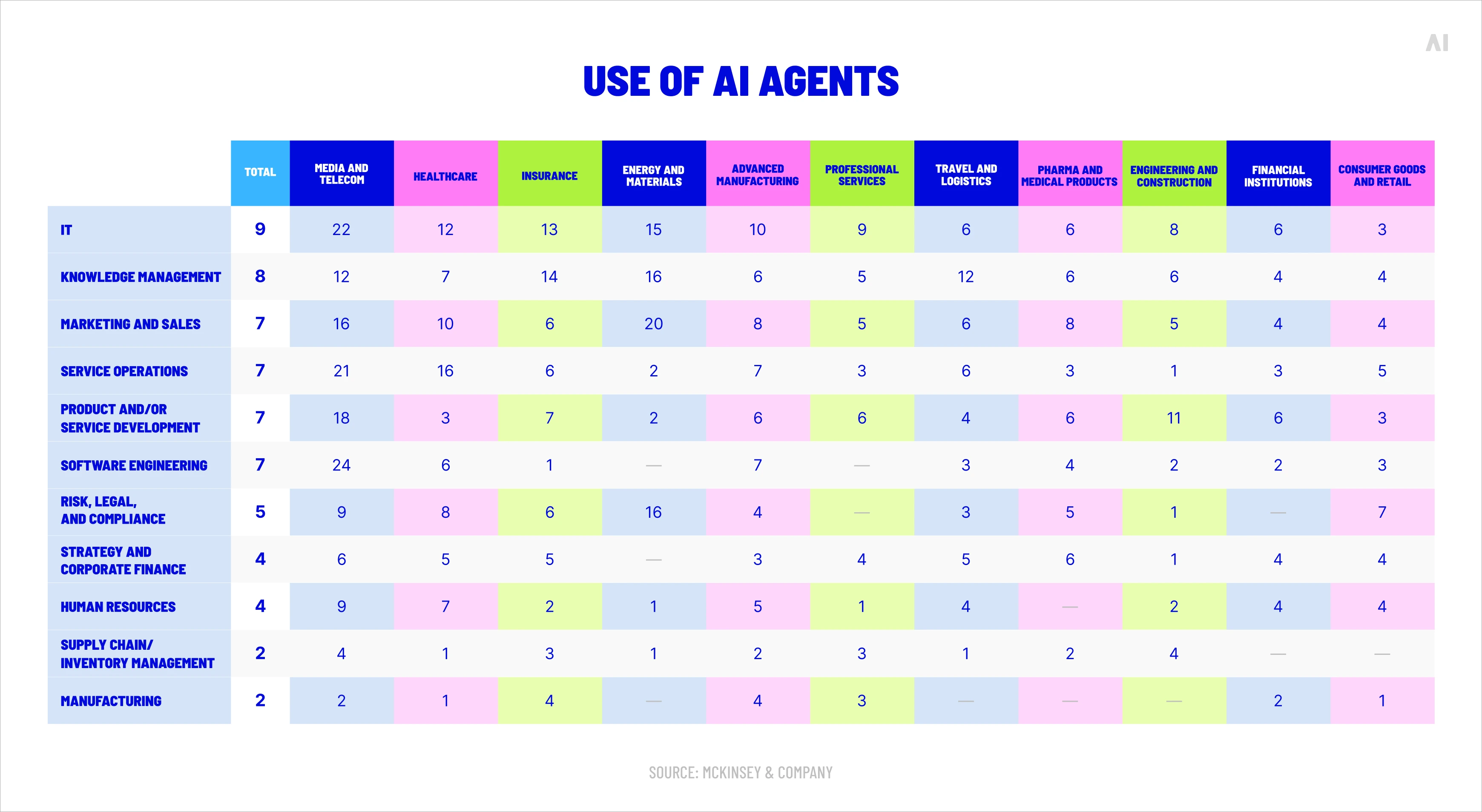
The category has matured quickly. McKinsey's State of AI 2025, surveying 1,993 respondents across 105 countries, found88% of organizations now use AI in at least one business function—up from 78% the year before, with marketing and sales the function most consistently reporting revenue increases attributable to AI use. The shift from experimental pilots to operational deployment has happened. The next question, which the same research makes uncomfortably clear, is whether organizations have built the infrastructure to capture value from what they've already adopted.
Reported use of AI in at least one business function (Source)
The mechanics are easier to describe than to engineer. AI marketing platforms ingest cross-channel data—campaign performance, audience behavior, conversion signals, supply-side metrics, external context—at volumes that would defeat manual analysis. Machine learning models identify patterns: which segments are converting where, which channels are saturated, which budget shifts would compound, which creatives are decaying. Predictive models forecast outcomes for proposed actions. The system then either recommends or directly executes the optimization, watches what happens, and updates its priors.
The crucial property is continuous learning. Every campaign, every conversion, every shift in audience behavior becomes signal that improves the next decision. Where a marketing automation platform is essentially static—it runs the rules it was given until someone changes them—an AI marketing platform is adaptive by construction. The Duke CMO Survey reports that AI and machine learning now power 17.2% of all marketing efforts, a 100% increase since 2022, with marketing leaders projecting 157% growth over the next three years to reach 44.2% of all activities. That trajectory is not a forecast. It is what's already happening.
Manual optimization shrinks, because the system is doing the work that media planners and analysts used to do by hand.
Decision speed accelerates, because the cycle between observation, analysis, and action collapses from weeks to minutes.
And continuous performance management replaces periodic review, because the campaign is being actively managed by the system between the dashboards a CMO actually looks at.
This is what people mean when they say AI changes the rhythm of marketing. The work isn't faster automation. It's a different operating model—one in which strategy and creative remain human, but the optimization layer sitting underneath them runs continuously, on data the team would not otherwise see in time to act on.
Business benefits of artificial intelligence marketing platforms
The benefits of AI marketing platforms cluster around four outcomes that senior marketers are now expected to defend in front of finance: higher ROI, less wasted spend, faster decisions, and the ability to scale without proportionally scaling headcount. Each connects directly to a question CMOs are being asked, and each illustrates where AI marketing platforms produce value that automation alone cannot.
Higher marketing ROI
AI marketing platforms drive higher return on marketing investment by continuously optimizing the variables that determine performance—audience targeting, channel mix, budget allocation, creative selection—against the business outcomes that actually matter. Where rule-based optimization stops at the boundary of what was anticipated, AI platforms keep going.
The mechanism is straightforward:
The system runs thousands of micro-decisions per day, each informed by what it has just learned.
Budget gets reallocated mid-flight from underperforming channels to ones that are converting.
Creative variants get rotated based on engagement decay.
Audience segments get refined as behavioral patterns emerge.
None of this is genuinely possible inside a marketing automation platform, because the platform doesn't have the model to reason about it. It is the natural mode of an AI platform.
In 2025, the Association of National Advertisers found only 41%of programmatic ad spend resulted in quality impressions—viewable, valid, non-fraudulent—meaning roughly 60% of the dollars going into the open programmatic market produced nothing the brand could meaningfully count. The waste is structural. It comes from underperforming inventory, supply paths bloated with intermediaries, and targeting that optimizes to the platform's metric rather than the brand's.
AI marketing platforms address this by operating at the layer where the waste is generated. They identify which channels are underperforming on the brand's actual KPIs, which supply paths produce real engagement versus which produce billable impressions, and where budget is being absorbed without proportional return. No optimization rule, however clever, solves a problem the system cannot see. The fix is visibility.
The decision speed argument is sometimes made in cartoonish terms—"AI makes decisions in milliseconds!"—that obscure what's actually changing. The shift is not that decisions are faster. It is that the gap between observation and action has closed. McKinsey's research finds that AI high performers are 2.8 times more likely than their peers to have fundamentally redesigned workflows around AI—which is, when you read it carefully, a statement about decision architecture, not technology adoption.
In practical terms: the system spots performance shifts faster than a human team could; it surfaces those shifts as recommendations or executes them within guardrails; the team approves, intervenes, or strategizes from a position of knowing rather than guessing. The decision does not get easier. It gets earlier.
Scalable cross-channel growth
Scaling without breaking is the unglamorous prize. Most marketing teams hit a complexity ceiling somewhere around five active channels, beyond which coordination overhead consumes the gains. AI marketing platforms remove that ceiling by treating cross-channel optimization as a single problem rather than a stack of single-channel problems.
The cross-channel measurement gap is documented and stubborn. Nielsen's 2025 Annual Marketing Report found that only 32% of marketers globally measure their media spending holistically across digital and traditional channels . That figure dropped to 23% in Europe. When teams cannot measure across channels, they cannot optimize across them either. AI platforms close that gap from both directions: ingesting unified data and outputting decisions that respect the cross-channel system, not the channel silo.
AI marketing platforms vs Marketing automation platforms: Key differences
The AI vs marketing automation comparison is best understood as a difference in what each system is for, not what it does. Both manage marketing activity. Only one of them was built to make the activity better at scale. The table below summarizes the contrast at a feature level; the sub-sections below it walk through the implications.
Marketing automation does what it is told. An AI marketing platform works out what to do. That statement is straightforward, and it captures the AI vs automation distinction more honestly than most longer ones.
Automation answers the question of how an instruction is carried out.
AI platforms answer the question of what the instruction should be in the first place.
Conflating the two is the most common reason organizations buy AI tools and find themselves disappointed: they have replaced a hammer with a more expensive hammer, when what they needed was a different shop.
Rule-based workflows vs adaptive systems
The rule-based model assumes the future resembles the past closely enough that a human can describe it in advance. The adaptive model assumes it doesn't. In a stable environment, rules win on speed and predictability. In a volatile one—which is to say, in any current marketing environment—adaptive systems win because rules degrade, and degrading rules generate worse outcomes the longer they run.
Channel-level vs cross-channel optimization
Most automation platforms optimize within a channel. They make email better, or social better, or display better. AI marketing platforms optimize across channels—moving budget between them, sequencing them, recognizing that a customer who saw a CTV ad and clicked a search result is a single customer rather than two attribution events. The difference compounds as channels multiply.
Static campaigns vs real-time optimization
A static campaign runs as configured. A real-time-optimized campaign adjusts targeting, message, and budget allocation based on live performance signals, often within the same flight. The static campaign is a bet placed before the race. The optimized campaign is a position adjusted while the race is being run.
Manual control vs autonomous intelligence
Manual control is the model in which the platform does what the operator says, and the operator's expertise determines the ceiling. Autonomous intelligence is the model in which the system makes the routine decisions itself, escalating exceptions for human judgment. The trade-off is real: organizations have to give up some of the granular control they used to have over each individual lever. What they gain, in return, is the ability to act on insight at a speed and scale no team can match.
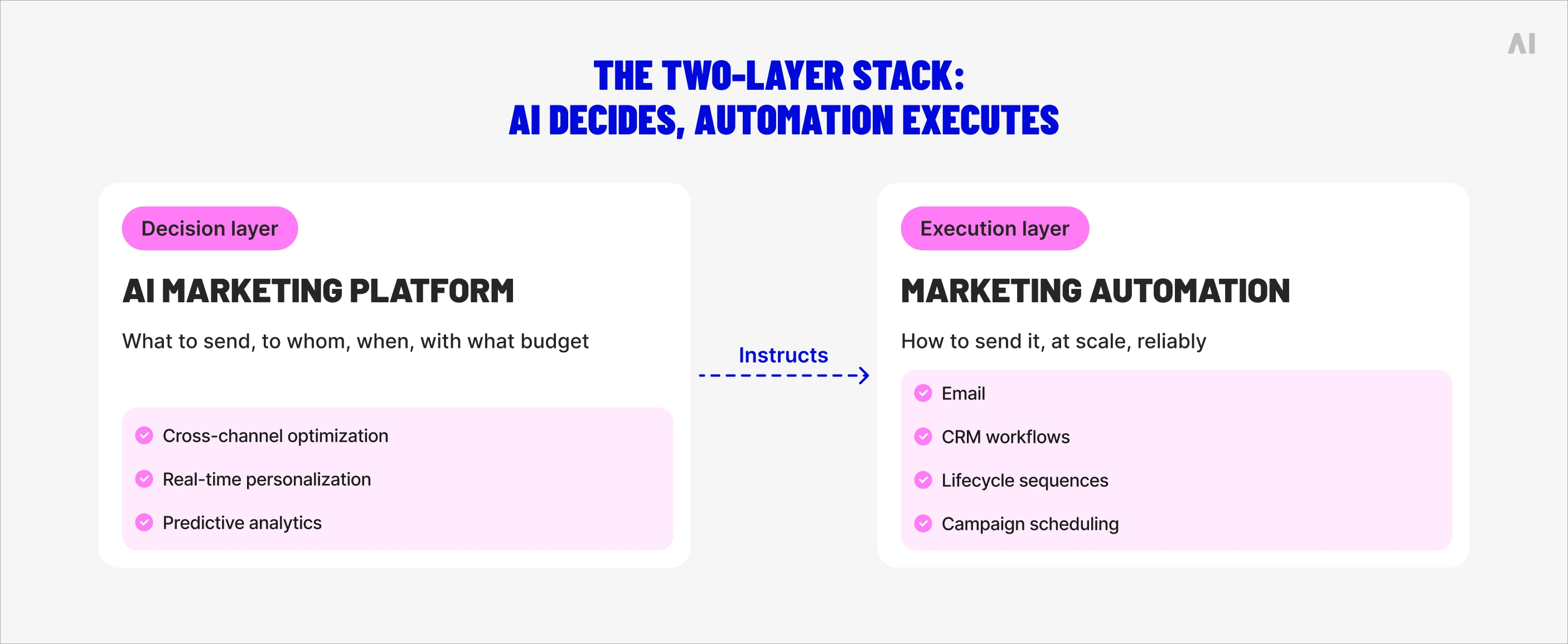
⚡ Marketing automation is the execution layer; AI is the decision layer.
Each is doing a different job, and the most sophisticated marketing organizations are now using both—explicitly and deliberately, with clear lines about which is responsible for what.
The two-layer stack: AI decides, automation executes
In this architecture, the AI marketing platform analyzes cross-channel data, identifies what should happen next, and instructs the automation platform to do it. The automation platform—the existing email engine, the CRM workflow, the campaign management system—receives the instruction and executes faithfully. Neither replaces the other. The point is to stop asking the automation platform to do work it was never designed for, and to give it intelligent instructions instead.
This is not theoretical. It's what the better-resourced marketing teams are quietly already doing: keeping the automation infrastructure they've spent years building, layering AI-driven decisioning on top, and using the combination to turn the existing stack into something more responsive than the sum of its parts. The integration is the lift, not the rebuild.
⚡ The most sophisticated marketing organizations have stopped treating AI and automation as competing investments. They've started treating them as different layers of the same system—and the gains have been disproportionate to either alone.
If automation is execution and AI marketing platforms are decisioning, agentic AI is the next stage—systems that don't just decide, but plan, act, and adapt across multi-step workflows with minimal human input. The distinction is that agents can hold goals across a sequence of actions, maintain context, use tools, and re-plan when conditions change. They are, in the strict sense, autonomous.
The evolution: from rule-based automation to agentic AI
The pace of adoption is faster than most CMOs are tracking. Gartner predicts that 40% of enterprise applications will feature task-specific AI agents by the end of 2026, up from less than 5% in 2025. Looking further out, Gartner forecasts that 60% of brands will use agentic AI to deliver streamlined one-to-one interactions by 2028.
"This marks the end of channel-based marketing as we know it. "— Senior Principal Researcher Emily Weiss (Gartner)
The honest counterweight is that the technology is not yet delivering on the marketing promises being made for it. Gartner's October 2025 survey of martech leaders found that 45% of those with AI agents in pilots or production say the vendor-offered capabilities don't meet expected business performance. Half cite a lack of technical and data-stack readiness; half cite a shortage of technical talent. Agentic AI is real, and it's coming, but the organizations capturing value from it now are doing the underlying work—data infrastructure, governance, workflow redesign—that vendor demos rarely show.
Where AI marketing platforms outperform automation
There are scenarios in which marketing automation does the job and AI marketing platforms would be overkill—modest channel mixes, small audiences, predictable lifecycles. There are also scenarios in which automation is structurally insufficient and the gap between what it can do and what the business needs widens by the quarter. The four below are the most common.
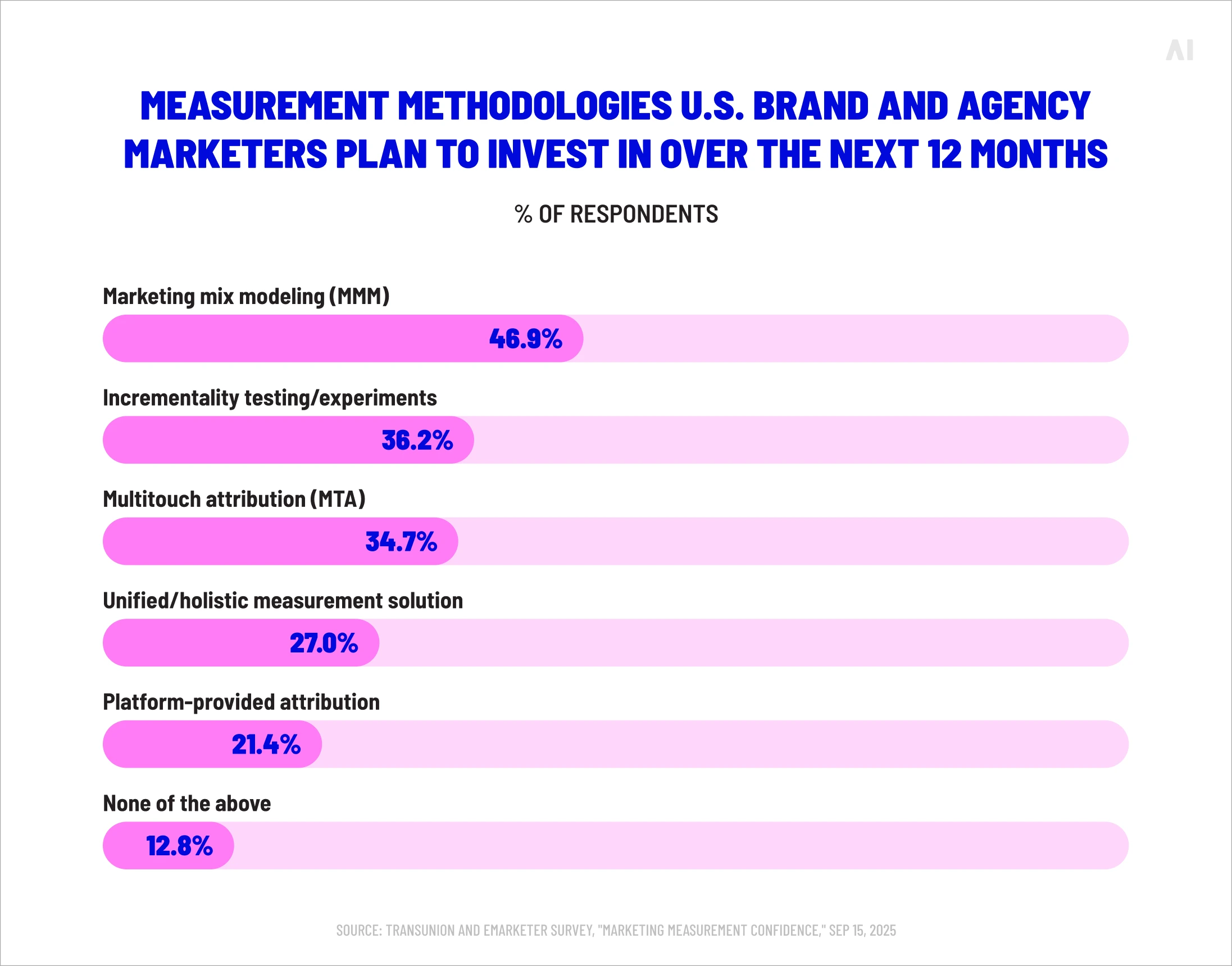
Static budget allocation is the default in most automation-only stacks: a quarterly plan, locked in advance, adjusted manually when something visibly breaks. AI marketing platforms move budget continuously, based on what is actually working. The shift from periodic to continuous optimization is what produces the efficiency gains finance asks about—and increasingly, what funds the case for further investment. EMARKETER's July 2025 research found that 46.9% of US brand and agency marketers plan to invest more in marketing mix modeling over the next year, in large part because manual planning has stopped being defensible against AI-driven measurement that actually quantifies channel contribution.
Measurement methodologies used by US brand and agency marketers (Source)
A customer who clicks a search ad, opens an email, watches a CTV spot, and converts via retargeting is a single journey that a single-channel automation platform sees as four unrelated events. AI marketing platforms reassemble the journey, optimize across the touchpoints rather than within each one, and produce orchestration that automation, on its own, cannot. The improvement isn't a marginal lift; it is the difference between coordinated marketing and a coincidence of marketing activities.
Personalization at scale
Personalization in automation platforms means rule-based content swaps tied to predefined segments. Personalization in AI marketing platforms means real-time, behavior-driven decisions about what content, offer, or message to serve to which person, calculated on the fly from the signals that just arrived. The bar customers have set for relevance—and the speed at which their context changes—has moved past what segment-based logic can deliver.
Media buying and supply optimization
Media efficiency is where AI marketing platforms produce the cleanest economic case, because the waste is documented and the optimization is mechanical. Solutions like supply-side curation—applying AI to filter inventory before it reaches the buy side, optimizing supply paths to remove unnecessary intermediaries, prioritizing brand-safe placements—produce measurable reductions in wasted spend. AI Digital's Smart Supply is one example of this category: a curation layer that applies AI-driven path optimization and direct SSP relationships to keep budget closer to working media. The outcome that matters isn't methodology. It's what reaches the buy side, and what doesn't.
How to choose the right marketing platform approach
The choice between automation, AI marketing platforms, or both is not theoretical for any business spending real money on marketing. It comes down to scale, complexity, and the business outcomes the marketing function is being held to. The framework below maps the three.
Automation alone is enough when the marketing operation is small enough, channel-narrow enough, and predictable enough that the rules a competent operator writes will hold for long enough to pay back. Email-led nurture programs, single-product lifecycles, and B2B businesses with stable funnels often fit. The signal that automation is enough is that nobody is asking the team to optimize across channels in real time, and nobody is being asked to defend cross-channel ROI to the CFO. Where that's true, the more sophisticated platforms are buying capability that won't be used.
When AI marketing platforms become critical
AI marketing platforms become critical when channel complexity, data volume, or the pace of change has outstripped what manual optimization can keep up with. The triggers are recognizable: cross-channel measurement starts feeling like guesswork; budget reallocation always lags performance; the team is hiring analysts to keep up rather than to drive growth; the senior leadership conversation has shifted from "did the campaign run?" to "what did the spend produce?" When more than one of those is true, decisioning has become the constraint, and the constraint is the right place to invest.
The combination is the configuration most large marketing organizations end up at. AI handles the decisioning layer—what to send, where, when, to whom, with how much budget. Automation handles the execution—actually sending the email, queuing the campaign, advancing the sequence. The integration is the work, and it is the work that produces the gains.
From automation to AI marketing: how to make the shift
Moving from a marketing automation–led stack to one that includes AI-driven decisioning is less a technology project than an operating-model shift. The shift fails most often not because the AI doesn't work, but because the organization wasn't structured to act on what the AI produced. The four steps below are the order in which the teams capturing real value tend to do it.
AI is only as useful as the data it is reasoning over. Before introducing decisioning capability, audit the data you have, the tracking that produces it, and the integrations that move it between systems. Most organizations find at this stage that the data is fragmented, the tracking has gaps, and the integrations are partial. That's normal. Fix it before adding intelligence on top, or the intelligence will optimize against incomplete signal.
2. Identify high-impact opportunities
Not every problem benefits equally from AI-driven decisioning. The opportunities with the highest payback are usually budget optimization, cross-channel performance, and personalization at scale—places where the manual cost of getting it right is high and the marginal value of getting it slightly more right is large. Pick one or two. Resist the temptation to deploy AI everywhere at once.
The most common failure mode is producing AI-driven insight that nobody acts on. Insight that lives in a dashboard is a report, not a decision. The integration that matters is the one between the AI marketing platform and the execution systems already in the stack—the automation platform, the campaign management tools, the bidding systems. The shorter the path from insight to action, the more value the AI captures.
4. Track outcomes, not activity
Marketing has too many metrics that measure activity rather than outcomes—sends, clicks, impressions. The teams that get the most out of AI marketing platforms reorient their KPI hierarchy around the outcomes the business is trying to produce: revenue, ROAS, customer acquisition cost, lifetime value. The shift is uncomfortable because it makes some long-protected programs look worse. That's the point. The teams that do it earliest are the ones that defend their budgets best when the conversation gets sharper.
How AI Digital enables AI-driven marketing
A coherent stack for the conversation above has three components: a decision layer, an execution layer, and a media-quality layer. The decision layer is where intelligence lives. The execution layer is where it acts. The media-quality layer is where it doesn't waste itself on supply that won't repay it. AI Digital is built around exactly this architecture, and the three products that compose it map directly to the three layers.
Elevate: decision intelligence layer
Elevate is AI Digital's marketing intelligence platform—the decision layer. It unifies research, planning, optimization, and reporting in a single workspace, applying AI to the full digital landscape rather than to programmatic alone.
In practice, that means an AI-Assisted Media Planner that translates campaign objectives into structured plans across DSPs; AI Audience Segments that map a target description into channel-ready segments; cookieless targeting that runs alongside standard segmentation; and Marketing Mix Modeling and Path-to-Conversion analysis that quantify what is actually driving outcomes versus what is simply present in the journey.
The point of the platform is to compress the gap between observation and action, and to do it on data the team would not otherwise see in time to act.
Smart Supply: media efficiency and quality
Smart Supply is the media-quality layer. It curates premium inventory, optimizes supply paths to remove unnecessary intermediaries, and uses AI-driven filtering to ensure budget reaches working media rather than getting absorbed in the gaps between SSPs.
The structural argument for the layer is the one the ANA's data has been making for two years: too much programmatic spend produces nothing the brand can count, and the most efficient way to fix that is to act before the impression is bought, not after. Smart Supply is the operationalization of that argument.
Open Garden Framework: ecosystem integration
The Open Garden Framework is the integration logic that makes the other two layers work as a system rather than as isolated tools. Where walled gardens—Google, Meta, Amazon—restrict cross-platform data and force advertisers to optimize within their proprietary environments, Open Garden treats the ecosystem as a single playing field. Data flows where it needs to. DSPs are chosen on performance, not allegiance. The advertiser's KPIs sit above the platform's, not below them. It is the framework version of an architectural commitment: the brand's outcomes are the optimization target.
The combination is what produces the business outcomes—improved marketing efficiency, scalable cross-channel growth, and the kind of decision speed senior teams ask for when they say they want to "be more data-driven" without quite knowing what that should look like operationally. Decisioning happens in Elevate. Execution happens through the existing automation and campaign infrastructure. Media efficiency is enforced by Smart Supply. The architecture connects, and that's the part that ends up mattering most.
Conclusion on AI vs marketing automation: Improve marketing efficiency with the right platform choice
The argument behind every section of this piece is the same one. Marketing automation platforms remain valuable; they execute reliably, at scale, the work that nobody should be doing by hand. AI marketing platforms are the layer above them—the part of the stack that decides what the execution should be doing in the first place. The two are not substitutes. The choice of which to deploy is determined by whether the binding constraint is operational efficiency or decision quality, and for most large marketing organizations the answer is increasingly both.
Key takeaways:
Marketing automation platforms streamline execution, but they don't optimize performance on their own.
AI marketing platforms improve efficiency by driving real-time decisions, dynamic budget allocation, and cross-channel optimization.
The highest impact comes from combining AI decisioning with automation execution—layered, not substituted.
Choosing the right platform depends on data scale, channel complexity, and the business outcomes the team is being measured against.
For organizations rebuilding their stack around the difference between execution and decisioning, the question worth asking before the next vendor demo is the one most easily skipped: what decision is the system actually making, and against what objective? AI Digital's combination of Elevate, Smart Supply, and the Open Garden Framework is built around a specific answer to that question—decisioning that respects the brand's outcomes, execution that respects the brand's existing stack, and media efficiency that respects what the budget can actually return. To explore where that fits with your own operation, get in touch.
Blind spot
Key issues
Business impact
AI Digital solution
Lack of transparency in AI models
• Platforms own AI models and train on proprietary data • Brands have little visibility into decision-making • "Walled gardens" restrict data access
• Inefficient ad spend • Limited strategic control • Eroded consumer trust • Potential budget mismanagement
Open Garden framework providing: • Complete transparency • DSP-agnostic execution • Cross-platform data & insights
Optimizing ads vs. optimizing impact
• AI excels at short-term metrics but may struggle with brand building • Consumers can detect AI-generated content • Efficiency might come at cost of authenticity
• Short-term gains at expense of brand health • Potential loss of authentic connection • Reduced effectiveness in storytelling
Smart Supply offering: • Human oversight of AI recommendations • Custom KPI alignment beyond clicks • Brand-safe inventory verification
The illusion of personalization
• Segment optimization rebranded as personalization • First-party data infrastructure challenges • Personalization vs. surveillance concerns
• Potential mismatch between promise and reality • Privacy concerns affecting consumer trust • Cost barriers for smaller businesses
Elevate platform features: • Real-time AI + human intelligence • First-party data activation • Ethical personalization strategies
AI-Driven efficiency vs. decision-making
• AI shifting from tool to decision-maker • Black box optimization like Google Performance Max • Human oversight limitations
• Strategic control loss • Difficulty questioning AI outputs • Inability to measure granular impact • Potential brand damage from mistakes
Managed Service with: • Human strategists overseeing AI • Custom KPI optimization • Complete campaign transparency
Fig. 1. Summary of AI blind spots in advertising
Dimension
Walled garden advantage
Walled garden limitation
Strategic impact
Audience access
Massive, engaged user bases
Limited visibility beyond platform
Reach without understanding
Data control
Sophisticated targeting tools
Data remains siloed within platform
Fragmented customer view
Measurement
Detailed in-platform metrics
Inconsistent cross-platform standards
Difficult performance comparison
Intelligence
Platform-specific insights
Limited data portability
Restricted strategic learning
Optimization
Powerful automated tools
Black-box algorithms
Reduced marketer control
Fig. 2. Strategic trade-offs in walled garden advertising.
Core issue
Platform priority
Walled garden limitation
Real-world example
Attribution opacity
Claiming maximum credit for conversions
Limited visibility into true conversion paths
Meta and TikTok's conflicting attribution models after iOS privacy updates
Data restrictions
Maintaining proprietary data control
Inability to combine platform data with other sources
Amazon DSP's limitations on detailed performance data exports
Cross-channel blindspots
Keeping advertisers within ecosystem
Fragmented view of customer journey
YouTube/DV360 campaigns lacking integration with non-Google platforms
Black box algorithms
Optimizing for platform revenue
Reduced control over campaign execution
Self-serve platforms using opaque ML models with little advertiser input
Performance reporting
Presenting platform in best light
Discrepancies between platform-reported and independently measured results
Consistently higher performance metrics in platform reports vs. third-party measurement
Fig. 1. The Walled garden misalignment: Platform interests vs. advertiser needs.
Key dimension
Challenge
Strategic imperative
ROAS volatility
Softer returns across digital channels
Shift from soft KPIs to measurable revenue impact
Media planning
Static plans no longer effective
Develop agile, modular approaches adaptable to changing conditions
Brand/performance
Traditional division dissolving
Create full-funnel strategies balancing long-term equity with short-term conversion
Capability
Key features
Benefits
Performance data
Elevate forecasting tool
• Vertical-specific insights • Historical data from past economic turbulence • "Cascade planning" functionality • Real-time adaptation
• Provides agility to adjust campaign strategy based on performance • Shows which media channels work best to drive efficient and effective performance • Confident budget reallocation • Reduces reaction time to market shifts
• Dataset from 10,000+ campaigns • Cuts response time from weeks to minutes
• Reaches people most likely to buy • Avoids wasted impressions and budgets on poor-performing placements • Context-aligned messaging
• 25+ billion bid requests analyzed daily • 18% improvement in working media efficiency • 26% increase in engagement during recessions
Full-funnel accountability
• Links awareness campaigns to lower funnel outcomes • Tests if ads actually drive new business • Measures brand perception changes • "Ask Elevate" AI Chat Assistant
• Upper-funnel to outcome connection • Sentiment shift tracking • Personalized messaging • Helps balance immediate sales vs. long-term brand building
• Natural language data queries • True business impact measurement
Open Garden approach
• Cross-platform and channel planning • Not locked into specific platforms • Unified cross-platform reach • Shows exactly where money is spent
• Reduces complexity across channels • Performance-based ad placement • Rapid budget reallocation • Eliminates platform-specific commitments and provides platform-based optimization and agility
• Coverage across all inventory sources • Provides full visibility into spending • Avoids the inability to pivot across platform as you’re not in a singular platform
Fig. 1. How AI Digital helps during economic uncertainty.
Trend
What it means for marketers
Supply & demand lines are blurring
Platforms from Google (P-Max) to Microsoft are merging optimization and inventory in one opaque box. Expect more bundled “best available” media where the algorithm, not the trader, decides channel and publisher mix.
Walled gardens get taller
Microsoft’s O&O set now spans Bing, Xbox, Outlook, Edge and LinkedIn, which just launched revenue-sharing video programs to lure creators and ad dollars. (Business Insider)
Retail & commerce media shape strategy
Microsoft’s Curate lets retailers and data owners package first-party segments, an echo of Amazon’s and Walmart’s approaches. Agencies must master seller-defined audiences as well as buyer-side tactics.
AI oversight becomes critical
Closed AI bidding means fewer levers for traders. Independent verification, incrementality testing and commercial guardrails rise in importance.
Fig. 1. Platform trends and their implications.
Metric
Connected TV (CTV)
Linear TV
Video Completion Rate
94.5%
70%
Purchase Rate After Ad
23%
12%
Ad Attention Rate
57% (prefer CTV ads)
54.5%
Viewer Reach (U.S.)
85% of households
228 million viewers
Retail Media Trends 2025
Access Complete consumer behaviour analyses and competitor benchmarks.
Identify and categorize audience groups based on behaviors, preferences, and characteristics
Michaels Stores: Implemented a genAI platform that increased email personalization from 20% to 95%, leading to a 41% boost in SMS click through rates and a 25% increase in engagement.
Estée Lauder: Partnered with Google Cloud to leverage genAI technologies for real-time consumer feedback monitoring and analyzing consumer sentiment across various channels.
High
Medium
Automated ad campaigns
Automate ad creation, placement, and optimization across various platforms
Showmax: Partnered with AI firms toautomate ad creation and testing, reducing production time by 70% while streamlining their quality assurance process.
Headway: Employed AI tools for ad creation and optimization, boosting performance by 40% and reaching 3.3 billion impressions while incorporating AI-generated content in 20% of their paid campaigns.
High
High
Brand sentiment tracking
Monitor and analyze public opinion about a brand across multiple channels in real time
L’Oréal: Analyzed millions of online comments, images, and videos to identify potential product innovation opportunities, effectively tracking brand sentiment and consumer trends.
Kellogg Company: Used AI to scan trending recipes featuring cereal, leveraging this data to launch targeted social campaigns that capitalize on positive brand sentiment and culinary trends.
High
Low
Campaign strategy optimization
Analyze data to predict optimal campaign approaches, channels, and timing
DoorDash: Leveraged Google’s AI-powered Demand Gen tool, which boosted its conversion rate by 15 times and improved cost per action efficiency by 50% compared with previous campaigns.
Kitsch: Employed Meta’s Advantage+ shopping campaigns with AI-powered tools to optimize campaigns, identifying and delivering top-performing ads to high-value consumers.
High
High
Content strategy
Generate content ideas, predict performance, and optimize distribution strategies
JPMorgan Chase: Collaborated with Persado to develop LLMs for marketing copy, achieving up to 450% higher clickthrough rates compared with human-written ads in pilot tests.
Hotel Chocolat: Employed genAI for concept development and production of its Velvetiser TV ad, which earned the highest-ever System1 score for adomestic appliance commercial.
High
High
Personalization strategy development
Create tailored messaging and experiences for consumers at scale
Stitch Fix: Uses genAI to help stylists interpret customer feedback and provide product recommendations, effectively personalizing shopping experiences.
Instacart: Uses genAI to offer customers personalized recipes, mealplanning ideas, and shopping lists based on individual preferences and habits.
Medium
Medium
Share article
Url copied to clipboard
No items found.
Subscribe to our Newsletter
THANK YOU FOR YOUR SUBSCRIPTION
Oops! Something went wrong while submitting the form.
Questions? We have answers
AI marketing platforms vs automation: which one delivers better ROI?
AI marketing platforms typically deliver higher ROI in environments with multi-channel complexity, large data volumes, and continuous performance pressure, because they optimize the decisions automation platforms can only execute. Automation can produce strong ROI in narrower contexts—single-channel programs, predictable lifecycles—where rule-based execution is sufficient. The honest answer is that the comparison is rarely apples-to-apples; the question that matters more is which layer of the stack each is operating in, and whether both layers are being asked to do the work they were built for.
Do I still need marketing automation if I use an AI marketing platform?
Almost certainly yes. AI marketing platforms are built to make and optimize decisions; they are not built to execute the actual sends, sequences, and CRM workflows automation platforms handle reliably. The two layers complement each other: the AI platform decides what should happen; the automation platform makes it happen. Pulling out automation in favor of AI usually means re-engineering work that was already solved, with no corresponding payback.
When should a business switch from automation to AI marketing platforms?
The signal is rarely a single moment. It tends to be a pattern: cross-channel performance becomes hard to measure; budget reallocation lags the performance signals coming back; the team is adding analysts to keep up rather than to drive growth; senior leadership has reframed the conversation from activity to outcomes. When several of those are true, decisioning has become the constraint, and AI marketing platforms are the structural answer.
What problems can AI marketing platforms solve that automation can't?
Cross-channel optimization, real-time personalization, dynamic budget allocation, and continuous learning from performance data. All four require a model of the system as a whole that rule-based platforms do not have. Automation can be configured to do narrower versions of each—a personalization rule here, a quarterly budget adjustment there—but the depth and pace at which AI platforms operate produces a different category of outcome.
Are AI marketing platforms worth the investment for mid-sized businesses?
Increasingly, yes—though the right starting point matters more than the absolute scale of the deployment. Mid-sized businesses tend to capture the strongest payback from focused use cases: budget optimization, cross-channel measurement, or personalization at scale, deployed over a defined period with clear success metrics. The risk to manage is buying capability faster than the team can use it. Phased adoption tends to outperform big-bang deployment.
What's the biggest limitation of marketing automation platforms today?
The structural limit is that they execute rules a human had to write, and the rules don't keep up with the environment. As channels multiply, customer journeys fragment, and signal becomes noisier, the maintenance cost of keeping rule-based systems current rises faster than the value the rules produce. Automation is doing exactly what it was designed to do; the design just doesn't extend to the problem most marketing operations now face.
What's the difference between AI and automation in marketing?
The difference between AI and automation in marketing comes down to what each system is built to do. Automation executes a sequence of actions that someone has already decided on—sending the email, advancing the workflow, scoring the lead against a predefined rule. Artificial intelligence, in marketing platforms, makes the decision in the first place: which audience to target, which channel to prioritize, how to reallocate budget mid-flight, when a creative is decaying. Put differently, the difference between automation and AI is the difference between a system that follows instructions reliably and a system that produces the instructions in the first place. The two are not in competition. The most effective marketing operations use them as layers—AI for decisioning, automation for execution—and the integration between them is where most of the actual value gets captured.
Have other questions?
If you have more questions, contact us so we can help.
Questions? We have answers
This is some text inside of a div block.
Lorem ipsum dolor sit amet, consectetur adipiscing elit. Suspendisse varius enim in eros elementum tristique. Duis cursus, mi quis viverra ornare, eros dolor interdum nulla, ut commodo diam libero vitae erat. Aenean faucibus nibh et justo cursus id rutrum lorem imperdiet. Nunc ut sem vitae risus tristique posuere.
This is some text inside of a div block.
Lorem ipsum dolor sit amet, consectetur adipiscing elit. Suspendisse varius enim in eros elementum tristique. Duis cursus, mi quis viverra ornare, eros dolor interdum nulla, ut commodo diam libero vitae erat. Aenean faucibus nibh et justo cursus id rutrum lorem imperdiet. Nunc ut sem vitae risus tristique posuere.
This is some text inside of a div block.
Lorem ipsum dolor sit amet, consectetur adipiscing elit. Suspendisse varius enim in eros elementum tristique. Duis cursus, mi quis viverra ornare, eros dolor interdum nulla, ut commodo diam libero vitae erat. Aenean faucibus nibh et justo cursus id rutrum lorem imperdiet. Nunc ut sem vitae risus tristique posuere.
This is some text inside of a div block.
Lorem ipsum dolor sit amet, consectetur adipiscing elit. Suspendisse varius enim in eros elementum tristique. Duis cursus, mi quis viverra ornare, eros dolor interdum nulla, ut commodo diam libero vitae erat. Aenean faucibus nibh et justo cursus id rutrum lorem imperdiet. Nunc ut sem vitae risus tristique posuere.
This is some text inside of a div block.
Lorem ipsum dolor sit amet, consectetur adipiscing elit. Suspendisse varius enim in eros elementum tristique. Duis cursus, mi quis viverra ornare, eros dolor interdum nulla, ut commodo diam libero vitae erat. Aenean faucibus nibh et justo cursus id rutrum lorem imperdiet. Nunc ut sem vitae risus tristique posuere.
This is some text inside of a div block.
Lorem ipsum dolor sit amet, consectetur adipiscing elit. Suspendisse varius enim in eros elementum tristique. Duis cursus, mi quis viverra ornare, eros dolor interdum nulla, ut commodo diam libero vitae erat. Aenean faucibus nibh et justo cursus id rutrum lorem imperdiet. Nunc ut sem vitae risus tristique posuere.
This is some text inside of a div block.
Lorem ipsum dolor sit amet, consectetur adipiscing elit. Suspendisse varius enim in eros elementum tristique. Duis cursus, mi quis viverra ornare, eros dolor interdum nulla, ut commodo diam libero vitae erat. Aenean faucibus nibh et justo cursus id rutrum lorem imperdiet. Nunc ut sem vitae risus tristique posuere.




.svg)
.svg)



.webp)