In-Game or In-Sync? Winning the "Second Screen" Scrimmage
Kelly Wittmann
February 13, 2026
15
minutes read
Super Bowl Sunday still does one thing better than anything else in American media: it creates a single, shared moment at national scale. Super Bowl LX lands on February 8, 2026 at Levi’s Stadium in Santa Clara, with NBCUniversal carrying the broadcast and Peacock as a major streaming destination.
Brands know what that moment costs. Reported pricing for a 30-second spot is averaging around $8 million, with some placements crossing $10 million this year.
The mistake is thinking that the investment ends with the spot.
Because the broadcast is only the master narrative now. The business outcomes are won in the messy, fast-moving layer that sits beside it: the second screen, the scroll, the search, the group chat, the clips, the shopping overlays, the “wait, what was that brand?” moment, the impulse to act while the game is still happening.
That layer is where the Super Bowl becomes measurable. Or wasteful.
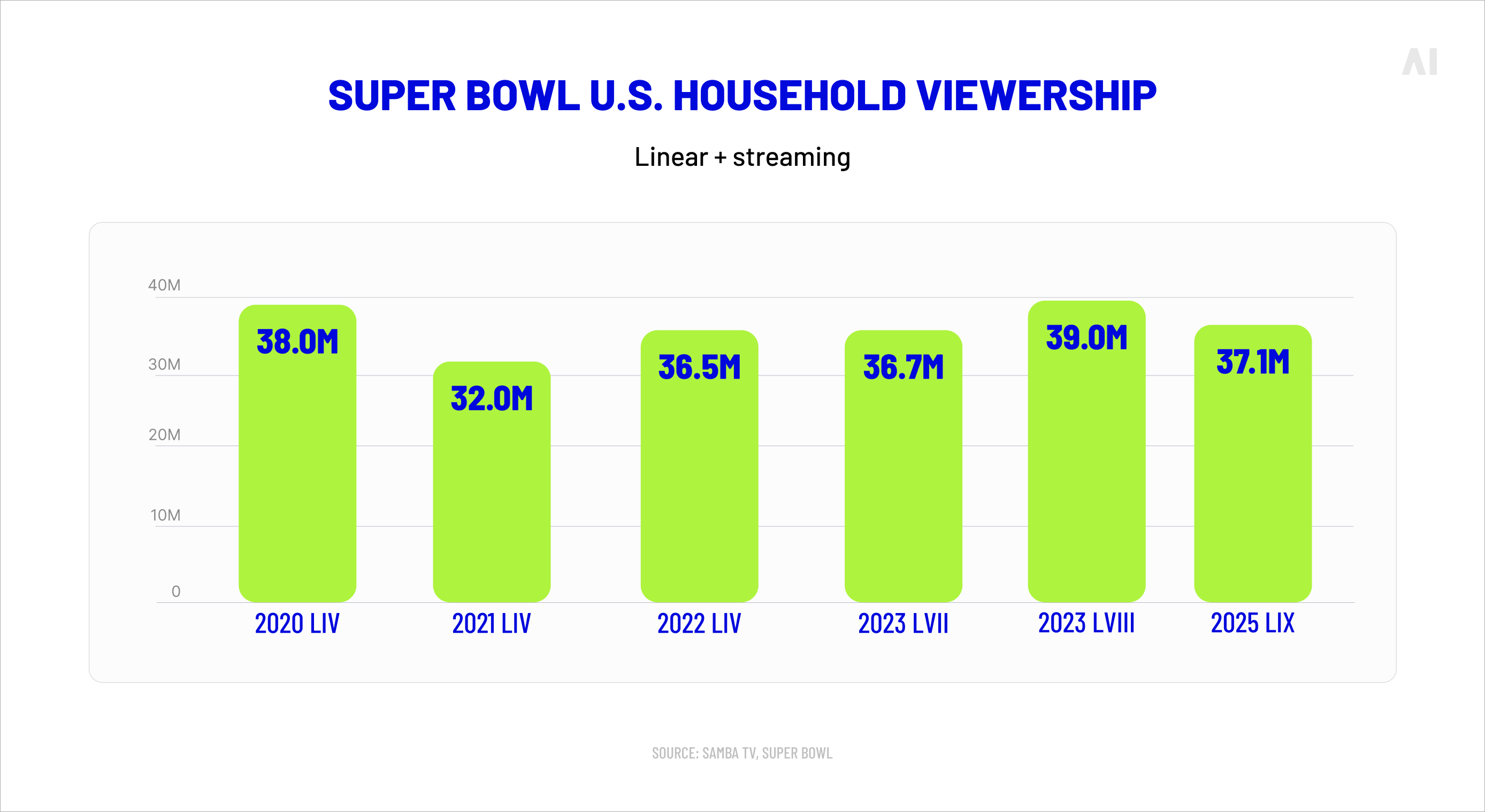
Pic. Super Bowl US household viewership (linear + streaming) (Source).
The moment got bigger. Attention got more divided.
It’s tempting to treat divided attention like a problem to solve. It’s not. It’s the current operating system.
Consumers don’t “leave” the game when they pick up a phone. They often go deeper into it. They check stats. They react in real time. They look up an actor, a product, a brand promise, a promo. They watch a replay because the broadcast moved on. They’re not stepping away from the moment; they’re extending it into the places where intent lives.
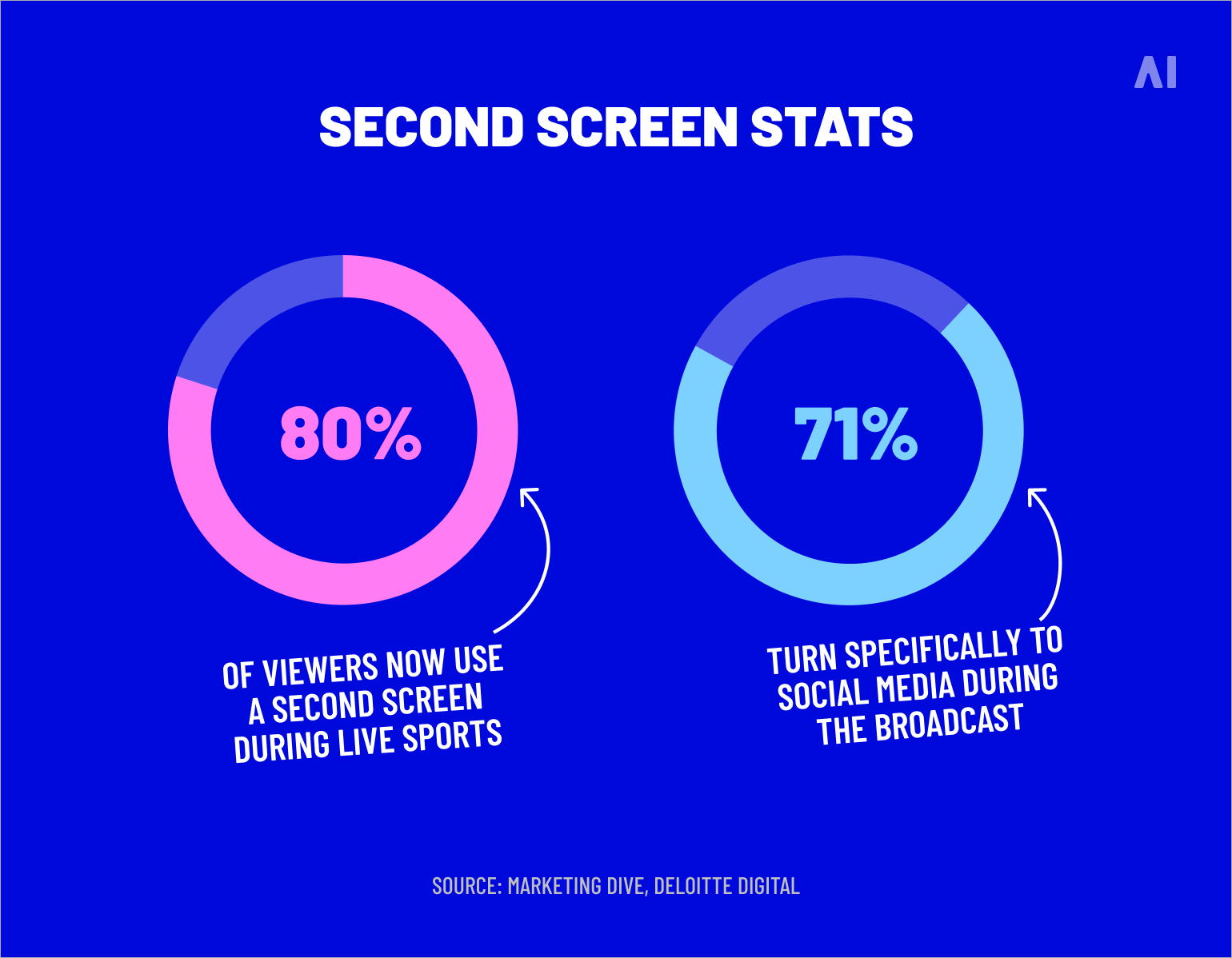
Surveys ahead of recent Super Bowls have consistently pointed to a majority of viewers engaging with the game across multiple screens or platforms. And research and industry reporting around streaming-era sports coverage keeps reinforcing the same direction: the event experience is now cross-platform by default.
That creates a straightforward challenge for agencies and brands.
If your Super Bowl plan is “big spot, then social posts,” you’re not doing a second-screen strategy but are filling whitespace.
⚡ The broadcast spot creates shock and awe. The second screen decides whether it becomes impact.
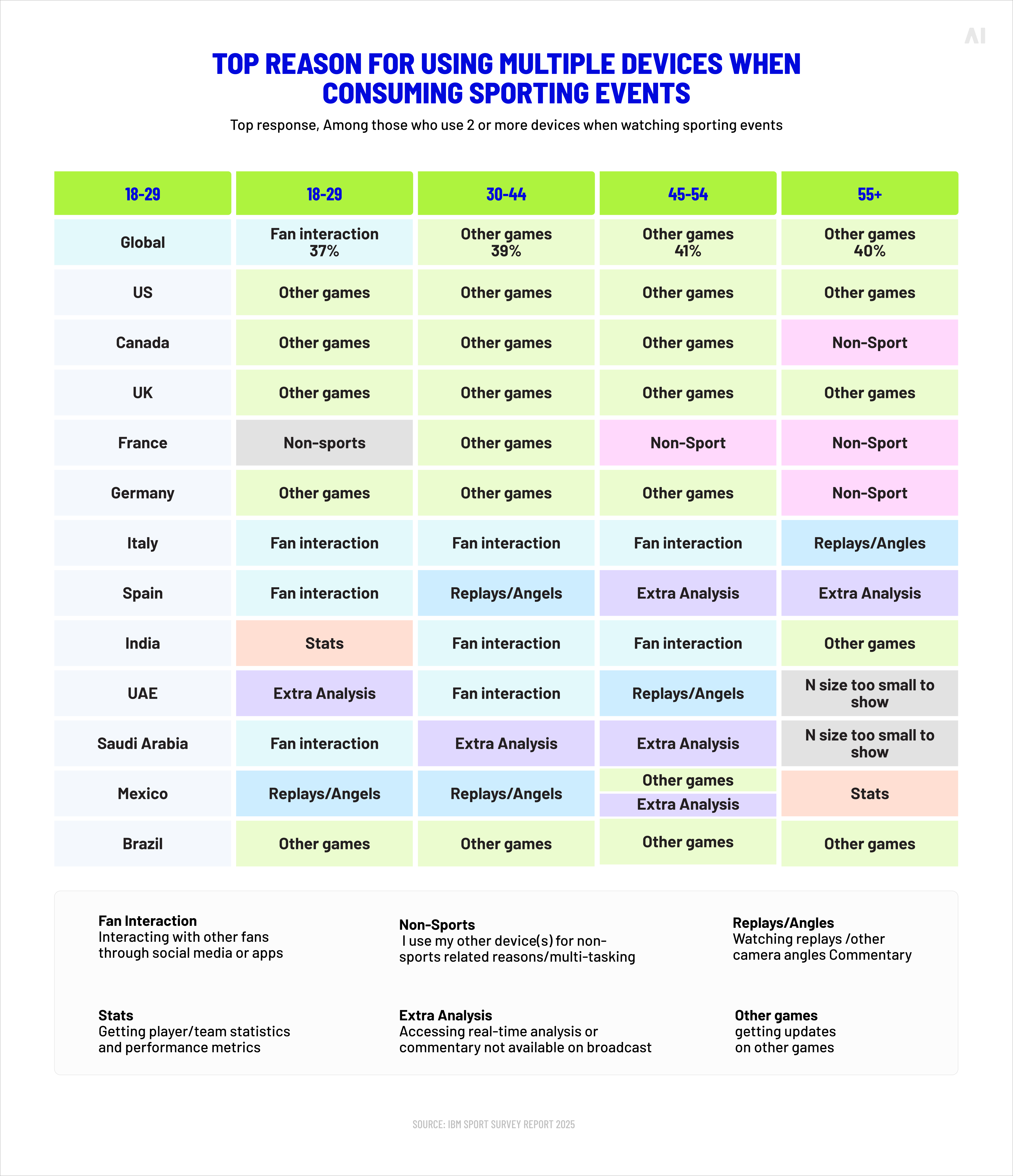
Pic. The top reason sports fans use two or more devices while consuming sporting events (Source).
Linear vs. liquid: the scrimmage is happening off the TV
Here’s a clean way to think about Super Bowl media in 2026.
Linear is the master narrative: It’s the big-budget creative moment. It’s the celebrity cameo. It’s the comedy beat. It’s the sixty-second film you sweated over for months.
Liquid is the scrimmage: It moves quickly and it moves everywhere. It flows between TikTok and live tweets, between sports apps and streaming menus, between Google searches and shoppable TV prompts. It’s where people trade reactions and take action.
That’s why the old funnel vocabulary fails here. “Awareness, consideration, conversion” makes it sound sequential and calm. Super Bowl behavior isn’t. It’s simultaneous.
The brands that win don’t merely “run campaigns across channels.” They synchronize. They anticipate the moments when attention spikes, and they show up with the right creative and the right offer in the right environment while the viewer is still in-game.
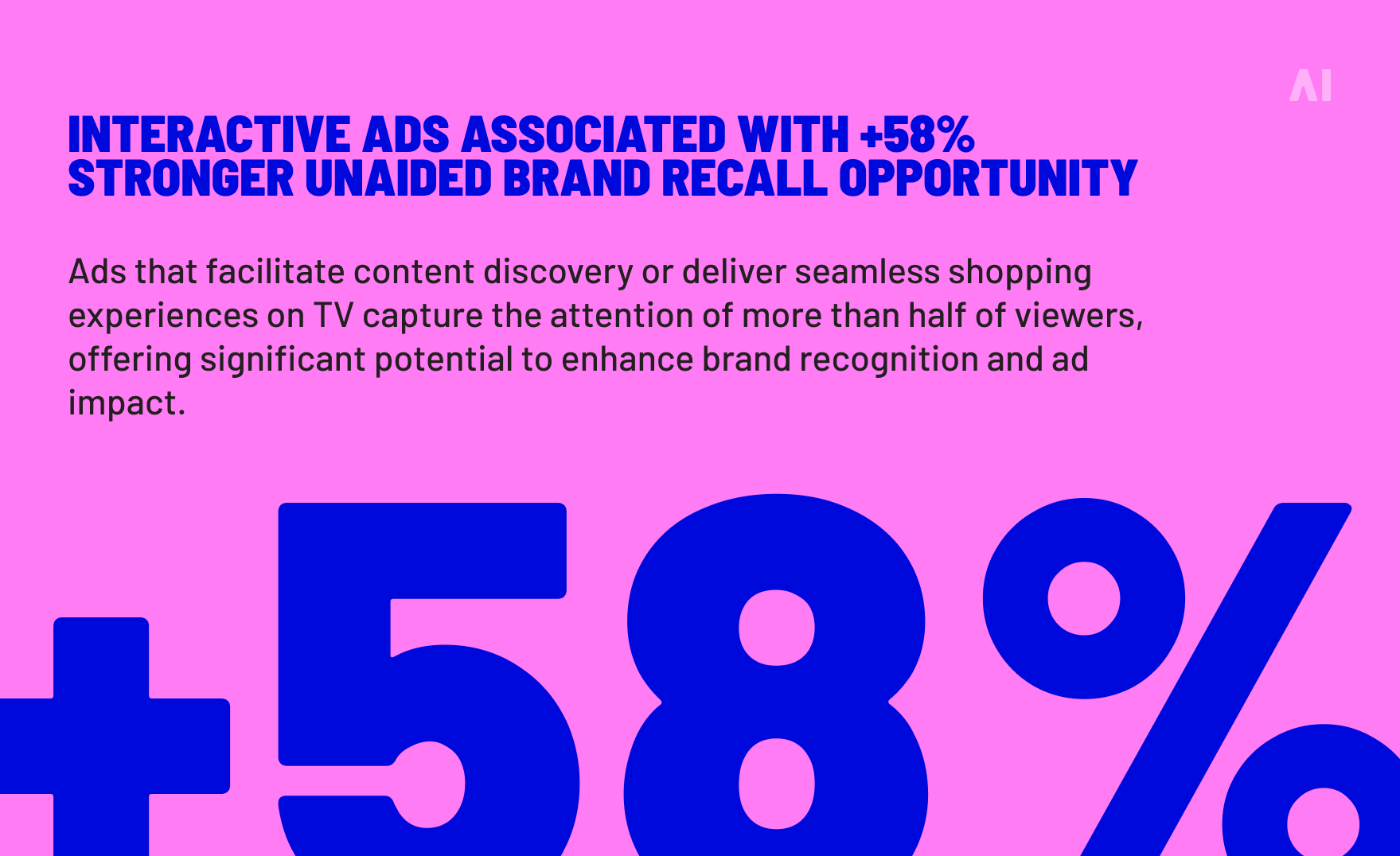
Pic. 51% of TV streamers engage in commerce-related activity on TV (Source).
The most common failure mode: the $8M spot gets a plan, everything else gets improvisation
Most Super Bowl strategies are built like a pyramid: the TV spot is the top, and everything else is treated like supporting material.
That structure makes sense inside a linear world. It breaks in a cross-screen one.
In the liquid layer, outcomes don’t come from presence. They come from timing, context, and continuity.
A snack ad hits during a tense third-and-long. The viewer laughs, then reaches for their phone to see who the actor was or to check if the brand is running a promotion.
A car ad drops a new model reveal. The viewer searches the model name, not the brand.
A retail brand runs a “big game deal,” but the offer isn’t discoverable in the first two search results, and the paid social creative doesn’t match the TV story, and the landing page isn’t built for game-night traffic.
The problem is operational coherence.
If your second-screen strategy isn’t running in lockstep with the live game flow, you’re paying for halo and leaving results to chance.
Walled gardens make the second screen easier to buy and harder to prove
In the liquid layer, the biggest temptation is also the biggest trap: chase the audience into closed ecosystems because the tools are convenient and the reporting looks clean.
Walled gardens are not “bad.” They’re powerful. But their incentives are not the same as yours. They optimize inside their own boundaries, using their own measurement, toward outcomes that often serve platform revenue before advertiser truth.
That matters most during tentpole moments, because the stakes are higher and the noise is louder.
When measurement becomes a platform-specific story, brands are left with a familiar frustration: everyone reports success, but nobody can explain which parts actually drove business impact.
This is where the Open Garden philosophy becomes less like a media preference and more like a governance requirement.
Open Garden: a strategy for visibility when the journey is fragmented
At AI Digital, we describe Open Garden as a practical stance: keep control, keep transparency, keep the ability to learn across environments.
Open Garden is not a rejection of the big platforms. It’s a way to avoid becoming dependent on any single one for truth.
In practice, it means:
Cross-platform visibility instead of siloed reporting
Neutral access to inventory rather than default prioritization of a platform’s owned supply
Optimization tied to business outcomes rather than DSP-native proxy metrics
It also means demanding “glass-box” accountability: knowing where your ads ran, how supply paths were chosen, and what you paid for the media versus the machinery around it.
If the second screen is where intent shows up, Open Garden is how you make that intent measurable.
The unglamorous part that decides efficiency: supply path chaos under peak demand
Super Bowl week does strange things to programmatic markets. Demand surges, and the ecosystem behaves like it’s under stress.
Prices rise. Intermediary hops multiply. Inventory gets repackaged and resold. Quality variation becomes harder to spot quickly, and it gets easier for budgets to drift into “close enough” placements that look premium on a slide but don’t perform like premium in reality.
None of this is theoretical. The industry has spent years building transparency standards because the supply chain is complicated and can be opaque without deliberate controls.
The IAB Tech Lab created tools like sellers.json to help buyers validate who is authorized to sell inventory.
Advertiser groups like the World Federation of Advertisers have highlighted supply chain accountability as a core requirement for trust in programmatic.
The point isn’t to drown in standards. The point is to recognize the pattern: when you’re buying in the loudest marketplace of the year, inefficiency scales fast unless you have a supply discipline that can withstand it.
Smart Supply: premium precision when the market gets noisy
This is where Smart Supply fits, and why it matters specifically in a Super Bowl environment.
Smart Supply is designed to make programmatic supply behave more like a controlled, outcome-driven buy, especially when open exchanges are flooded with demand. The industry often labels this category “curation.” We think that word is too vague to be useful. What matters is the actual work:
selecting high-quality supply
filtering out low-value or unsafe placements before they reach your campaign
reducing unnecessary intermediary hops that inflate costs
verifying that what you bought is what you intended to buy
Smart Supply is built to stay neutral. It’s DSP-agnostic by design, and it’s explicitly meant to remove inventory bias that can appear when platforms prioritize their own supply. It’s also structured around deal IDs that are built for a specific inventory type and KPI, rather than “one-size-fits-all” packages.
Two practical operating modes matter here:
Deal libraries for broad KPIs and scaled buys (think completed views, quality reach, stable frequency).
Campaign-specific deals for tighter audiences or aggressive outcomes, designed to learn and adjust as performance data comes back.
This is the part of the story many Super Bowl advertisers underweight. They focus on what the creative says, and forget that programmatic delivery quality is often what determines whether the second-screen follow-on performs like a premium experience or like a leaky bucket.
The 2026 scoreboard: fewer proxies, more accountability
Here’s the line we draw for Super Bowl media in 2026:
If you can’t explain how the liquid layer drove business impact, you didn’t really run a Super Bowl strategy. You ran entertainment.
The scoreboard needs to move beyond vanity metrics that are easy to collect and hard to tie to outcomes. In practice, that means measuring what the second screen is actually doing for you:
Brand lift signals where you can run them credibly
Search demand during and immediately after the spot
Site engagement quality (not just traffic volume)
Commerce signals that reflect real intent, not accidental clicks
Incremental outcomes where you can build a credible holdout or comparison
{{26-in-game-or-in-sync-2="/tables"}}
The point isn’t to demand perfect attribution from a chaotic moment. It’s to demand defensible truth.
And that’s where Open Garden and Smart Supply connect into a coherent solution:
Open Garden protects visibility across the fragmented journey.
Smart Supply protects delivery quality when the market is inflated and noisy.
A practical playbook for brands “surrounding the game”
If you’re building a Super Bowl plan now, this is the checklist we’d push to the top of the room.
Treat the TV spot as a spark, not the system. The spot is the opening play. The drive is what follows.
Pre-build your second-screen continuity. Your social, CTV, video, and search presence should look and feel like the same story, not separate campaigns that happen to share a logo.
Decide what truth you need before you buy. If you can’t see where your ads ran and how the supply path was chosen, you’re giving up the ability to learn at the moment when learning is most valuable.
Protect premium delivery when demand spikes. Super Bowl auctions magnify inefficiency. Put supply discipline in place so you don’t pay top-dollar CPMs for mid-tier delivery.
Optimize with a real-time operating cadence. If you’re waiting for next-day reporting to adjust, you’re missing the game-night window when intent is hottest.
Measure outcomes executives recognize. The board doesn’t care that a platform reported a strong view-through rate. They care what moved: demand, consideration, revenue, retention.
Closing: sync or sink
A Super Bowl spot can still stop the room. Money and celebrity help with that.
What separates the winners now is what happens next—when the room immediately picks up its phone. That second-screen surge is where curiosity turns into intent, and where intent either gets captured cleanly or evaporates into noise.
Brands that treat digital as the connective tissue of game night build something sturdier than a single splash. They connect the broadcast moment to a coordinated follow-through: consistent creative, disciplined supply paths, and measurement that can stand up in a serious conversation. Brands that treat the second screen as an afterthought get what Super Bowl ads have always delivered in the worst case—applause, a few memes, and no clarity on what moved.
In 2026, the best Super Bowl ad isn’t the one everyone quotes on Monday. It’s the one that can show what changed on Tuesday.
If any of this resonated—and you’re thinking about how to build a smarter plan around your next big moment (the Super Bowl, the Olympics, a product launch, a category tentpole)—let’s talk. We’re always up for a real conversation and a productive discussion about what’s possible, what’s practical, and how to make the next one measurable.
Blind spot
Key issues
Business impact
AI Digital solution
Lack of transparency in AI models
• Platforms own AI models and train on proprietary data • Brands have little visibility into decision-making • "Walled gardens" restrict data access
• Inefficient ad spend • Limited strategic control • Eroded consumer trust • Potential budget mismanagement
Open Garden framework providing: • Complete transparency • DSP-agnostic execution • Cross-platform data & insights
Optimizing ads vs. optimizing impact
• AI excels at short-term metrics but may struggle with brand building • Consumers can detect AI-generated content • Efficiency might come at cost of authenticity
• Short-term gains at expense of brand health • Potential loss of authentic connection • Reduced effectiveness in storytelling
Smart Supply offering: • Human oversight of AI recommendations • Custom KPI alignment beyond clicks • Brand-safe inventory verification
The illusion of personalization
• Segment optimization rebranded as personalization • First-party data infrastructure challenges • Personalization vs. surveillance concerns
• Potential mismatch between promise and reality • Privacy concerns affecting consumer trust • Cost barriers for smaller businesses
Elevate platform features: • Real-time AI + human intelligence • First-party data activation • Ethical personalization strategies
AI-Driven efficiency vs. decision-making
• AI shifting from tool to decision-maker • Black box optimization like Google Performance Max • Human oversight limitations
• Strategic control loss • Difficulty questioning AI outputs • Inability to measure granular impact • Potential brand damage from mistakes
Managed Service with: • Human strategists overseeing AI • Custom KPI optimization • Complete campaign transparency
Fig. 1. Summary of AI blind spots in advertising
Dimension
Walled garden advantage
Walled garden limitation
Strategic impact
Audience access
Massive, engaged user bases
Limited visibility beyond platform
Reach without understanding
Data control
Sophisticated targeting tools
Data remains siloed within platform
Fragmented customer view
Measurement
Detailed in-platform metrics
Inconsistent cross-platform standards
Difficult performance comparison
Intelligence
Platform-specific insights
Limited data portability
Restricted strategic learning
Optimization
Powerful automated tools
Black-box algorithms
Reduced marketer control
Fig. 2. Strategic trade-offs in walled garden advertising.
Core issue
Platform priority
Walled garden limitation
Real-world example
Attribution opacity
Claiming maximum credit for conversions
Limited visibility into true conversion paths
Meta and TikTok's conflicting attribution models after iOS privacy updates
Data restrictions
Maintaining proprietary data control
Inability to combine platform data with other sources
Amazon DSP's limitations on detailed performance data exports
Cross-channel blindspots
Keeping advertisers within ecosystem
Fragmented view of customer journey
YouTube/DV360 campaigns lacking integration with non-Google platforms
Black box algorithms
Optimizing for platform revenue
Reduced control over campaign execution
Self-serve platforms using opaque ML models with little advertiser input
Performance reporting
Presenting platform in best light
Discrepancies between platform-reported and independently measured results
Consistently higher performance metrics in platform reports vs. third-party measurement
Fig. 1. The Walled garden misalignment: Platform interests vs. advertiser needs.
Key dimension
Challenge
Strategic imperative
ROAS volatility
Softer returns across digital channels
Shift from soft KPIs to measurable revenue impact
Media planning
Static plans no longer effective
Develop agile, modular approaches adaptable to changing conditions
Brand/performance
Traditional division dissolving
Create full-funnel strategies balancing long-term equity with short-term conversion
Capability
Key features
Benefits
Performance data
Elevate forecasting tool
• Vertical-specific insights • Historical data from past economic turbulence • "Cascade planning" functionality • Real-time adaptation
• Provides agility to adjust campaign strategy based on performance • Shows which media channels work best to drive efficient and effective performance • Confident budget reallocation • Reduces reaction time to market shifts
• Dataset from 10,000+ campaigns • Cuts response time from weeks to minutes
• Reaches people most likely to buy • Avoids wasted impressions and budgets on poor-performing placements • Context-aligned messaging
• 25+ billion bid requests analyzed daily • 18% improvement in working media efficiency • 26% increase in engagement during recessions
Full-funnel accountability
• Links awareness campaigns to lower funnel outcomes • Tests if ads actually drive new business • Measures brand perception changes • "Ask Elevate" AI Chat Assistant
• Upper-funnel to outcome connection • Sentiment shift tracking • Personalized messaging • Helps balance immediate sales vs. long-term brand building
• Natural language data queries • True business impact measurement
Open Garden approach
• Cross-platform and channel planning • Not locked into specific platforms • Unified cross-platform reach • Shows exactly where money is spent
• Reduces complexity across channels • Performance-based ad placement • Rapid budget reallocation • Eliminates platform-specific commitments and provides platform-based optimization and agility
• Coverage across all inventory sources • Provides full visibility into spending • Avoids the inability to pivot across platform as you’re not in a singular platform
Fig. 1. How AI Digital helps during economic uncertainty.
Trend
What it means for marketers
Supply & demand lines are blurring
Platforms from Google (P-Max) to Microsoft are merging optimization and inventory in one opaque box. Expect more bundled “best available” media where the algorithm, not the trader, decides channel and publisher mix.
Walled gardens get taller
Microsoft’s O&O set now spans Bing, Xbox, Outlook, Edge and LinkedIn, which just launched revenue-sharing video programs to lure creators and ad dollars. (Business Insider)
Retail & commerce media shape strategy
Microsoft’s Curate lets retailers and data owners package first-party segments, an echo of Amazon’s and Walmart’s approaches. Agencies must master seller-defined audiences as well as buyer-side tactics.
AI oversight becomes critical
Closed AI bidding means fewer levers for traders. Independent verification, incrementality testing and commercial guardrails rise in importance.
Fig. 1. Platform trends and their implications.
Metric
Connected TV (CTV)
Linear TV
Video Completion Rate
94.5%
70%
Purchase Rate After Ad
23%
12%
Ad Attention Rate
57% (prefer CTV ads)
54.5%
Viewer Reach (U.S.)
85% of households
228 million viewers
Retail Media Trends 2025
Access Complete consumer behaviour analyses and competitor benchmarks.
Identify and categorize audience groups based on behaviors, preferences, and characteristics
Michaels Stores: Implemented a genAI platform that increased email personalization from 20% to 95%, leading to a 41% boost in SMS click through rates and a 25% increase in engagement.
Estée Lauder: Partnered with Google Cloud to leverage genAI technologies for real-time consumer feedback monitoring and analyzing consumer sentiment across various channels.
High
Medium
Automated ad campaigns
Automate ad creation, placement, and optimization across various platforms
Showmax: Partnered with AI firms toautomate ad creation and testing, reducing production time by 70% while streamlining their quality assurance process.
Headway: Employed AI tools for ad creation and optimization, boosting performance by 40% and reaching 3.3 billion impressions while incorporating AI-generated content in 20% of their paid campaigns.
High
High
Brand sentiment tracking
Monitor and analyze public opinion about a brand across multiple channels in real time
L’Oréal: Analyzed millions of online comments, images, and videos to identify potential product innovation opportunities, effectively tracking brand sentiment and consumer trends.
Kellogg Company: Used AI to scan trending recipes featuring cereal, leveraging this data to launch targeted social campaigns that capitalize on positive brand sentiment and culinary trends.
High
Low
Campaign strategy optimization
Analyze data to predict optimal campaign approaches, channels, and timing
DoorDash: Leveraged Google’s AI-powered Demand Gen tool, which boosted its conversion rate by 15 times and improved cost per action efficiency by 50% compared with previous campaigns.
Kitsch: Employed Meta’s Advantage+ shopping campaigns with AI-powered tools to optimize campaigns, identifying and delivering top-performing ads to high-value consumers.
High
High
Content strategy
Generate content ideas, predict performance, and optimize distribution strategies
JPMorgan Chase: Collaborated with Persado to develop LLMs for marketing copy, achieving up to 450% higher clickthrough rates compared with human-written ads in pilot tests.
Hotel Chocolat: Employed genAI for concept development and production of its Velvetiser TV ad, which earned the highest-ever System1 score for adomestic appliance commercial.
High
High
Personalization strategy development
Create tailored messaging and experiences for consumers at scale
Stitch Fix: Uses genAI to help stylists interpret customer feedback and provide product recommendations, effectively personalizing shopping experiences.
Instacart: Uses genAI to offer customers personalized recipes, mealplanning ideas, and shopping lists based on individual preferences and habits.
Medium
Medium
Share article
Url copied to clipboard
No items found.
Subscribe to our Newsletter
THANK YOU FOR YOUR SUBSCRIPTION
Oops! Something went wrong while submitting the form.
Questions? We have answers
Have other questions?
If you have more questions, contact us so we can help.
Questions? We have answers
This is some text inside of a div block.
Lorem ipsum dolor sit amet, consectetur adipiscing elit. Suspendisse varius enim in eros elementum tristique. Duis cursus, mi quis viverra ornare, eros dolor interdum nulla, ut commodo diam libero vitae erat. Aenean faucibus nibh et justo cursus id rutrum lorem imperdiet. Nunc ut sem vitae risus tristique posuere.
This is some text inside of a div block.
Lorem ipsum dolor sit amet, consectetur adipiscing elit. Suspendisse varius enim in eros elementum tristique. Duis cursus, mi quis viverra ornare, eros dolor interdum nulla, ut commodo diam libero vitae erat. Aenean faucibus nibh et justo cursus id rutrum lorem imperdiet. Nunc ut sem vitae risus tristique posuere.
This is some text inside of a div block.
Lorem ipsum dolor sit amet, consectetur adipiscing elit. Suspendisse varius enim in eros elementum tristique. Duis cursus, mi quis viverra ornare, eros dolor interdum nulla, ut commodo diam libero vitae erat. Aenean faucibus nibh et justo cursus id rutrum lorem imperdiet. Nunc ut sem vitae risus tristique posuere.
This is some text inside of a div block.
Lorem ipsum dolor sit amet, consectetur adipiscing elit. Suspendisse varius enim in eros elementum tristique. Duis cursus, mi quis viverra ornare, eros dolor interdum nulla, ut commodo diam libero vitae erat. Aenean faucibus nibh et justo cursus id rutrum lorem imperdiet. Nunc ut sem vitae risus tristique posuere.
This is some text inside of a div block.
Lorem ipsum dolor sit amet, consectetur adipiscing elit. Suspendisse varius enim in eros elementum tristique. Duis cursus, mi quis viverra ornare, eros dolor interdum nulla, ut commodo diam libero vitae erat. Aenean faucibus nibh et justo cursus id rutrum lorem imperdiet. Nunc ut sem vitae risus tristique posuere.
This is some text inside of a div block.
Lorem ipsum dolor sit amet, consectetur adipiscing elit. Suspendisse varius enim in eros elementum tristique. Duis cursus, mi quis viverra ornare, eros dolor interdum nulla, ut commodo diam libero vitae erat. Aenean faucibus nibh et justo cursus id rutrum lorem imperdiet. Nunc ut sem vitae risus tristique posuere.
This is some text inside of a div block.
Lorem ipsum dolor sit amet, consectetur adipiscing elit. Suspendisse varius enim in eros elementum tristique. Duis cursus, mi quis viverra ornare, eros dolor interdum nulla, ut commodo diam libero vitae erat. Aenean faucibus nibh et justo cursus id rutrum lorem imperdiet. Nunc ut sem vitae risus tristique posuere.

.svg)
.svg)