Most enterprise marketing teams now run more software than their finance counterparts and have less idea what any of it is really doing. In this article, we look at why disconnected marketing operations quietly degrade business performance, what an integrated marketing system actually involves at the operational layer, and how organizations are rebuilding their data, platforms, and reporting into something more accountable than the stack they inherited.
The problem is not a shortage of data. Enterprise marketing teams have plenty. The problem is that the data does not agree with itself — a condition that more dashboards, more platforms, and more reporting cycles have done remarkably little to improve.
The practical effect is an organization that has never been better informed on paper and has never found it harder to answer the one question leadership will no longer let pass: what, precisely, did any of this do for revenue?
This is the problem integrated marketing systems set out to solve — and the reason the category has grown as rapidly as it has over the past two years is not that integration suddenly became fashionable. It is that the cost of fragmentation became undeniable. Teams were losing the working week to reconciliation: stitching together outputs from tools that were never built to see each other, producing reports that raised more questions than they settled, defending attribution stories that finance had stopped taking seriously. An integrated system brings customer data, platforms, analytics, reporting, and workflows into one environment.
The sections that follow deal with what this actually looks like in practice: the operational demands of an integrated marketing system, the points at which disconnected stacks tend to give way, how to move toward integration without the upheaval of a full rebuild, and what each of the core technologies — CRM, CDPs, marketing automation, analytics, integration infrastructure — brings when it is finally made to cooperate.
What is an integrated marketing system?
An integrated marketing system (IMS) is the operational architecture that connects an organization's marketing data, platforms, workflows, and reporting into a single working environment.
The terminology can be confusing because it overlaps with an older concept, integrated marketing communications, which was concerned mainly with delivering a consistent brand message across paid, owned, and earned channels.
That problem has not gone away — but it is no longer the binding constraint. The constraint now is operational. Marketing teams produce, capture, and act on more data per quarter than they did per year a decade ago, and the systems generating that data were rarely designed to talk to one another. An integrated marketing system addresses the resulting gap between what marketing knows and what marketing can actually do with what it knows.
The distinction is worth holding onto.
Integrated marketing communications is a creative discipline: making sure the email, the display campaign, and the radio spot tell the same story.
Integrated marketing systems is an infrastructure discipline: making sure the email platform, the audience data, the campaign reporting, and the finance ledger refer to the same customers, the same outcomes, and the same KPIs.
The strongest organizations are now expected to do both, which is partly why the integrated marketing solutions category has matured so quickly across the wider digital advertising ecosystem over the last two years.
There is a useful working definition embedded in how mature enterprises describe the work: an integrated marketing system is the layer at which planning, activation, measurement, and reporting reference a shared source of truth. Whether the business sells software, manages a federal agency's outreach budget, runs a retail account, or coordinates an automotive distributor network, the operational ambition is the same.
Why disconnected marketing systems hurt business performance
There is no shortage of evidence that disconnected marketing systems quietly drain budget, slow decisions, and degrade reporting. The 2025 Gartner CMO Spend Survey found marketing budgets flat at 7.7% of company revenue for a second consecutive year, with 59% of CMOs reporting insufficient budget to execute their 2025 strategy. Those numbers do not point to overall under-investment in tools. They point to investment that has not been organized. The same survey found martech now consumes 22.4% of total marketing spend — a meaningful share, and one whose pay-off has been declining as the surrounding stack has grown more fragmented.
A disconnected system rarely fails through one obvious break. It fails through a series of small ones. A campaign manager exports a CSV from a media platform; an analyst reconciles it manually against a CRM record; a regional team rebuilds the same audience inside a different DSP because the upstream export did not arrive in the right shape; finance and marketing produce different revenue attributions in the same quarter and meet in the middle through negotiation rather than data. Each of these gaps is small. The cumulative effect is large.
⚡ When platforms each maintain their own definition of the customer, the customer becomes whatever the dashboard says they are this morning, and the business stops being able to answer its own questions with any consistency.
Disconnected platforms and fragmented data
Fragmentation rarely arrives by design. It accumulates across years of separate purchases by separate teams: the CRM bought by sales, the marketing automation tool added two cycles later by demand gen, the analytics suite chosen by digital, the CDP brought in once the audience data stopped agreeing with itself, the DSP procured by media.
Each decision made sense in its moment. The trouble surfaces in what runs between them — every platform brings its own identity graph, its own definitions of audience and attribution, its own export rhythm.
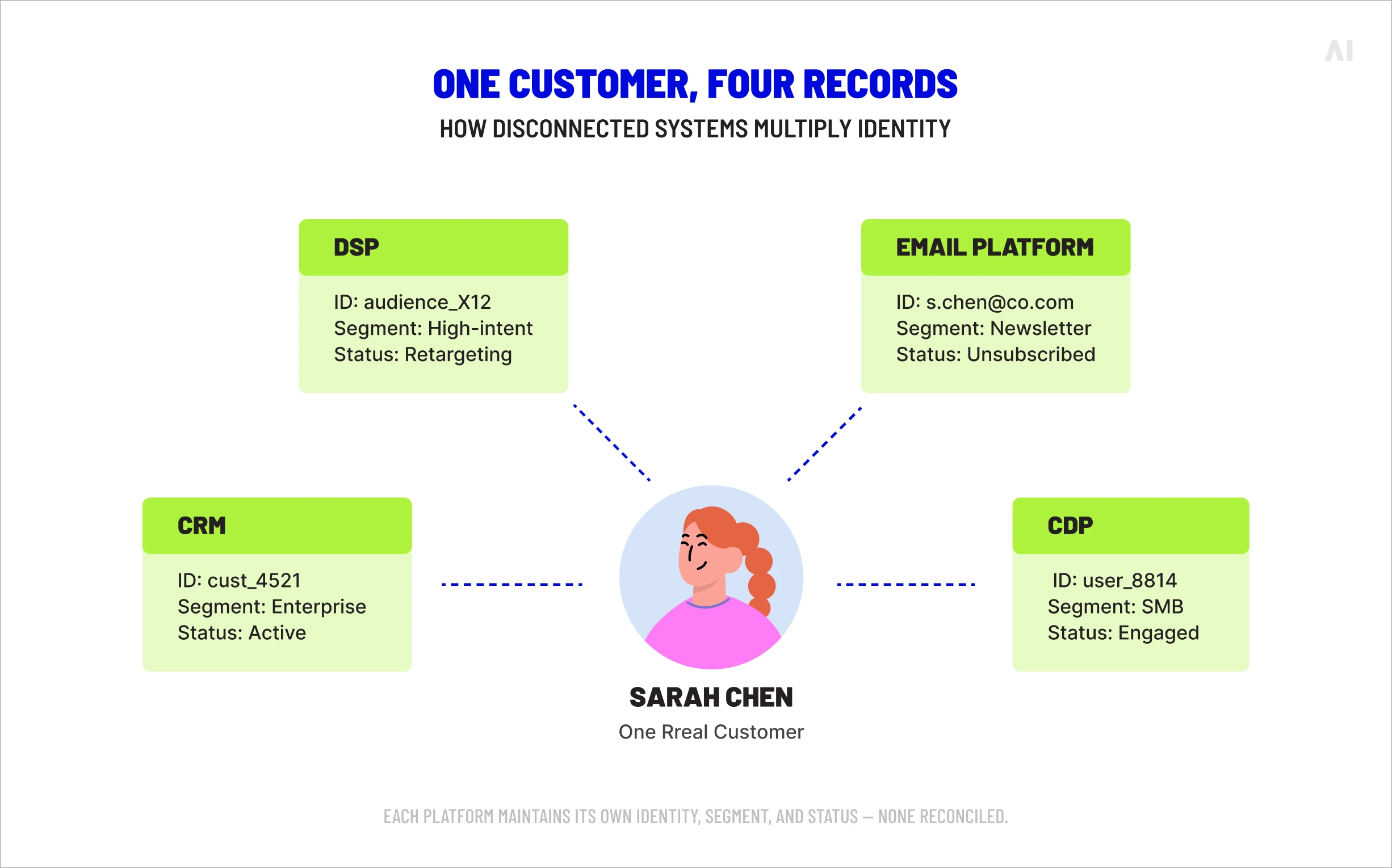
The result reaches the working week in familiar forms: duplicate customer records, adjacent reports that disagree about the same quarter, retargeting campaigns chasing people who unsubscribed months ago because the suppression file never made the trip.
The pattern is unremarkable across enterprise marketing, and the cost of it lives in the places nobody routinely audits.
One customer, four records.
The data side is the most expensive layer of the problem.
HubSpot's most recent State of Marketing data found that 61% of marketers cite integrating data from different sources as a primary obstacle to delivering coherent insight.
MuleSoft's 2025 Connectivity Benchmark put the figure higher for IT leaders specifically: 95% reported that integration issues actively impede AI adoption across the wider organization. AI cannot reason over data it cannot reach. Neither can the people running the campaigns.
Data silos and operational misalignment
The operational symptoms are easier to recognize than the data ones. Two teams report on the same quarter with different numbers. The agency presents a media plan optimized against KPIs that the analytics team has already retired. A pipeline forecast lands in finance two weeks late because someone is reconciling spreadsheets by hand.
Northwestern Medill's 2025 IMC marketers' survey found that 44.7% of marketers now rank cross-team coordination among their top operational concerns — a higher proportion than for any single technology issue.
Misalignment slows the half of marketing that is supposed to be fast. It also costs the half that is supposed to be strategic, because leadership ends up auditing data rather than acting on it.
Writing on the Q1 2026 Forrester Wave for Marketing Measurement and Optimization Services, the lead analyst named the three most common struggles in marketing measurement as a skills shortage, inconsistent data quality, and a lack of internal trust in the outputs — all of which trace back to the underlying infrastructure rather than to any single platform.
The contrast below summarizes how integration affects the work. It is intended to be read top-to-bottom by row.
The reading is straightforward: the gap is mostly procedural. The systems that integrate well are usually the ones whose owners insisted on shared definitions before shared dashboards.
Signs your marketing systems need integration
Most fragmentation is recognized only retrospectively, often after a quarter where something measurable went wrong. The pattern is usually visible earlier. The clearest early signals tend to show up in how the operation actually runs:
Reporting is reconciled rather than read. If weekly performance review involves comparing two reports to identify the discrepancy, the systems beneath them are doing more arguing than informing.
Customer data lives in more than one place by design. A separate identity graph in the CDP, the CRM, and the activation layer is a fragmentation in waiting, not a redundancy.
Audience definitions drift between platforms. A "high-intent" segment in one system does not match the "high-intent" segment in another, and no one can quickly explain why.
Campaign launch requires multiple manual exports. If activating a campaign requires CSV handoffs between tools, the system has not been integrated; it has been stitched.
Performance optimization lags by more than a week. Real performance management runs in days. If the cycle is fortnightly, the system is failing the team running it.
Finance and marketing produce different revenue attributions. No system is fully right here, but two systems that flatly disagree on contribution by channel are not measuring the same business.
Procurement involves five overlapping contracts in adjacent categories. The bigger problem is rarely the contract itself; it is the workflow underneath it.
None of these symptoms individually justifies overhauling an organization's infrastructure. Three or more of them appearing together usually do.
How integrated marketing systems connect data and operations
The structural answer to fragmentation is architectural rather than procurement-led. What it requires is a more honest model of how the existing tools should reference one another.
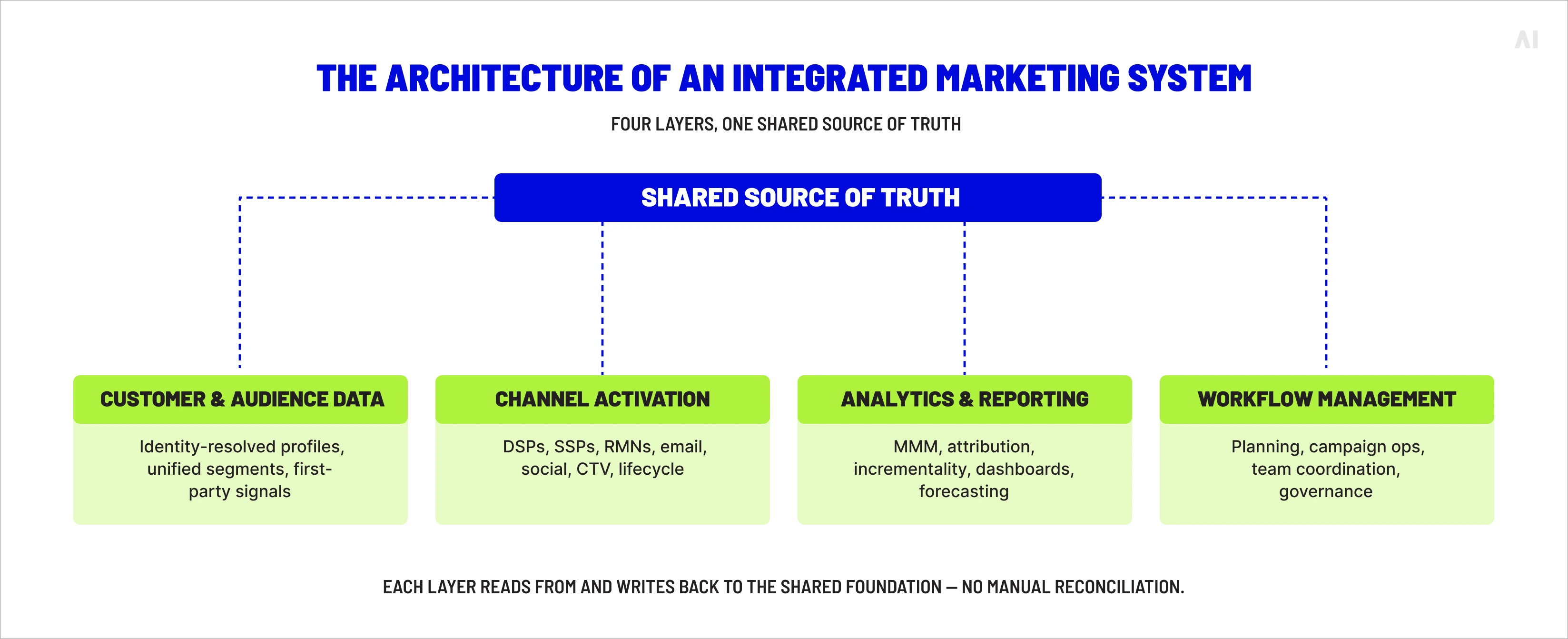
An integrated marketing system connects four operational layers — customer and audience data; activation across channels; analytics and reporting; and campaign and workflow management — into a shared environment in which each layer can see the others and act on what they hold.
The mechanics differ by enterprise, but the consequences are consistent.
Audience segments built against unified customer data flow directly into activation rather than being rebuilt in each platform.
Reporting refers to the same KPIs that planning used.
The finance ledger and the marketing dashboard recognize the same revenue.
Cross-channel performance can be evaluated as a connected system rather than as a series of platform-level reports, each defending itself.
The wider context here is that integrated marketing systems no longer sit inside marketing alone. Forrester's 2026 evaluation of revenue marketing platforms for B2B treated the unification of marketing, sales, and customer data as the central evaluation criterion — a signal that the integration question has now travelled up to the revenue function in the round, rather than living inside a single department.
This has knock-on effects on how organizations buy technology. Where individual point solutions used to compete on feature, the market is now competing on coherence — on whether the next purchase will make the existing infrastructure more, or less, connected.
The same logic now shows up in how serious advertisers think about the activation layer, where open web programmatic execution is being chosen specifically because it keeps the data, planning, and reporting infrastructure portable rather than captured by a single platform.
AI Digital's own framing of this — set out at length in alternatives to the walled garden — is that the operational case for openness is practical, and it begins with integration.
The architecture of an integrated marketing system
Benefits of integrated marketing systems
The benefits of integrated marketing solutions fall into four categories — visibility, measurement, decision speed, and budget efficiency — and each has a clear operational shape.
Better customer and campaign visibility
Visibility is the most immediate gain because it is the most regularly missing.
A unified customer view collapses the duplication that fragmented systems generate by design: the same person appearing as three records, with three preference states, across three platforms.
With shared identity resolution and a shared audience model, segmentation does not have to be re-engineered for each activation, and campaigns do not have to be reconciled retrospectively to find out who they reached.
The follow-on effect is more consistent messaging. The earlier discipline of integrated marketing communications is easier to deliver when the underlying systems agree on who the audience actually is.
Improved cross-channel performance measurement
Performance measurement is the part of marketing most degraded by fragmentation, and the part most improved by integration. Disconnected systems will routinely over-credit whichever channel happens to have the most generous attribution logic.
The reporting layer is where integration delivers its most visible operational gain. Centralized dashboards drawing on a shared data foundation reduce the time between event and analysis from days to hours. Real performance optimization lives in that gap. When the cycle from data refresh to decision can run in a single working session rather than over a fortnight, the people running campaigns spend their time interpreting performance rather than building the report that contains it.
Efficient budget and workflow management
Budget efficiency follows from the other three. Once visibility, measurement, and decision speed are functional, the underlying budget question — where is the next marginal dollar best spent? — becomes answerable. Where it is not answerable, the typical loss is between a fifth and a third of working budget tied up in channels that under-contribute or duplicate spend already running elsewhere.
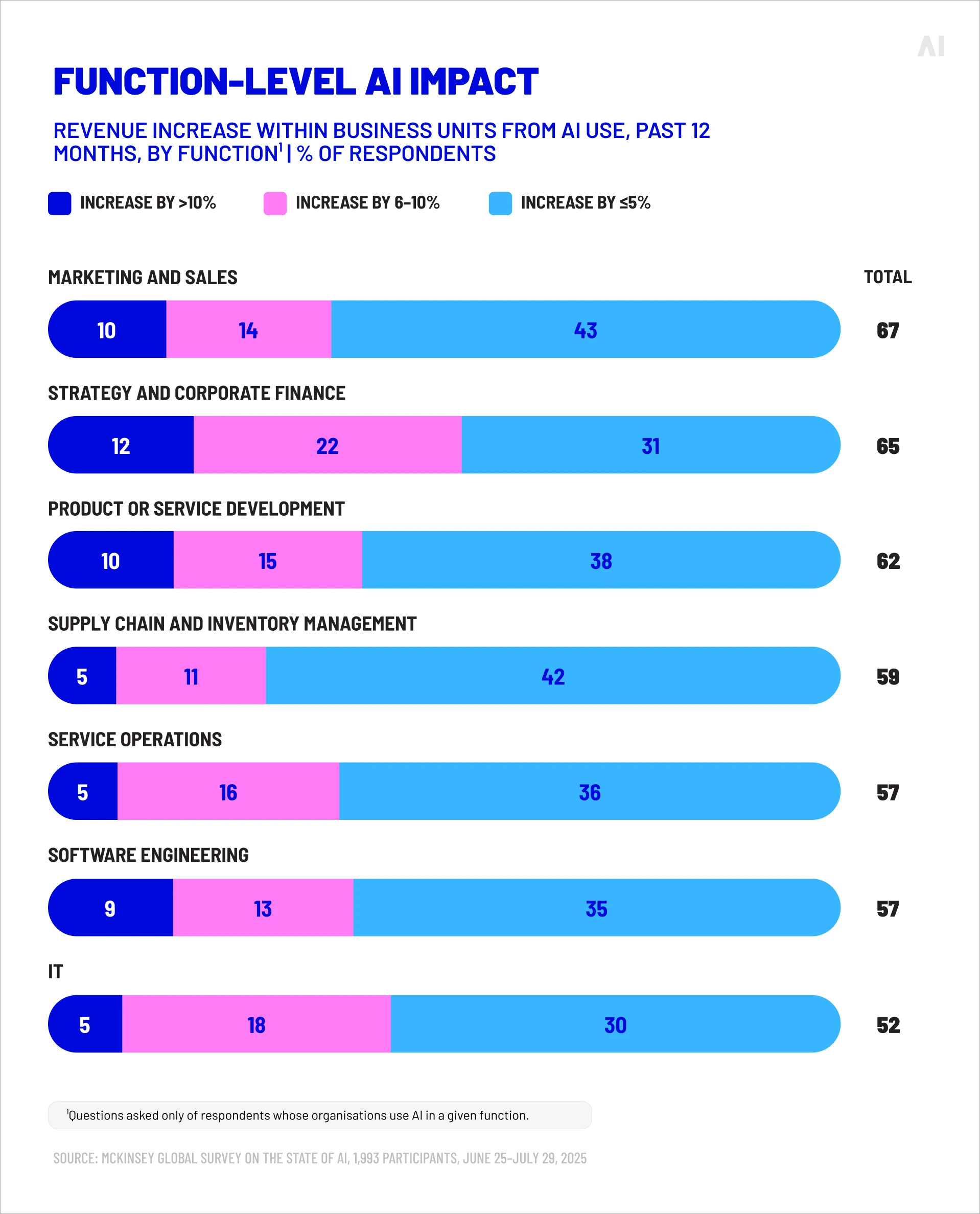
Workflow improvements compound the effect. The Gartner 2025 CMO data found that 22% of CMOs are already using GenAI to reduce reliance on external creative and strategy resources — a productivity gain that depends entirely on the underlying systems being connected enough to give the AI something useful to work with.
How to build an integrated marketing system
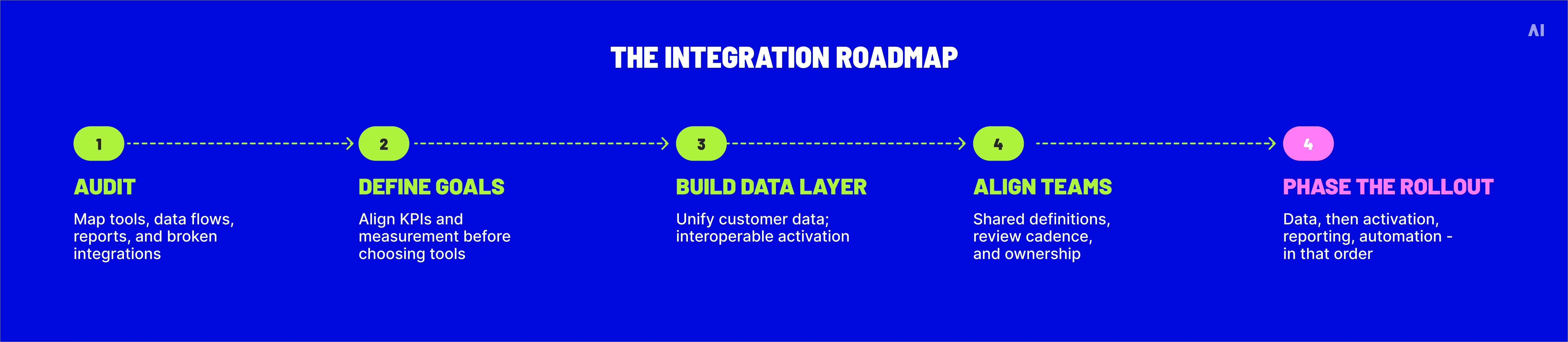
Building an integrated marketing system is mostly a sequencing problem. The order in which decisions are made matters more than the specific products chosen.
Audit your marketing infrastructure
The first move is an honest stock-take. Map the existing tools, the data flows between them, the reports each is responsible for, the integrations that have decayed, and the workflows that exist only in spreadsheets.
The audit is rarely flattering. It almost always identifies tools paid for but unused, integrations that were never built, and reports that nobody reads.
The point of the exercise is to establish a baseline rather than to allocate blame.
Define business goals and measurement frameworks
The second move is to align measurement with business outcomes before selecting any new technology. KPIs that have drifted away from revenue, pipeline, or customer lifetime value are the leading cause of platform sprawl, because each new tool is bought to chase a metric that has already lost its anchor.
A measurement framework that names primary outcomes, secondary diagnostics, and the attribution methodology that connects them is a more useful procurement document than any RFP shortlist.
Build a centralized and interoperable data ecosystem
With goals and measurement defined, the data layer becomes the priority infrastructure investment. Centralized does not mean monolithic: the strongest enterprise architectures combine an identity-resolved customer data foundation with interoperable activation platforms that can read from and write back to it. Open frameworks tend to support this work better than walled ones, because they assume the next purchase will need to plug into the current one.
AI Digital's Open Garden framework is built around that assumption, operating DSP- and vendor-agnostically across 15+ DSPs so that audience data, planning logic, and reporting remain portable across the activation layer rather than being captured by any one platform's environment.
Within that architecture, an intelligence layer makes the difference between unified data and useful data. AI Digital's Elevatesits there: a marketing intelligence platform that unifies research, planning, optimization, and reporting across the digital ecosystem, drawing on 150 billion data points monthly and over 10,000 audience attributes. It pulls campaign planning, audience segmentation, competitive analysis, attribution, and reporting into a single environment, with an AI-assisted media planner built on more than 8,000 historical campaigns across 12+ DSPs. The value here is operational coherence: planning, optimization, and measurement reference the same audience model and the same KPIs, rather than disagreeing across separate environments.
Technology cannot solve a coordination problem on its own. Integrated systems work because the teams using them have agreed, in advance, on shared definitions, shared review cycles, and shared ownership of outputs.
The least successful integration projects are usually the ones where this work is left until after deployment. A weekly review cadence shared across marketing, analytics, and finance is worth more than any reporting layer it relies on.
Implement and optimize incrementally
Few enterprises can replatform marketing operations in one go without absorbing material risk. Phased implementation — beginning with the data layer, then activation, then reporting, then automation — gives the organization time to adjust workflows around each new piece of infrastructure.
Bringing in an integration partner with sector experience usually accelerates this work; AI Digital's managed service exists for exactly that reason, providing media planning, marketing execution, and cross-channel coordination under the same operational logic as the platform layer.
Technologies behind integrated marketing systems
The technology question is, in the end, less interesting than the operational one. Every IMS depends on five technology categories — CRM, customer data platforms, marketing automation, analytics and reporting, and integration infrastructure — and the value of each is determined by how well it talks to the others, not by which vendor logo sits on the contract.
CRM platforms
A CRM platform manages customer relationships, sales pipeline, and lifecycle data: the system of record for who the business is talking to and what it has agreed with them.
In an integrated environment, the CRM functions less as a sales tool than as an organizational source of truth on accounts, contacts, and revenue. When the CRM and marketing systems disagree on identity, every downstream metric becomes negotiable.
Customer Data Platforms (CDPs)
A Customer Data Platform unifies customer data from multiple sources — web, mobile, transactional, offline — into a single, identity-resolved profile that downstream activation tools can read.
The CDP earns its place when it removes the need to maintain duplicate audience definitions across systems. It does not earn its place if it becomes one more siloed identity graph in a stack that already has three.
Marketing automation platforms
Marketing automation handles lead nurture, lifecycle messaging, workflow orchestration, and personalized engagement at scale. Its real strength inside an integrated system is the ability to coordinate cross-channel sequences off the same audience definitions and the same behavioural signals the rest of the stack is reading. Without that shared foundation, automation simply industrializes the same fragmentation it was meant to solve.
Analytics, reporting, and integration infrastructure
Analytics, BI tools, APIs, and middleware are the connective layer most often skimped on and most often regretted. They handle the work of synchronizing data across platforms, building the reporting layer above the data layer, and supporting the forecasting that planning teams now rely on — including the kind of structured demand and channel projections set out in retail forecasting, where integration determines whether the forecast is reliable enough to make commercial decisions against.
The categories below describe what each layer is responsible for and where it earns its keep inside a connected operational environment.
The five layers are not equal in cost, but they are equal in consequence: any one of them missing tends to compromise the others.
Integrated marketing solutions for enterprise and government
Enterprise and public-sector organizations face a version of the integration problem at scale: multiple teams, multiple regions, multiple agencies, multiple regulatory regimes, and a procurement process that struggles with vendor consolidation. The solutions look slightly different in each context.
Enterprise coordination and centralized reporting
In an enterprise context, integrated marketing solutions are mostly a coordination problem dressed as a technology problem. A multinational running campaigns across fifteen markets, six business units, and four agency partners cannot afford to reconcile data manually at the group level. Centralized platforms address this by giving each operating unit local autonomy on activation while reporting up to a shared performance layer above.
Elevate is positioned for this kind of structure: research, planning, optimization, and reporting unified into one intelligence layer, with modules covering audience segmentation, competitive analysis, MMM, path to conversion, cookieless targeting, and AI-assisted planning. The operational value, again, is coherence — group reporting that holds up because everyone built campaigns against the same definitions.
Supply chain and retail media integration
The retail and commerce side of the picture has changed more than most in the last two years. EMARKETER's December 2025 forecast put US retail media ad spend at $60.32 billion in 2025, projected to rise to $71.09 billion in 2026 — a 17.8% year-on-year increase, outpacing both search and social. Forrester's broader forecast puts global retail media on a trajectory from $184 billion in 2025 to $312 billion by 2030.
As that money moves, the operational complexity moves with it: brands now run campaigns across retailer media networks, off-site retailer-data extensions, in-store activations, and connected TV environments that need to be planned, measured, and reconciled together rather than as separate channels.
The principles set out in retail digital marketing apply across all of them: shared audiences, transparent supply paths, and comparable measurement.
Coordinating supply-side activity inside an integrated marketing system requires the same logic as the rest of the stack — clean data in, transparent paths through, comparable measurement out. AI Digital's Smart Supplyoperates at that layer, curating premium ad inventory across 9+ SSPs against KPI-aligned outcomes rather than platform-favoured ones, and removing the bid-stream inflation that fragmented supply paths produce as a side-effect. For brands investing in commerce environments and retail media at scale, that kind of integration is the difference between treating supply as a procurement category and treating it as a managed input to a unified system.
Compliance is now a first-order design consideration for integrated marketing solutions, not a final-stage review. The US Federal Data Strategy, the EU Data Act, and an expanding set of state-level privacy regimes have all moved the locus of governance from a single legal function to the architecture itself. Interoperable ecosystems handle this better than walled ones because they keep the data portable and the consent records auditable.
The Open Garden framework supports that posture: by operating across multiple DSPs and SSPs rather than inside one, it avoids the lock-in that makes regulatory portability difficult, and the transparent supply paths underneath produce the kind of audit trail that procurement and legal teams are increasingly required to deliver on demand.
Public-sector marketing is one of the more demanding integration environments. Federal advertising contract obligations totalled$14.9 billion across the last decade, according to a 2024 US GAO report, and the wider federal contracting market is projected to reach $7.5 trillion by 2027. Federal procurement spending grew 6.5% in the first 100 days of 2025 alone.
Marketing teams operating in this environment have to coordinate outreach across multiple agencies, justify spend against compliance and audit requirements, track opportunity pipelines through long procurement cycles, and prove performance to oversight rather than only to leadership.
Integrated systems support this work by consolidating opportunity tracking, lead intelligence, outreach coordination, and reporting into a single managed environment. AI Digital's managed service is the natural fit for public-sector and procurement-led organizations that need this work coordinated end-to-end: media planning and execution, audience and inventory selection, and cross-channel reporting handled under a single operational logic rather than across five overlapping vendors. The advantage in a regulated environment is less about novel capability than about defensibility — being able to show, in audit, exactly what was bought, where it ran, what it cost, and what it produced.
AI for integrated marketing systems
AI is now embedded in almost every layer of an integrated marketing system, but its real contribution is uneven. It is excellent at pattern recognition, automation, and synthesis; it is poor at causal reasoning and judgement. The strongest implementations treat AI as a productivity multiplier on an already-coherent system rather than as a substitute for the underlying integration. The same principle runs through AI-targeted advertising: the model is only as useful as the data it can see.
AI excels at deriving audience structure from behavioural data — clustering, propensity modelling, persona inference — and at applying that structure consistently across channels. Inside an integrated system, audience segmentation and ads personalization that read from a unified customer data foundation produce segments that are usable everywhere, rather than reproducible only inside the platform that built them.
Predictive models are where AI earns its place in planning. Forecasts of audience reach, engagement, conversion, and revenue contribution can now be generated in minutes rather than days.
The value of those forecasts depends entirely on the quality and breadth of the data underneath them: a forecast built on a single platform's data is a fragment forecast, however sophisticated the model. Integrated systems give predictive AI the breadth it needs to be useful at the planning layer.
Automated campaign coordination
Workflow automation across channels is a less glamorous but more reliable AI application. Lead routing, audience refresh, creative variant rotation, and budget reallocation can all be handled by automation that reads from and writes back to the same shared data foundation.
In programmatic environments specifically, that automation reaches into the real-time bidding layer, where bid logic adjusts continuously against performance signals returned from the wider integrated stack.
The point is to remove the manual reconciliation work that fragmented systems generate, freeing the team to spend its time on what the system is reporting rather than on building the report.
AI-driven optimization and reporting
The optimization and reporting layer is where AI's strengths combine.
Anomaly detection identifies underperformance before a human review would catch it.
Attribution models can be calibrated against incrementality tests automatically.
Reporting can be generated, summarized, and surfaced to the right stakeholder without an analyst preparing it by hand.
None of this is theoretical. It is, however, only as good as the integration beneath it.
The barriers to integration are predictable, and most are organizational rather than technological.
Legacy infrastructure is the most cited. Many enterprises are running marketing systems whose original architecture predates the data they now hold, and whose vendors are reluctant to expose the integration surfaces required to make the system more portable.
Data quality is the second most cited problem — fragmented systems produce inconsistent records by design, and cleaning that record-set is rarely a one-quarter project.
Beyond data and infrastructure, the harder problems are governance and ownership. Integration projects fail more often because nobody owns the cross-platform data contract than because the platforms themselves resist connection.
Reporting standards inconsistencies, KPI drift, and the absence of a strategic plan beyond procurement-led rationalization are recurrent themes.
The 95% of IT leaders who told MuleSoft that integration impedes AI adoption are not all working in organizations with broken APIs; many are working in organizations whose definition of "the customer" has been allowed to vary across departments for so long that no platform can fix it without an upstream decision.
Measurement is where an integrated marketing system either earns its budget or fails its audit. A 2025 Gartner survey of 125 CEOs and CFOs found that just 22% felt they had received significant clarity from their CMO on marketing accountabilities, and only 27% said their CMO's performance had exceeded expectations the previous year. The gap reflects an infrastructure problem more than a performance one — most marketers' systems cannot produce the kind of causal evidence that gives finance the clarity it now demands.
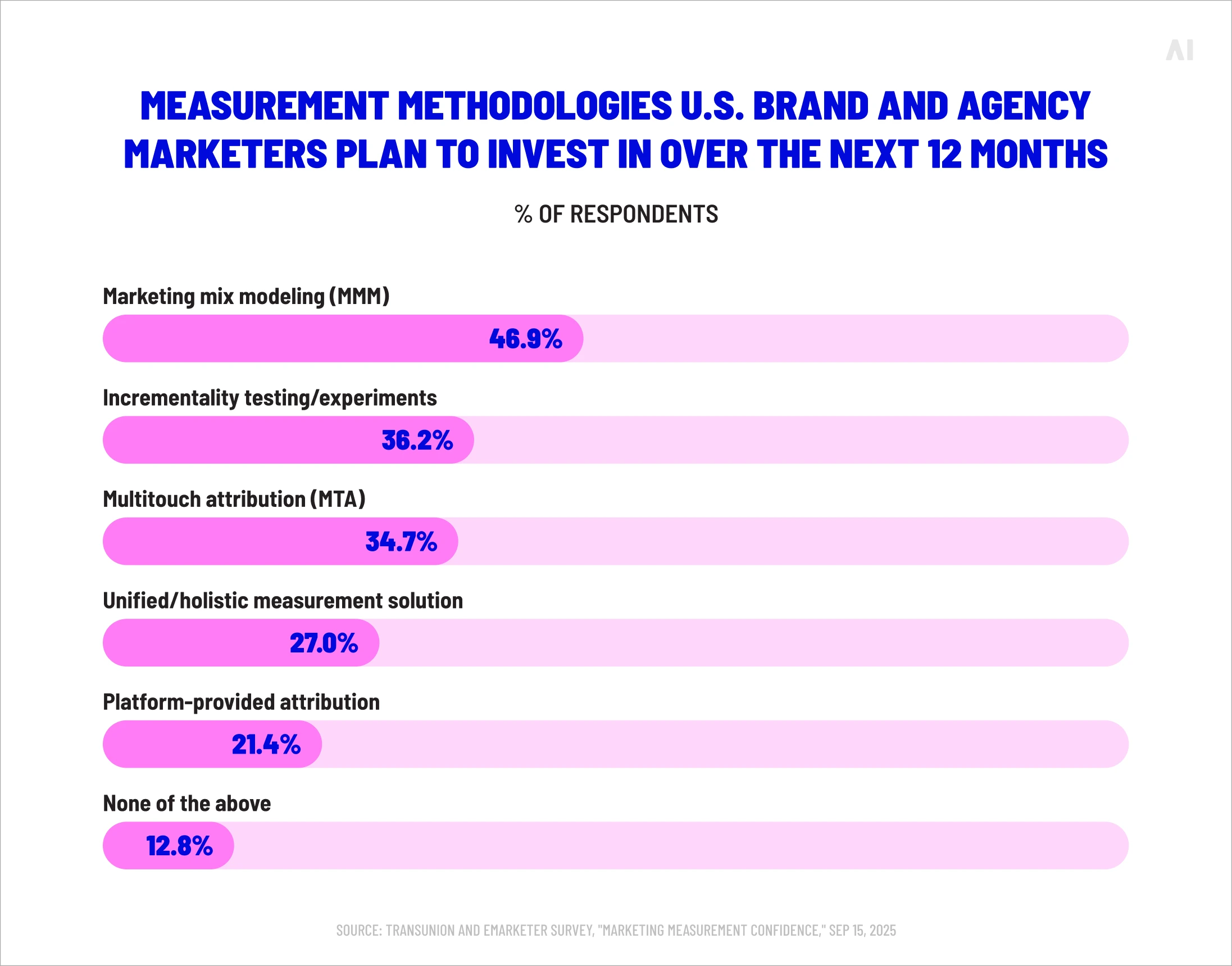
Unified measurement combines marketing mix modelling, multi-touch attribution, and incrementality testing into a single decision framework, with each method correcting for the others' blind spots.
MMMprovides the strategic, finance-credible view of cross-channel contribution including offline media.
Attribution provides the tactical, digital-channel view useful for in-flight optimization.
Incrementality testing acts as the calibration layer that reconciles them. Inside an integrated system, this triangulation runs continuously rather than as a quarterly exercise.
Nearly half of US marketers investing more in MMM (Source)
The broader case for connecting these methods to a single set of digital marketing KPIs — defined once, applied everywhere — is the operational core of the discipline.
The connection back to the platform layer is direct: Elevate's MMM and path-to-conversion modules are designed to sit inside this unified framework, producing the cross-channel attribution view that planning and reporting both rely on. The point is not the individual module. It is that planning, optimization, and measurement reference the same data, the same time grain, and the same KPIs.
The three measurement methods below answer different questions and run on different cadences. The point of unifying them is that no single method, used alone, is sufficient — and the conflicts between them are diagnostically useful.
A unified framework runs all three. Where any two contradict, the discrepancy itself is informative — usually pointing to a tracking gap, an unmodelled lag, or a definitional drift between systems that needs addressing.
Key trends in integrated marketing systems
Four trends now define the direction of enterprise marketing operations, all of them connected to the integration discipline rather than to any particular tool.
The first is the move from fragmented dashboards to unified measurement. The Q1 2026 Forrester Wave recognised providers offering unified measurement at scale, with Forrester describing the leading approach as one in which "most clients do some type of unified modeling" across MMM, attribution, and incrementality. The CFO conversation has changed alongside it: financial leadership is now in the measurement meeting, and is unlikely to leave.
The second is the rise of interoperable, privacy-first data ecosystems. Walled-garden lock-in is being repriced in light of regulatory and AI-readiness requirements. Architectures that keep data portable across platforms — and consent auditable across jurisdictions — are now treated as risk mitigation rather than as ideological preference.
The third is real-time operational analytics. Decision cadences that used to run weekly now run daily, and channels like programmatic and retail media are increasingly being managed in near-real time. The infrastructure required to support those cadences is the integration layer underneath the activation tools, not the activation tools themselves.
The fourth is the absorption of AI into the operating layer of marketing. The wider productivity discussion has moved from should we use AI? to what does AI need from us to be useful? The answer, in nearly every case, is integrated data — clean, identity-resolved,
Build smarter and connected marketing operations
The pattern across all of the above is consistent. Disconnected marketing systems degrade visibility, slow decisions, and hide the connection between marketing activity and business outcomes. Integrated marketing systems — where data, platforms, workflows, and reporting refer to the same shared truth — produce the operational coherence that lets enterprise marketing teams perform like the strategic function leadership now expects them to be.
The organizations now investing in centralized infrastructure, AI-driven optimization, and interoperable ecosystems are building marketing operations that scale, adapt, and explain themselves to finance. The ones that are not are accumulating tools faster than they can connect them, and paying for that mismatch in places that are difficult to attribute and easy to ignore.
If integration is the work in front of your team, AI Digital can help with the parts of it that sit inside the digital marketing layer: cross-channel planning and activation through the Open Garden framework; intelligence and unified reporting through Elevate; supply curation through Smart Supply; and the managed services to coordinate any or all of the above. The wider range of what we do is set out on the site, and the team is reachable through the get-in-touch page.
Blind spot
Key issues
Business impact
AI Digital solution
Lack of transparency in AI models
• Platforms own AI models and train on proprietary data • Brands have little visibility into decision-making • "Walled gardens" restrict data access
• Inefficient ad spend • Limited strategic control • Eroded consumer trust • Potential budget mismanagement
Open Garden framework providing: • Complete transparency • DSP-agnostic execution • Cross-platform data & insights
Optimizing ads vs. optimizing impact
• AI excels at short-term metrics but may struggle with brand building • Consumers can detect AI-generated content • Efficiency might come at cost of authenticity
• Short-term gains at expense of brand health • Potential loss of authentic connection • Reduced effectiveness in storytelling
Smart Supply offering: • Human oversight of AI recommendations • Custom KPI alignment beyond clicks • Brand-safe inventory verification
The illusion of personalization
• Segment optimization rebranded as personalization • First-party data infrastructure challenges • Personalization vs. surveillance concerns
• Potential mismatch between promise and reality • Privacy concerns affecting consumer trust • Cost barriers for smaller businesses
Elevate platform features: • Real-time AI + human intelligence • First-party data activation • Ethical personalization strategies
AI-Driven efficiency vs. decision-making
• AI shifting from tool to decision-maker • Black box optimization like Google Performance Max • Human oversight limitations
• Strategic control loss • Difficulty questioning AI outputs • Inability to measure granular impact • Potential brand damage from mistakes
Managed Service with: • Human strategists overseeing AI • Custom KPI optimization • Complete campaign transparency
Fig. 1. Summary of AI blind spots in advertising
Dimension
Walled garden advantage
Walled garden limitation
Strategic impact
Audience access
Massive, engaged user bases
Limited visibility beyond platform
Reach without understanding
Data control
Sophisticated targeting tools
Data remains siloed within platform
Fragmented customer view
Measurement
Detailed in-platform metrics
Inconsistent cross-platform standards
Difficult performance comparison
Intelligence
Platform-specific insights
Limited data portability
Restricted strategic learning
Optimization
Powerful automated tools
Black-box algorithms
Reduced marketer control
Fig. 2. Strategic trade-offs in walled garden advertising.
Core issue
Platform priority
Walled garden limitation
Real-world example
Attribution opacity
Claiming maximum credit for conversions
Limited visibility into true conversion paths
Meta and TikTok's conflicting attribution models after iOS privacy updates
Data restrictions
Maintaining proprietary data control
Inability to combine platform data with other sources
Amazon DSP's limitations on detailed performance data exports
Cross-channel blindspots
Keeping advertisers within ecosystem
Fragmented view of customer journey
YouTube/DV360 campaigns lacking integration with non-Google platforms
Black box algorithms
Optimizing for platform revenue
Reduced control over campaign execution
Self-serve platforms using opaque ML models with little advertiser input
Performance reporting
Presenting platform in best light
Discrepancies between platform-reported and independently measured results
Consistently higher performance metrics in platform reports vs. third-party measurement
Fig. 1. The Walled garden misalignment: Platform interests vs. advertiser needs.
Key dimension
Challenge
Strategic imperative
ROAS volatility
Softer returns across digital channels
Shift from soft KPIs to measurable revenue impact
Media planning
Static plans no longer effective
Develop agile, modular approaches adaptable to changing conditions
Brand/performance
Traditional division dissolving
Create full-funnel strategies balancing long-term equity with short-term conversion
Capability
Key features
Benefits
Performance data
Elevate forecasting tool
• Vertical-specific insights • Historical data from past economic turbulence • "Cascade planning" functionality • Real-time adaptation
• Provides agility to adjust campaign strategy based on performance • Shows which media channels work best to drive efficient and effective performance • Confident budget reallocation • Reduces reaction time to market shifts
• Dataset from 10,000+ campaigns • Cuts response time from weeks to minutes
• Reaches people most likely to buy • Avoids wasted impressions and budgets on poor-performing placements • Context-aligned messaging
• 25+ billion bid requests analyzed daily • 18% improvement in working media efficiency • 26% increase in engagement during recessions
Full-funnel accountability
• Links awareness campaigns to lower funnel outcomes • Tests if ads actually drive new business • Measures brand perception changes • "Ask Elevate" AI Chat Assistant
• Upper-funnel to outcome connection • Sentiment shift tracking • Personalized messaging • Helps balance immediate sales vs. long-term brand building
• Natural language data queries • True business impact measurement
Open Garden approach
• Cross-platform and channel planning • Not locked into specific platforms • Unified cross-platform reach • Shows exactly where money is spent
• Reduces complexity across channels • Performance-based ad placement • Rapid budget reallocation • Eliminates platform-specific commitments and provides platform-based optimization and agility
• Coverage across all inventory sources • Provides full visibility into spending • Avoids the inability to pivot across platform as you’re not in a singular platform
Fig. 1. How AI Digital helps during economic uncertainty.
Trend
What it means for marketers
Supply & demand lines are blurring
Platforms from Google (P-Max) to Microsoft are merging optimization and inventory in one opaque box. Expect more bundled “best available” media where the algorithm, not the trader, decides channel and publisher mix.
Walled gardens get taller
Microsoft’s O&O set now spans Bing, Xbox, Outlook, Edge and LinkedIn, which just launched revenue-sharing video programs to lure creators and ad dollars. (Business Insider)
Retail & commerce media shape strategy
Microsoft’s Curate lets retailers and data owners package first-party segments, an echo of Amazon’s and Walmart’s approaches. Agencies must master seller-defined audiences as well as buyer-side tactics.
AI oversight becomes critical
Closed AI bidding means fewer levers for traders. Independent verification, incrementality testing and commercial guardrails rise in importance.
Fig. 1. Platform trends and their implications.
Metric
Connected TV (CTV)
Linear TV
Video Completion Rate
94.5%
70%
Purchase Rate After Ad
23%
12%
Ad Attention Rate
57% (prefer CTV ads)
54.5%
Viewer Reach (U.S.)
85% of households
228 million viewers
Retail Media Trends 2025
Access Complete consumer behaviour analyses and competitor benchmarks.
Identify and categorize audience groups based on behaviors, preferences, and characteristics
Michaels Stores: Implemented a genAI platform that increased email personalization from 20% to 95%, leading to a 41% boost in SMS click through rates and a 25% increase in engagement.
Estée Lauder: Partnered with Google Cloud to leverage genAI technologies for real-time consumer feedback monitoring and analyzing consumer sentiment across various channels.
High
Medium
Automated ad campaigns
Automate ad creation, placement, and optimization across various platforms
Showmax: Partnered with AI firms toautomate ad creation and testing, reducing production time by 70% while streamlining their quality assurance process.
Headway: Employed AI tools for ad creation and optimization, boosting performance by 40% and reaching 3.3 billion impressions while incorporating AI-generated content in 20% of their paid campaigns.
High
High
Brand sentiment tracking
Monitor and analyze public opinion about a brand across multiple channels in real time
L’Oréal: Analyzed millions of online comments, images, and videos to identify potential product innovation opportunities, effectively tracking brand sentiment and consumer trends.
Kellogg Company: Used AI to scan trending recipes featuring cereal, leveraging this data to launch targeted social campaigns that capitalize on positive brand sentiment and culinary trends.
High
Low
Campaign strategy optimization
Analyze data to predict optimal campaign approaches, channels, and timing
DoorDash: Leveraged Google’s AI-powered Demand Gen tool, which boosted its conversion rate by 15 times and improved cost per action efficiency by 50% compared with previous campaigns.
Kitsch: Employed Meta’s Advantage+ shopping campaigns with AI-powered tools to optimize campaigns, identifying and delivering top-performing ads to high-value consumers.
High
High
Content strategy
Generate content ideas, predict performance, and optimize distribution strategies
JPMorgan Chase: Collaborated with Persado to develop LLMs for marketing copy, achieving up to 450% higher clickthrough rates compared with human-written ads in pilot tests.
Hotel Chocolat: Employed genAI for concept development and production of its Velvetiser TV ad, which earned the highest-ever System1 score for adomestic appliance commercial.
High
High
Personalization strategy development
Create tailored messaging and experiences for consumers at scale
Stitch Fix: Uses genAI to help stylists interpret customer feedback and provide product recommendations, effectively personalizing shopping experiences.
Instacart: Uses genAI to offer customers personalized recipes, mealplanning ideas, and shopping lists based on individual preferences and habits.
Medium
Medium
Share article
Url copied to clipboard
No items found.
Subscribe to our Newsletter
THANK YOU FOR YOUR SUBSCRIPTION
Oops! Something went wrong while submitting the form.
Questions? We have answers
What are the biggest signs of fragmented marketing infrastructure?
The most reliable signs are operational rather than technological: weekly reporting is reconciled rather than read; the same customer exists as multiple records across systems; audience definitions drift between platforms; campaign launches require manual exports; optimization cycles lag by more than a week; and marketing and finance produce different revenue numbers for the same quarter. Any three of these appearing together usually justify an audit.
Why is first-party data important in integrated marketing systems?
First-party data is the only customer signal an enterprise actually owns and can govern across its systems. Inside an integrated environment, it functions as the identity-resolved foundation that activation, measurement, and reporting all reference. As third-party signals continue to weaken under privacy regulation and cookie deprecation, first-party data has become both an operational asset and a compliance one.
How do integrated systems support cross-channel performance tracking?
By giving every channel a shared reference layer for audiences, KPIs, and attribution methodology. Cross-channel performance tracking fails inside fragmented systems because each platform reports against its own definition of contribution. An integrated system reconciles those views — usually through a unified measurement framework that combines MMM, attribution, and incrementality testing — and treats the residual discrepancies as diagnostic information rather than as noise.
What technologies are required for integrated marketing operations?
The five technology categories most commonly involved are CRM systems, customer data platforms, marketing automation, analytics and BI, and integration infrastructure (APIs, iPaaS, middleware). Activation layers — DSPs, SSPs, retail media networks — sit on top of these. The value of any individual technology is determined by how well it talks to the others, not by which vendor sells it.
How can AI improve marketing system integration and optimization?
AI improves integrated systems most where data is already coherent: audience modelling, predictive forecasting, automated workflow coordination, anomaly detection, and attribution calibration. It performs poorly where data is fragmented, because pattern-recognition over inconsistent records produces inconsistent recommendations. The strongest implementations treat AI as a productivity layer on top of integrated data rather than as a substitute for the underlying integration work.
Why do enterprise and government organizations use integrated marketing systems?
Both face the same problem at scale: multiple teams, multiple regions or agencies, multiple vendors, and a procurement or compliance regime that struggles with fragmentation. Integrated systems consolidate opportunity tracking, outreach coordination, performance reporting, and audit trails into a single environment, which is operationally efficient and — for public-sector and regulated organizations — defensible under audit.
How do interoperable marketing ecosystems improve operational efficiency?
Interoperable ecosystems keep data, audiences, and reporting portable across platforms rather than captured inside any one of them. The efficiency gain is twofold: the team avoids the cost of rebuilding the same audience or report in five places, and the organization retains the flexibility to swap underlying tools without losing the data layer that runs on top of them. In privacy-regulated and AI-ready environments, interoperability is becoming infrastructure rather than ideology.
Have other questions?
If you have more questions, contact us so we can help.
Questions? We have answers
This is some text inside of a div block.
Lorem ipsum dolor sit amet, consectetur adipiscing elit. Suspendisse varius enim in eros elementum tristique. Duis cursus, mi quis viverra ornare, eros dolor interdum nulla, ut commodo diam libero vitae erat. Aenean faucibus nibh et justo cursus id rutrum lorem imperdiet. Nunc ut sem vitae risus tristique posuere.
This is some text inside of a div block.
Lorem ipsum dolor sit amet, consectetur adipiscing elit. Suspendisse varius enim in eros elementum tristique. Duis cursus, mi quis viverra ornare, eros dolor interdum nulla, ut commodo diam libero vitae erat. Aenean faucibus nibh et justo cursus id rutrum lorem imperdiet. Nunc ut sem vitae risus tristique posuere.
This is some text inside of a div block.
Lorem ipsum dolor sit amet, consectetur adipiscing elit. Suspendisse varius enim in eros elementum tristique. Duis cursus, mi quis viverra ornare, eros dolor interdum nulla, ut commodo diam libero vitae erat. Aenean faucibus nibh et justo cursus id rutrum lorem imperdiet. Nunc ut sem vitae risus tristique posuere.
This is some text inside of a div block.
Lorem ipsum dolor sit amet, consectetur adipiscing elit. Suspendisse varius enim in eros elementum tristique. Duis cursus, mi quis viverra ornare, eros dolor interdum nulla, ut commodo diam libero vitae erat. Aenean faucibus nibh et justo cursus id rutrum lorem imperdiet. Nunc ut sem vitae risus tristique posuere.
This is some text inside of a div block.
Lorem ipsum dolor sit amet, consectetur adipiscing elit. Suspendisse varius enim in eros elementum tristique. Duis cursus, mi quis viverra ornare, eros dolor interdum nulla, ut commodo diam libero vitae erat. Aenean faucibus nibh et justo cursus id rutrum lorem imperdiet. Nunc ut sem vitae risus tristique posuere.
This is some text inside of a div block.
Lorem ipsum dolor sit amet, consectetur adipiscing elit. Suspendisse varius enim in eros elementum tristique. Duis cursus, mi quis viverra ornare, eros dolor interdum nulla, ut commodo diam libero vitae erat. Aenean faucibus nibh et justo cursus id rutrum lorem imperdiet. Nunc ut sem vitae risus tristique posuere.
This is some text inside of a div block.
Lorem ipsum dolor sit amet, consectetur adipiscing elit. Suspendisse varius enim in eros elementum tristique. Duis cursus, mi quis viverra ornare, eros dolor interdum nulla, ut commodo diam libero vitae erat. Aenean faucibus nibh et justo cursus id rutrum lorem imperdiet. Nunc ut sem vitae risus tristique posuere.

.svg)
.svg)