Marketing Intelligence Platforms: From Data to Decisions to Performance
Sarah Moss
May 25, 2026
10
minutes read
Marketing teams have never had more data, yet making confident decisions with it has rarely felt harder. This article examines what marketing intelligence platforms are, how they work, and how to use them to turn fragmented data into decisions that move business performance.
Just 26% of marketing leaders say they are completely satisfied with how well their data sources are unified, according to Salesforce's tenth State of Marketing report. The same research found that 75% of marketers have already adopted AI—yet 84% admit to running generic campaigns. Set against Gartner's 2025 CMO Spend Survey—marketing budgets flat at 7.7% of revenue, with 59% of CMOs reporting their share is already insufficient to execute strategy—the operational picture sharpens. Performance teams are being asked to do more, on flat budgets, against data that does not cohere.
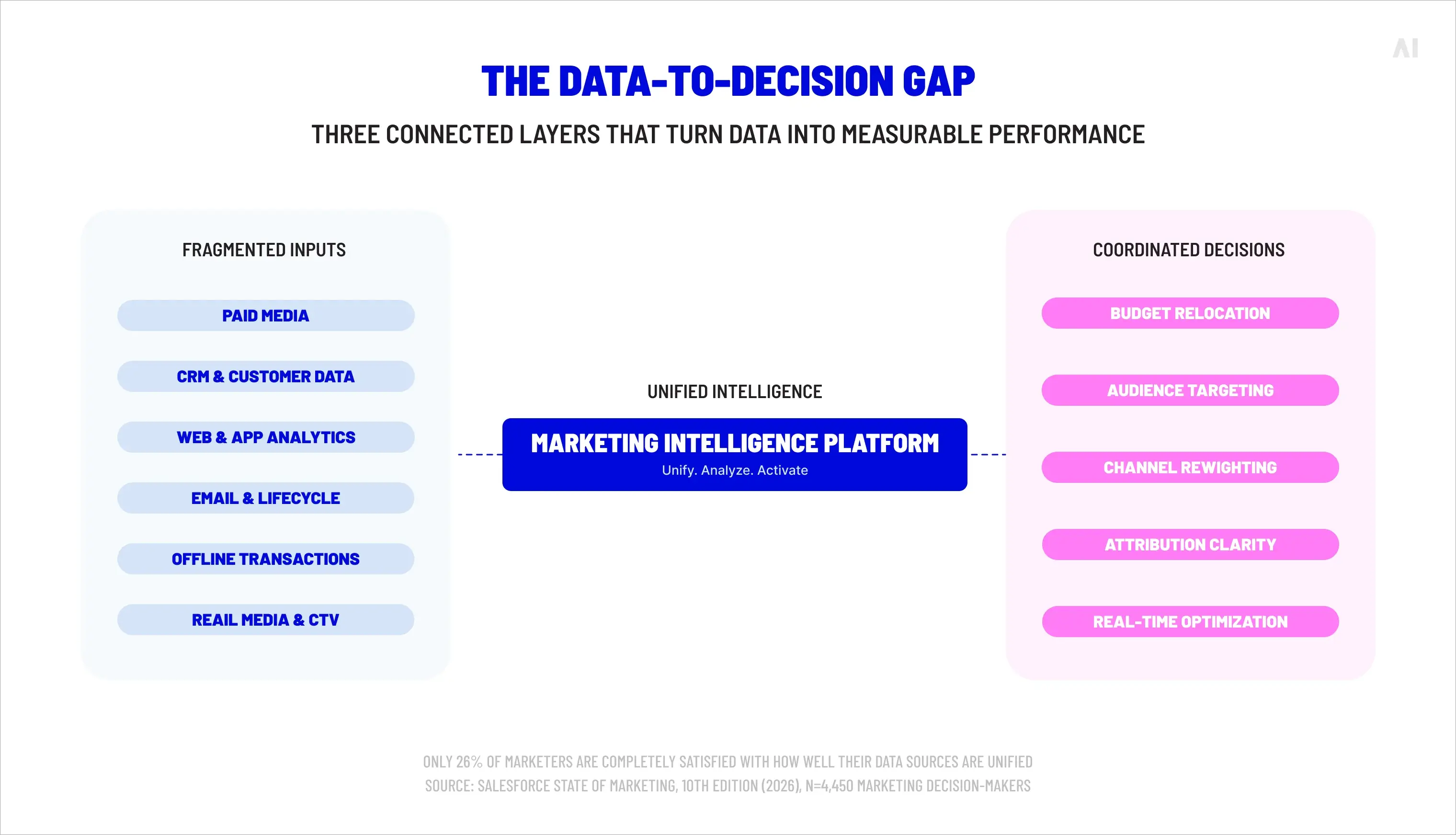
The cost of that incoherence shows up where budget reviews scrutinize most: paid media bought against partial signal, audiences segmented from incomplete profiles, attribution models that quietly over-credit whichever channel happens to fire last. Performance leaders are not short of dashboards. They are short of a structured way to convert what is in those dashboards into the next budget decision, the next creative test, the next channel reweighting. That gap—between data that exists and decisions it can support—is where marketing intelligence platforms come in.
A marketing intelligence platform unifies disparate marketing data, applies AI and analytics across it, and links the resulting insight directly to action. Unlike legacy analytics or BI tools, which mostly look backward, these platforms are designed to inform what to do next and, increasingly, to execute it automatically. For marketers running budgets across channels, attribution layers, and walled-garden inventory, the difference between the right platform and the wrong one is the difference between reacting to last quarter's results and adjusting this quarter's plan in time to matter.
Marketing planning and measurement by the numbers (Source)
What is a marketing intelligence platform (and why traditional analytics falls short)?
A marketing intelligence platform is a system that collects, unifies, analyzes, and activates marketing data to improve decisions and performance. It sits above the operational tools—DSPs, ad platforms, CRM, CDPs, web analytics, offline data—and turns the signal those tools generate into a coordinated view of what is working, what is not, and where to direct the next dollar.
The data-to-decision gap
The distinction from older marketing analytics tools matters because the two categories are often confused.
Marketing analytics platforms describe what happened: clicks, sessions, conversions, ROAS by channel, broken out across whichever cuts the dashboard supports. They are reporting layers.
A marketing intelligence platform is closer to a decision layer. It takes the same underlying data, cleans it, joins it across channels, runs predictive and prescriptive models against it, and surfaces decisions—not just descriptions.
Traditional dashboards struggle with three problems modern marketing has made unavoidable.
The first is latency: by the time a weekly report is built, the campaigns it describes are already two weeks into their flight.
The second is fragmentation: each platform reports its own truth, in its own taxonomy, on its own cadence.
The third is interpretability: even when the data is timely and joined, most teams lack the analytical capacity to act on it before the next standup.
AI-driven intelligence platforms attempt to solve all three at once.
The shift is not cosmetic. Gartner's 2025 spend research found that the top productivity actions CMOs are taking are leveraging data and analytics to optimize performance and using technology—particularly AI—to automate key tasks.
The platforms that combine those two capabilities are doing the heaviest lifting in 2025 and 2026 marketing stacks.
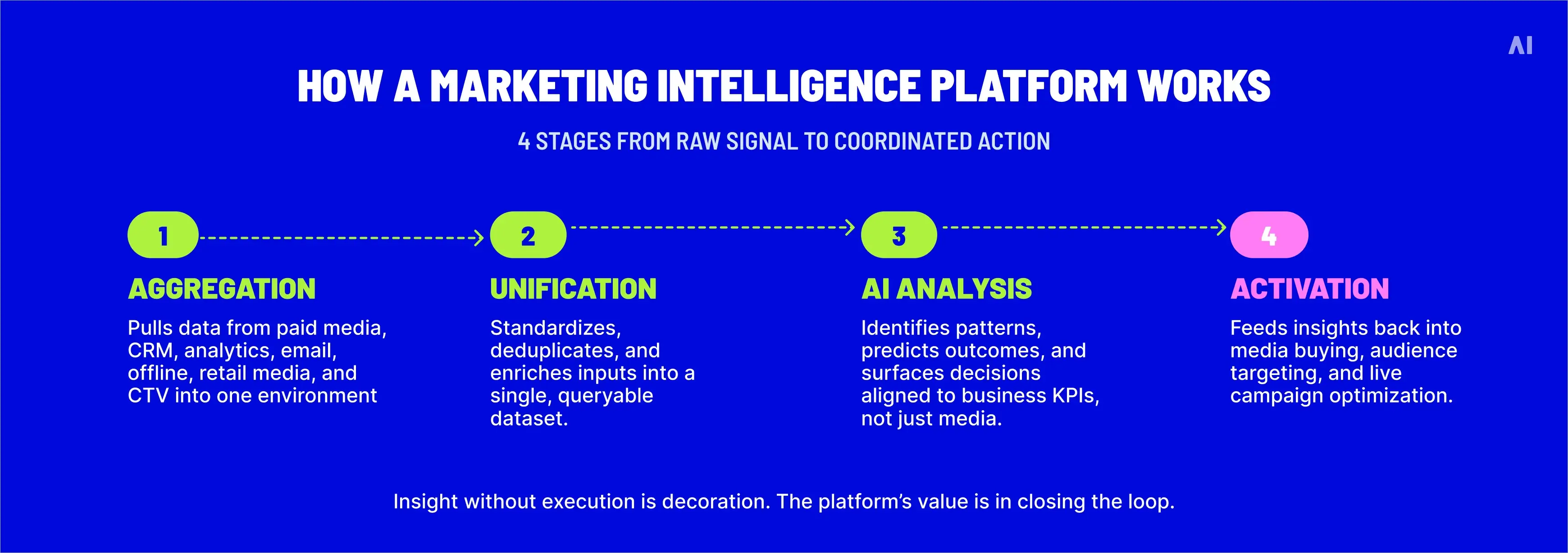
The mechanics of a marketing intelligence platform tend to follow four stages: aggregation, unification, AI-driven analysis, and activation. The difference between buying a tool and using one is understanding each.
How a marketing intelligence platform works: four stages
Data aggregation across channels
A platform's value begins with breadth. Marketing data sits scattered across paid media platforms (Meta, Google, TikTok, DSPs), web and app analytics, CRM and customer service systems, email and lifecycle tools, offline transaction data, and increasingly, retail media and CTV reporting.
A marketing intelligence platform pulls these inputs into a single environment via prebuilt connectors, APIs, and direct integrations with data warehouses.
The aim is not to centralize everything for the sake of it, but to remove the manual workflow of stitching reports together—and the errors that workflow generates.
Data unification and enrichment
Aggregated data is rarely clean data. Different platforms label the same campaigns differently. Audience segments duplicate across tools. Conversion events fire inconsistently. Unification is where raw inputs are standardized, deduplicated, and reconciled into a single, queryable dataset. Enrichment layers on third-party context—household income, lifestyle attributes, intent signals—that turn rows of behavioral data into something a strategist can plan against.
According to Salesforce's 2026 research, high-performing marketers are 2.4 times more likely than their peers to have unified their data sources.
AI-driven analysis and prediction
Once data is clean and connected, AI takes over the heavy interpretive work. Pattern recognition identifies which audiences, creatives, and channels are driving incremental outcomes. Predictive models forecast what will happen if budgets shift, what conversion rates a new audience is likely to deliver, and where saturation is starting to bite into returns. The move is from describing what occurred to recommending what to do next.
AI Digital's Elevate is one example of how this layer is being built in practice. The platform draws on more than 150 billion data points monthly and 10,000-plus audience attributes to generate audience segments, personas, and competitive analyses, which then feed directly into media planning. Its AI-Assisted Media Planner has been trained on 8,000-plus historical campaigns across 12-plus DSPs—turning what was once a strategist's manual exercise into a structured, scenario-tested first draft.
Insight without execution is decoration. The final stage of a marketing intelligence platform is closing the loop—taking the recommendations the AI surfaces and applying them to live campaigns. That can mean reallocating budget across channels, adjusting bid strategies, refreshing audience segments, or filtering out inventory the data says is underperforming.
AI Digital's Smart Supply illustrates the execution side. Operating as a supply-side intelligence layer rather than a media vendor, it filters and optimizes inventory across nine-plus SSPs, applies AI-driven supply path optimization to remove unnecessary bid hops that inflate CPMs, and ensures media dollars work harder against the KPIs the brand actually cares about. It is a working example of what activation looks like when intelligence is wired directly to execution rather than left in a dashboard.
Core Features of a Marketing Intelligence Platform
The mechanics matter, but features are where intelligence platforms compete in practice. Six capabilities, in particular, separate a platform that drives performance from one that just centralizes the dashboards that already exist. Each is also a stress test of the platform's underlying integration model—because none of them work if the data layer beneath is closed, biased toward owned inventory, or limited to a single platform's view of the world.
That cross-platform substrate is the structural prerequisite. AI Digital's Open Garden framework is one model for how it gets built: a DSP-agnostic operating philosophy that connects 15-plus DSPs and unifies cross-channel performance into a single neutral environment, rather than routing decisions through any one platform's preferred inventory. Without that kind of integration layer, the features below tend to deliver inside walled gardens but break across them.
Unified data management
A unified data layer is the foundation. The platform pulls in data from paid media, organic search, CRM, web and app analytics, email, offline transactions, and external enrichment sources, then standardizes the schemas, harmonizes naming conventions, and resolves identities across systems. Cleaner reporting is the obvious benefit. The deeper one is that every downstream feature—from attribution to prediction—runs on the same reconciled dataset. The above-mentioned Salesforce's report found that high-performing marketers are 2.8 times more likely than peers to use customer data to create relevant experiences. Unification is what makes that possible at scale.
Cross-channel performance analytics
Once data is unified, the platform can compare performance across channels on a like-for-like basis: which campaigns drive incremental revenue, which audiences convert profitably across touchpoints, which placements deliver versus inflate spend.
That comparison is harder than it sounds. Each channel reports in its own currency—view-through conversions, click-throughs, attributed revenue, brand lift—and a marketing intelligence platform's job is to translate those into a common performance language so a CMO can see, at a glance, where the next dollar should go.
Attribution and measurement
Attribution is where most measurement systems fail quietly. Nielsen's 2025 Annual Marketing Report, based on responses from 1,400 global marketing professionals, found that only 32% of marketers measure their media spending holistically across digital and traditional channels. The result is overlap, double-counting, and systematically miscalibrated budgets.
Modern intelligence platforms address this by combining multi-touch attribution with marketing mix modeling and incrementality testing, then reconciling the three. The IAB published its Modernizing MMM Best Practices guide in December 2025, framing MMM as essential for measurement under signal loss and fragmented media delivery.
Predictive analytics and forecasting
The shift from reactive to proactive marketing turns on prediction. Platforms now apply machine learning to historical performance data to forecast which audiences will likely respond to a creative, what budgets will yield against a target ROAS, and where channel saturation is approaching diminishing returns.
The output is not a guarantee but a structured probability—one that lets teams test scenarios before committing budget. That alone changes the rhythm of planning meetings, where the question moves from what happened last month to what is most likely to work next.
Reporting that lags by a week is reporting against decisions that have already been made. Modern platforms provide near-real-time visibility into how campaigns are pacing, which creatives are wearing out, which audiences are softening, and which channels are over- or under-delivering.
The point is not the dashboard itself but the compression of the lag between data arriving and decisions being made—from weeks to hours.
For teams managing seven-figure flights, that compression is where ROI improvements actually accumulate.
The final layer is automation: the platform doesn't just recommend—it acts. Budget pacing adjusts mid-flight, audience segments are refreshed against incoming behavioral data, bids are recalibrated against changing inventory pricing, and creatives are rotated based on early engagement signals. Human strategists set the rules, define the KPIs, and review the outputs—but the operational tempo runs faster than any team could match manually. This is where the productivity gains Gartner's research highlights—49% of CMOs citing time efficiency from generative AI, 40% citing cost efficiency—actually show up.
❝❞ With limited funds, marketing leaders are boosting productivity in order to drive growth. CMOs are leveraging data analytics and technology, particularly AI, in order to squeeze more from static budgets. — Ewan McIntyre, VP Analyst and Chief of Research, Gartner Marketing Practice (Source).
Types of Marketing Intelligence Platforms
Marketing intelligence is a category, not a single product. Different platforms specialize in different parts of the customer-and-campaign lifecycle, and the right one—or the right combination—depends on which problems are loudest in a given marketing operation. Four categories cover most of what marketers will encounter when shortlisting vendors.
Customer intelligence platforms (CDPs and lifecycle tools)
Customer data platforms (CDPs) and lifecycle marketing tools sit closest to first-party customer data. They unify identities across web, app, email, and offline interactions, build complete customer profiles, and feed segmentation engines that power lifecycle marketing—onboarding, retention, win-back, loyalty.
The strongest examples translate raw customer data into named segments that can be activated across paid media and owned channels alike. Buyers tend to be retail, ecommerce, financial services, and DTC brands with rich first-party data and a strong retention focus.
Advertising and media intelligence platforms
This category sits closest to paid media. Advertising and media intelligence platforms unify performance data across DSPs, ad networks, walled gardens, and direct buys, then optimize budget, targeting, and inventory selection across them.
The best examples are DSP-agnostic—meaning they don't favor inventory from any one platform—and combine planning, buying, and reporting into a single workflow. Buyers tend to be brands and agencies running large multi-channel paid programs where cross-platform comparability is the operational pain point.
Competitive and market intelligence tools
Competitive and market intelligence platforms look outward rather than inward. They monitor competitor campaigns, ad creative, spend levels, share of voice, audience overlap, and category trends.
Used well, they shorten the cycle between a competitor's move and a brand's response, and provide context that internal performance data alone cannot supply.
Used badly, they become reporting tools that surface interesting facts no one acts on.
The discipline is treating competitive insight as a strategic input, not a curiosity.
Product and behavioral analytics platforms analyze user behavior inside digital products—websites, apps, in-product flows. They map journeys, identify friction points, and quantify conversion rate impact at the level of feature, page, or step.
While historically owned by product teams, the strongest marketing operations now treat behavioral analytics as part of the marketing intelligence stack—because acquisition signal is often weakest where post-click behavior is least understood.
In practice, larger marketing operations rarely use just one. The strongest marketing intelligence solutions stack categories: a retail brand might run a CDP for first-party data, an advertising intelligence platform for paid media planning, and a behavioral analytics tool for site optimization—all feeding into a unified reporting layer.
The integration question matters more than the category question: how cleanly the chosen platforms talk to each other determines whether they add up to anything more than separate logins.
Business Benefits of Marketing Intelligence Platforms
The business case for a marketing intelligence platform is not abstract. It shows up in four places budget reviews actually care about: revenue earned, dollars saved, decision speed, and how easily the marketing organization can scale without proportional headcount. Five concrete benefits drive most of the ROI conversations in 2026.
Improve ROI with data-driven optimization
The simplest argument for a marketing intelligence platform is that the same media budget produces better results.
Unified data exposes which channels, audiences, and creatives drive incremental outcomes—and which produce activity that looks impressive in platform reporting but does not move revenue. Continuous optimization, run against a single reconciled dataset rather than against each platform's self-reported numbers, compounds over a campaign cycle.
For brands operating on flat budgets through 2025 and 2026, the difference between a 3.2x and a 4.1x ROAS is not a rounding error—it is what makes next year's budget defensible.
MMM ranked the most reliable measurement methodology (Source)
Cut wasted ad spend
Programmatic advertising leaks money in places most marketing teams do not see.
Bid stream recycling routes a $25 CPM through multiple SSPs before reaching a buyer, inflating the price to $34 or higher with no improvement in inventory quality. Low-viewability inventory absorbs impressions that never load. Fraudulent or invalid traffic charges for engagement that never happens. A marketing intelligence platform identifies these inefficiencies and routes around them.
AI Digital's Smart Supply is one example of how this works at the activation layer. By filtering inventory across nine-plus SSPs through AI-driven supply path optimization, removing indirect bid hops, and applying invalid-traffic protection before impressions are bought, it ensures media dollars reach inventory that actually performs against the brand's KPI—rather than inventory that performs against the SSP's revenue line. The waste cut here is not marginal. It is often the fastest path to improved ROAS without spending another dollar.
Make faster marketing decisions
Speed compounds in marketing. A team that can shift budget within hours of seeing performance data outperforms a team running the same campaigns but reading reports a week late—even when both have access to the same intelligence. Marketing intelligence platforms compress the loop between data arriving and decisions being executed, turning insight into action within the same cycle the campaign is still live.
AI Digital's Elevate is built around that compression:
The Path to Conversion module visualizes which touchpoints actually influenced a conversion, not just the last click;
The Marketing Mix Modeling solution provides cross-channel budget guidance through a clean interface rather than the multi-month engagement traditional MMM consultancies require.
The "Ask Elevate" conversational AI assistant lets strategists query campaign performance in plain language and receive answers within seconds—the kind of latency reduction that changes whether a meeting ends with a decision or a follow-up.
Optimize performance across all marketing channels
Channel-by-channel optimization tends to produce channel-by-channel local maxima—and a global suboptimum. A platform that compares paid social against CTV against retail media against search on the same outcome metric, rather than each on its native vanity metrics, lets teams reallocate against the channel actually delivering at the margin.
Brand investment can be defended on incrementality data; performance budgets can be redirected before saturation eats the next dollar. The unified view is the prerequisite; the action is reweighting.
Scale marketing without complexity
The fifth benefit is structural. Marketing operations running more campaigns, in more markets, against more audience segments tend to add headcount in proportion.
A marketing intelligence platform breaks that proportionality.
Automated reporting that took analysts a week to build runs continuously.
Audience segments that took strategists days to define are generated in minutes.
AI-assisted media planning evaluates 100,000-plus placements against a campaign brief and returns a structured first draft.
None of this removes the strategist—but it removes the operational drag that previously capped how much one strategist could meaningfully oversee.
How to choose the right marketing intelligence platform
Choosing a marketing intelligence platform is less about feature checklists than about matching capability to the specific problems a marketing operation is trying to solve.
A useful evaluation framework starts not with the platform but with the decisions the platform will need to support—budget reallocation across channels, audience expansion, attribution clarity, faster reporting cycles, or all of the above—and works backward from there.
Five questions tend to separate a strong shortlist from a thorough one.
First: how many of the data sources the marketing team actually uses can the platform integrate cleanly, without months of custom engineering?
Second: does the analytics layer go beyond reporting into recommendation and prediction—and how is that intelligence surfaced to the people making decisions?
Third: how does activation work—does the platform feed insights back into media buying and campaign management automatically, or does the loop close manually somewhere?
Fourth: how does the vendor handle bias—is the platform DSP-agnostic and inventory-neutral, or does its commercial model favor particular routes to media?
And fifth: what does total cost of ownership look like at scale, including the integration work, the team time, and the ongoing optimization most platforms quietly require?
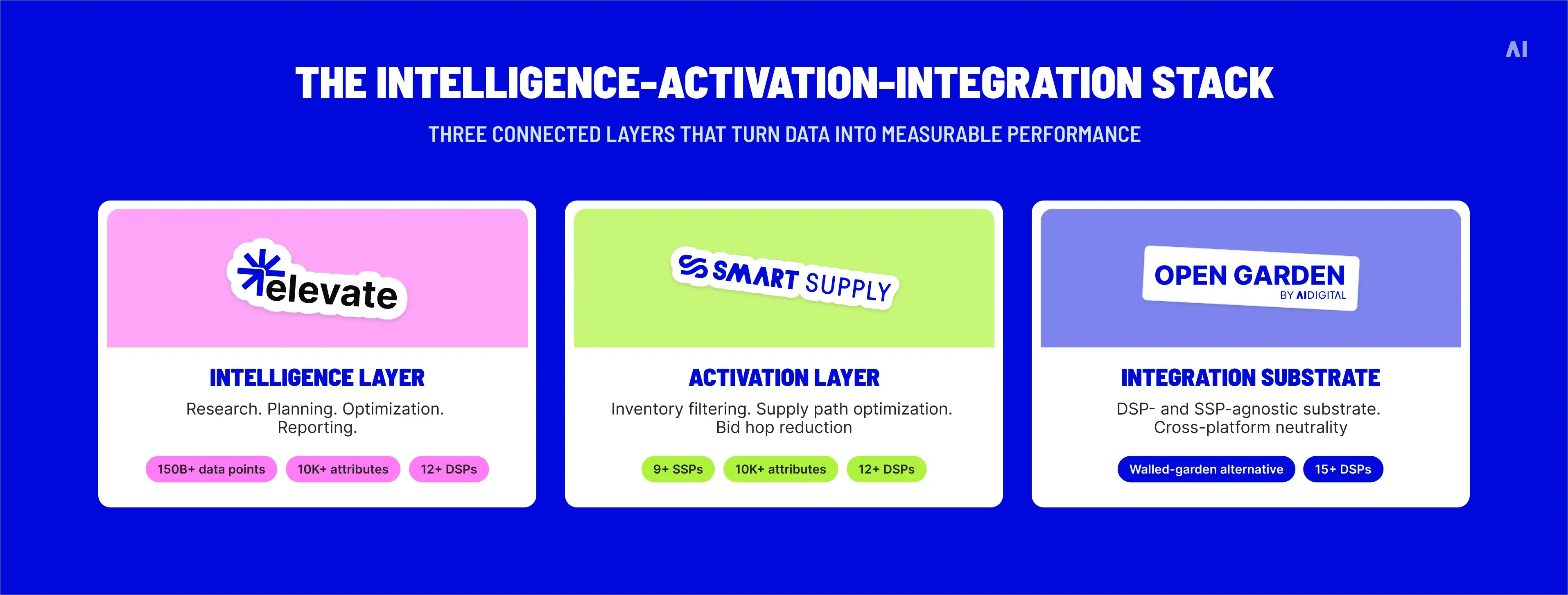
AI Digital approaches this question by aligning platform capabilities with measurable business outcomes rather than feature surface area. The combination of Elevate's intelligence layer, Smart Supply's activation layer, and the Open Garden framework's neutral integration substrate is designed to operate as a connected system—research, planning, optimization, and reporting under one decision architecture, with execution wired directly into the media stack.
⚡ The strongest marketing intelligence platforms are the ones whose features add up to a workflow a marketing team can actually run.
How marketing teams turn insights into performance
Owning a marketing intelligence platform and using one are different things. The platforms that justify their cost are those whose insights show up in budget decisions, campaign briefs, and executive reviews—not those whose dashboards remain bookmarked but unread. Five practical applications drive most of the measurable performance gains marketing teams report in 2026, each with a familiar failure mode worth naming.
Budget allocation and media optimization
The most common ROI lever is reweighting spend toward channels and campaigns proven to drive incremental outcomes. A marketing intelligence platform analyzes performance across the full media mix, identifies where saturation is starting to bite, and recommends reallocations against the relevant business KPI.
The familiar mistake is allocating from fragmented data — making confident reweighting decisions on top of channel reports that do not reconcile to each other, often producing optimizations that look right per-channel and wrong in aggregate. Unified data makes the difference between optimization and educated guessing.
Connected customer data turns generic campaigns into segmented ones, and segmented campaigns into individually relevant ones. Salesforce's research has documented widespread AI adoption alongside persistent personalization gaps—a pattern that almost always traces back to data fragmentation rather than a personalization technology shortfall.
The mistake worth avoiding is investing in personalization tools before the underlying customer data has been unified. The most expensive personalization engine in the world produces generic output when fed disconnected inputs.
Cross-channel campaign performance improvement
A unified view of cross-channel performance changes which questions teams can answer. Instead of "how did paid social perform last quarter," the question becomes "which combination of paid social, CTV, and retail media drove incremental revenue, and at what budget weighting."
The mistake is optimizing isolated metrics—completion rates on CTV, CTRs on paid social—rather than the cross-channel outcome the metrics are supposed to feed. Native dashboards reward channel-local optimization. Marketing intelligence platforms reward outcome-aligned optimization.
External signal—competitor spend, share of voice, category trends, ad creative shifts—gives internal performance data context. A campaign that looks underperforming against last quarter may be performing perfectly well against a category that has tripled in advertising volume.
The mistake is treating competitive intelligence as a reporting layer rather than an input to strategy. Insights that do not change a brief or a budget are entertainment, not intelligence.
Implementation and scaling challenges
The final practical reality is that platforms do not deliver value automatically on activation. Scaling marketing intelligence across an organization requires data hygiene, integration discipline, defined ownership, and ongoing optimization—much of which sits outside the platform itself.
The mistake is underestimating the operating model required to keep the platform performant. Vendors who pitch implementation as a one-time project tend to deliver one-time results.
The combination of AI Digital's Elevate, Smart Supply, and the Open Garden framework is one example of how these challenges get addressed as a connected system.
Elevate handles the intelligence layer—research, planning, optimization, and reporting against unified data.
Smart Supply operationalizes the insights at the activation layer, ensuring media dollars reach inventory that actually performs.
The Open Garden framework provides the integration substrate underneath, keeping data flow and inventory access neutral across 15-plus DSPs and nine-plus SSPs rather than routed through any one platform's preferences.
Buying a marketing intelligence platform is a multi-quarter commitment, not a quarter-end purchase. The realistic question for a CMO is not whether the platform looks capable in a demo but what it will take to make it operational, what the all-in cost actually is, and how long until it produces returns the budget process can defend. Three areas tend to surprise marketing teams implementing one for the first time.
Implementation timeline and resources
Timelines vary by integration depth.
A lightweight deployment—connecting a handful of channels to a unified reporting layer—can be live in four to eight weeks.
A mid-complexity implementation, with CRM integration, identity resolution, and a customized attribution model, typically runs two to four months.
Enterprise deployments involving data warehouse integration, full marketing mix modeling, governance frameworks, and multi-market scope often span four to nine months and continue iterating after launch.
Beyond the platform itself, three resources determine whether implementation succeeds: clean source data (or a credible plan to get there), a defined owner inside the marketing organization, and a willingness to revisit measurement frameworks rather than port the old ones unchanged. Vendors handle the technical lift. The operating-model decisions sit with the buyer.
Cost factors and pricing models
Total cost of ownership extends well beyond licensing. Data volume, the number of integrations, the depth of AI and analytics capability, professional services for implementation, and ongoing optimization support all factor into the actual annual spend.
Marketing intelligence software is typically priced under one of three models: subscription pricing tied to user seats or feature tiers, usage-based pricing tied to data volume or impressions analyzed, and custom enterprise contracts that bundle platform access with managed services.
The structurally important number is not the headline subscription fee but the all-in cost once integration, optimization, and team time are accounted for. Marketing teams that benchmark only on license cost tend to be the ones surprised by year-two budgets.
ROI from a marketing intelligence platform compounds rather than arrives. Early benefits show up within the first quarter—faster reporting cycles, cleaner cross-channel visibility, and the elimination of obvious media waste once unified data exposes it.
The deeper returns—improved budget allocation, reduced CAC, lift in retention through stronger personalization, and the productivity gains that let lean teams run more campaigns—accumulate over six to twelve months as the platform's recommendations are tested and the operating model matures around them.
Gartner's 2025 CMO Spend Survey found that 61% of CMOs now view marketing as a profit center rather than a cost center—up from 53% the year prior. Marketing intelligence platforms are part of why that shift is plausible.
Marketing intelligence platform: From data chaos to marketing control
Marketing intelligence platforms close the gap between data that exists and decisions that benefit from it. Instead of running campaigns against scattered reports—each channel reporting its own truth, on its own schedule, in its own taxonomy—performance teams operate from a single coordinated view: real-time, predictive, and wired into execution. Budget reallocations happen within the same cycle the campaign is live. Audiences get refreshed against incoming behavioral data. Wasted media spend is identified and routed around before it compounds. Marketing teams scale without proportional headcount, because operational drag has been absorbed into the platform itself.
For marketers under pressure to deliver more on flat budgets through 2026, the strategic question is not whether a marketing intelligence platform is worth the investment—but whether the cost of continuing without one is sustainable.
AI Digital builds intelligence, activation, and neutral integration as a connected system. Elevate provides the intelligence layer for research, planning, optimization, and reporting. Smart Supply operationalizes the insights at the activation layer, removing inefficiencies that drain media budgets. The Open Garden framework keeps the underlying data and inventory access neutral across DSPs and SSPs rather than routed through any one platform's preferences. To explore how this stack could fit your marketing operation, get in touch.
Blind spot
Key issues
Business impact
AI Digital solution
Lack of transparency in AI models
• Platforms own AI models and train on proprietary data • Brands have little visibility into decision-making • "Walled gardens" restrict data access
• Inefficient ad spend • Limited strategic control • Eroded consumer trust • Potential budget mismanagement
Open Garden framework providing: • Complete transparency • DSP-agnostic execution • Cross-platform data & insights
Optimizing ads vs. optimizing impact
• AI excels at short-term metrics but may struggle with brand building • Consumers can detect AI-generated content • Efficiency might come at cost of authenticity
• Short-term gains at expense of brand health • Potential loss of authentic connection • Reduced effectiveness in storytelling
Smart Supply offering: • Human oversight of AI recommendations • Custom KPI alignment beyond clicks • Brand-safe inventory verification
The illusion of personalization
• Segment optimization rebranded as personalization • First-party data infrastructure challenges • Personalization vs. surveillance concerns
• Potential mismatch between promise and reality • Privacy concerns affecting consumer trust • Cost barriers for smaller businesses
Elevate platform features: • Real-time AI + human intelligence • First-party data activation • Ethical personalization strategies
AI-Driven efficiency vs. decision-making
• AI shifting from tool to decision-maker • Black box optimization like Google Performance Max • Human oversight limitations
• Strategic control loss • Difficulty questioning AI outputs • Inability to measure granular impact • Potential brand damage from mistakes
Managed Service with: • Human strategists overseeing AI • Custom KPI optimization • Complete campaign transparency
Fig. 1. Summary of AI blind spots in advertising
Dimension
Walled garden advantage
Walled garden limitation
Strategic impact
Audience access
Massive, engaged user bases
Limited visibility beyond platform
Reach without understanding
Data control
Sophisticated targeting tools
Data remains siloed within platform
Fragmented customer view
Measurement
Detailed in-platform metrics
Inconsistent cross-platform standards
Difficult performance comparison
Intelligence
Platform-specific insights
Limited data portability
Restricted strategic learning
Optimization
Powerful automated tools
Black-box algorithms
Reduced marketer control
Fig. 2. Strategic trade-offs in walled garden advertising.
Core issue
Platform priority
Walled garden limitation
Real-world example
Attribution opacity
Claiming maximum credit for conversions
Limited visibility into true conversion paths
Meta and TikTok's conflicting attribution models after iOS privacy updates
Data restrictions
Maintaining proprietary data control
Inability to combine platform data with other sources
Amazon DSP's limitations on detailed performance data exports
Cross-channel blindspots
Keeping advertisers within ecosystem
Fragmented view of customer journey
YouTube/DV360 campaigns lacking integration with non-Google platforms
Black box algorithms
Optimizing for platform revenue
Reduced control over campaign execution
Self-serve platforms using opaque ML models with little advertiser input
Performance reporting
Presenting platform in best light
Discrepancies between platform-reported and independently measured results
Consistently higher performance metrics in platform reports vs. third-party measurement
Fig. 1. The Walled garden misalignment: Platform interests vs. advertiser needs.
Key dimension
Challenge
Strategic imperative
ROAS volatility
Softer returns across digital channels
Shift from soft KPIs to measurable revenue impact
Media planning
Static plans no longer effective
Develop agile, modular approaches adaptable to changing conditions
Brand/performance
Traditional division dissolving
Create full-funnel strategies balancing long-term equity with short-term conversion
Capability
Key features
Benefits
Performance data
Elevate forecasting tool
• Vertical-specific insights • Historical data from past economic turbulence • "Cascade planning" functionality • Real-time adaptation
• Provides agility to adjust campaign strategy based on performance • Shows which media channels work best to drive efficient and effective performance • Confident budget reallocation • Reduces reaction time to market shifts
• Dataset from 10,000+ campaigns • Cuts response time from weeks to minutes
• Reaches people most likely to buy • Avoids wasted impressions and budgets on poor-performing placements • Context-aligned messaging
• 25+ billion bid requests analyzed daily • 18% improvement in working media efficiency • 26% increase in engagement during recessions
Full-funnel accountability
• Links awareness campaigns to lower funnel outcomes • Tests if ads actually drive new business • Measures brand perception changes • "Ask Elevate" AI Chat Assistant
• Upper-funnel to outcome connection • Sentiment shift tracking • Personalized messaging • Helps balance immediate sales vs. long-term brand building
• Natural language data queries • True business impact measurement
Open Garden approach
• Cross-platform and channel planning • Not locked into specific platforms • Unified cross-platform reach • Shows exactly where money is spent
• Reduces complexity across channels • Performance-based ad placement • Rapid budget reallocation • Eliminates platform-specific commitments and provides platform-based optimization and agility
• Coverage across all inventory sources • Provides full visibility into spending • Avoids the inability to pivot across platform as you’re not in a singular platform
Fig. 1. How AI Digital helps during economic uncertainty.
Trend
What it means for marketers
Supply & demand lines are blurring
Platforms from Google (P-Max) to Microsoft are merging optimization and inventory in one opaque box. Expect more bundled “best available” media where the algorithm, not the trader, decides channel and publisher mix.
Walled gardens get taller
Microsoft’s O&O set now spans Bing, Xbox, Outlook, Edge and LinkedIn, which just launched revenue-sharing video programs to lure creators and ad dollars. (Business Insider)
Retail & commerce media shape strategy
Microsoft’s Curate lets retailers and data owners package first-party segments, an echo of Amazon’s and Walmart’s approaches. Agencies must master seller-defined audiences as well as buyer-side tactics.
AI oversight becomes critical
Closed AI bidding means fewer levers for traders. Independent verification, incrementality testing and commercial guardrails rise in importance.
Fig. 1. Platform trends and their implications.
Metric
Connected TV (CTV)
Linear TV
Video Completion Rate
94.5%
70%
Purchase Rate After Ad
23%
12%
Ad Attention Rate
57% (prefer CTV ads)
54.5%
Viewer Reach (U.S.)
85% of households
228 million viewers
Retail Media Trends 2025
Access Complete consumer behaviour analyses and competitor benchmarks.
Identify and categorize audience groups based on behaviors, preferences, and characteristics
Michaels Stores: Implemented a genAI platform that increased email personalization from 20% to 95%, leading to a 41% boost in SMS click through rates and a 25% increase in engagement.
Estée Lauder: Partnered with Google Cloud to leverage genAI technologies for real-time consumer feedback monitoring and analyzing consumer sentiment across various channels.
High
Medium
Automated ad campaigns
Automate ad creation, placement, and optimization across various platforms
Showmax: Partnered with AI firms toautomate ad creation and testing, reducing production time by 70% while streamlining their quality assurance process.
Headway: Employed AI tools for ad creation and optimization, boosting performance by 40% and reaching 3.3 billion impressions while incorporating AI-generated content in 20% of their paid campaigns.
High
High
Brand sentiment tracking
Monitor and analyze public opinion about a brand across multiple channels in real time
L’Oréal: Analyzed millions of online comments, images, and videos to identify potential product innovation opportunities, effectively tracking brand sentiment and consumer trends.
Kellogg Company: Used AI to scan trending recipes featuring cereal, leveraging this data to launch targeted social campaigns that capitalize on positive brand sentiment and culinary trends.
High
Low
Campaign strategy optimization
Analyze data to predict optimal campaign approaches, channels, and timing
DoorDash: Leveraged Google’s AI-powered Demand Gen tool, which boosted its conversion rate by 15 times and improved cost per action efficiency by 50% compared with previous campaigns.
Kitsch: Employed Meta’s Advantage+ shopping campaigns with AI-powered tools to optimize campaigns, identifying and delivering top-performing ads to high-value consumers.
High
High
Content strategy
Generate content ideas, predict performance, and optimize distribution strategies
JPMorgan Chase: Collaborated with Persado to develop LLMs for marketing copy, achieving up to 450% higher clickthrough rates compared with human-written ads in pilot tests.
Hotel Chocolat: Employed genAI for concept development and production of its Velvetiser TV ad, which earned the highest-ever System1 score for adomestic appliance commercial.
High
High
Personalization strategy development
Create tailored messaging and experiences for consumers at scale
Stitch Fix: Uses genAI to help stylists interpret customer feedback and provide product recommendations, effectively personalizing shopping experiences.
Instacart: Uses genAI to offer customers personalized recipes, mealplanning ideas, and shopping lists based on individual preferences and habits.
Medium
Medium
Share article
Url copied to clipboard
No items found.
Subscribe to our Newsletter
THANK YOU FOR YOUR SUBSCRIPTION
Oops! Something went wrong while submitting the form.
Questions? We have answers
What is a marketing intelligence platform in simple terms?
A marketing intelligence platform unifies marketing data from multiple sources, applies AI and analytics to it, and uses the resulting insights to guide and execute campaigns. Where traditional analytics tools describe what happened, an intelligence platform helps decide what to do next—and increasingly automates parts of the response. The point is to shorten the time between data arriving, decisions being made, and action being taken.
How is marketing intelligence different from analytics tools?
Marketing analytics tools are reporting layers: they describe past performance through dashboards, ad hoc reports, and channel-level metrics. Marketing intelligence platforms are decision layers: they unify data across channels, run predictive and prescriptive models, surface recommendations, and feed insights into media buying and campaign management. Analytics tells you what happened. A marketing intelligence tool tells you what to do—and then helps you do it.
What data should a marketing intelligence platform include?
At minimum, paid media performance across all platforms, web and app analytics, CRM and customer data, email and lifecycle metrics, and offline transaction data. Stronger implementations also pull in retail media reporting, CTV measurement, third-party enrichment data, and competitive signals. The principle is breadth across the customer journey rather than depth in any one channel—fragmented inputs produce fragmented outputs, regardless of how capable the platform's AI is.
How do marketing intelligence platforms improve ROI?
Through four mechanisms: better budget allocation against unified performance data, reduced waste from inefficient inventory and channels, faster decision cycles that let teams act while campaigns are still live, and personalization driven by complete customer profiles rather than partial ones. The combined effect is that the same media budget produces stronger outcomes—and that the operating cost of running campaigns falls as automation absorbs work that previously consumed analyst time.
Are marketing intelligence platforms suitable for small businesses?
Smaller marketing operations can benefit, but the platform's complexity should match the operation's scope. Lightweight tools that unify reporting across a handful of channels and apply basic AI optimization deliver real value to small teams. Enterprise platforms with full MMM, deep CDP capability, and complex governance are usually overbuilt for small business needs and produce more cost than return. The shortlist starts with what the marketing team actually needs to decide differently.
How long does the implementation of marketing intelligence platforms take?
Lightweight implementations connecting a few channels to a unified reporting layer typically go live in four to eight weeks. Mid-complexity deployments with CRM integration and customized attribution take two to four months. Enterprise implementations involving data warehouse integration, full MMM, and multi-market scope often run four to nine months. In all cases, implementation continues evolving after the platform is live—the operating model takes time to mature around it.
What are common adoption challenges?
Three recur. The first is data quality—platforms cannot generate reliable intelligence on top of inconsistent inputs, and most marketing organizations underestimate the data hygiene work required. The second is unclear ownership—without a defined operator inside the marketing team, the platform drifts into an underused dashboard. The third is unrealistic ROI timelines—expecting returns automatically rather than understanding the platform as a system that requires ongoing optimization. Adoption challenges are usually operational, not technical.
Have other questions?
If you have more questions, contact us so we can help.
Questions? We have answers
This is some text inside of a div block.
Lorem ipsum dolor sit amet, consectetur adipiscing elit. Suspendisse varius enim in eros elementum tristique. Duis cursus, mi quis viverra ornare, eros dolor interdum nulla, ut commodo diam libero vitae erat. Aenean faucibus nibh et justo cursus id rutrum lorem imperdiet. Nunc ut sem vitae risus tristique posuere.
This is some text inside of a div block.
Lorem ipsum dolor sit amet, consectetur adipiscing elit. Suspendisse varius enim in eros elementum tristique. Duis cursus, mi quis viverra ornare, eros dolor interdum nulla, ut commodo diam libero vitae erat. Aenean faucibus nibh et justo cursus id rutrum lorem imperdiet. Nunc ut sem vitae risus tristique posuere.
This is some text inside of a div block.
Lorem ipsum dolor sit amet, consectetur adipiscing elit. Suspendisse varius enim in eros elementum tristique. Duis cursus, mi quis viverra ornare, eros dolor interdum nulla, ut commodo diam libero vitae erat. Aenean faucibus nibh et justo cursus id rutrum lorem imperdiet. Nunc ut sem vitae risus tristique posuere.
This is some text inside of a div block.
Lorem ipsum dolor sit amet, consectetur adipiscing elit. Suspendisse varius enim in eros elementum tristique. Duis cursus, mi quis viverra ornare, eros dolor interdum nulla, ut commodo diam libero vitae erat. Aenean faucibus nibh et justo cursus id rutrum lorem imperdiet. Nunc ut sem vitae risus tristique posuere.
This is some text inside of a div block.
Lorem ipsum dolor sit amet, consectetur adipiscing elit. Suspendisse varius enim in eros elementum tristique. Duis cursus, mi quis viverra ornare, eros dolor interdum nulla, ut commodo diam libero vitae erat. Aenean faucibus nibh et justo cursus id rutrum lorem imperdiet. Nunc ut sem vitae risus tristique posuere.
This is some text inside of a div block.
Lorem ipsum dolor sit amet, consectetur adipiscing elit. Suspendisse varius enim in eros elementum tristique. Duis cursus, mi quis viverra ornare, eros dolor interdum nulla, ut commodo diam libero vitae erat. Aenean faucibus nibh et justo cursus id rutrum lorem imperdiet. Nunc ut sem vitae risus tristique posuere.
This is some text inside of a div block.
Lorem ipsum dolor sit amet, consectetur adipiscing elit. Suspendisse varius enim in eros elementum tristique. Duis cursus, mi quis viverra ornare, eros dolor interdum nulla, ut commodo diam libero vitae erat. Aenean faucibus nibh et justo cursus id rutrum lorem imperdiet. Nunc ut sem vitae risus tristique posuere.



.svg)
.svg)