Marketing Measurement Strategy: How to Measure and Optimize Performance Across Channels
Sarah Moss
July 2, 2026
17
minutes read
Fragmented customer journeys, privacy restrictions, and unreliable platform attribution have made marketing measurement harder to trust. A customer may see a CTV ad, click a paid social campaign, compare products through search, open an email, and convert later through a CRM or sales interaction, while each platform reports performance differently. For businesses managing multi-channel investment, this creates a serious problem: more reports do not always mean more clarity. A connected marketing measurement strategy helps teams improve optimization, strengthen forecasting, and make smarter budget allocation decisions across channels.
A marketing measurement strategy gives businesses a structured way to understand what is working, what is wasting budget, and where performance can improve across channels. It brings together analytics, attribution, experimentation, forecasting, and optimization so marketing teams can move beyond disconnected dashboards and make clearer investment decisions.
This matters because measurement has become harder to trust. Customer journeys now move across paid search, social, CTV, display, retail media, email, websites, CRM touchpoints, and sales interactions. At the same time, privacy restrictions, browser changes, and closed advertising platforms have reduced visibility into how customers move from first exposure to conversion. Platform-reported attribution can show part of the picture, but it often cannot explain true incremental impact across the full journey.
Marketing leaders also face tighter budget pressure. Gartner reports that marketing budgets rose only slightly from 7.7% of company revenue in 2025 to 7.8% in 2026, increasing the need for sharper prioritization, stronger forecasting, and better resource allocation.
This article explains how businesses can build a modern marketing measurement framework that improves reporting accuracy, optimizes marketing investments, and supports decision-making in privacy-first environments. It covers how to measure performance across the customer journey, strengthen data infrastructure, use attribution alongside MMM and incrementality, automate analysis, and turn measurement into a practical system for growth.
A modern marketing measurement strategy is a connected operational framework for evaluating how marketing activity contributes to business performance across channels. It aligns business goals, revenue priorities, analytics, attribution methods, experimentation, forecasting, and optimization processes into one system for decision-making.
Instead of measuring each campaign or platform separately, a measurement strategy helps teams understand how different channels work together. Paid search may capture active demand, CTV may increase brand visibility, paid social may support consideration, email may improve retention, and sales activity may influence final conversion. A modern strategy gives each touchpoint a clearer role and helps teams evaluate performance across the full customer journey.
This matters because channel-level reporting can easily create distorted decisions. A platform may claim credit for conversions based on its own attribution model, while another platform reports different results for the same customer journey. Without a connected framework, teams may overinvest in channels that look efficient in isolation but do not create incremental growth.
A strong marketing measurement strategy helps businesses answer more useful questions:
Which channels are improving revenue?
Which campaigns are generating qualified demand?
Where is budget being wasted? Which audiences produce stronger lifetime value?
What should be scaled, tested, or reduced next?
It also improves forecasting and planning. When businesses combine historical performance, attribution insights, incrementality testing, media mix modeling, and revenue data, they can make stronger decisions about future investment. This is especially important as digital channels dominate marketing budgets. Gartner reported that digital channels accounted for 61.1% of total marketing spend in 2025, making cross-channel visibility more important for budget allocation and performance optimization.
💡In short, a modern measurement strategy turns reporting into an operating system for growth. It helps teams measure marketing effectiveness more accurately, optimize spend continuously, and connect performance decisions to long-term business outcomes.
Measure performance across the customer journey
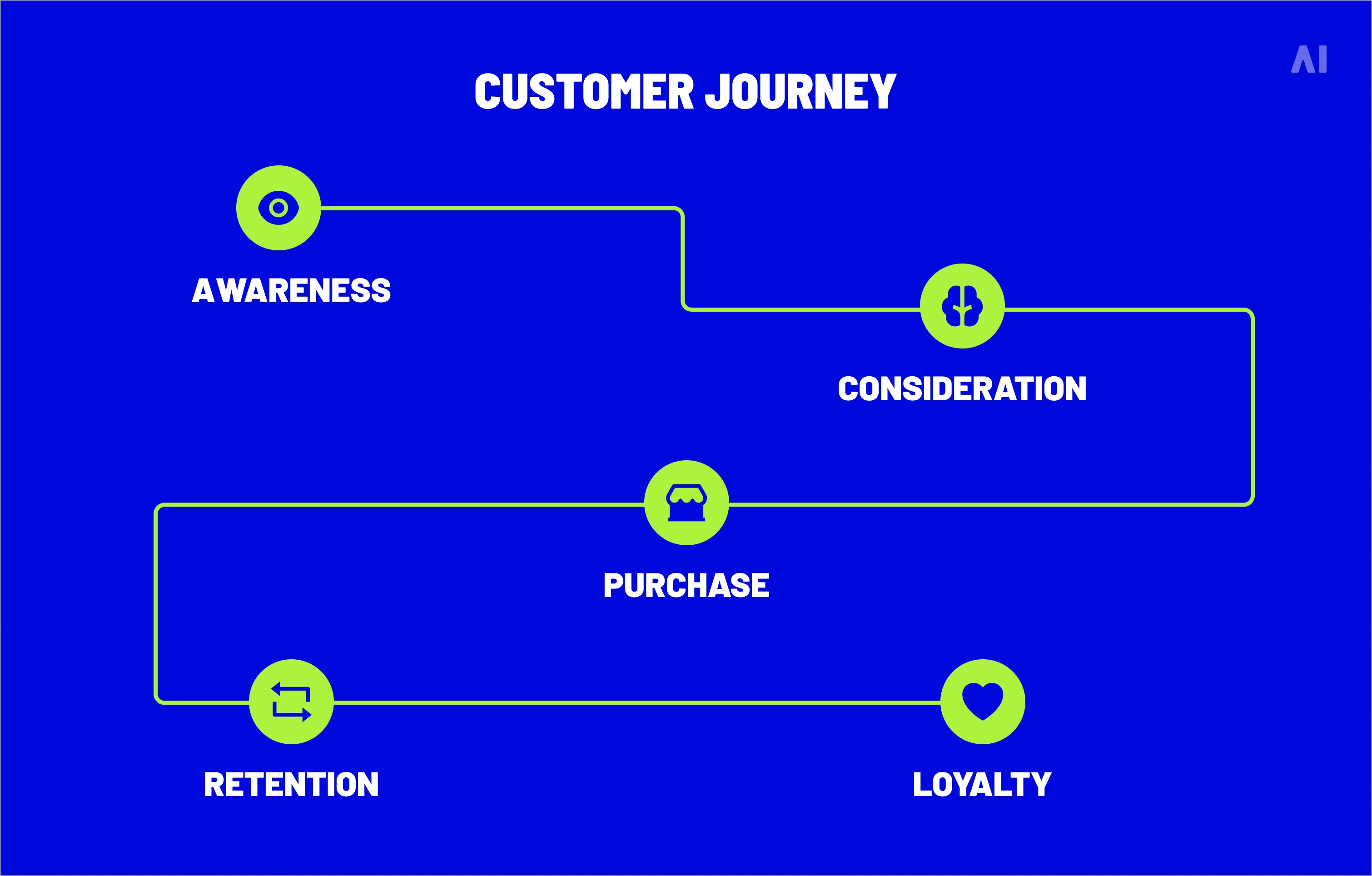
A strong marketing measurement strategy should not give all credit to the last click before conversion. Most customers do not see one ad, click once, and buy immediately. A shopper might first notice a brand through a CTV ad, search for reviews two days later, click a paid search result, abandon the cart, receive a reminder email, and finally purchase after seeing a retargeting ad.
If the business only measures the final conversion, paid search or retargeting may look like the only channels that worked. But CTV, reviews, email, and product-page visits may have helped move the customer closer to purchase. BCG argues that marketers need to move beyond a rigid linear funnel and understand which touchpoints influence customer decisions across real journeys, including streaming, scrolling, searching, and shopping behaviors.
💡A modern measurement strategy should therefore track the full lifecycle: how people discover the brand, how they evaluate the offer, what pushes them to convert, and what keeps them buying after the first purchase.
Awareness and demand generation
Awareness measurement shows whether marketing is creating attention among the right people before they are ready to buy. For example, a CTV campaign for a home fitness brand may not drive purchases on the same day. But it can increase branded Google searches, bring new visitors to product pages, grow retargeting pools, and make paid search campaigns perform better the following week.
Useful metrics include reach, frequency, video completion rate, branded search lift, new website visitors, engaged sessions, and assisted conversions. The point is not to force upper-funnel channels to behave like direct-response ads. It is to measure whether they are increasing qualified demand that later shows up in search, site traffic, and conversion paths.
Engagement and conversion performance
Engagement and conversion measurement shows how well marketing turns interest into action. This includes paid search, paid social, retargeting, landing pages, product pages, email sequences, lead forms, demo requests, checkout flows, and sales follow-up.
For example, a B2B SaaS buyer may click a LinkedIn ad, read a comparison page, leave, return through Google Search, download a guide, and book a demo after receiving an email. If measurement gives all credit to Google Search, the team may cut LinkedIn even though it introduced the buyer to the solution.
Useful metrics include conversion rate, cost per acquisition, lead quality, form completion rate, cart abandonment, sales-qualified leads, pipeline contribution, and assisted revenue.
Retention and customer value
Measurement should not stop after acquisition. A campaign that brings cheap customers is not necessarily successful if those customers churn quickly, never buy again, or require heavy discounts to return.
For a subscription business, retention metrics may include onboarding completion, product usage, renewal rate, churn rate, upsell conversion, and customer lifetime value. For ecommerce, teams should track repeat purchase rate, average order value, loyalty participation, return frequency, and revenue from returning customers.
For example, one campaign may produce expensive first purchases but attract customers who buy again every month. Another may bring low-cost one-time buyers who never return. Journey-based measurement helps teams see which channels create profitable customers, not just fast conversions.
Build marketing measurement infrastructure
A marketing measurement strategy needs a reliable infrastructure behind it.
If campaign data sits in ad platforms, sales data sits in a CRM, ecommerce data sits in Shopify or another commerce system, and customer behavior sits in web analytics, teams cannot see the full performance picture. They end up comparing partial reports instead of making confident decisions.
Strong measurement infrastructure connects the systems that shape marketing performance: ad platforms, analytics tools, CRM records, ecommerce revenue, call tracking, customer data platforms, offline sales, and operational data.
💡The goal is to make reporting accurate enough that teams can decide where to increase spend, where to cut waste, and which channels are actually contributing to revenue.
Cross-channel data integration helps teams stop making decisions from isolated platform reports. For example, Meta may show strong lead volume, Google Ads may show efficient conversions, and the CRM may show that most closed-won deals came from a smaller group of high-intent search and retargeting campaigns. Without integration, the media team may keep optimizing for low-cost leads instead of qualified revenue.
⚡️This is where centralized intelligence environments become useful. AI Digital’s Elevate is positioned as an AI-powered marketing platform that connects fragmented digital data into clearer control, strategy, and measurable business results. Its page states that Elevate analyzes 8,000 ad campaigns, processes 150 billion monthly data points, uses 10,000 audience attributes, and integrates with 12+ DSPs. These capabilities support the kind of consolidated planning, optimization, and reporting environment that cross-channel measurement requires.
As third-party tracking becomes less reliable, first-party data is becoming more important for accurate measurement. This includes data from website visits, purchases, form submissions, CRM activity, loyalty programs, email engagement, product usage, and offline sales.
For example, an ecommerce brand should know not only which ad drove the first purchase, but whether that customer returned, used a discount code, bought full-price products, or joined a loyalty program. A B2B company should know whether a paid campaign generated a form fill, a qualified opportunity, or a deal that later closed.
Consistent tracking structures also matter. UTMs, event names, conversion definitions, consent signals, and revenue fields should be standardized across teams. IAB’s State of Data 2024 report found that 71% of brands, agencies, and publishers are increasing their first-party datasets, showing how quickly the market is moving toward owned data as privacy restrictions reshape measurement.
CRM and revenue intelligence
CRM and revenue intelligence connect marketing activity to actual business results. Without CRM integration, a campaign may look successful because it generated many leads. But the sales team may later find that those leads had no budget, no buying authority, or no real intent.
For example, a software company might see that one campaign produced 500 leads at a low cost, while another produced only 80 leads at a higher cost. If the second campaign created more qualified opportunities and closed revenue, it is the better investment. CRM data helps marketing teams understand lead quality, deal velocity, pipeline contribution, customer value, and revenue influence across channels.
A strong marketing measurement strategy should not track every available metric with the same level of importance. The priority should be the metrics that help teams make business decisions: where to spend more, where to reduce waste, which channels create qualified demand, and which campaigns support profitable growth.
For example, a campaign with a high click-through rate may look strong in a platform dashboard, but if those clicks do not convert into revenue, pipeline, repeat purchases, or customer value, the metric is not enough. Marketing leaders need a measurement model that connects campaign activity to commercial outcomes.
This is especially important when budgets are under pressure. Gartner reported that marketing budgets remained flat at7.7% of overall company revenue in 2025, which means teams have less room to justify spend based on soft engagement metrics alone.
⚡️Read more:CTV measurement and how to evaluate performance beyond impressions.
For example, an ecommerce brand may see that one campaign has a strong ROAS, but after discounts, shipping costs, returns, and media costs are included, the profit margin may be weak. Another campaign may have a lower ROAS but attract customers who buy again within 60 days. That second campaign may be more valuable for the business.
This is why profitability metrics should sit next to platform metrics. Teams should not only ask, “Did this campaign convert?” They should ask, “Did this campaign create profitable customers?”
Revenue and pipeline performance
Revenue and pipeline metrics show whether marketing is contributing to sales outcomes. For B2B teams, this means tracking qualified leads, sales-qualified opportunities, pipeline contribution, deal velocity, win rate, revenue influence, and closed-won revenue.
For example, a paid LinkedIn campaign may generate fewer leads than a broad display campaign, but those leads may come from larger accounts, move faster through the pipeline, and close at a higher rate. If the team only measures lead volume or cost per lead, it may cut the campaign that actually supports stronger revenue.
A better measurement approach connects source, campaign, account quality, sales stage movement, and final revenue. This helps marketing and sales evaluate the same growth reality.
Customer growth and lifetime value
Customer growth metrics help teams measure what happens after acquisition. These include repeat purchase rate, churn, retention, renewal rate, average order value, customer lifetime value, upsell revenue, and incremental revenue.
For example, a subscription business may discover that customers acquired through paid search convert quickly but cancel after one month, while customers acquired through educational content and email nurturing stay longer and upgrade more often. In that case, the lower-volume channel may create stronger long-term value.
💡A modern marketing measurement strategy should therefore measure both short-term acquisition and long-term customer value. The goal is not simply to buy more conversions. The goal is to understand which channels, campaigns, and audiences create sustainable growth.
Use attribution, MMM, and incrementality
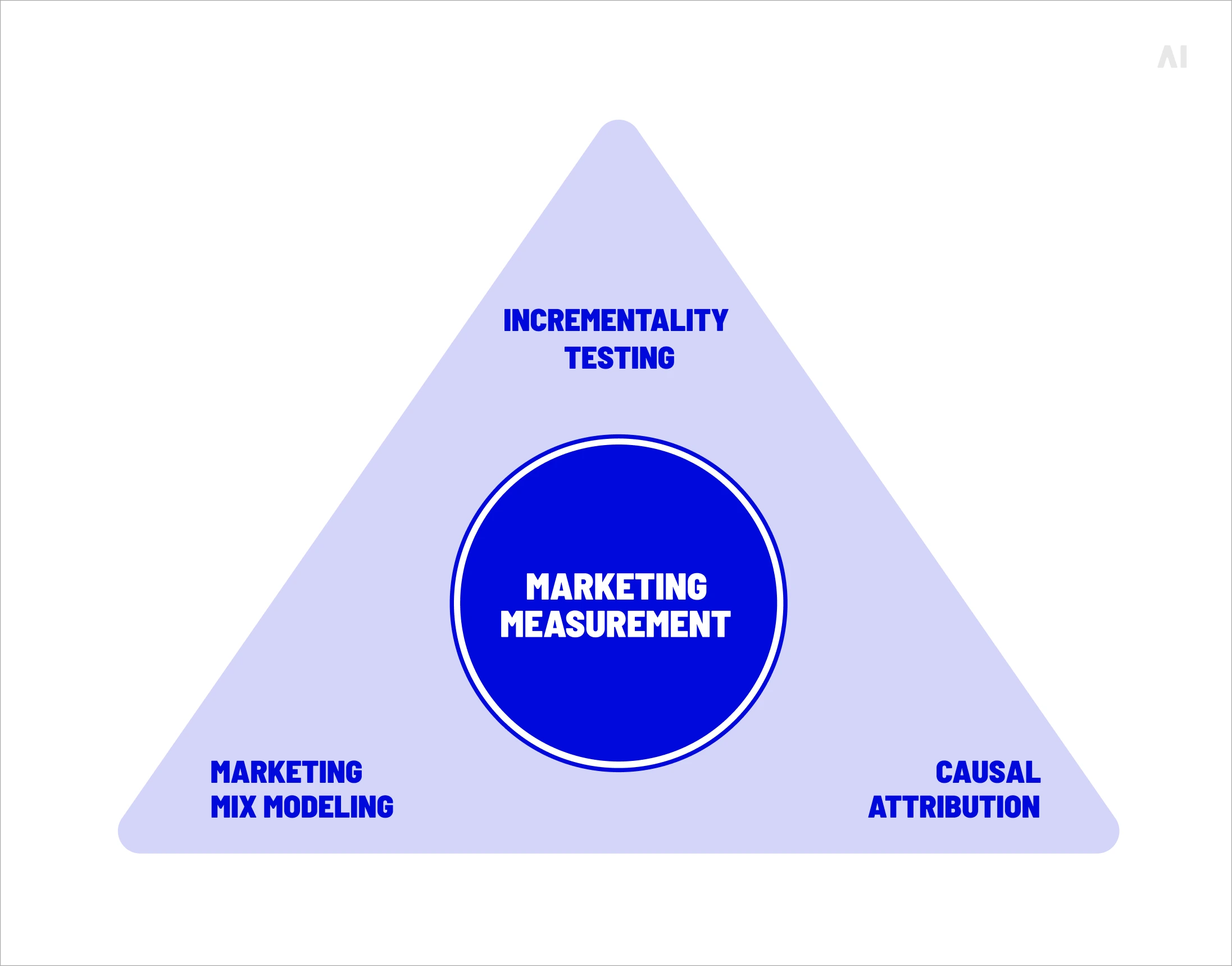
A modern marketing measurement strategy should not depend on one method to explain performance. Attribution, media mix modeling, and incrementality each answer a different question. Attribution helps teams understand which touchpoints were involved in a conversion. MMM shows how channels contribute to business results over time. Incrementality testing shows whether marketing caused outcomes that would not have happened otherwise.
Used together, these methods give businesses a more realistic view of channel contribution. This is important because customer journeys are fragmented, privacy restrictions reduce visibility, and platform-reported attribution often favors the platform reporting the result.
Attribution models assign credit to marketing touchpoints before a conversion. A first-touch model credits the channel that introduced the customer. A last-touch model credits the final interaction before conversion. Multi-touch attribution distributes credit across several touchpoints, such as a paid social click, a product page visit, an email open, and a paid search return.
Attribution is useful for short-term campaign optimization. For example, if a B2B team sees that demo requests often include paid search, retargeting, and email before conversion, it can improve landing pages, follow-up sequences, and retargeting messages.
The limitation is that attribution does not always prove impact. If a customer already planned to buy, the last ad they clicked may receive credit even if it did not change the outcome. Platform bias also creates problems. Google, Meta, TikTok, Amazon, and other platforms may each report conversions through their own attribution logic, so the same sale can be counted differently in several systems. Privacy restrictions, cookie loss, app tracking limits, and walled gardens make the picture even less complete.
MMM and incrementality measurement
Media mix modeling helps businesses understand how marketing channels affect sales, revenue, or other business outcomes over time. Instead of tracking individual users, MMM uses aggregated data such as weekly spend, impressions, promotions, seasonality, pricing, offline activity, and sales results.
For example, an ecommerce brand may use MMM to understand whether CTV, paid search, Meta, retail media, and email are contributing to total revenue differently across seasonal campaigns. This is useful when user-level attribution is incomplete or when upper-funnel channels influence demand over a longer period.
Incrementality testing goes one step further by asking whether marketing created additional results. For example, a retailer may hold out one region from a campaign and compare results against exposed regions. If exposed regions generate higher sales after controlling for normal demand, the difference can show incremental impact.
💡MMM is useful for strategic planning and budget allocation. Incrementality is useful for proving lift. Together, they help teams avoid overvaluing channels that only capture existing demand.
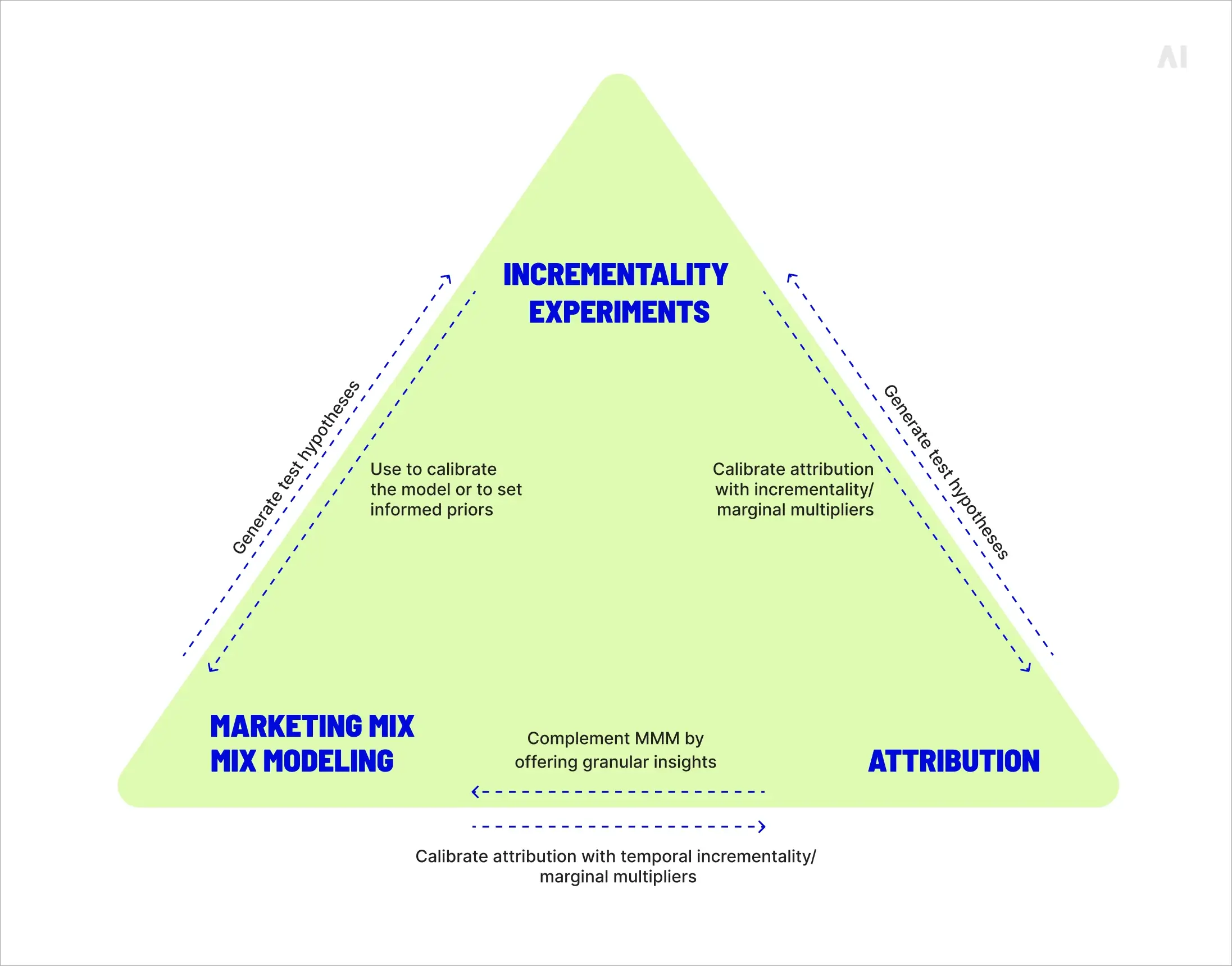
The strongest measurement systems combine attribution, MMM, incrementality, experimentation, and forecasting. Each method should guide a different type of decision.
Attribution can help optimize active campaigns, creative paths, and conversion journeys. MMM can support quarterly or annual budget planning. Incrementality tests can validate whether a channel, audience, or offer is producing real lift. Forecasting can help teams estimate what may happen if spend increases, decreases, or shifts across channels.
For example, a marketing team may use attribution to see that retargeting supports conversions, MMM to see that CTV improves total demand over time, and incrementality testing to confirm whether paid social is creating new customers or simply reaching people who would have purchased anyway.
💡This kind of marketing measurement framework gives teams a clearer way to decide what to scale, what to test, and where budget should move next.
Optimize marketing performance and budget allocation
A marketing measurement strategy should help teams make budget decisions before money is wasted, not only explain performance after the quarter ends. The real value of measurement is knowing when to scale, when to pause, and when to shift investment across channels.
For example, an ecommerce brand may see that paid search is driving purchases at a strong CPA, while paid social is bringing cheaper traffic but fewer repeat buyers. A B2B company may find that display campaigns generate low-cost form fills, but webinars and retargeting produce stronger sales-qualified opportunities. In both cases, measurement should help the team move budget toward the campaigns that create better business outcomes, not only better platform numbers.
Underperforming channels and spend efficiency
Ongoing measurement helps teams detect inefficient spend earlier. A channel may look healthy at the surface level because impressions, clicks, or leads are increasing. But deeper measurement may show that the audience quality is weak, conversion rates are declining, or customers from that channel have low lifetime value.
For example, if a campaign produces many leads at a low CPA but only 2% become qualified opportunities, the budget may be better used elsewhere. If a retargeting campaign keeps reaching people who already purchased, the team should suppress those audiences instead of paying for unnecessary impressions.
💡Good measurement turns performance reviews into specific actions: reduce bids, exclude low-quality audiences, refresh creative, change landing pages, or reallocate spend to stronger channels.
Forecasting and budget planning
Forecasting helps businesses plan spend with more confidence. Instead of deciding next month’s budget only from last month’s ROAS, teams can combine historical performance, seasonality, inventory levels, promotional calendars, customer demand, and channel contribution.
For example, a retailer preparing for a seasonal campaign may forecast that demand will rise in specific product categories, but inventory will be limited in certain regions. In that case, the team should not simply increase media spend everywhere. It should direct budget toward products and locations where demand, margin, and availability align.
⚡️AI Digital’s Smart Supply supports this type of optimization from the media supply side. Its page describes AI-powered supply, real-time optimization, transparent supply paths, direct SSP access, traffic filtering, and in-flight deal adjustments. This helps advertisers reduce inefficient placements and align media buying with performance signals instead of treating inventory as a black box.
⚡️Read more:Retail forecasting and how it supports smarter planning and growth.
Short-term and long-term growth balance
Budget allocation should balance immediate acquisition with long-term growth. If a team only optimizes for short-term CPA, it may cut channels that build demand, improve brand recall, or increase future conversion rates. If it only invests in upper-funnel activity, it may miss near-term revenue targets.
A better approach is to define the role of each channel. Paid search may capture demand now. CTV and video may grow future demand. Email and CRM may improve retention. Measurement should show how these roles work together, so teams can protect profitability today while still building revenue for the next quarter and beyond.
Automate marketing analysis and performance optimization
Modern marketing measurement strategies increasingly depend on AI-powered analytics and automation because manual reporting cannot keep up with the volume of cross-channel data. A marketing team may be tracking paid search, paid social, CTV, retail media, display, email, CRM activity, ecommerce revenue, and sales pipeline at the same time. By the time each report is exported, cleaned, and compared manually, the opportunity to optimize may already be gone.
AI helps teams process these signals faster. It can detect sudden changes in CPA, ROAS, conversion rate, traffic quality, audience performance, or revenue contribution before they become larger problems. For example, if a paid search campaign starts spending more while conversion quality drops, AI-powered monitoring can flag the issue early. If a CTV campaign is increasing branded search and site visits in specific markets, automated analysis can help the team identify that pattern faster than a manual weekly review.
This shift is becoming more important as AI moves from experiment to operating model. Gartner reports that marketing leaders expect AI-driven automation of marketing work to more than double, from 16% in 2026 to 36% by 2028. That means more teams will rely on AI not only for content or workflows, but also for measurement, forecasting, and optimization decisions.
AI also improves forecasting. Instead of planning next month’s budget only from last month’s performance, teams can use historical spend, seasonality, customer demand, channel trends, inventory, and revenue data to estimate what may happen next. For an ecommerce brand, this can mean identifying when demand is likely to rise for a product category. For a B2B team, it can mean predicting which campaigns are more likely to influence qualified pipeline.
Automation does not remove the need for human judgment. Marketing leaders still need to decide which trade-offs make sense: whether to protect margin, increase reach, improve lead quality, or invest in longer-term brand growth. The role of AI is to make those decisions faster, clearer, and less dependent on slow manual reporting.
Adapt marketing measurement for privacy-first environments
A modern marketing measurement strategy has to work in a privacy-first environment. Regulations, browser restrictions, consent requirements, and declining third-party cookie reliability have changed how businesses collect and validate marketing data. The result is a measurement environment where platform dashboards may show activity, but marketers still need stronger ways to understand what is accurate, what is missing, and what can be trusted.
This is not a small operational issue. IAB’s State of Data 2024 report found that 95% of advertising and data decision-makers expected continued signal loss and/or privacy legislation in 2024 and beyond. For marketing teams, that means measurement has to rely more on first-party data, privacy-safe tracking, transparent reporting logic, and cross-channel validation instead of assuming every customer interaction can be tracked perfectly.
Server-side tracking and privacy resilience
Server-side tracking helps businesses improve measurement control when browser-based tracking becomes less reliable. Instead of depending only on client-side tags that can be blocked, restricted, or interrupted, server-side setups send selected event data from the company’s own server environment to analytics and advertising platforms.
For example, an ecommerce brand can track purchases, checkout events, and customer consent signals more consistently from its server-side setup. A B2B company can connect form submissions, CRM updates, and qualified lead events with better control over what data is shared. This does not remove the need for consent management, but it helps teams build more resilient reporting structures around first-party data and validated events.
Closed platform dependency and visibility limitations
Another challenge is closed platform dependency. Walled gardens can report campaign performance inside their own environments, but they often limit how much visibility advertisers have across the full media mix. A platform may show strong attributed conversions, but the advertiser still needs to know whether those conversions were incremental, whether another channel also influenced the same customer, and whether the platform’s logic matches the company’s own revenue data.
⚡️This is where AI Digital’s Open Garden Framework becomes relevant as a branded measurement and media strategy approach. AI Digital defines the framework around DSP-agnostic execution, transparency, first-party data ownership, and flexible cross-channel measurement. Its guide on what the Open Garden Framework is positions it as a way to connect platforms, data, and inventory with a KPI-first, vendor-neutral operating model.
⚡️This matters because advertisers still need to work with major platforms, but they should not rely entirely on platform-reported attribution. AI Digital’s articles on walled gardens and walled gardens vs open internet explain the trade-off between platform scale and measurement control.
Privacy-first measurement also depends on compliance and reporting discipline. Teams need clear consent management, consistent event definitions, documented data flows, and regular validation between platforms, analytics tools, CRM systems, and revenue records.
For example, if paid media reports 1,000 conversions but the CRM shows only 300 qualified leads, the measurement process should identify why the gap exists. The issue may be duplicate events, weak lead quality, missing consent, incorrect attribution windows, or mismatched conversion definitions. Reliable reporting is not only about collecting data. It is about knowing which data is usable for business decisions.
Build a smarter marketing measurement strategy
A smarter marketing measurement strategy is not about adding more dashboards or collecting more campaign data. It is about helping businesses understand what to do next. Marketing teams need measurement systems that improve performance decisions, forecasting confidence, operational efficiency, and budget allocation across channels.
AI Digital supports this shift through solutions built around transparent media execution, AI-powered optimization, privacy-conscious measurement, and scalable marketing intelligence. For businesses struggling with fragmented reporting, limited attribution visibility, or disconnected performance data, AI Digital helps turn measurement into a clearer operating system for growth.
Key takeaways:
Align measurement with revenue goals, not only campaign-level metrics.
Connect marketing, sales, CRM, analytics, and media data into one measurement view.
Measure channels across the full customer journey, from awareness to retention.
Combine attribution with MMM, incrementality testing, forecasting, and revenue data.
Use AI-assisted optimization to detect performance changes and budget opportunities faster.
Build privacy-conscious measurement systems that rely on first-party data, server-side tracking, and transparent reporting logic.
Focus on business outcomes such as CAC, LTV, pipeline quality, retention, profitability, and incremental growth.
⚡️Teams exploring AI Digital’s broader capabilities can learn more through what we do, while businesses ready to improve measurement, planning, and optimization can get in touch to discuss the right strategy.
Because eventually every company discovers the same thing: collecting more data is not the same as knowing what to do next. A modern measurement strategy gives businesses the structure to interpret data correctly, optimize spend confidently, and turn marketing measurement into a long-term performance advantage.
Blind spot
Key issues
Business impact
AI Digital solution
Lack of transparency in AI models
• Platforms own AI models and train on proprietary data • Brands have little visibility into decision-making • "Walled gardens" restrict data access
• Inefficient ad spend • Limited strategic control • Eroded consumer trust • Potential budget mismanagement
Open Garden framework providing: • Complete transparency • DSP-agnostic execution • Cross-platform data & insights
Optimizing ads vs. optimizing impact
• AI excels at short-term metrics but may struggle with brand building • Consumers can detect AI-generated content • Efficiency might come at cost of authenticity
• Short-term gains at expense of brand health • Potential loss of authentic connection • Reduced effectiveness in storytelling
Smart Supply offering: • Human oversight of AI recommendations • Custom KPI alignment beyond clicks • Brand-safe inventory verification
The illusion of personalization
• Segment optimization rebranded as personalization • First-party data infrastructure challenges • Personalization vs. surveillance concerns
• Potential mismatch between promise and reality • Privacy concerns affecting consumer trust • Cost barriers for smaller businesses
Elevate platform features: • Real-time AI + human intelligence • First-party data activation • Ethical personalization strategies
AI-Driven efficiency vs. decision-making
• AI shifting from tool to decision-maker • Black box optimization like Google Performance Max • Human oversight limitations
• Strategic control loss • Difficulty questioning AI outputs • Inability to measure granular impact • Potential brand damage from mistakes
Managed Service with: • Human strategists overseeing AI • Custom KPI optimization • Complete campaign transparency
Fig. 1. Summary of AI blind spots in advertising
Dimension
Walled garden advantage
Walled garden limitation
Strategic impact
Audience access
Massive, engaged user bases
Limited visibility beyond platform
Reach without understanding
Data control
Sophisticated targeting tools
Data remains siloed within platform
Fragmented customer view
Measurement
Detailed in-platform metrics
Inconsistent cross-platform standards
Difficult performance comparison
Intelligence
Platform-specific insights
Limited data portability
Restricted strategic learning
Optimization
Powerful automated tools
Black-box algorithms
Reduced marketer control
Fig. 2. Strategic trade-offs in walled garden advertising.
Core issue
Platform priority
Walled garden limitation
Real-world example
Attribution opacity
Claiming maximum credit for conversions
Limited visibility into true conversion paths
Meta and TikTok's conflicting attribution models after iOS privacy updates
Data restrictions
Maintaining proprietary data control
Inability to combine platform data with other sources
Amazon DSP's limitations on detailed performance data exports
Cross-channel blindspots
Keeping advertisers within ecosystem
Fragmented view of customer journey
YouTube/DV360 campaigns lacking integration with non-Google platforms
Black box algorithms
Optimizing for platform revenue
Reduced control over campaign execution
Self-serve platforms using opaque ML models with little advertiser input
Performance reporting
Presenting platform in best light
Discrepancies between platform-reported and independently measured results
Consistently higher performance metrics in platform reports vs. third-party measurement
Fig. 1. The Walled garden misalignment: Platform interests vs. advertiser needs.
Key dimension
Challenge
Strategic imperative
ROAS volatility
Softer returns across digital channels
Shift from soft KPIs to measurable revenue impact
Media planning
Static plans no longer effective
Develop agile, modular approaches adaptable to changing conditions
Brand/performance
Traditional division dissolving
Create full-funnel strategies balancing long-term equity with short-term conversion
Capability
Key features
Benefits
Performance data
Elevate forecasting tool
• Vertical-specific insights • Historical data from past economic turbulence • "Cascade planning" functionality • Real-time adaptation
• Provides agility to adjust campaign strategy based on performance • Shows which media channels work best to drive efficient and effective performance • Confident budget reallocation • Reduces reaction time to market shifts
• Dataset from 10,000+ campaigns • Cuts response time from weeks to minutes
• Reaches people most likely to buy • Avoids wasted impressions and budgets on poor-performing placements • Context-aligned messaging
• 25+ billion bid requests analyzed daily • 18% improvement in working media efficiency • 26% increase in engagement during recessions
Full-funnel accountability
• Links awareness campaigns to lower funnel outcomes • Tests if ads actually drive new business • Measures brand perception changes • "Ask Elevate" AI Chat Assistant
• Upper-funnel to outcome connection • Sentiment shift tracking • Personalized messaging • Helps balance immediate sales vs. long-term brand building
• Natural language data queries • True business impact measurement
Open Garden approach
• Cross-platform and channel planning • Not locked into specific platforms • Unified cross-platform reach • Shows exactly where money is spent
• Reduces complexity across channels • Performance-based ad placement • Rapid budget reallocation • Eliminates platform-specific commitments and provides platform-based optimization and agility
• Coverage across all inventory sources • Provides full visibility into spending • Avoids the inability to pivot across platform as you’re not in a singular platform
Fig. 1. How AI Digital helps during economic uncertainty.
Trend
What it means for marketers
Supply & demand lines are blurring
Platforms from Google (P-Max) to Microsoft are merging optimization and inventory in one opaque box. Expect more bundled “best available” media where the algorithm, not the trader, decides channel and publisher mix.
Walled gardens get taller
Microsoft’s O&O set now spans Bing, Xbox, Outlook, Edge and LinkedIn, which just launched revenue-sharing video programs to lure creators and ad dollars. (Business Insider)
Retail & commerce media shape strategy
Microsoft’s Curate lets retailers and data owners package first-party segments, an echo of Amazon’s and Walmart’s approaches. Agencies must master seller-defined audiences as well as buyer-side tactics.
AI oversight becomes critical
Closed AI bidding means fewer levers for traders. Independent verification, incrementality testing and commercial guardrails rise in importance.
Fig. 1. Platform trends and their implications.
Metric
Connected TV (CTV)
Linear TV
Video Completion Rate
94.5%
70%
Purchase Rate After Ad
23%
12%
Ad Attention Rate
57% (prefer CTV ads)
54.5%
Viewer Reach (U.S.)
85% of households
228 million viewers
Retail Media Trends 2025
Access Complete consumer behaviour analyses and competitor benchmarks.
Identify and categorize audience groups based on behaviors, preferences, and characteristics
Michaels Stores: Implemented a genAI platform that increased email personalization from 20% to 95%, leading to a 41% boost in SMS click through rates and a 25% increase in engagement.
Estée Lauder: Partnered with Google Cloud to leverage genAI technologies for real-time consumer feedback monitoring and analyzing consumer sentiment across various channels.
High
Medium
Automated ad campaigns
Automate ad creation, placement, and optimization across various platforms
Showmax: Partnered with AI firms toautomate ad creation and testing, reducing production time by 70% while streamlining their quality assurance process.
Headway: Employed AI tools for ad creation and optimization, boosting performance by 40% and reaching 3.3 billion impressions while incorporating AI-generated content in 20% of their paid campaigns.
High
High
Brand sentiment tracking
Monitor and analyze public opinion about a brand across multiple channels in real time
L’Oréal: Analyzed millions of online comments, images, and videos to identify potential product innovation opportunities, effectively tracking brand sentiment and consumer trends.
Kellogg Company: Used AI to scan trending recipes featuring cereal, leveraging this data to launch targeted social campaigns that capitalize on positive brand sentiment and culinary trends.
High
Low
Campaign strategy optimization
Analyze data to predict optimal campaign approaches, channels, and timing
DoorDash: Leveraged Google’s AI-powered Demand Gen tool, which boosted its conversion rate by 15 times and improved cost per action efficiency by 50% compared with previous campaigns.
Kitsch: Employed Meta’s Advantage+ shopping campaigns with AI-powered tools to optimize campaigns, identifying and delivering top-performing ads to high-value consumers.
High
High
Content strategy
Generate content ideas, predict performance, and optimize distribution strategies
JPMorgan Chase: Collaborated with Persado to develop LLMs for marketing copy, achieving up to 450% higher clickthrough rates compared with human-written ads in pilot tests.
Hotel Chocolat: Employed genAI for concept development and production of its Velvetiser TV ad, which earned the highest-ever System1 score for adomestic appliance commercial.
High
High
Personalization strategy development
Create tailored messaging and experiences for consumers at scale
Stitch Fix: Uses genAI to help stylists interpret customer feedback and provide product recommendations, effectively personalizing shopping experiences.
Instacart: Uses genAI to offer customers personalized recipes, mealplanning ideas, and shopping lists based on individual preferences and habits.
Medium
Medium
Share article
Url copied to clipboard
No items found.
Subscribe to our Newsletter
THANK YOU FOR YOUR SUBSCRIPTION
Oops! Something went wrong while submitting the form.
Questions? We have answers
How often should businesses update their marketing measurement strategy?
Businesses should review their marketing measurement strategy at least quarterly and update it whenever major changes affect performance visibility. This includes new channels, privacy changes, CRM updates, attribution model changes, budget shifts, product launches, or changes in sales cycles. For example, an ecommerce brand running seasonal campaigns may need monthly measurement reviews, while a B2B company with a longer sales cycle may need quarterly analysis tied to pipeline and closed revenue.
Why do many marketing measurement strategies fail?
Many marketing measurement strategies fail because they are built around dashboards instead of decisions. Teams may track clicks, impressions, leads, and platform conversions without connecting those metrics to revenue, customer quality, retention, or profitability. Measurement also breaks down when data is fragmented across ad platforms, analytics tools, CRM systems, and sales reports. A stronger strategy starts with business goals, then defines the data, KPIs, attribution methods, and optimization processes needed to support them.
How does a measurement strategy improve budget allocation decisions?
A marketing measurement strategy improves budget allocation by showing which channels and campaigns create real business value. For example, one channel may generate cheap leads, but those leads may not become qualified opportunities. Another channel may cost more but produce customers with higher lifetime value. Measurement helps teams compare spend efficiency, pipeline contribution, conversion quality, retention, and incremental impact, so budgets can move toward the channels that support profitable growth.
What role does first-party data play in measurement strategy?
First-party data is becoming central to modern measurement because it comes directly from a company’s own customer relationships. This includes website activity, purchases, CRM records, email engagement, loyalty data, product usage, and sales interactions. As third-party tracking becomes less reliable, first-party data helps businesses improve audience accuracy, reporting reliability, personalization, and revenue analysis. It also gives teams more control over how data is collected, validated, and used across channels.
How do businesses align marketing measurement with revenue goals?
Businesses align marketing measurement with revenue goals by connecting campaign data to CRM, sales, ecommerce, and customer value data. Instead of measuring only cost per lead or campaign conversions, teams should track qualified pipeline, closed revenue, customer acquisition cost, lifetime value, win rate, retention, and profit contribution. For example, a campaign should not be judged only by how many leads it generates, but by whether those leads become valuable customers.
When should companies move beyond attribution-only measurement?
Companies should move beyond attribution-only measurement when customer journeys become too complex for one attribution model to explain accurately. This often happens when businesses run campaigns across paid search, paid social, CTV, display, retail media, email, CRM, and offline sales channels. Attribution can show touchpoint involvement, but it does not always prove incremental impact. At that stage, businesses should combine attribution with MMM, incrementality testing, forecasting, and revenue analysis.
Have other questions?
If you have more questions, contact us so we can help.
Questions? We have answers
This is some text inside of a div block.
Lorem ipsum dolor sit amet, consectetur adipiscing elit. Suspendisse varius enim in eros elementum tristique. Duis cursus, mi quis viverra ornare, eros dolor interdum nulla, ut commodo diam libero vitae erat. Aenean faucibus nibh et justo cursus id rutrum lorem imperdiet. Nunc ut sem vitae risus tristique posuere.
This is some text inside of a div block.
Lorem ipsum dolor sit amet, consectetur adipiscing elit. Suspendisse varius enim in eros elementum tristique. Duis cursus, mi quis viverra ornare, eros dolor interdum nulla, ut commodo diam libero vitae erat. Aenean faucibus nibh et justo cursus id rutrum lorem imperdiet. Nunc ut sem vitae risus tristique posuere.
This is some text inside of a div block.
Lorem ipsum dolor sit amet, consectetur adipiscing elit. Suspendisse varius enim in eros elementum tristique. Duis cursus, mi quis viverra ornare, eros dolor interdum nulla, ut commodo diam libero vitae erat. Aenean faucibus nibh et justo cursus id rutrum lorem imperdiet. Nunc ut sem vitae risus tristique posuere.
This is some text inside of a div block.
Lorem ipsum dolor sit amet, consectetur adipiscing elit. Suspendisse varius enim in eros elementum tristique. Duis cursus, mi quis viverra ornare, eros dolor interdum nulla, ut commodo diam libero vitae erat. Aenean faucibus nibh et justo cursus id rutrum lorem imperdiet. Nunc ut sem vitae risus tristique posuere.
This is some text inside of a div block.
Lorem ipsum dolor sit amet, consectetur adipiscing elit. Suspendisse varius enim in eros elementum tristique. Duis cursus, mi quis viverra ornare, eros dolor interdum nulla, ut commodo diam libero vitae erat. Aenean faucibus nibh et justo cursus id rutrum lorem imperdiet. Nunc ut sem vitae risus tristique posuere.
This is some text inside of a div block.
Lorem ipsum dolor sit amet, consectetur adipiscing elit. Suspendisse varius enim in eros elementum tristique. Duis cursus, mi quis viverra ornare, eros dolor interdum nulla, ut commodo diam libero vitae erat. Aenean faucibus nibh et justo cursus id rutrum lorem imperdiet. Nunc ut sem vitae risus tristique posuere.
This is some text inside of a div block.
Lorem ipsum dolor sit amet, consectetur adipiscing elit. Suspendisse varius enim in eros elementum tristique. Duis cursus, mi quis viverra ornare, eros dolor interdum nulla, ut commodo diam libero vitae erat. Aenean faucibus nibh et justo cursus id rutrum lorem imperdiet. Nunc ut sem vitae risus tristique posuere.

.svg)
.svg)