7 Best Performance Marketing Platforms in 2026: Features, Pricing, and Fit
Mary Gabrielyan
May 12, 2026
17
minutes read
Many marketers today run campaigns across affiliates, paid media, creators, retail media, and programmatic channels, yet still struggle to connect performance data, manage partners efficiently, and optimize spend in real time. Despite increased investment in marketing platforms and analytics tools, fragmented tracking setups and inconsistent attribution models often prevent teams from seeing a clear, unified picture of what is actually driving results. A performance marketing platform addresses this gap by bringing together tracking, attribution, reporting, and partner management into a single operational layer, allowing teams to move beyond siloed optimization and make faster, data-driven decisions across channels.
The role of a performance marketing platform has evolved significantly over the past few years. What was once primarily a tracking and attribution layer is now a core component of marketing infrastructure. Today’s performance marketing software is expected to operate across multiple channels, integrate fragmented data sources, and support real-time decision-making in increasingly complex environments.
This shift is not theoretical — it is driven by measurable changes in the ecosystem. According to Google, over 60% of marketers report a decline in signal quality due to privacy changes and reduced third-party cookie availability, directly impacting attribution accuracy and campaign optimization. At the same time, research from IAB shows that more than 70% of advertisers are now running campaigns across at least four digital channels, increasing operational complexity and data fragmentation.
Rising costs are compounding the issue. Gartner reports that customer acquisition costs have increased by over 60% in the past five years, putting pressure on marketing teams to justify every dollar of spend with clear performance data. However, without unified tracking and consistent attribution models, many organizations still struggle to connect campaigns to outcomes.
💡In this environment, relying on isolated performance marketing tools is no longer sufficient. Businesses need systems that can connect data across channels, standardize attribution logic, and provide a consistent view of performance. This is why many organizations are moving toward more interoperable marketing ecosystems that prioritize flexibility and data control.
⚡️Frameworks such as AI Digital’s Open Garden Framework reflect this shift. Instead of operating within closed, platform-specific environments, marketers are adopting vendor-neutral approaches that enable cross-platform measurement, independent optimization, and more transparent decision-making.
This article examines how modern marketing performance platforms address these challenges and compares the leading solutions available in 2026, focusing on how each platform supports tracking, attribution, partner management, and performance optimization across increasingly fragmented marketing environments.
What is a performance marketing platform?
A performance marketing platform is a type of performance marketing software designed to help businesses track, measure, and optimize marketing outcomes across multiple channels, partners, and campaigns. Unlike broader martech stacks that focus on content, CRM, or brand awareness, a marketing performance platform is built specifically around efficiency, attribution, and ROI — it answers a simple but critical question: which activities are actually driving measurable results?
In practice, this means consolidating fragmented data from different marketing platforms into a unified system where teams can monitor conversions, evaluate channel performance, and make budget decisions based on outcomes rather than assumptions. This has become increasingly important as signal loss and channel fragmentation reduce visibility. According to Google, privacy-driven changes have significantly limited cross-site tracking, forcing marketers to rely more on modeled and aggregated data, which increases the need for centralized performance systems.
💡A modern digital performance platform therefore acts as an operational layer that sits between execution and strategy — connecting campaign data, standardizing attribution logic, and enabling consistent reporting across environments.
Retail media ad spending through 2028
⚡️This aligns with broader performance frameworks discussed in AI Digital’s approach to performance marketing strategy and measurement models outlined in digital marketing KPI, where performance is evaluated through clear, outcome-based metrics rather than isolated channel reports.
Core capabilities of performance marketing software
At a functional level, performance marketing tools are not just reporting dashboards—they are systems that support daily decision-making across campaign execution, partner management, and optimization workflows.
One of the core capabilities is conversion tracking, which allows teams to measure specific actions such as purchases, sign-ups, or leads across different channels. This is closely tied to attribution modeling, where the platform assigns value to different touchpoints in the customer journey, helping marketers understand how channels contribute to outcomes rather than evaluating them in isolation.
Another critical function is unified reporting. Instead of navigating multiple platform dashboards, teams can access standardized performance data in one place, reducing inconsistencies and enabling faster analysis. This becomes particularly important as organizations scale across channels and markets.
For businesses running affiliate or partner programs, partner management and payout workflows are essential. Platforms automate onboarding, track partner-driven conversions, and manage commission structures, significantly reducing operational overhead. According to Forrester, automation in partner and affiliate management can reduce operational costs by up to 30%, particularly in large-scale programs.
Additional capabilities include fraud detection and prevention, which helps identify invalid traffic or duplicate conversions, and optimization tools that enable budget reallocation based on performance signals. Increasingly, platforms are integrating machine learning models to support predictive optimization, though their effectiveness depends heavily on data quality and integration depth.
In practical terms, these capabilities translate into a single outcome: giving teams the ability to move from reactive reporting to proactive performance management.
Which channels do performance marketing platforms support?
Investments due to data & signal loss
A typical performance marketing platform supports a broad mix of digital channels, but coverage varies significantly depending on the tool.
Most platforms are built to handle affiliate marketing and partner programs, where tracking and attribution are essential for commission-based models. These systems are also commonly used for paid social campaigns, where performance data needs to be aligned with broader attribution frameworks beyond platform-reported metrics.
In addition, many platforms support influencer and creator campaigns, enabling brands to track conversions and measure ROI from partnerships that extend beyond traditional advertising formats.
⚡️More advanced digital performance platforms integrate with programmatic advertising ecosystems, allowing teams to connect impression-level delivery with downstream conversions. This is particularly relevant in environments such as those described in AI Digital’s analysis of programmatic advertising and programmatic display advertising, where multiple intermediaries and data layers can complicate performance measurement.
Display advertising, retail media, and emerging channels like connected TV are also increasingly being incorporated, although integration depth can vary. According to IAB, over 70% of advertisers now operate across multiple digital channels simultaneously, reinforcing the need for platforms that can unify performance data across environments.
The key consideration is not how many channels a platform supports, but how well it aligns with the specific mix of campaigns a business actually runs.
Why businesses use performance marketing platforms
The primary reason businesses adopt a marketing performance platform is not access to more data—it is the ability to make better decisions with the data they already have.
First, these platforms provide centralized visibility, allowing teams to evaluate performance across campaigns, channels, and partners in a single environment. This reduces reliance on fragmented reporting and improves consistency in how performance is measured.
Second, they enable cleaner attribution, which is critical in an environment where platform-reported metrics often conflict. By applying standardized attribution logic, businesses can compare channels more accurately and allocate budgets based on actual contribution rather than surface-level metrics.
Third, they improve partner oversight and accountability, particularly in affiliate and creator ecosystems where performance-based compensation depends on accurate tracking.
Fourth, they support faster optimization. Instead of waiting for delayed reports, teams can identify underperforming campaigns in near real time and reallocate spend accordingly. This is increasingly important as acquisition costs rise and margins tighten.
Finally, they strengthen control over acquisition efficiency, helping businesses focus on outcomes such as cost per acquisition, incremental revenue, and profitability. This aligns with broader conversion-focused strategies outlined in conversion marketing, where success is defined by measurable business impact rather than activity volume.
💡In aggregate, a performance marketing platform becomes less of a reporting tool and more of a decision infrastructure—one that enables marketers to operate with greater precision in a fragmented and data-constrained ecosystem.
How to choose the right performance marketing platform
Selecting the right performance marketing platform is not about identifying a universally “best” solution — it is about finding the best fit for a specific business model, channel mix, and measurement strategy. Different platforms are optimized for different use cases, from affiliate-heavy growth models to complex, multi-channel campaign environments. The evaluation process should therefore focus on how well a platform supports your operational priorities and decision-making needs, rather than how many features it lists.
Define your performance marketing goals
The starting point is clarity on what the platform must do exceptionally well. For some businesses, the priority is scaling affiliate or partner programs; for others, it is improving attribution accuracy or managing campaigns across multiple channels.
According to Gartner, organizations that align marketing technology selection with defined business outcomes are significantly more likely to achieve measurable ROI improvements.
This is consistent with AI Digital’s strategic approach to performance marketing: platforms should be evaluated based on how they support specific growth levers, not generic capabilities. Defining these priorities upfront prevents over-investment in tools that do not materially impact performance.
Evaluate tracking and attribution accuracy
Measurement quality is foundational. Without reliable tracking, optimization decisions become speculative. Privacy changes and signal loss have made this more complex — Google highlights that marketers are increasingly relying on aggregated and modeled data due to reduced third-party cookie availability.
💡As a result, businesses should prioritize platforms that support first-party data strategies, server-side tracking, and cookieless measurement approaches.
No marketing performance platform operates in isolation. Integration with CRM systems, analytics tools, ad platforms, ecommerce infrastructure, and CDPs is critical for ensuring data consistency and operational efficiency.
Disconnected systems create reporting discrepancies and slow down decision-making. In contrast, well-integrated platforms enable clean data flows and unified reporting, allowing teams to act on insights faster and with greater confidence.
Assess automation and AI capabilities
Automation is increasingly central to modern performance marketing software, but not all AI capabilities deliver equal value. The focus should be on actionable intelligence, not feature labels.
Effective platforms use automation to support budget allocation, anomaly detection, forecasting, and campaign optimization. According to McKinsey & Company, AI-driven marketing optimization can improve efficiency by 10–20%when applied to decision-making workflows rather than isolated tasks.
From an AI Digital perspective, the key differentiator is whether the platform translates data into usable insights that directly inform decisions. Automation should enhance human strategy—not replace it—by reducing manual workload and improving the speed and accuracy of optimization.
Compare pricing models and scalability
Pricing for a performance marketing platform should be evaluated beyond entry-level costs, focusing on how expenses evolve as the business grows. Most performance marketing software follows subscription-based, usage-based (e.g., per conversion or event), or revenue-share models. While entry pricing may appear competitive, costs often increase with higher data volumes, more partners, and expanded feature access.
Scalability is equally critical. As campaigns grow across channels and markets, the platform must handle larger datasets, more complex attribution models, and expanding partner ecosystems without compromising performance or reporting accuracy.
According to Forrester, hidden costs—such as data overages, integrations, and feature add-ons—are a common issue as marketing platforms scale.
The key is to assess long-term fit: a strong marketing performance platform should support growth efficiently, maintaining cost predictability, operational simplicity, and performance visibility as complexity increases.
7 Leading performance marketing platforms for 2026
The platforms below all operate in the broader performance marketing platform category, but they solve different problems. Some are strongest in affiliate and partner management, others in campaign tracking, attribution, or media-buying optimization. That distinction matters: the goal is not to find the “best” platform in isolation, but the one that best matches your growth model, channel mix, and operational needs.
The comparison below summarizes each platform by its most practical evaluation criteria: where it fits best, what it does particularly well, how it connects into the wider stack, and how pricing is structured. The positioning and product details here are based on the vendors’ own websites and pricing pages.
Everflow positions itself as a modern partner marketing platform for running affiliate, creator, influencer, and referral programs in one place. That framing makes it especially relevant for digital-first brands and agencies that want one operating layer for both tracking and partner operations rather than a collection of disconnected tools.
Its core strengths are unified tracking, partner management, payouts, and flexible reporting, with additional controls for pacing, caps, and anomaly monitoring. Everflow also emphasizes a fast launch path, which is useful for teams that want to go live quickly without a long implementation cycle. For companies scaling partnership-led acquisition, it is one of the stronger options for combining attribution visibility with partner lifecycle management.
2. Affise
Affise is one of the more established platforms in this space and is built for brands, agencies, and networks managing large or complex partner programs. Its positioning leans heavily on analytics, automation, and fraud prevention.
On its official platform pages, Affise highlights AI predictions, conversion-funnel reporting, retention analysis, and anti-fraud controls that track issues such as spam clicks, proxies, fake traffic, and double IPs. It also promotes a marketplace and integration ecosystem, including 250+ integrated marketing platforms and advertisers through its CPAPI layer. That makes Affise a strong fit for businesses that need broad partner infrastructure, operational automation, and more international or multi-program scale than a lightweight affiliate tool can handle.
3. Voluum
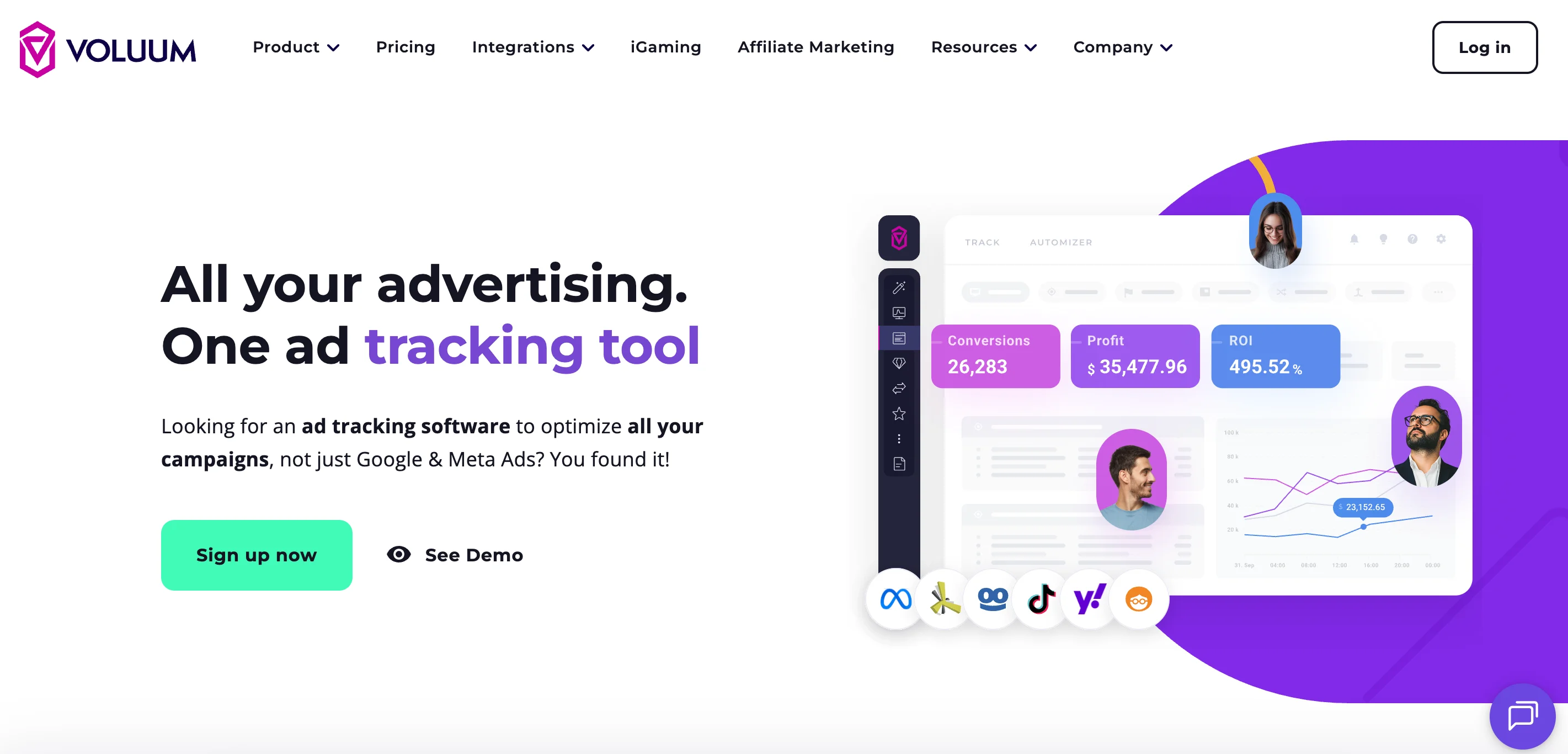
Voluum is best understood as a campaign tracking and optimization platform for media buyers and performance teams that need fast, execution-oriented insight. The company describes itself as a cloud-based ad tracker that connects campaign elements across platforms and helps users identify the most profitable combinations of traffic, ads, landing pages, and offers.
Its strongest differentiators are speed and control: Voluum emphasizes real-time reporting, support for multiple ad formats, and visibility into 30+ metrics for visits, clicks, and conversions. It also combines tracking with automation and anti-fraud functions, which is why it remains popular with aggressive performance teams focused on traffic buying efficiency rather than broader partner ecosystem management.
4. impact.com
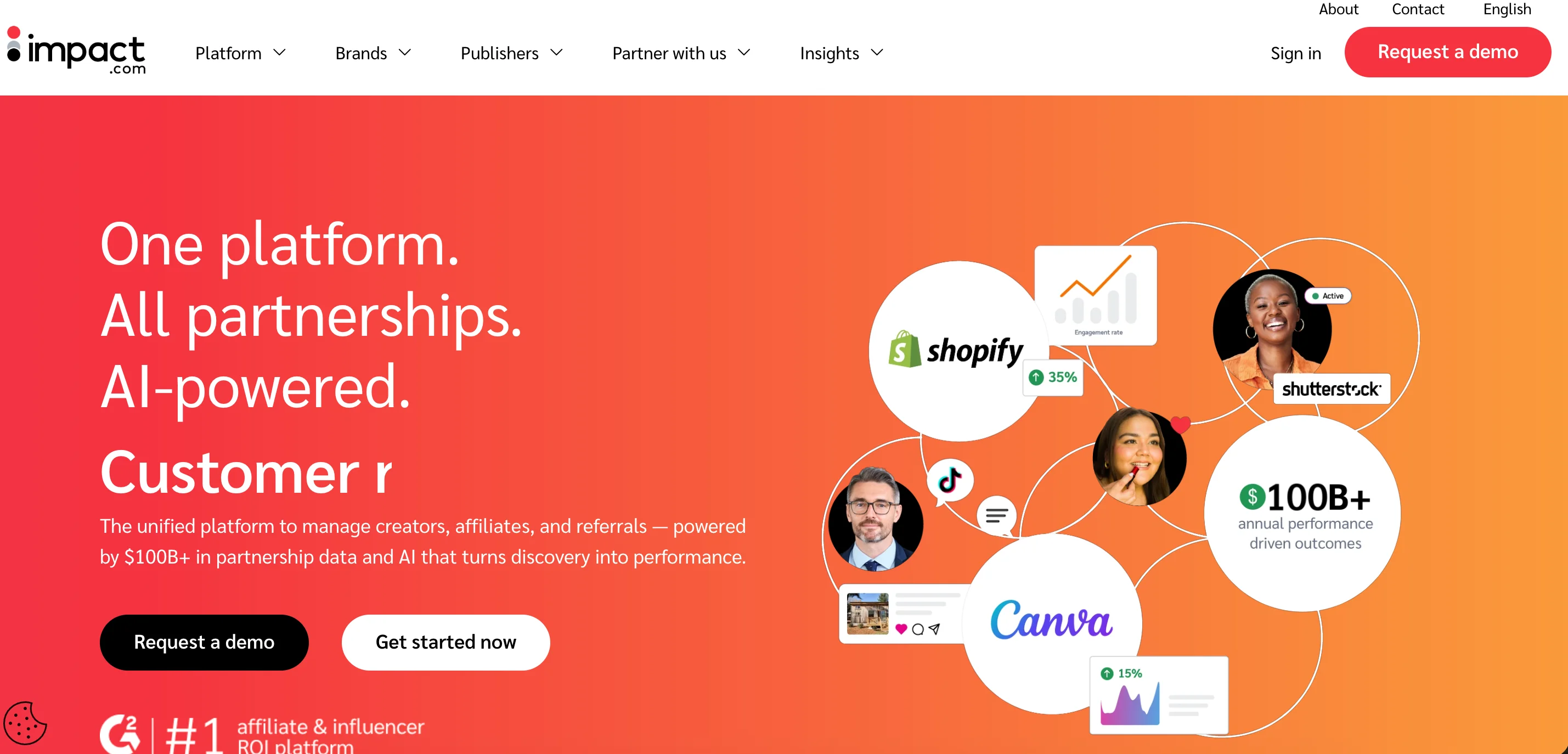
impact.com is one of the most comprehensive partnership automation platforms in the market and is especially relevant for larger brands with diverse partner ecosystems. Its platform spans affiliates, influencers, referrals, mobile partnerships, business development, and broader analytics and attribution use cases.
A major differentiator is scale: impact.com says its marketplace provides access to 90,000 partners, and the company also positions the platform around $100B+ in partnership data for AI-powered optimization. For enterprise teams, its value lies in managing the full partnership lifecycle—discovery, contracting, tracking, engagement, protection, and optimization—inside one system. With pricing starting at $500 per month for Essentials and higher tiers adding API-based tracking, forecasting, anomaly detection, and fraud scoring, it is particularly strong for mature partnership-led growth programs.
5. TUNE (formerly HasOffers)
TUNE is designed for brands, agencies, and networks that want more infrastructure control than many packaged partner platforms provide. Its official positioning centers on flexibility and control of data and partner programs, which is why it continues to appeal to businesses with technical teams and custom workflow requirements.
TUNE supports partner management, fraud prevention, and international payment processing, while its broader product architecture emphasizes API access and cross-channel tracking across app, mobile web, and desktop. It also offers privacy-compliant Javascript tracking and server postback methods, which is useful for teams that care about tracking resilience and implementation flexibility. For enterprise environments where custom setup, direct integrations, and long-term control matter, TUNE remains a strong option.
6. Trackier
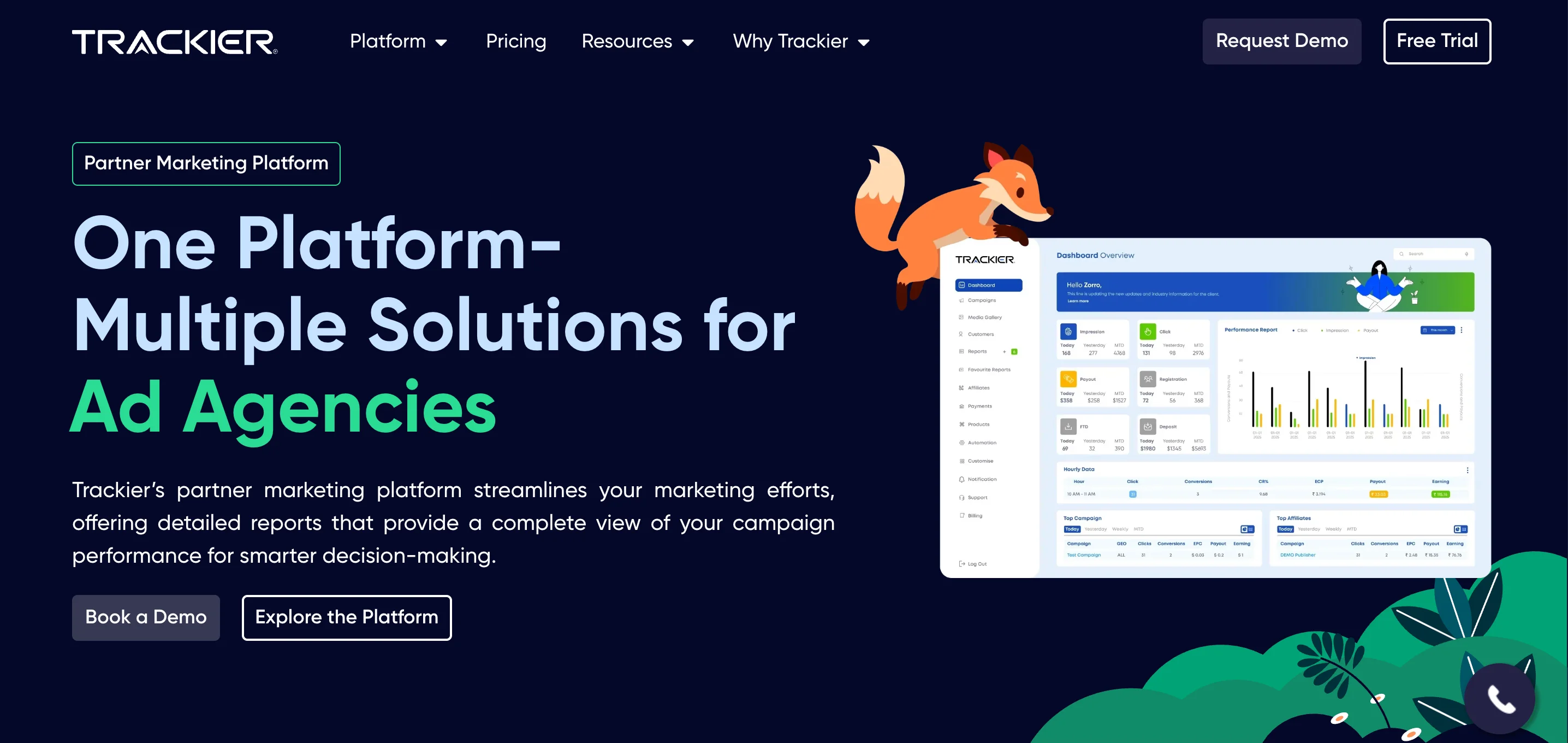
Trackier combines affiliate tracking, campaign analytics, fraud prevention, and workflow automation in a package aimed at scaling programs without making implementation overly technical. The platform presents itself as a solution for brands, agencies, and advertisers that need transparent campaign reporting and better operational control.
On its pricing and platform pages, Trackier emphasizes plug-and-play integrations with analytics tools, ecommerce platforms, CRMs, and ad networks, alongside automation for traffic routing, payouts, caps, and fraud filters. That makes it a practical fit for ecommerce businesses, agencies, and fast-growing networks that want stronger visibility and automation than entry-level tools provide, but do not necessarily need the heavier enterprise infrastructure associated with larger partnership suites.
7. PartnerStack
PartnerStack is the most specialized platform on this list because it is built primarily for B2B SaaS partner ecosystems. Rather than treating partnerships as a single affiliate channel, it is designed to run affiliate, referral, influencer, and reseller motions side by side. Its main strengths are partner recruitment, onboarding, commission automation, and performance visibility.
PartnerStack says it helps brands recruit from thousands of active partners, automate onboarding journeys, and manage global payouts with built-in tax and currency handling. It also highlights concrete customer outcomes, including 200% year-over-year growth in partner program sales for Monday.com and 18% of new trials driven by partnerships for Teamwork. For SaaS companies building partner-led revenue engines, that specialization is its biggest advantage.
Essential features to look for in a performance marketing platform
Choosing a performance marketing platform ultimately comes down to whether it can support reliable measurement, clear partner visibility, and efficient optimization at scale. While specific needs vary by business model, certain capabilities consistently determine whether a platform delivers real value or simply adds another reporting layer. These features function as a practical buyer’s checklist—focusing on how well a platform enables better decisions, not just more data.
Advanced attribution and conversion tracking
Accurate attribution is the foundation of any marketing performance platform. Without it, teams cannot confidently identify which channels, partners, or touchpoints are driving revenue.
This directly impacts budget allocation: if attribution is inconsistent or biased toward platform-reported metrics, investment decisions become misaligned with actual performance.
The challenge has intensified with signal loss. Google notes that privacy changes have reduced the availability of deterministic user-level data, increasing reliance on modeled attribution.
⚡️As a result, platforms that support multi-touch attribution models, server-side tracking, and first-party data integration are becoming essential. These approaches, explored further in multi-touch attribution, provide a more realistic view of how conversions happen across fragmented journeys.
Fraud prevention and traffic quality controls
Performance data is only as reliable as the traffic behind it. Invalid clicks, bot traffic, and low-quality placements can distort reporting and inflate costs without generating real value. According to Juniper Research, digital ad fraud losses are projected to exceed $362 billion annually, highlighting the scale of the issue.
💡A strong digital performance platform should include built-in fraud detection, anomaly monitoring, and traffic validation mechanisms. These tools help identify suspicious patterns, prevent duplicate or fake conversions, and protect campaign budgets.
⚡️As discussed in CTV ad fraud, fraud risks are expanding across newer channels as well, making proactive protection a critical requirement rather than an optional feature.
Partner and affiliate management
Modern performance marketing software goes beyond tracking—it enables businesses to manage entire partner ecosystems. This includes recruiting affiliates, organizing partner tiers, monitoring performance, and automating commission structures and payouts.
As partner programs scale, manual processes become inefficient and error-prone. Platforms that centralize partner data and automate workflows provide operational clarity and scalability, allowing teams to focus on growth rather than administration.
💡From an AI Digital perspective, this capability is essential for maintaining transparency and control in performance-driven ecosystems where multiple partners contribute to outcomes.
Automation and AI optimization
Automation has become a core requirement for any modern performance marketing platform, primarily because campaign environments are too dynamic for manual optimization alone. Performance signals change continuously across channels, audiences, and creatives, and delayed responses can directly impact efficiency.
AI-driven automation helps teams identify trends, detect anomalies, and adjust campaigns in real time—whether that means reallocating budget toward higher-performing channels or flagging unexpected drops in conversion rates. According to McKinsey & Company, marketing teams using AI-driven optimization can improve efficiency by 10–20%, particularly when automation is applied to decision-making workflows rather than isolated tasks.
⚡️The practical value lies in reducing manual workload while improving responsiveness. As explored in AI in digital marketing, the most effective systems translate large volumes of data into actionable insights that support faster and more accurate decisions, rather than simply automating surface-level tasks.
Custom reporting and data visualization
Data alone does not drive performance—interpretable insight does. A strong marketing performance platform should provide customizable dashboards and reporting layers that allow teams to analyze performance from different perspectives, including channel, partner, campaign, and revenue impact.
This flexibility is critical because different stakeholders require different views. Marketing teams need granular optimization data, finance teams focus on cost efficiency and ROI, and leadership requires high-level performance summaries tied to business outcomes.
According to Gartner,organizations that align analytics with decision-making processes significantly improve marketing effectiveness, highlighting the importance of usable reporting rather than static dashboards. Custom reporting enables teams to move from fragmented metrics to coherent performance narratives that directly inform strategy and budget allocation.
Open supply access and cross-platform media optimization
As digital ecosystems become more fragmented, many performance teams are moving away from relying exclusively on closed platforms and toward more open, transparent media environments. This shift is driven by the need for better visibility, greater control over inventory quality, and more consistent cross-platform optimization.
A digital performance platform that supports broader supply access allows businesses to compare performance across multiple sources, reduce dependency on single-platform reporting, and optimize campaigns based on unified data rather than siloed metrics.
⚡️This is where approaches like AI Digital’s Smart Supply become relevant. By analyzing supply paths, identifying inefficiencies, and prioritizing higher-quality inventory, Smart Supply enables advertisers to improve transparency, reduce waste, and enhance overall campaign performance.
From an operational perspective, this reflects a broader shift: performance marketing is no longer just about optimizing campaigns within platforms, but about structuring how media is sourced and evaluated across the entire ecosystem.
Performance marketing platform use cases
A performance marketing platform is not a one-size-fits-all solution—it adapts to different business models, operational structures, and growth strategies. While the underlying capabilities remain consistent, how they are applied varies significantly depending on whether the user is an agency, ecommerce brand, SaaS company, or affiliate network. Understanding these use cases helps clarify where these platforms deliver the most value in real-world scenarios.
Agencies managing multiple campaigns
Agencies operate in highly complex environments, managing campaigns across multiple clients, channels, and objectives simultaneously. A marketing performance platform enables them to centralize tracking, standardize reporting, and maintain consistent attribution logic across accounts.
Instead of relying on fragmented platform dashboards, agencies can monitor performance in one place, compare results across campaigns, and optimize spend based on unified data. This is particularly important as client expectations around transparency and ROI accountability continue to increase. According to Deloitte, data-driven marketing organizations are significantly more likely to outperform peers in campaign efficiency and ROI, reinforcing the need for centralized performance systems.
Ecommerce brands optimizing acquisition costs
For ecommerce businesses, the primary focus is controlling acquisition costs while maximizing revenue. A performance marketing platform helps teams improve conversion tracking accuracy, align attribution across channels, and evaluate performance beyond platform-reported metrics.
This is critical as customer acquisition costs continue to rise. More accurate measurement allows ecommerce teams to optimize spend across paid media, affiliates, and partner channels, ensuring that budgets are allocated to the most profitable sources.
SaaS companies increasingly rely on partner-led growth, including referral, affiliate, and reseller programs. A digital performance platform allows them to track partner-driven conversions, attribute revenue accurately, and manage commission structures at scale.
These platforms also support partner onboarding, engagement, and lifecycle management, which are essential for sustaining growth beyond direct acquisition channels. For SaaS businesses, the ability to connect partner performance directly to recurring revenue metrics is a key differentiator.
Affiliate networks managing thousands of partners
Affiliate networks operate at scale, often managing thousands of partners across multiple campaigns and advertisers. A performance marketing platform provides the infrastructure needed to track clicks, conversions, and payouts accurately while maintaining transparency across the network.
Automation plays a central role here — handling partner onboarding, performance monitoring, fraud detection, and commission payments. Without these systems, operational complexity would quickly become unmanageable.
At this level, the platform is not just a tool but a core operational backbone, enabling networks to maintain efficiency, ensure data integrity, and scale performance programs without losing control over reporting and financial accuracy.
Building a scalable performance marketing ecosystem
A performance marketing platform is a critical foundation — but on its own, it is not sufficient to support long-term, scalable growth. As marketing environments become more fragmented and data signals less reliable, businesses need a broader ecosystem that combines measurement, media optimization, and intelligence layers into a cohesive infrastructure.
The limitation of relying on standalone performance marketing tools is that they often operate in isolation. Tracking may be centralized, but media buying, supply quality, forecasting, and strategic planning remain disconnected. This creates inefficiencies: decisions are made with partial visibility, optimization happens within channel silos, and performance gains are incremental rather than systemic.
A scalable approach requires connecting three key layers:
Measurement and attribution (performance marketing platforms)
Media and supply optimization (how and where inventory is sourced)
Intelligence and forecasting (how decisions are guided and scaled)
This is where AI Digital’s ecosystem approach becomes relevant.
The Open Garden Framework provides a structural foundation by enabling a vendor-neutral, interoperable environment where data, inventory, and measurement are not locked into closed platforms. This allows businesses to maintain flexibility and transparency across channels while improving cross-platform optimization.
On top of this, solutions like Smart Supply focus on supply-path optimization—analyzing how impressions are sourced, identifying inefficiencies, and prioritizing higher-quality inventory. This directly impacts performance by reducing waste and improving the consistency of campaign outcomes.
The third layer is intelligence. AI Digital’s Elevate is designed to enhance decision-making through advanced analytics, forecasting, and AI-driven insights. Rather than relying only on historical reporting, Elevate enables teams to anticipate performance trends, model different scenarios, and make more informed budget allocation decisions. This shifts performance marketing from reactive optimization to proactive strategy, where planning and execution are tightly connected.
In combination, these components create a more scalable ecosystem: one where data flows freely, media is optimized at the source level, and decisions are supported by predictive intelligence.
💡The result is not just better campaign performance, but a more resilient marketing infrastructure—capable of adapting to ongoing changes in privacy, platforms, and consumer behavior without losing visibility or control.
Which performance marketing platform is right for your business?
There is no single performance marketing platform that fits every organization. The right choice depends on what your business needs to solve most effectively — and where performance gaps currently exist.
If your primary challenge is measurement clarity, then platforms with strong attribution and tracking capabilities should be the priority.
If growth depends on partnerships, then partner and affiliate management becomes the deciding factor.
For teams focused on execution, campaign optimization and real-time performance insights may carry more weight.
And for more advanced organizations, the key requirement may be infrastructure flexibility—the ability to connect data, media, and decision-making across a broader ecosystem.
The most effective approach is to evaluate platforms based on how they support your specific growth model, not on feature lists or market positioning. A well-chosen marketing performance platform should integrate naturally into your workflows, improve decision-making speed, and scale with your operations as complexity increases.
At the same time, it is important to recognize that software alone does not define performance. The strongest results come from combining the right platform with high-quality media supply, reliable measurement frameworks, and continuous optimization strategies.
⚡️If you are evaluating how to structure your performance marketing stack—or how to align platforms, media, and optimization into a more scalable system—you can explore the right approach for your business through AI Digital’s consulting and solutions. Learn more or get in touch.
Blind spot
Key issues
Business impact
AI Digital solution
Lack of transparency in AI models
• Platforms own AI models and train on proprietary data • Brands have little visibility into decision-making • "Walled gardens" restrict data access
• Inefficient ad spend • Limited strategic control • Eroded consumer trust • Potential budget mismanagement
Open Garden framework providing: • Complete transparency • DSP-agnostic execution • Cross-platform data & insights
Optimizing ads vs. optimizing impact
• AI excels at short-term metrics but may struggle with brand building • Consumers can detect AI-generated content • Efficiency might come at cost of authenticity
• Short-term gains at expense of brand health • Potential loss of authentic connection • Reduced effectiveness in storytelling
Smart Supply offering: • Human oversight of AI recommendations • Custom KPI alignment beyond clicks • Brand-safe inventory verification
The illusion of personalization
• Segment optimization rebranded as personalization • First-party data infrastructure challenges • Personalization vs. surveillance concerns
• Potential mismatch between promise and reality • Privacy concerns affecting consumer trust • Cost barriers for smaller businesses
Elevate platform features: • Real-time AI + human intelligence • First-party data activation • Ethical personalization strategies
AI-Driven efficiency vs. decision-making
• AI shifting from tool to decision-maker • Black box optimization like Google Performance Max • Human oversight limitations
• Strategic control loss • Difficulty questioning AI outputs • Inability to measure granular impact • Potential brand damage from mistakes
Managed Service with: • Human strategists overseeing AI • Custom KPI optimization • Complete campaign transparency
Fig. 1. Summary of AI blind spots in advertising
Dimension
Walled garden advantage
Walled garden limitation
Strategic impact
Audience access
Massive, engaged user bases
Limited visibility beyond platform
Reach without understanding
Data control
Sophisticated targeting tools
Data remains siloed within platform
Fragmented customer view
Measurement
Detailed in-platform metrics
Inconsistent cross-platform standards
Difficult performance comparison
Intelligence
Platform-specific insights
Limited data portability
Restricted strategic learning
Optimization
Powerful automated tools
Black-box algorithms
Reduced marketer control
Fig. 2. Strategic trade-offs in walled garden advertising.
Core issue
Platform priority
Walled garden limitation
Real-world example
Attribution opacity
Claiming maximum credit for conversions
Limited visibility into true conversion paths
Meta and TikTok's conflicting attribution models after iOS privacy updates
Data restrictions
Maintaining proprietary data control
Inability to combine platform data with other sources
Amazon DSP's limitations on detailed performance data exports
Cross-channel blindspots
Keeping advertisers within ecosystem
Fragmented view of customer journey
YouTube/DV360 campaigns lacking integration with non-Google platforms
Black box algorithms
Optimizing for platform revenue
Reduced control over campaign execution
Self-serve platforms using opaque ML models with little advertiser input
Performance reporting
Presenting platform in best light
Discrepancies between platform-reported and independently measured results
Consistently higher performance metrics in platform reports vs. third-party measurement
Fig. 1. The Walled garden misalignment: Platform interests vs. advertiser needs.
Key dimension
Challenge
Strategic imperative
ROAS volatility
Softer returns across digital channels
Shift from soft KPIs to measurable revenue impact
Media planning
Static plans no longer effective
Develop agile, modular approaches adaptable to changing conditions
Brand/performance
Traditional division dissolving
Create full-funnel strategies balancing long-term equity with short-term conversion
Capability
Key features
Benefits
Performance data
Elevate forecasting tool
• Vertical-specific insights • Historical data from past economic turbulence • "Cascade planning" functionality • Real-time adaptation
• Provides agility to adjust campaign strategy based on performance • Shows which media channels work best to drive efficient and effective performance • Confident budget reallocation • Reduces reaction time to market shifts
• Dataset from 10,000+ campaigns • Cuts response time from weeks to minutes
• Reaches people most likely to buy • Avoids wasted impressions and budgets on poor-performing placements • Context-aligned messaging
• 25+ billion bid requests analyzed daily • 18% improvement in working media efficiency • 26% increase in engagement during recessions
Full-funnel accountability
• Links awareness campaigns to lower funnel outcomes • Tests if ads actually drive new business • Measures brand perception changes • "Ask Elevate" AI Chat Assistant
• Upper-funnel to outcome connection • Sentiment shift tracking • Personalized messaging • Helps balance immediate sales vs. long-term brand building
• Natural language data queries • True business impact measurement
Open Garden approach
• Cross-platform and channel planning • Not locked into specific platforms • Unified cross-platform reach • Shows exactly where money is spent
• Reduces complexity across channels • Performance-based ad placement • Rapid budget reallocation • Eliminates platform-specific commitments and provides platform-based optimization and agility
• Coverage across all inventory sources • Provides full visibility into spending • Avoids the inability to pivot across platform as you’re not in a singular platform
Fig. 1. How AI Digital helps during economic uncertainty.
Trend
What it means for marketers
Supply & demand lines are blurring
Platforms from Google (P-Max) to Microsoft are merging optimization and inventory in one opaque box. Expect more bundled “best available” media where the algorithm, not the trader, decides channel and publisher mix.
Walled gardens get taller
Microsoft’s O&O set now spans Bing, Xbox, Outlook, Edge and LinkedIn, which just launched revenue-sharing video programs to lure creators and ad dollars. (Business Insider)
Retail & commerce media shape strategy
Microsoft’s Curate lets retailers and data owners package first-party segments, an echo of Amazon’s and Walmart’s approaches. Agencies must master seller-defined audiences as well as buyer-side tactics.
AI oversight becomes critical
Closed AI bidding means fewer levers for traders. Independent verification, incrementality testing and commercial guardrails rise in importance.
Fig. 1. Platform trends and their implications.
Metric
Connected TV (CTV)
Linear TV
Video Completion Rate
94.5%
70%
Purchase Rate After Ad
23%
12%
Ad Attention Rate
57% (prefer CTV ads)
54.5%
Viewer Reach (U.S.)
85% of households
228 million viewers
Retail Media Trends 2025
Access Complete consumer behaviour analyses and competitor benchmarks.
Identify and categorize audience groups based on behaviors, preferences, and characteristics
Michaels Stores: Implemented a genAI platform that increased email personalization from 20% to 95%, leading to a 41% boost in SMS click through rates and a 25% increase in engagement.
Estée Lauder: Partnered with Google Cloud to leverage genAI technologies for real-time consumer feedback monitoring and analyzing consumer sentiment across various channels.
High
Medium
Automated ad campaigns
Automate ad creation, placement, and optimization across various platforms
Showmax: Partnered with AI firms toautomate ad creation and testing, reducing production time by 70% while streamlining their quality assurance process.
Headway: Employed AI tools for ad creation and optimization, boosting performance by 40% and reaching 3.3 billion impressions while incorporating AI-generated content in 20% of their paid campaigns.
High
High
Brand sentiment tracking
Monitor and analyze public opinion about a brand across multiple channels in real time
L’Oréal: Analyzed millions of online comments, images, and videos to identify potential product innovation opportunities, effectively tracking brand sentiment and consumer trends.
Kellogg Company: Used AI to scan trending recipes featuring cereal, leveraging this data to launch targeted social campaigns that capitalize on positive brand sentiment and culinary trends.
High
Low
Campaign strategy optimization
Analyze data to predict optimal campaign approaches, channels, and timing
DoorDash: Leveraged Google’s AI-powered Demand Gen tool, which boosted its conversion rate by 15 times and improved cost per action efficiency by 50% compared with previous campaigns.
Kitsch: Employed Meta’s Advantage+ shopping campaigns with AI-powered tools to optimize campaigns, identifying and delivering top-performing ads to high-value consumers.
High
High
Content strategy
Generate content ideas, predict performance, and optimize distribution strategies
JPMorgan Chase: Collaborated with Persado to develop LLMs for marketing copy, achieving up to 450% higher clickthrough rates compared with human-written ads in pilot tests.
Hotel Chocolat: Employed genAI for concept development and production of its Velvetiser TV ad, which earned the highest-ever System1 score for adomestic appliance commercial.
High
High
Personalization strategy development
Create tailored messaging and experiences for consumers at scale
Stitch Fix: Uses genAI to help stylists interpret customer feedback and provide product recommendations, effectively personalizing shopping experiences.
Instacart: Uses genAI to offer customers personalized recipes, mealplanning ideas, and shopping lists based on individual preferences and habits.
Medium
Medium
Share article
Url copied to clipboard
No items found.
Subscribe to our Newsletter
THANK YOU FOR YOUR SUBSCRIPTION
Oops! Something went wrong while submitting the form.
Questions? We have answers
What is the best performance marketing platform in 2026?
There is no single “best” performance marketing platform in 2026—it depends on the business model and primary use case. Platforms like Everflow and Affise are strong for affiliate and partner ecosystems, Voluum excels in campaign tracking and media buying optimization, while impact.com and PartnerStack are better suited for large-scale partnership programs.
The key is alignment: the right performance marketing software is the one that best supports your attribution needs, channel mix, and growth strategy—not the one with the most features.
How do performance marketing platforms track conversions and attribution?
A performance marketing platform tracks conversions using a combination of tracking pixels, server-to-server (postback) integrations, and increasingly first-party data frameworks. These systems capture user interactions across channels and assign value to touchpoints through attribution models such as last-click, first-click, or multi-touch. Due to privacy changes, many platforms now rely on modeled and aggregated data in addition to deterministic tracking. According to Google, the shift away from third-party cookies has made hybrid tracking approaches essential for maintaining measurement accuracy.
What is the difference between a performance marketing platform and marketing automation software?
A performance marketing platform focuses on tracking, attribution, partner management, and campaign optimization, with a direct emphasis on measurable outcomes like conversions and revenue. In contrast, marketing automation software is typically designed for customer lifecycle management, including email campaigns, lead nurturing, and CRM workflows. While both systems can overlap in data usage, their core purpose is different: performance platforms optimize acquisition efficiency, while automation tools focus on engagement and retention.
How do performance marketing platforms improve marketing ROI?
These platforms improve ROI by enabling more accurate attribution, faster optimization, and better budget allocation. By consolidating data across channels, teams can identify which campaigns and partners are driving real results and shift spend accordingly. Additionally, features such as fraud detection, automation, and real-time reporting reduce wasted spend and improve operational efficiency. According to McKinsey & Company, data-driven optimization supported by AI can improve marketing efficiency by 10–20%, directly impacting ROI.
What integrations should a performance marketing platform support?
A strong marketing performance platform should integrate with key components of the marketing stack, including:
- CRM systems (for customer and revenue data)
- Analytics platforms (for deeper performance insights)
- Ad platforms (for campaign execution and data syncing)
- Ecommerce systems (for transaction and conversion tracking)
- Payment and billing tools (for partner payouts)
- Customer data platforms (CDPs) for unified data management
These integrations ensure consistent data flow, accurate reporting, and efficient operations, allowing teams to move from fragmented insights to a unified view of performance across channels.
Have other questions?
If you have more questions, contact us so we can help.
Questions? We have answers
This is some text inside of a div block.
Lorem ipsum dolor sit amet, consectetur adipiscing elit. Suspendisse varius enim in eros elementum tristique. Duis cursus, mi quis viverra ornare, eros dolor interdum nulla, ut commodo diam libero vitae erat. Aenean faucibus nibh et justo cursus id rutrum lorem imperdiet. Nunc ut sem vitae risus tristique posuere.
This is some text inside of a div block.
Lorem ipsum dolor sit amet, consectetur adipiscing elit. Suspendisse varius enim in eros elementum tristique. Duis cursus, mi quis viverra ornare, eros dolor interdum nulla, ut commodo diam libero vitae erat. Aenean faucibus nibh et justo cursus id rutrum lorem imperdiet. Nunc ut sem vitae risus tristique posuere.
This is some text inside of a div block.
Lorem ipsum dolor sit amet, consectetur adipiscing elit. Suspendisse varius enim in eros elementum tristique. Duis cursus, mi quis viverra ornare, eros dolor interdum nulla, ut commodo diam libero vitae erat. Aenean faucibus nibh et justo cursus id rutrum lorem imperdiet. Nunc ut sem vitae risus tristique posuere.
This is some text inside of a div block.
Lorem ipsum dolor sit amet, consectetur adipiscing elit. Suspendisse varius enim in eros elementum tristique. Duis cursus, mi quis viverra ornare, eros dolor interdum nulla, ut commodo diam libero vitae erat. Aenean faucibus nibh et justo cursus id rutrum lorem imperdiet. Nunc ut sem vitae risus tristique posuere.
This is some text inside of a div block.
Lorem ipsum dolor sit amet, consectetur adipiscing elit. Suspendisse varius enim in eros elementum tristique. Duis cursus, mi quis viverra ornare, eros dolor interdum nulla, ut commodo diam libero vitae erat. Aenean faucibus nibh et justo cursus id rutrum lorem imperdiet. Nunc ut sem vitae risus tristique posuere.
This is some text inside of a div block.
Lorem ipsum dolor sit amet, consectetur adipiscing elit. Suspendisse varius enim in eros elementum tristique. Duis cursus, mi quis viverra ornare, eros dolor interdum nulla, ut commodo diam libero vitae erat. Aenean faucibus nibh et justo cursus id rutrum lorem imperdiet. Nunc ut sem vitae risus tristique posuere.
This is some text inside of a div block.
Lorem ipsum dolor sit amet, consectetur adipiscing elit. Suspendisse varius enim in eros elementum tristique. Duis cursus, mi quis viverra ornare, eros dolor interdum nulla, ut commodo diam libero vitae erat. Aenean faucibus nibh et justo cursus id rutrum lorem imperdiet. Nunc ut sem vitae risus tristique posuere.


%20ii.webp)
%E2%80%8D%20.webp)



.webp)

.svg)
.svg)