Programmatic IO: How Automated Insertion Orders Are Changing Digital Advertising Deals
Tatev Malkhasyan
March 13, 2026
17
minutes read
Programmatic IOs are where direct deals meet programmatic execution: the same commercial agreement, but expressed in a way platforms can actually run, pace, and reconcile without email chains and spreadsheet archaeology. If you’ve been stuck in the IO vs programmatic debate, this guide explains what a programmatic IO is, what’s inside it, how it works across DSP/SSP setups.
If you’ve ever been stuck in the “IO vs programmatic” loop—where a deal is supposed to be direct, yet still behaves like a software-driven buy—you’re not alone. The short explanation is that insertion orders didn’t disappear; they got encoded. A programmatic IO (programmatic insertion order) turns what used to be a mostly manual contract-and-trafficking workflow into a system-defined agreement that platforms can execute, pace, and reconcile with far fewer human handoffs.
⚡ A programmatic IO isn’t a new kind of deal. It’s the old deal, expressed in a way machines can actually run.
Programmatic buying is already the center of gravity in the U.S. market. In the latest Interactive Advertising Bureau / PwC Internet Ad Revenue reporting for full-year 2024, programmatic revenue reached$134.8B (up 18% YoY). That scale creates pressure for cleaner, faster deal operations—especially when premium inventory, audience rules, and measurement requirements are involved.
💡 If you want the broader backdrop first (how programmatic pipes work, where auctions fit, and why “programmatic” isn’t a single buying method), AI Digital’s primer on programmatic advertising is a good starting point.
What is a programmatic insertion order (Programmatic IO)?
A programmatic insertion order is an insertion order whose terms and execution parameters are structured for platform-based delivery—so the deal can be activated through programmatic infrastructure (SSPs, DSPs, ad servers, deal IDs, and standardized signaling) instead of being run primarily through emails, spreadsheets, and manual trafficking.
In plain terms: it’s still an IO, but with enough machine-readable detail that systems can:
configure the deal consistently on both sides (buyer and seller),
enforce the agreed rules (pricing, supply, targeting, pacing),
and produce reporting that maps back to those terms for reconciliation.
Programmatic IOs show up most often in programmatic direct arrangements (e.g., preferred deals, private marketplace deals, programmatic guaranteed), where you want direct-like control and predictability, but you also want programmatic execution.
{{26-Programmatic-IO-SEO-1="/tables"}}
They’re especially common in channels where operational complexity is high—like CTV—where standards work (e.g., OpenRTB updates for CTV signaling) continues to tighten how buyers and sellers describe inventory and delivery rules.
A programmatic IO typically includes the same business “bones” as a traditional IO, but it adds (or formalizes) the parts that reduce ambiguity when platforms execute the deal. Think of it as contract terms + configuration-ready metadata.
{{26-Programmatic-IO-SEO-2="/tables"}}
Below are the elements you’ll usually see, and what they do in practice.
Parties and roles
This is the “who is responsible for what” layer: advertiser, agency, DSP seat, publisher, SSP, sales house, and any intermediaries (including curation roles, where relevant). When roles are unclear, reporting and billing disputes get louder—fast.
Deal type and deal identifiers
The IO should clearly define whether the agreement is programmatic guaranteed, preferred, PMP, curated, etc., and include deal IDs (or the mechanism for mapping them). Deal IDs are how the pipes recognize the deal in the bidstream.
Flight dates, delivery goals, pacing rules
Flight dates are obvious. What’s less obvious is how pacing is handled when reality deviates from the plan (under-delivery, supply constraints, creative approvals, frequency caps, etc.). The more explicit the pacing logic, the fewer “why didn’t it spend?” escalations you’ll have.
Pricing and commercial terms
CPM (or other basis), floors, fixed rates, priority, and any terms related to makegoods or credits. If there’s a guaranteed component, the deal usually includes what counts as “delivered” (viewable? completed views? specific placement rules?).
Inventory definition
This includes where ads can run (sites/apps, app bundles, channels, genres, content ratings, supply paths, ad pod rules in CTV, placement types). Standards like OpenRTB help normalize inventory descriptions, but the IO is where you make the business definition explicit.
Targeting and audience rules
Audience segments, geo, device, frequency controls, contextual rules, and inclusion/exclusion lists. For many buyers, this is the whole point of buying direct in the first place: control.
Creative requirements and QA workflow
Formats, specs, ad durations, audio levels, subtitles, companion creatives, clickthrough behavior, VAST/VPAID expectations, and approval workflow. This is where many deals break, particularly when the creative spec differs across publishers or device environments.
Measurement, reporting, and verification
What metrics matter, what vendors are used, how logs are shared (if at all), and how discrepancies are resolved. If attribution is involved, define the attribution window and methodology up front.
Data use and privacy constraints
Consent expectations, restricted data usage, and any rules tied to state-level privacy requirements. Even if your legal team covers the fine print, the IO needs to reflect what the platforms can actually enforce.
Key benefits of Programmatic IO for advertisers and publishers
Programmatic IOs exist because the operational friction of direct deals is real—and it compounds as spend, channels, and governance requirements increase.
Faster time to launch, fewer “lost in translation” moments
A traditional IO workflow can die by a thousand cuts: a missing field, a mismatched targeting rule, an incorrect rate, a misconfigured frequency cap, a creative spec that didn’t get forwarded. Programmatic IOs push the deal toward shared configuration instead of “two teams building two versions of the same deal.”
That doesn’t eliminate mistakes, but it reduces the most expensive kind of mistake: the one you discover after the campaign has been live for a week.
Cleaner handoffs between sales, ad ops, and activation teams
When the IO is structured for programmatic execution, you can standardize who owns each step:
sales finalizes business terms,
ad ops validates inventory and creative requirements,
activation teams implement and optimize,
finance reconciles against reporting that reflects the original terms.
The outcome is less “tribal knowledge,” more repeatability.
Better forecasting and inventory accountability
Direct deals rise or fall on predictability: will the inventory be there, will it deliver in-flight, and will the buyer accept the outcome? With programmatic IOs, sellers can describe supply more precisely and buyers can set controls that match the real constraints of the inventory (especially in CTV).
Stronger compliance posture when rules keep changing
The privacy and identity environment is not stable, and platform policies evolve. Google has publicly shifted its approach to third-party cookies and Privacy Sandbox plans over time, and the current direction emphasizes that some Sandbox technologies are being phased out.
A programmatic IO won’t “solve privacy,” but it can make governance more practical by forcing clarity:
What data is allowed for targeting?
What happens when identifiers are limited?
Which systems are responsible for enforcing restrictions?
Easier expansion into channels where “digital” is growing inside traditional media
As more inventory becomes digital and programmatically accessible, deal mechanics matter more. For example, the Out of Home Advertising Association of America reported that Digital OOH accounted for 35% of total OOH revenue year-to-date and grew 11.6% in Q3 2025.
As “real world” channels digitize, buyers increasingly need deal workflows that feel like digital operations, not bespoke paperwork.
Programmatic IOs don’t remove negotiation; they change what happens after negotiation. The workflow is still: agree terms → set up deal → activate → optimize → reconcile. The difference is that the middle steps become more standardized and easier to audit—because the deal’s business terms are expressed in a way ad tech platforms can execute consistently.
Before anyone talks price or inventory, you need a plan that’s specific enough to be executable in platforms. That means defining the goal in a way that maps to buying controls and reporting—otherwise the “deal” becomes a vague promise that’s hard to diagnose when delivery is off.
At a practical level, planning usually covers:
Objective and success criteria: awareness (reach/frequency, viewable impressions), consideration (engaged visits, video completion), performance (CPA/ROAS, qualified actions).
Channel role: what belongs in direct deals versus open auction. Premium formats, sensitive adjacency, and predictable delivery often push you toward a deal-based approach.
KPI expectations and tolerances: what counts as “on track,” what variance is acceptable, and when the team will intervene (daily pacing checks, mid-flight optimization cadence).
Audience and suitability boundaries: inclusion/exclusion rules, contextual requirements, geo constraints, competitive separation, and any category-level restrictions.
Measurement approach: which reporting source is primary, what verification applies, and what the discrepancy policy will be.
This planning stage is also where you decide whether you need an IO-style deal at all. If your priority is maximum flexibility and impression-level price discovery, auction buying is usually cleaner. If your priority is defined inventory, defined terms, and predictable delivery, a programmatic IO workflow starts to make sense.
Deal negotiation and agreement
This is where the business terms are set—and where many future problems are either prevented or quietly scheduled for later.
A solid negotiation phase goes beyond “rate + dates” and explicitly aligns on:
Inventory definition: which environments and placements are in scope (site/app lists, content categories, device types, CTV app ecosystems, dayparting rules).
Pricing model and fees: CPM or other pricing basis, floors, fixed rates, and clarity on any platform fees that affect effective CPM.
Volume commitments: what is guaranteed versus “best effort,” plus what happens if delivery falls short (makegoods, credits, extensions, or reallocation).
Targeting and suitability constraints: audience segments, frequency caps, contextual rules, brand safety requirements, and exclusion lists.
Creative and approval timelines: specs, formats, duration limits (especially for video/CTV), and how long approvals typically take.
Reporting terms: which metrics matter, which systems are considered authoritative, and how discrepancies will be handled.
The key principle here is simple: write terms that platforms can enforce. If a platform can’t reliably apply a condition (or applies it differently depending on supply), it shouldn’t be framed as guaranteed behavior in the agreement. Instead, treat it as a goal with a fallback plan.
⚡ A deal fails more often from unclear enforceability than from a bad rate.
Campaign setup through ad tech platforms
Once terms are agreed, the deal has to be expressed inside the systems that will actually deliver it. This is the stage where programmatic IOs earn their keep, because the goal is to avoid the classic scenario: buyer and seller each set up “the same deal” in separate tools, then discover mid-flight that the settings don’t match.
In most stacks, setup includes a few consistent building blocks:
Deal creation on the sell side: the publisher/SSP defines the deal, attaches inventory rules, sets pricing, and generates the deal ID (or IDs).
Deal availability to the buy side: the deal ID becomes selectable in the DSP (sometimes automatically, sometimes after seat-level permissions are configured).
Line item configuration in the DSP/ad server: the buyer sets budget, pacing, targeting, frequency, creative rotation rules, and measurement tags—based on what was agreed.
Creative trafficking and validation: assets are uploaded, validated against specs, and approved. For video, this is where duration, file weight, audio levels, and tracking behavior commonly trigger delays.
Brand safety and verification alignment: confirmation that suitability controls and verification vendors (if any) are applied consistently across the path.
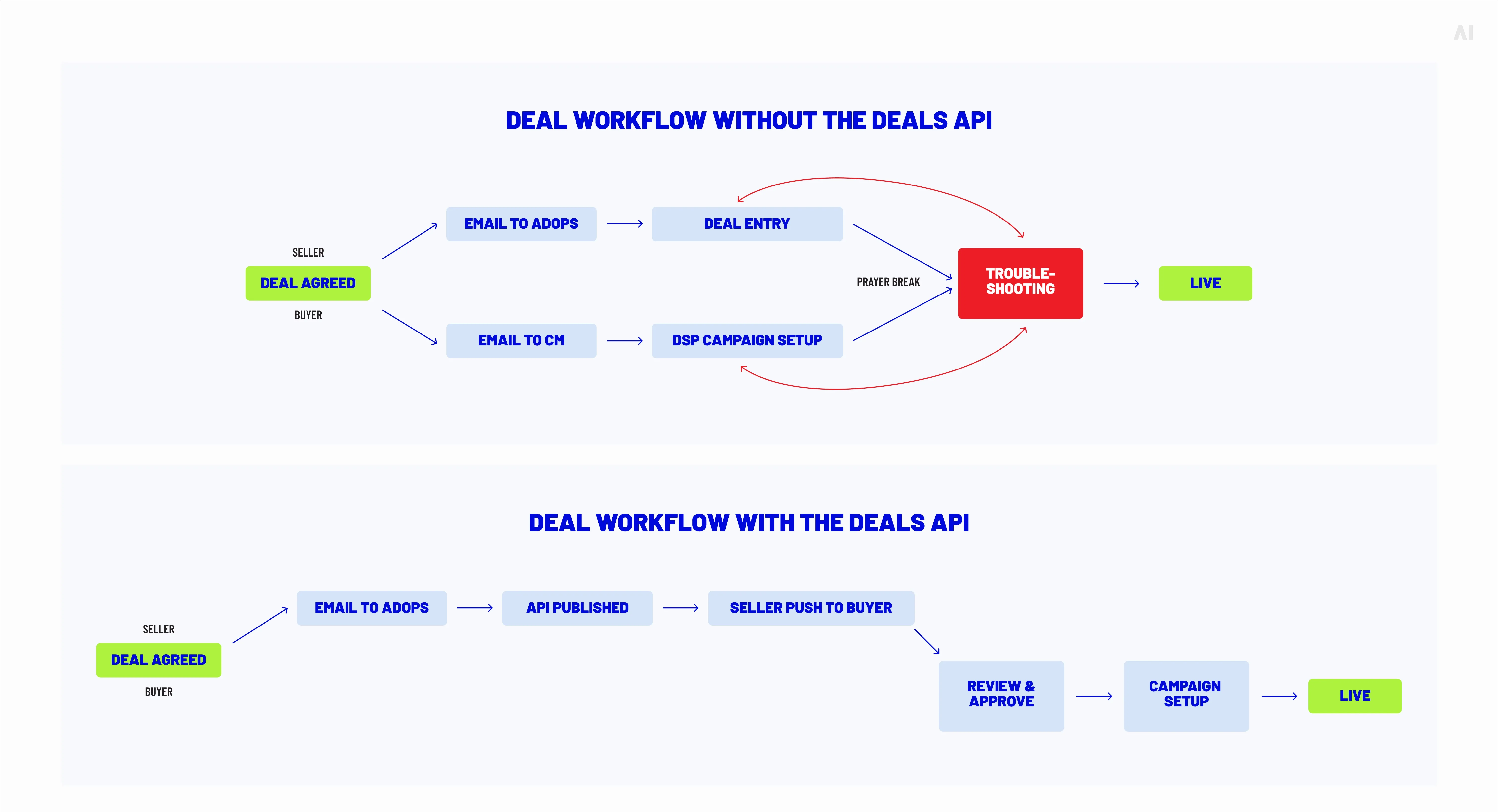
One reason this stage keeps improving is that the industry is trying to standardize how deal metadata is shared, so fewer details are re-keyed by humans. For example, the IAB Tech Lab’s Deals API is designed to standardize deal synchronization and reduce manual deal entry across systems; Version 1.0 was finalized on February 6, 2026.
Once the deal is live, day-to-day success is less about “set it and forget it,” and more about whether the team can keep delivery aligned with the plan while staying inside the deal’s constraints.
{{26-Programmatic-IO-SEO-3="/tables"}}
This stage usually has three moving parts: pacing, supply fit, and creative performance.
Pacing
Pacing answers one question: are we spending and delivering in a way that matches the flight plan? If not, you diagnose where the constraint sits:
Is the audience too narrow for the available inventory?
Is frequency capped too aggressively relative to reach goals?
Is the bid or floor relationship preventing win rate?
Are creative approvals or technical issues blocking delivery?
Underdelivery fixes
Underdelivery is common even in deal-based buying, especially when constraints stack up. Fixes usually follow a hierarchy:
renegotiate or shift budget if the inventory just isn’t there
The programmatic advantage is that many adjustments are controlled and reversible. You can tighten or loosen rules without rewriting the entire agreement, as long as you stay within the IO’s boundaries.
Creative rotation and performance
Creative issues can quietly throttle delivery. If one asset performs poorly (or fails validation in certain environments), the deal may “deliver,” but at worse efficiency or with uneven exposure. Keeping rotation logic clean, monitoring creative-level performance, and refreshing assets on a schedule tends to prevent late-flight panic.
Reporting and reconciliation
This is where deal-based buying has historically gotten tense: buyer logs vs seller logs, different counting methods, and disputes that arrive after the budget is gone.
{{26-Programmatic-IO-SEO-4="/tables"}}
Programmatic IO workflows improve reporting consistency and billing accuracy for a straightforward reason: they tighten the relationship between what was agreed, how it was configured, and how it was measured. When the deal’s terms are structured, it becomes easier to trace a reporting discrepancy back to a specific cause (inventory scope mismatch, measurement settings, frequency enforcement differences, or creative validation behavior).
A strong reporting and reconciliation layer usually includes:
Defined source-of-truth rules: which platform/report is primary for billing, and which reports are diagnostic.
A discrepancy policy: thresholds that trigger investigation, time windows for disputes, and what evidence is required.
Consistent deal visibility: clear identification of who sold, packaged, or curated the deal can reduce confusion when multiple parties touch the supply chain—one of the motivations behind standardization efforts like Deals API.
Post-campaign documentation: what changed mid-flight (audience relaxations, creative swaps, pacing shifts) so the billing story matches the operational reality.
⚡ The fastest way to lose trust in direct deals is a reconciliation story no one can explain.
Programmatic IOs vs. traditional IOs
Traditional IOs aren’t dead. They’re still used for bespoke sponsorships, custom integrations, and deals where the “inventory” is more like a content partnership than an addressable ad placement. But for repeatable digital deals, programmatic IOs increasingly win on operational sanity.
{{26-Programmatic-IO-SEO-5="/tables"}}
A useful mental model: traditional IOs are human-readable first; programmatic IOs are machine-executable first (while still being contractually valid).
Programmatic IO vs RTB: Are they the same thing?
No. They use related infrastructure, but they solve different problems.
RTB (real-time bidding) is an auction-based buying method where each impression is evaluated and priced in real time. It’s designed for scale, flexibility, and impression-level optimization.
A programmatic IO is a way to run direct-style agreements through programmatic rails. The goal is control and predictability: defined inventory, defined terms, and clearer accountability.
Sometimes they meet in the middle: a PMP can still feel “auction-like” while being governed by direct terms. But the intent is different:
Challenges and common issues with Programmatic IOs
Programmatic IOs reduce certain kinds of friction, but they don’t make deal-based buying “set and forget.” What they do is expose misalignment earlier, because the deal’s terms are expressed in systems that will either enforce them or fail loudly when they can’t.
⚡ Automation doesn’t remove disagreement. It just stops you from hiding it inside a spreadsheet.
A surprisingly high share of Programmatic IO problems come from one thing: the deal is sold as an outcome, but implemented as a configuration. Sales teams talk in promises (“premium delivery,” “high attention,” “clean audience reach”). Ad ops teams have to translate that into enforceable settings (inventory lists, deal IDs, pacing, frequency, brand suitability, measurement rules).
Misalignment shows up in a few predictable ways:
Terms that aren’t enforceable in the pipes. For example, an IO might imply strict placement guarantees that the platform can’t consistently control.
Missing operational detail. The deal has a rate and a flight, but not the specifics that prevent waste (frequency logic, content exclusions, creative approvals, discrepancy policy).
Different interpretations of “what was sold.” One side thinks “premium” means a specific set of apps or publishers; the other thinks it means “not open exchange.”
How to manage it: treat the IO as the translation layer. The cleanest process is a short internal handoff where sales confirms the intent, and ops confirms the enforceable implementation. If a condition can’t be enforced, the IO should state the fallback behavior clearly (what happens if the inventory isn’t available, or if targeting becomes too restrictive).
Inventory gaps and underdelivery risk
Underdelivery is not always a performance failure. Often, it’s an inventory-definition failure.
In deal-based buying, delivery depends on the intersection of:
available supply in the defined environment,
the constraints you’ve layered on (audience, geo, frequency, suitability),
and price dynamics (floors, bid strategy, priority).
Inventory gaps can happen even when everyone is acting in good faith. Examples include: seasonal supply changes, sudden shifts in app/publisher availability, strict brand suitability filtering, or a deal that was scoped broadly in conversation but narrowly in setup.
How to manage it: plan fixes in a sequence, not as random toggles.
Remove blockers first (creative approvals, tracking errors, misconfigured settings).
Adjust controllable levers (pacing, bid logic, frequency caps, rotation rules).
If supply still isn’t there, renegotiate scope (inventory definition or terms) rather than forcing spend into the wrong environments.
This is also where standardization efforts help, because they reduce “two sides built two different deals.” As mentioned, the IAB Tech Lab’s Deals API is explicitly aimed at clarifying deal terms and reducing manual deal-entry mismatch across systems.
Integration with an existing ad tech stack
A Programmatic IO only runs as well as its connections to your stack. That includes the obvious platforms (DSP, SSP, ad server), but also the “hidden” dependencies: brand suitability tools, identity layers, verification vendors, and analytics workflows.
Integration pain tends to show up in three places:
Deal visibility and permissions. The deal exists, but the buyer can’t see it (seat permissions, SSP settings, marketplace configuration).
Inconsistent metadata mapping. Inventory definitions or targeting constraints don’t translate cleanly across systems, so what looks correct in one UI behaves differently in another.
CTV-specific execution differences. CTV is a common flashpoint because of ad pod rules, creative duration constraints, SSAI behaviors, and device rendering quirks. OpenRTB 2.6 introduced support for CTV ad pods (a meaningful step), but implementation differences across platforms still matter in day-to-day operations.
How to manage it: design your setup workflow as a repeatable playbook. That usually means a pre-flight checklist (deal ID mapping, inventory scope, frequency logic, creative validation, measurement tags) plus a short test phase before scaling budget.
Measurement mismatches and reporting disputes
Even when delivery is fine, reporting can still trigger conflict. Buyers and sellers may not count the same events in the same way, or they may filter traffic differently.
⚡ Bad measurement isn’t always fraud; sometimes it’s bots that look legitimate. DoubleVerify reports an 86% increase in general invalid traffic, driven in part by AI crawlers and scrapers.
Common mismatch areas include:
viewability standards and measurement vendors,
completion logic for video (and how “completed” is defined),
attribution approaches (especially when identity signals are limited).
Why reconciliation matters: finance and procurement don’t pay for “best effort explanations.” They pay for terms. If you can’t trace reporting back to the configuration and the agreement, every post-campaign conversation becomes subjective.
How to manage it: your IO should make two things explicit:
What is the billing source of truth? (publisher ad server, third-party verification, DSP, or an agreed hierarchy)
What is the discrepancy process? (thresholds, time window for disputes, required evidence)
A structured Programmatic IO helps here because it ties terms → configuration → measurement more tightly than manual IO workflows. That doesn’t eliminate disputes, but it makes them diagnosable.
Data governance and privacy limitations
Targeting and measurement aren’t just technical choices anymore; they’re governance choices. Cookie loss, consent frameworks, and platform policy shifts can change what’s realistically addressable and what “frequency” even means across environments.
As previously noted, Google’s Privacy Sandbox documentation explicitly notes that some Privacy Sandbox technologies are being phased out, and points to ongoing updates on plans for those technologies. That’s one example of a broader point: identifier availability and privacy controls keep evolving, and IO terms need to reflect what platforms can execute under those constraints.
⚡ The U.S. privacy map keeps moving, fast. NCSL notes that 49 states and D.C. introduced or considered 800+ consumer privacy bills in 2025—a signal that compliance is becoming an operating model, not a one-time project.
How to manage it: bake privacy realities into the deal design.
Define what data is allowed for targeting and measurement.
Define fallback behaviors when identity is limited (contextual delivery, broader geo, adjusted frequency logic).
Treat contextual signals as a first-class tool rather than a backup plan.
On the transparency side, supply chain standards like ads.txt and sellers.json exist to help buyers verify authorized sellers and intermediaries, which becomes more important when curated packaging complicates “who sold what.”
Net takeaway: Programmatic IOs improve execution, but only if your organization treats them as operational systems, not paperwork. The teams that win are the ones that standardize setup, define enforceable terms, and run governance as part of the workflow—not as an after-action report.
Future trends in Programmatic IO
The direction is clear: deal execution is becoming more software-led, more cross-channel, and more accountable. Buyers still want the same fundamentals—quality inventory, predictable delivery, defensible reporting—but they want those outcomes with less manual work and fewer “mystery gaps” between what was agreed and what actually ran.
AI-driven optimization and predictive bidding
AI doesn’t replace the deal. It improves what happens once the deal is live.
In programmatic IO workflows, the most useful AI applications are the ones that reduce operational guesswork:
Pacing intelligence: spotting early signals of underdelivery (or overspend) and suggesting the smallest safe adjustment—before you’ve burned half the flight.
Forecasting and supply-fit prediction: estimating whether the combination of inventory scope, audience constraints, and frequency expectations is realistically deliverable at the agreed rate.
Decision support during optimization: clarifying why delivery is constrained (creative eligibility, frequency ceilings, inventory availability, bid dynamics), so the team doesn’t “fix” the wrong thing.
This matters because many teams still optimize by feel. With deal-based buying, that approach gets expensive. When your inventory is defined and your terms are explicit, the optimization job becomes narrower but more technical. AI helps by turning noisy delivery signals into a clearer set of recommended actions.
A practical takeaway: the best-performing IO teams don’t ask “what’s the perfect model?” They ask “what decisions do we need to make every day, and can the system make them earlier, with less ambiguity?”
Growth of CTV, DOOH, and omnichannel programmatic deals
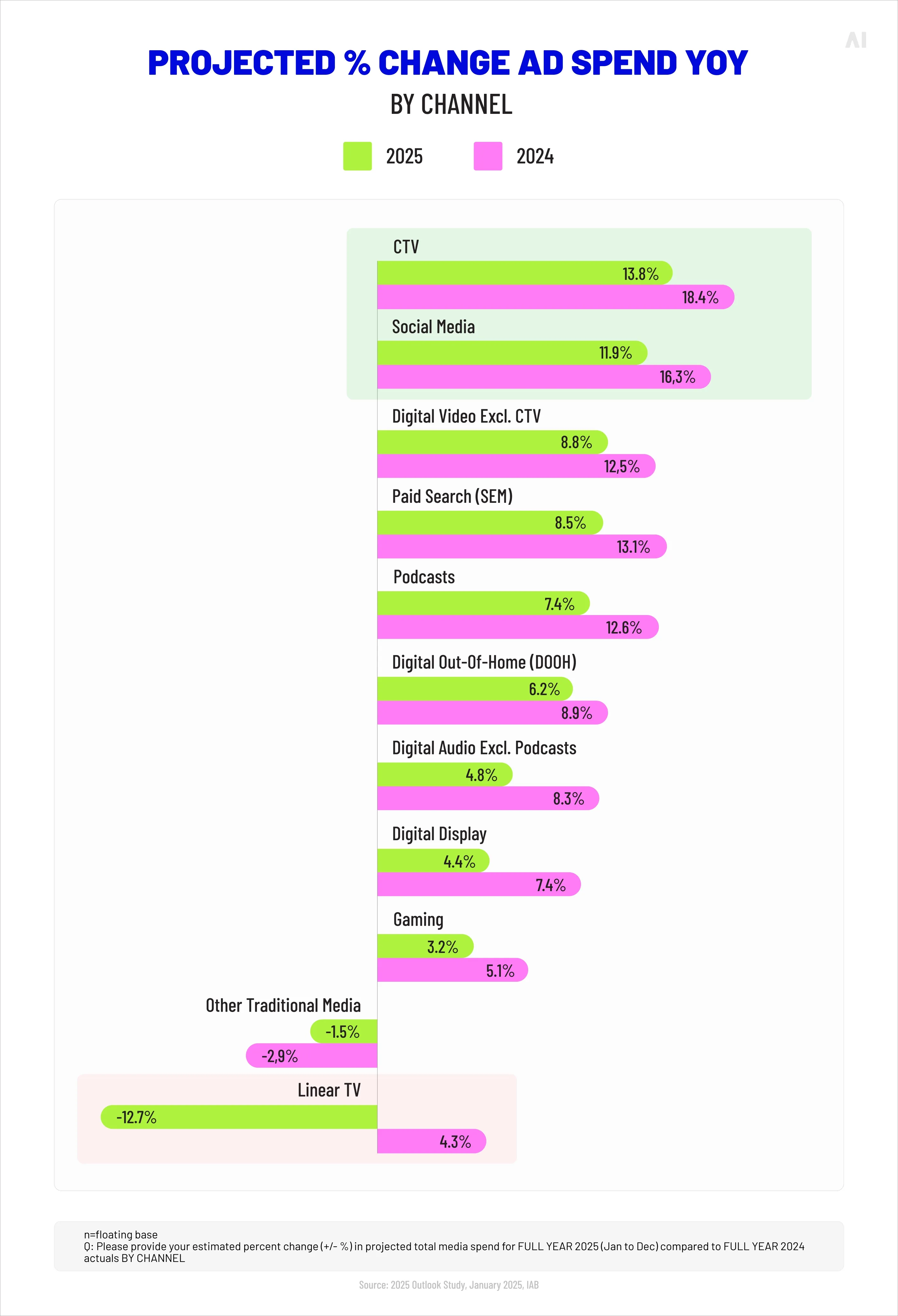
U.S. digital video spend was projected by IAB to reach $72B in 2025 — and that growth tends to pull premium inventory into more deal-based buying, especially in CTV where advertisers value predictable delivery and tighter control.
{{26-Programmatic-IO-SEO-6="/tables"}}
⚡ Streaming is now the default TV environment, not a side channel. Nielsen reports streaming reached 47.5% of U.S. TV viewing in December 2025, a record high.
This shift isn’t just about budgets. It’s about operating conditions:
CTV often brings stricter creative rules, stronger brand suitability needs, and more sensitivity to placement quality. When teams need clear guarantees (or at least clear definitions), IO-style buying becomes more attractive.
DOOH behaves like a hybrid channel: it needs direct-style planning (locations, dayparts, context), but it benefits from programmatic activation and faster iteration. As mentioned previously, the OAAA has reported that Digital OOH is a meaningful share of U.S. OOH revenue and continues to lead growth.
The bigger trend is omnichannel deal logic: advertisers want to apply consistent constraints (suitability, frequency intent, measurement rules) across multiple environments, without rebuilding the deal process from scratch each time.
💡 If you want channel-specific context, these two references are designed for that:
Privacy-first targeting and contextual deal execution
Privacy constraints don’t end IO-based buying. They change what “targeting” is allowed to mean, and they raise the value of signals you can legitimately use.
Programmatic IO can still work well in a privacy-first environment because it’s fundamentally about clear terms and controlled execution. The targeting layer simply becomes more weighted toward:
First-party signals: publisher first-party audiences, authenticated environments, and advertiser first-party activation (where applicable and compliant).
Contextual execution: content-based targeting, placement controls, and situational relevance—especially important when personal identifiers are limited.
Explicit fallback logic: what happens when addressability drops (broader context, wider geo, adjusted frequency expectations), so the campaign doesn’t collapse into confusion mid-flight.
A subtle but important change: contextual isn’t merely “what’s left when identity is gone.” In many premium environments, contextual is the most stable way to align to intent and suitability without dragging governance risk into every decision.
More automation in deal management (less human workload)
The next wave is less about inventing new deal types and more about removing friction from the ones we already use.
Expect continued movement toward:
Streamlined deal setup and synchronization: fewer manual entries, fewer mismatched line items, fewer “wrong deal ID” incidents.
Unified dashboards for deal health: one view that ties together delivery, pacing, creative eligibility, and discrepancy risk—so troubleshooting isn’t a scavenger hunt across platforms.
Clearer visibility into who packaged and sold the deal: especially as curation and deal packaging expand.
The bottom line: programmatic IO is becoming less “a contract plus heroics” and more “a contract plus repeatable software.” That shift won’t eliminate complexity, but it should make complexity more manageable—and far easier to explain when someone asks, “Why did we get this result?”
Conclusion: Why Programmatic IO is becoming the default way to run digital deals
Programmatic IOs aren’t hype. They’re an operational response to a simple reality: premium digital deals don’t scale cleanly when the workflow is mostly manual.
A programmatic IO gives you:
a clearer contract-to-execution link,
fewer setup mismatches,
faster activation,
and better odds that reporting and billing map back to what you agreed to buy.
If you’re adopting programmatic IO workflows, the practical move is to start with one repeatable deal type (PMP or preferred), standardize your fields and QA checklist, and only then expand into more complex guaranteed or curated structures.
If you want help pressure-testing your deal workflow—especially across DSP/SSP combinations, channels, and measurement requirements—AI Digital’s contact page is here.
Blind spot
Key issues
Business impact
AI Digital solution
Lack of transparency in AI models
• Platforms own AI models and train on proprietary data • Brands have little visibility into decision-making • "Walled gardens" restrict data access
• Inefficient ad spend • Limited strategic control • Eroded consumer trust • Potential budget mismanagement
Open Garden framework providing: • Complete transparency • DSP-agnostic execution • Cross-platform data & insights
Optimizing ads vs. optimizing impact
• AI excels at short-term metrics but may struggle with brand building • Consumers can detect AI-generated content • Efficiency might come at cost of authenticity
• Short-term gains at expense of brand health • Potential loss of authentic connection • Reduced effectiveness in storytelling
Smart Supply offering: • Human oversight of AI recommendations • Custom KPI alignment beyond clicks • Brand-safe inventory verification
The illusion of personalization
• Segment optimization rebranded as personalization • First-party data infrastructure challenges • Personalization vs. surveillance concerns
• Potential mismatch between promise and reality • Privacy concerns affecting consumer trust • Cost barriers for smaller businesses
Elevate platform features: • Real-time AI + human intelligence • First-party data activation • Ethical personalization strategies
AI-Driven efficiency vs. decision-making
• AI shifting from tool to decision-maker • Black box optimization like Google Performance Max • Human oversight limitations
• Strategic control loss • Difficulty questioning AI outputs • Inability to measure granular impact • Potential brand damage from mistakes
Managed Service with: • Human strategists overseeing AI • Custom KPI optimization • Complete campaign transparency
Fig. 1. Summary of AI blind spots in advertising
Dimension
Walled garden advantage
Walled garden limitation
Strategic impact
Audience access
Massive, engaged user bases
Limited visibility beyond platform
Reach without understanding
Data control
Sophisticated targeting tools
Data remains siloed within platform
Fragmented customer view
Measurement
Detailed in-platform metrics
Inconsistent cross-platform standards
Difficult performance comparison
Intelligence
Platform-specific insights
Limited data portability
Restricted strategic learning
Optimization
Powerful automated tools
Black-box algorithms
Reduced marketer control
Fig. 2. Strategic trade-offs in walled garden advertising.
Core issue
Platform priority
Walled garden limitation
Real-world example
Attribution opacity
Claiming maximum credit for conversions
Limited visibility into true conversion paths
Meta and TikTok's conflicting attribution models after iOS privacy updates
Data restrictions
Maintaining proprietary data control
Inability to combine platform data with other sources
Amazon DSP's limitations on detailed performance data exports
Cross-channel blindspots
Keeping advertisers within ecosystem
Fragmented view of customer journey
YouTube/DV360 campaigns lacking integration with non-Google platforms
Black box algorithms
Optimizing for platform revenue
Reduced control over campaign execution
Self-serve platforms using opaque ML models with little advertiser input
Performance reporting
Presenting platform in best light
Discrepancies between platform-reported and independently measured results
Consistently higher performance metrics in platform reports vs. third-party measurement
Fig. 1. The Walled garden misalignment: Platform interests vs. advertiser needs.
Key dimension
Challenge
Strategic imperative
ROAS volatility
Softer returns across digital channels
Shift from soft KPIs to measurable revenue impact
Media planning
Static plans no longer effective
Develop agile, modular approaches adaptable to changing conditions
Brand/performance
Traditional division dissolving
Create full-funnel strategies balancing long-term equity with short-term conversion
Capability
Key features
Benefits
Performance data
Elevate forecasting tool
• Vertical-specific insights • Historical data from past economic turbulence • "Cascade planning" functionality • Real-time adaptation
• Provides agility to adjust campaign strategy based on performance • Shows which media channels work best to drive efficient and effective performance • Confident budget reallocation • Reduces reaction time to market shifts
• Dataset from 10,000+ campaigns • Cuts response time from weeks to minutes
• Reaches people most likely to buy • Avoids wasted impressions and budgets on poor-performing placements • Context-aligned messaging
• 25+ billion bid requests analyzed daily • 18% improvement in working media efficiency • 26% increase in engagement during recessions
Full-funnel accountability
• Links awareness campaigns to lower funnel outcomes • Tests if ads actually drive new business • Measures brand perception changes • "Ask Elevate" AI Chat Assistant
• Upper-funnel to outcome connection • Sentiment shift tracking • Personalized messaging • Helps balance immediate sales vs. long-term brand building
• Natural language data queries • True business impact measurement
Open Garden approach
• Cross-platform and channel planning • Not locked into specific platforms • Unified cross-platform reach • Shows exactly where money is spent
• Reduces complexity across channels • Performance-based ad placement • Rapid budget reallocation • Eliminates platform-specific commitments and provides platform-based optimization and agility
• Coverage across all inventory sources • Provides full visibility into spending • Avoids the inability to pivot across platform as you’re not in a singular platform
Fig. 1. How AI Digital helps during economic uncertainty.
Trend
What it means for marketers
Supply & demand lines are blurring
Platforms from Google (P-Max) to Microsoft are merging optimization and inventory in one opaque box. Expect more bundled “best available” media where the algorithm, not the trader, decides channel and publisher mix.
Walled gardens get taller
Microsoft’s O&O set now spans Bing, Xbox, Outlook, Edge and LinkedIn, which just launched revenue-sharing video programs to lure creators and ad dollars. (Business Insider)
Retail & commerce media shape strategy
Microsoft’s Curate lets retailers and data owners package first-party segments, an echo of Amazon’s and Walmart’s approaches. Agencies must master seller-defined audiences as well as buyer-side tactics.
AI oversight becomes critical
Closed AI bidding means fewer levers for traders. Independent verification, incrementality testing and commercial guardrails rise in importance.
Fig. 1. Platform trends and their implications.
Metric
Connected TV (CTV)
Linear TV
Video Completion Rate
94.5%
70%
Purchase Rate After Ad
23%
12%
Ad Attention Rate
57% (prefer CTV ads)
54.5%
Viewer Reach (U.S.)
85% of households
228 million viewers
Retail Media Trends 2025
Access Complete consumer behaviour analyses and competitor benchmarks.
Identify and categorize audience groups based on behaviors, preferences, and characteristics
Michaels Stores: Implemented a genAI platform that increased email personalization from 20% to 95%, leading to a 41% boost in SMS click through rates and a 25% increase in engagement.
Estée Lauder: Partnered with Google Cloud to leverage genAI technologies for real-time consumer feedback monitoring and analyzing consumer sentiment across various channels.
High
Medium
Automated ad campaigns
Automate ad creation, placement, and optimization across various platforms
Showmax: Partnered with AI firms toautomate ad creation and testing, reducing production time by 70% while streamlining their quality assurance process.
Headway: Employed AI tools for ad creation and optimization, boosting performance by 40% and reaching 3.3 billion impressions while incorporating AI-generated content in 20% of their paid campaigns.
High
High
Brand sentiment tracking
Monitor and analyze public opinion about a brand across multiple channels in real time
L’Oréal: Analyzed millions of online comments, images, and videos to identify potential product innovation opportunities, effectively tracking brand sentiment and consumer trends.
Kellogg Company: Used AI to scan trending recipes featuring cereal, leveraging this data to launch targeted social campaigns that capitalize on positive brand sentiment and culinary trends.
High
Low
Campaign strategy optimization
Analyze data to predict optimal campaign approaches, channels, and timing
DoorDash: Leveraged Google’s AI-powered Demand Gen tool, which boosted its conversion rate by 15 times and improved cost per action efficiency by 50% compared with previous campaigns.
Kitsch: Employed Meta’s Advantage+ shopping campaigns with AI-powered tools to optimize campaigns, identifying and delivering top-performing ads to high-value consumers.
High
High
Content strategy
Generate content ideas, predict performance, and optimize distribution strategies
JPMorgan Chase: Collaborated with Persado to develop LLMs for marketing copy, achieving up to 450% higher clickthrough rates compared with human-written ads in pilot tests.
Hotel Chocolat: Employed genAI for concept development and production of its Velvetiser TV ad, which earned the highest-ever System1 score for adomestic appliance commercial.
High
High
Personalization strategy development
Create tailored messaging and experiences for consumers at scale
Stitch Fix: Uses genAI to help stylists interpret customer feedback and provide product recommendations, effectively personalizing shopping experiences.
Instacart: Uses genAI to offer customers personalized recipes, mealplanning ideas, and shopping lists based on individual preferences and habits.
Medium
Medium
Share article
Url copied to clipboard
No items found.
Subscribe to our Newsletter
THANK YOU FOR YOUR SUBSCRIPTION
Oops! Something went wrong while submitting the form.
Questions? We have answers
What’s the difference between programmatic IO and programmatic guaranteed?
Programmatic IO is the way the agreement is expressed and executed—an insertion order that’s structured so ad tech platforms can run it consistently, using deal IDs, defined inventory rules, pacing controls, and agreed measurement terms. Programmatic Guaranteed is a specific deal type where delivery is committed at agreed terms (typically a fixed CPM and defined volume), with expectations around makegoods or credits if delivery falls short. In other words, if you’re comparing IO vs programmatic buying, Programmatic IO is often the operational bridge that lets direct-style terms run on programmatic rails, while Programmatic Guaranteed is one particular outcome you can negotiate and then execute through that structure.
Can programmatic IO be used for PMP and preferred deals?
Yes. Programmatic IO is not limited to guaranteed commitments—it can also support Private Marketplace (PMP) and preferred deals where the focus is priority access, defined inventory, and clearer commercial terms rather than a strict delivery guarantee. In PMP and preferred setups, the IO structure helps by making the deal rules explicit (inventory scope, floors or fixed pricing, brand suitability, frequency intent, reporting expectations) so setup is less error-prone and reconciliation is simpler if delivery or performance needs investigation.
Does programmatic IO guarantee impression delivery?
Not by itself. A Programmatic IO can make delivery more predictable because it reduces setup mismatches and clarifies constraints, but “guarantee” comes from the negotiated deal type and the specific commitment written into the agreement. If the deal is programmatic guaranteed, delivery commitments are typically explicit, and the IO helps enforce the mechanics. If the deal is PMP or preferred, delivery depends on available inventory, competition, bid dynamics, and the constraints you’ve applied (audience, frequency, suitability), even if the IO is perfectly structured.
How does programmatic IO impact CPM and pricing negotiations?
It changes what you can negotiate confidently. With traditional workflows, pricing discussions can get distorted by uncertainty—buyers discount because they expect underdelivery or reporting disputes; sellers price defensively because they expect operational friction and exceptions. A well-structured programmatic IO reduces that uncertainty by tying pricing to clear inventory definitions, enforceable constraints, and a defined reporting and discrepancy process. That can support firmer CPMs for premium inventory when quality and delivery rules are clear, and it can also support more performance-friendly pricing when the buyer’s levers (pacing, frequency intent, audience rules) are transparent and measurable.
What platforms are used to execute programmatic IO deals?
Programmatic IO deals are typically executed through a DSP on the buy side and a publisher ad server and/or SSP on the sell side, with the deal represented via deal IDs and associated metadata. Depending on the setup, additional tools may be involved for verification, brand suitability, identity, and measurement—because those controls often need to be aligned with the deal’s terms. If you’re evaluating IO vs programmatic workflows internally, it helps to think of the IO as the contractual “spec,” and the DSP/SSP/ad server combination as the execution layer that enforces the spec.
What are the biggest risks of programmatic IO execution?
The biggest risks are operational rather than conceptual: misalignment between what was sold and what platforms can enforce, inventory definitions that are too narrow or too vague, creative approval delays that compress flight windows, and measurement mismatches that surface during reconciliation. Another common risk is treating the deal as done once it’s set up; in reality, pacing and underdelivery require active management, especially when constraints stack up (tight audience, strict suitability, aggressive frequency caps). Programmatic IO reduces manual errors, but it won’t rescue a deal that was negotiated with unrealistic assumptions or implemented without a clean pre-flight process.
How can publishers increase revenue using programmatic IO deals?
Publishers can use Programmatic IO deals to make premium inventory easier to buy repeatedly, which is often where revenue growth actually comes from: fewer one-off campaigns, more repeatable deal patterns, and fewer operational headaches that cause buyers to shift budget elsewhere. When publishers define inventory clearly, align creative and measurement requirements upfront, and provide predictable reporting and reconciliation terms, they reduce buyer uncertainty—which supports stronger CPMs and higher renewal rates. Programmatic IO structures also help publishers package audience and contextual value in a way that’s enforceable in platforms, making it easier to sell outcomes tied to quality and suitability rather than competing solely on price.
Have other questions?
If you have more questions, contact us so we can help.
Questions? We have answers
This is some text inside of a div block.
Lorem ipsum dolor sit amet, consectetur adipiscing elit. Suspendisse varius enim in eros elementum tristique. Duis cursus, mi quis viverra ornare, eros dolor interdum nulla, ut commodo diam libero vitae erat. Aenean faucibus nibh et justo cursus id rutrum lorem imperdiet. Nunc ut sem vitae risus tristique posuere.
This is some text inside of a div block.
Lorem ipsum dolor sit amet, consectetur adipiscing elit. Suspendisse varius enim in eros elementum tristique. Duis cursus, mi quis viverra ornare, eros dolor interdum nulla, ut commodo diam libero vitae erat. Aenean faucibus nibh et justo cursus id rutrum lorem imperdiet. Nunc ut sem vitae risus tristique posuere.
This is some text inside of a div block.
Lorem ipsum dolor sit amet, consectetur adipiscing elit. Suspendisse varius enim in eros elementum tristique. Duis cursus, mi quis viverra ornare, eros dolor interdum nulla, ut commodo diam libero vitae erat. Aenean faucibus nibh et justo cursus id rutrum lorem imperdiet. Nunc ut sem vitae risus tristique posuere.
This is some text inside of a div block.
Lorem ipsum dolor sit amet, consectetur adipiscing elit. Suspendisse varius enim in eros elementum tristique. Duis cursus, mi quis viverra ornare, eros dolor interdum nulla, ut commodo diam libero vitae erat. Aenean faucibus nibh et justo cursus id rutrum lorem imperdiet. Nunc ut sem vitae risus tristique posuere.
This is some text inside of a div block.
Lorem ipsum dolor sit amet, consectetur adipiscing elit. Suspendisse varius enim in eros elementum tristique. Duis cursus, mi quis viverra ornare, eros dolor interdum nulla, ut commodo diam libero vitae erat. Aenean faucibus nibh et justo cursus id rutrum lorem imperdiet. Nunc ut sem vitae risus tristique posuere.
This is some text inside of a div block.
Lorem ipsum dolor sit amet, consectetur adipiscing elit. Suspendisse varius enim in eros elementum tristique. Duis cursus, mi quis viverra ornare, eros dolor interdum nulla, ut commodo diam libero vitae erat. Aenean faucibus nibh et justo cursus id rutrum lorem imperdiet. Nunc ut sem vitae risus tristique posuere.
This is some text inside of a div block.
Lorem ipsum dolor sit amet, consectetur adipiscing elit. Suspendisse varius enim in eros elementum tristique. Duis cursus, mi quis viverra ornare, eros dolor interdum nulla, ut commodo diam libero vitae erat. Aenean faucibus nibh et justo cursus id rutrum lorem imperdiet. Nunc ut sem vitae risus tristique posuere.
.svg)
.svg)