Self-Serve TV Advertising Platforms: How to Choose and Scale in 2026
Sarah Moss
June 2, 2026
16
minutes read
Television used to reward scale over speed—big budgets, big agencies, big upfront commitments. In this article, we look at how self-serve TV advertising platforms are rewriting that equation, which ones matter in 2026, and what separates a platform that drives outcomes from one that quietly drains budget.
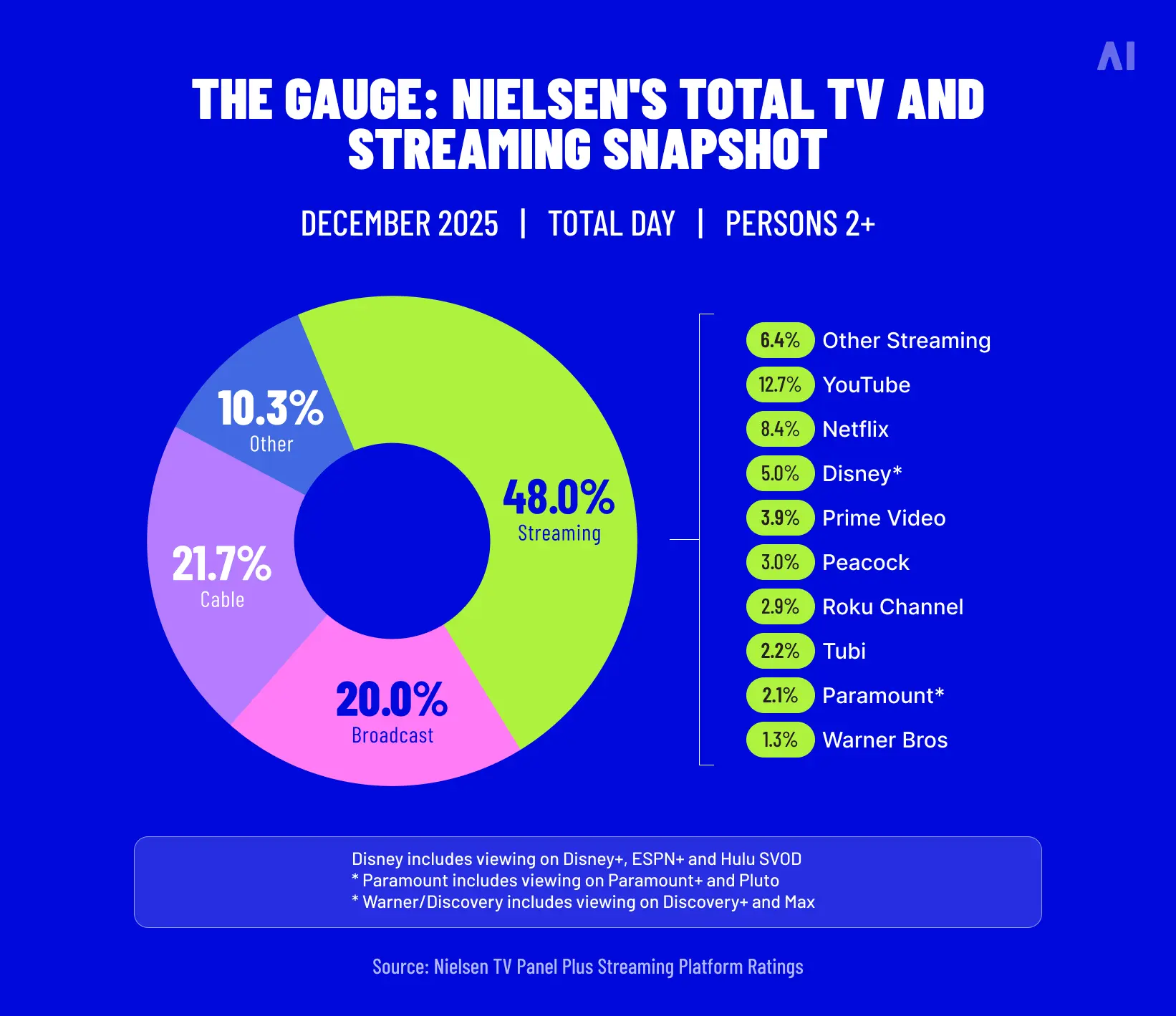
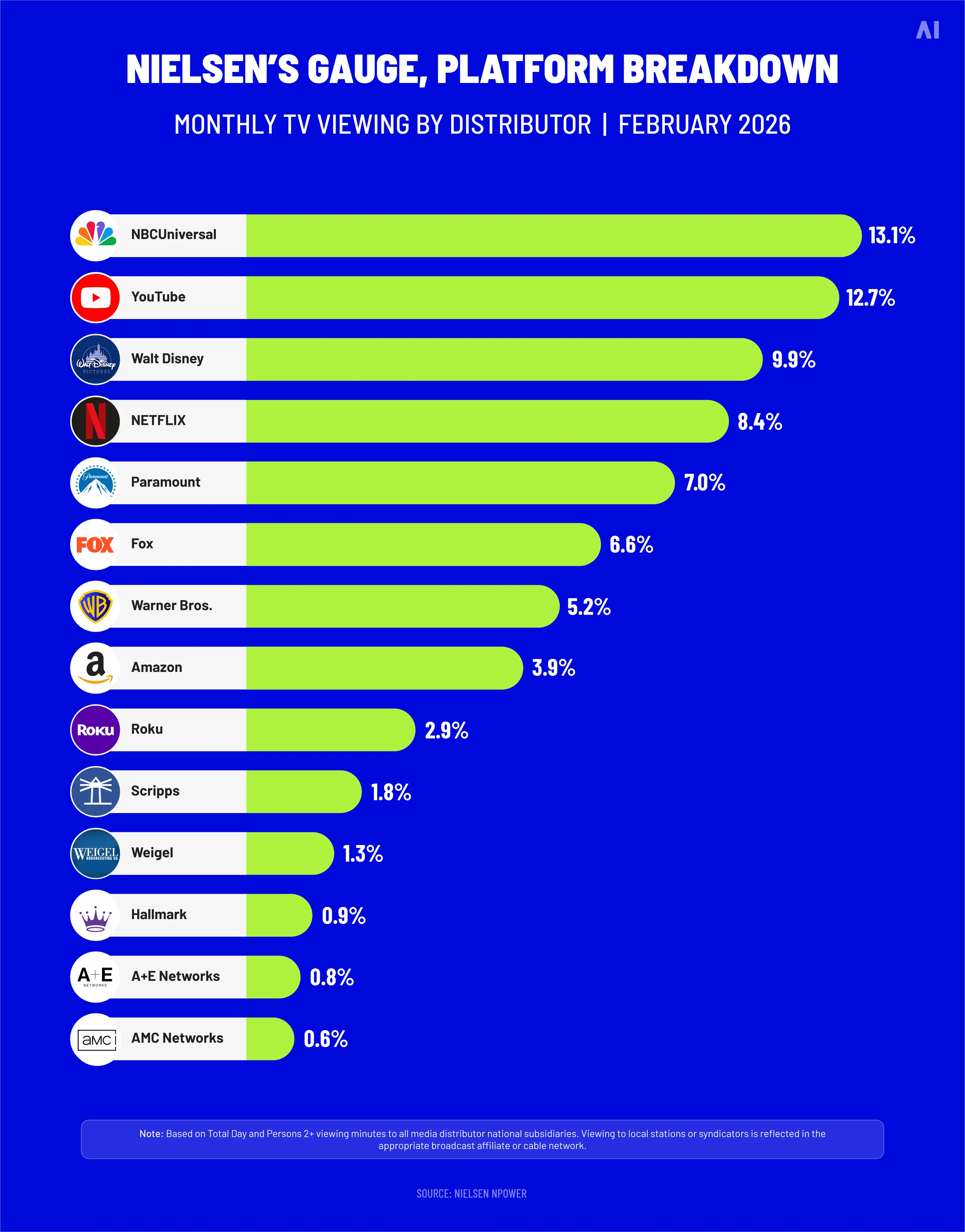
Television advertising no longer gets to call itself a branding channel and leave it at that. The CMO defending a TV budget in a quarterly review faces the same questions the CFO asks about paid search: what did it deliver, and can you show me? At the same time, the screen itself has changed hands. Nielsen's Gauge recorded streaming at 48% of all US viewing in February 2026 — the highest share on record. Linear is not finished, but it has lost something it is unlikely to get back: the assumption that it comes first.
The irony is that even with more platforms, more data and more measurement options than ever before, most advertisers still feel like passengers. Campaigns get handed off to agencies, routed through opaque supply chains, and reported on weeks later. By the time you see what worked, the window to do something about it is closed.
Self-serve TV advertising platforms are the answer to that problem. As TV becomes fully programmatic and data-driven, the self-serve platform is becoming the standard way modern marketing teams buy, optimize and measure streaming campaigns — not a cheaper alternative to managed service, but a different operating model built for control, speed and accountability. This article is a practical guide: how self-serve works, which platforms actually matter in 2026, how to pick one that fits your business, and how to avoid the mistakes that turn a powerful tool into an expensive hobby.
A self-serve advertising platform is a piece of software that lets an advertiser plan, buy, optimize and report on a campaign directly, without going through an agency or a managed-service team. You log in, upload creative, set a budget, choose targeting, and launch. The platform handles the auction mechanics, ad delivery and measurement in the background.
For years, TV was the opposite of this. Buying a spot meant negotiating with a network sales rep, committing to a flight weeks or months in advance, and waiting on paper reports to see what happened. A self serve ad platform for CTV collapses that workflow into an interface that, for anyone who has ever run a Google or Meta campaign, will feel immediately familiar. You pick an audience, pick an ad format, set a bid, and launch—sometimes in minutes.
What has changed in 2026 is the depth of what those platforms can do on the TV side. A good self-serve platform now gives you real-time bidding on premium streaming inventory, household-level targeting, non-skippable video, interactive and shoppable formats, and measurement that ties a 30-second spot to a website visit or a store trip. That is a radically different proposition from the TV self-serve tools of even three years ago.
The question most teams ask is not "is self-serve good?" but "is it right for us?" The honest answer is that each model has genuine strengths, and the choice depends on what you value most: execution speed, in-house expertise, cost structure, and how much you want to see inside the black box.
Managed service gives you a team of strategists, traders and analysts who run the campaign on your behalf. That team brings pattern recognition from hundreds of other campaigns, negotiating leverage with supply partners, and the bandwidth to act on data the moment it surfaces. The trade-off is cost (you are paying for people as well as media), some loss of direct control, and a dependency on the agency's priorities and DSP relationships.
Self-serve flips the economics. You pay platform fees rather than service fees. You own every decision. You can test an audience change at 10am, review the impact by lunchtime, and push the budget toward the winner by the end of the day. But that speed only produces results if the team behind the keyboard actually knows what it is looking at—and that is where many self-serve efforts quietly come apart.
The upside of a good self-serve platform is not only cost. It is tempo. Self-serve collapses the distance between a decision and its consequence—and on a channel where creative, audience and pacing levers all move performance, that tempo compounds.
Real-time optimization.Linear TV gave you a post-campaign report. A self-serve ad platform for CTV gives you dashboards that update within the hour. When a creative is underperforming, you swap it. When a region is over-delivering, you shift the budget. When frequency creeps above the point of diminishing return, you cap it. None of this requires a change order or a meeting.
Faster testing. On search and social, testing is table stakes. TV has lagged behind because production cycles were long and measurement was thin. Self-serve platforms have closed that gap, letting teams A/B test creative variants, audience segments and bid strategies inside a single campaign. One of the most striking shifts in CTV is that Roku's self-serve Ads Manager now lets brands launch campaigns from $500 using AI-upscaled social assets—an approach that would have been unthinkable on TV even two years ago.
Direct inventory access. Every intermediary in the supply chain takes a cut. The ANA's Q3 2025 Programmatic Transparency Benchmark found that the share of programmatic ad spend actually reaching publishers sits at 47.1%. Self-serve platforms that plug directly into publisher inventory—or that route through curated private marketplaces—reduce the number of hops and get more of each dollar onto the screen.
Accountability on outcomes, not impressions. Because self-serve platforms give advertisers direct access to their own data, the conversation moves from "we ran X million impressions" to "we drove Y visits, Z conversions." That shift is the reason CMOs are treating TV as performance inventory and not just awareness inventory.
Not every self-serve platform is built the same. The ones that deliver measurable outcomes share a specific set of capabilities—and the ones that do not, no matter how polished the interface looks, tend to leak efficiency in predictable ways. Here is what a 2026-grade self-serve advertising platform should do without you having to fight for it.
Cross-channel campaign management
TV does not exist in a vacuum. A viewer who sees your ad on a streaming service tonight is the same person scrolling social tomorrow and searching for your product on Wednesday. If your CTV campaign runs in one tool and your mobile and desktop campaigns run in three others, you are optimizing four fragments of the same journey in isolation.
A capable self-serve platform manages CTV, mobile and desktop campaigns in one place. That matters for three reasons.
Budget allocation gets smarter because the system can rebalance spend across devices based on incremental reach, not just cost per impression on any single channel.
Messaging stays consistent because creative and frequency caps apply across surfaces rather than in silos.
And performance tracking becomes unified, so you can see how an exposure on the big screen influenced the click that closed the sale.
The IAB's 2026 outlook singled out cross-platform measurement as one of the top focus areas for buyers, cited by 72% of respondents—up from 64% the prior year. The pressure to stitch channels together is coming from the top of the organization.
AI in ad platforms is no longer a side feature. It is the engine. The best self-serve platforms use machine learning to do three things well: predict which impressions are worth bidding on, reallocate budget toward audiences that are converting, and surface anomalies before they burn through a budget.
The practical benefit is fewer manual levers. Instead of a trader checking performance every few hours and adjusting bids by hand, the platform adjusts continuously—sometimes every few minutes.
The Trade Desk's Kokai platform, for example, is now running almost 100% of client spend, and the company's CEO Jeff Green put the market context plainly in Q3 2025 earnings: "CTV remains our largest and fastest-growing channel." AI is how platforms keep up with the volume and speed that modern CTV buying demands.
The caveat: AI only optimizes toward the goal you set. Ask it to drive the cheapest possible CPM and it will gladly serve your ad into low-value inventory. Ask it to drive qualified site visits or verified conversions, and the same engine produces very different outcomes. The KPI you feed the AI is the single most consequential decision you will make.
Transparent reporting is the difference between a platform that helps you improve and one that just shows you what happened. The benchmark: you should be able to see where every impression ran, what it cost, what it drove, and how that compares to forecast, without submitting a data request.
This matters more on TV than on any other digital channel. CTV supply chains are newer, thinner on standards, and riddled with duplication.
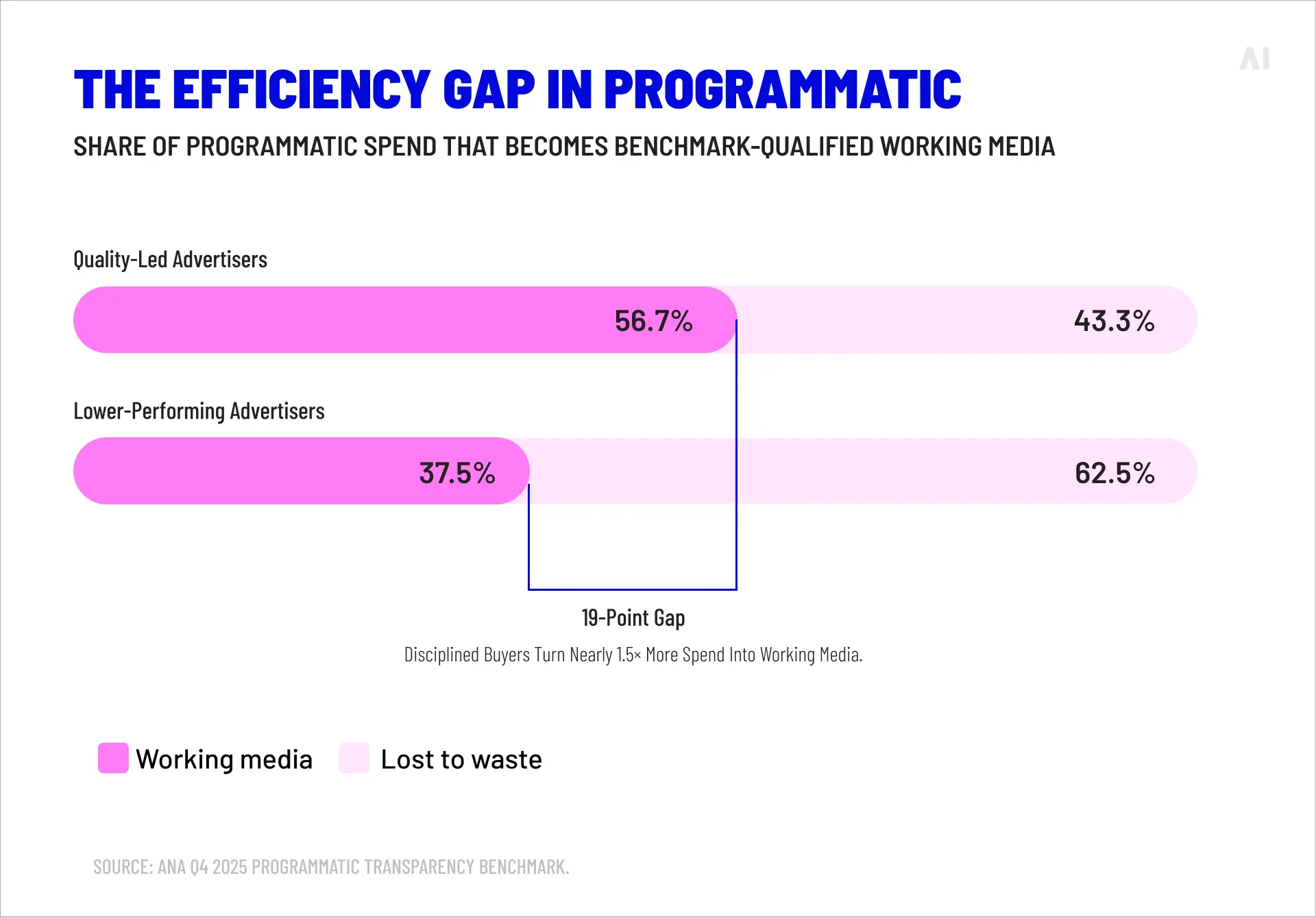
The ANA's Q2 2025 benchmark found that programmatic waste still costs global advertisers $26.8 billion annually, even as made-for-advertising exposure has dropped to a median of 0.8% of spend. ANA CEO Bob Liodice summarized the state of play by saying "quality is no longer a defensive control. It is the primary driver of programmatic performance."
The efficiency gap in programmatic
A self-serve platform that hides its supply chain behind aggregated dashboards is a platform you cannot audit. And on TV, what you cannot audit tends to cost you.
Good platforms go further than transparency—they provide attribution that connects TV exposures to downstream behavior, including site visits, app installs, store visits and sales. Multi-touch and incrementality-based methods are rapidly becoming the standard for brands that want to prove TV is doing real work, not just finishing touches on a conversion their paid search was already going to win.
Creative is the single biggest lever in TV advertising, and historically it was also the biggest barrier. Producing a broadcast-ready spot could take months and a five-figure budget—which put TV out of reach for many mid-market brands. 2026 self-serve platforms are tearing that barrier down.
Look for platforms that let you upload multiple creative variants and rotate them by audience, daypart or placement.
Look for built-in tools that take social-format assets and upscale them for streaming, which lets teams redeploy existing creative rather than commissioning new ones.
And look for support for interactive and shoppable formats—a viewer pressing OK on a Roku remote to add something to a cart is no longer a novelty, it is an expected capability.
The strongest creative workflows let you test versions early and often. When a platform can tell you within days which version resonated with which audience, you stop making creative decisions by committee and start making them by data.
There is no league table of CTV platforms, and treating the landscape as one leads to poor decisions. What exists is a map of different specializations—enterprise scale here, performance marketing there, retail media in one corner, privacy-first buying in another. The right choice depends on what you are trying to do, not on which name you happened to encounter first.
The ten platforms below are the ones currently shaping how advanced advertisers buy TV inventory in 2026. Each entry describes what the platform is best suited to, where it genuinely excels, and the trade-offs worth knowing before you commit a budget.
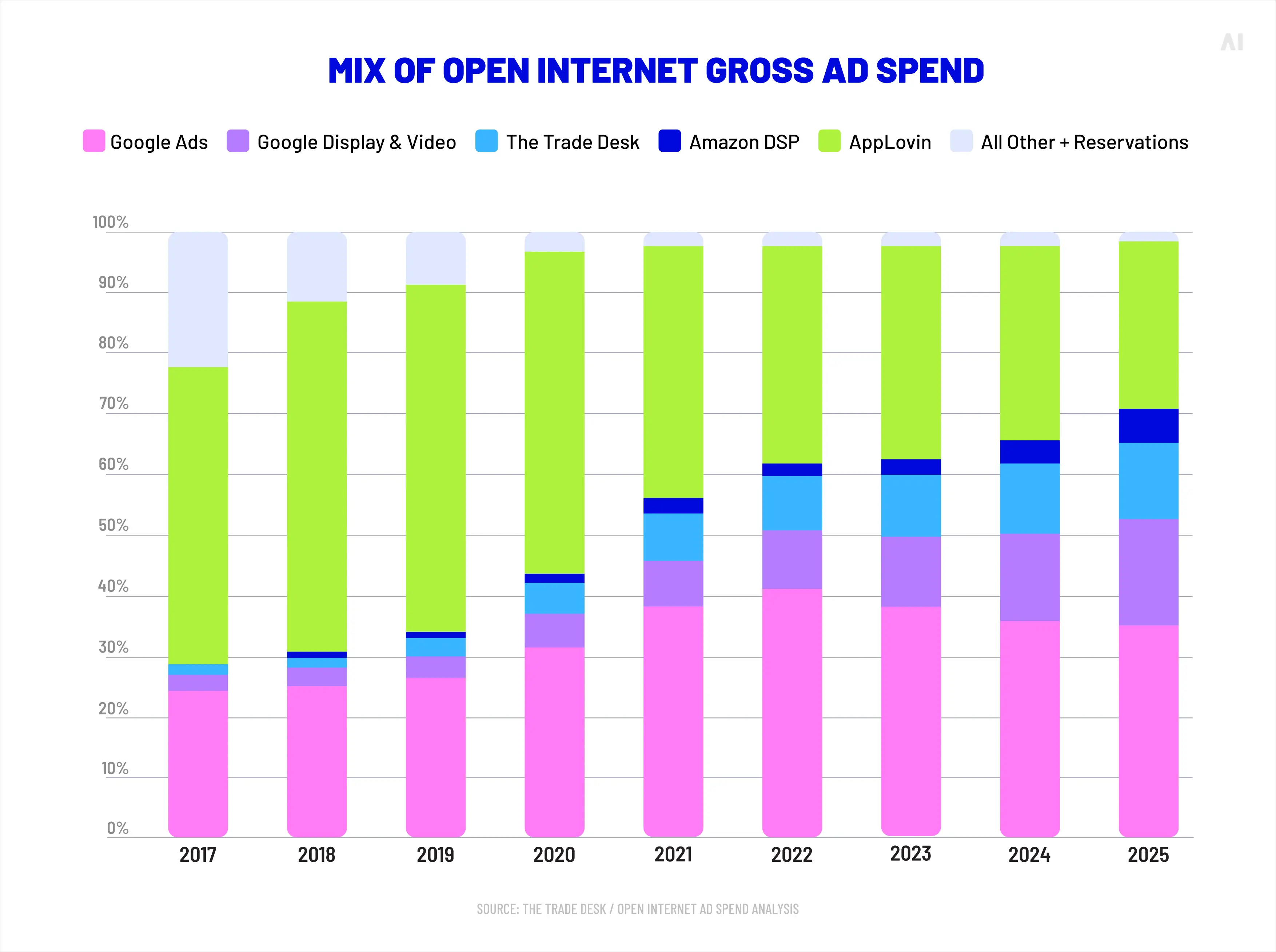
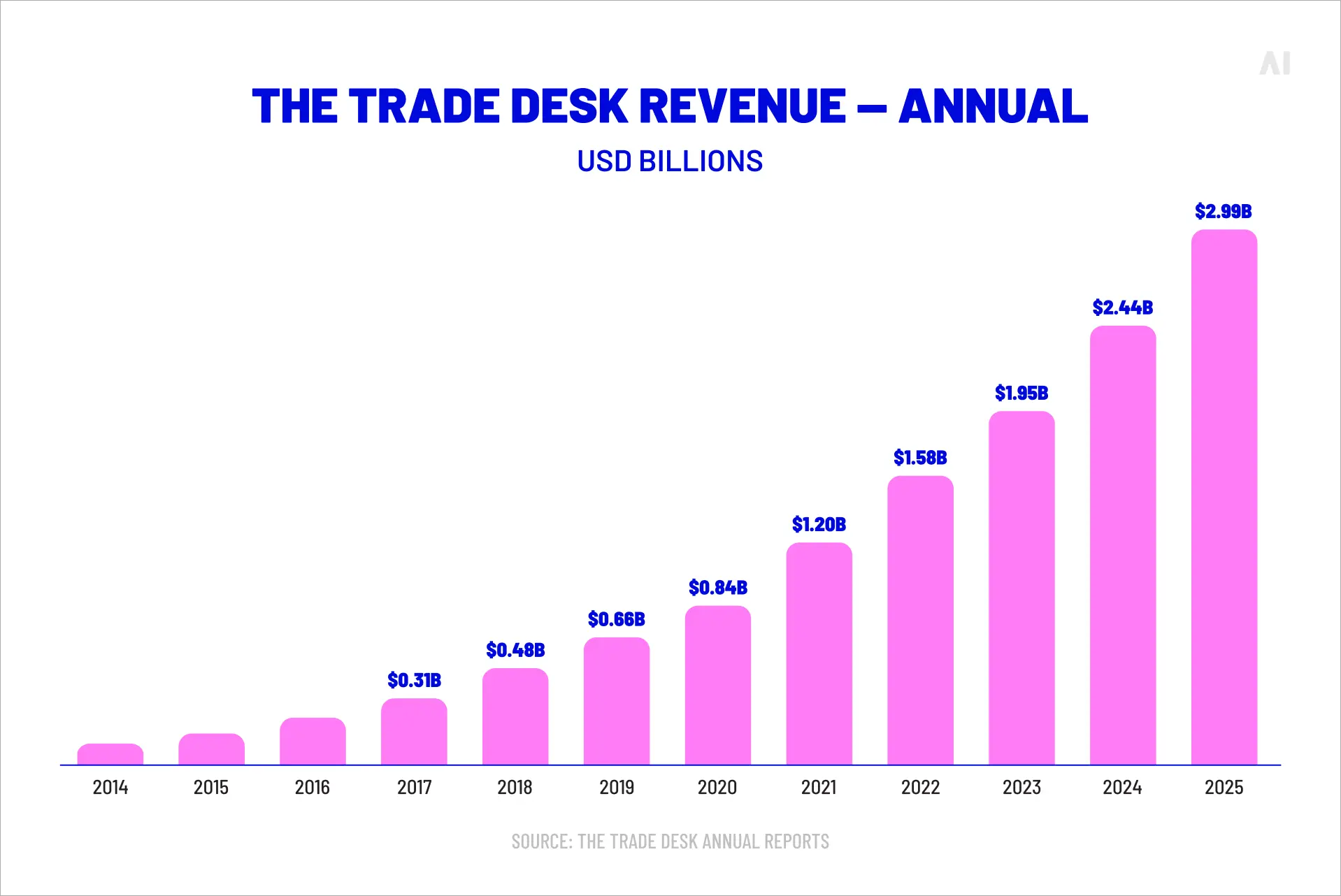
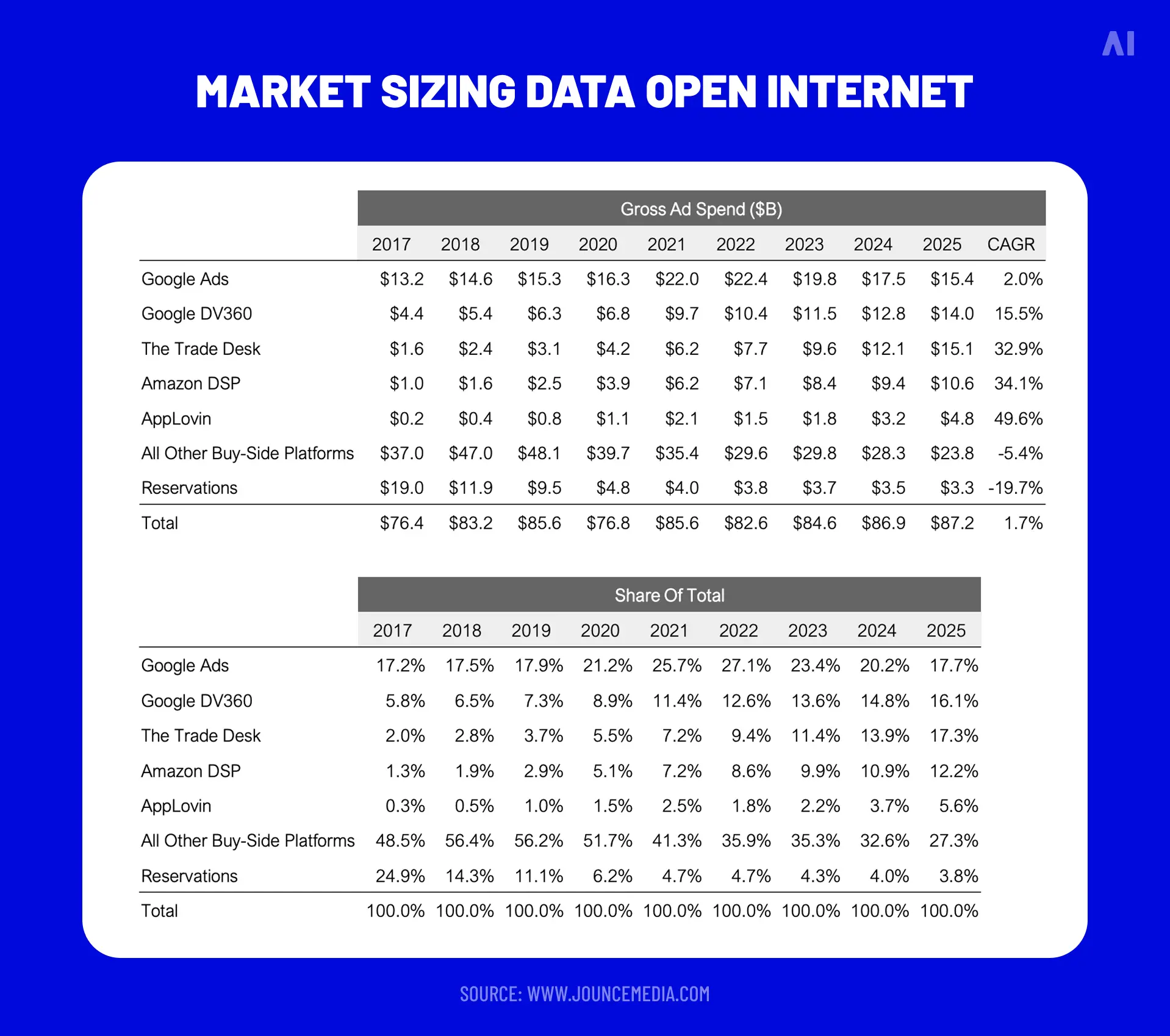
The Trade Desk is the independent DSP of choice for large advertisers running high-budget, cross-channel programmatic campaigns. Its FY2025 revenue reached $2.9 billion, with CTV its largest and fastest-growing channel, and its Kokai AI platform now handling nearly all client spend. The Trade Desk's strength is scale combined with independence—it does not own inventory, so its optimization engine is not conflicted by the need to fill owned supply.
What to know:The Trade Desk is a true enterprise tool. It rewards advertisers who bring sophisticated data, dedicated traders and real budget to the platform. Smaller advertisers often struggle to reach the minimums that unlock its most valuable features, and the learning curve is steeper than consumer-grade self-serve tools.
Google DV360
Google Display & Video 360 sits inside the broader Google Marketing Platform and is built for advertisers who want to manage CTV, video, display and other formats under one roof. Its deepest strength is integration with YouTube and the rest of the Google ecosystem, plus robust measurement and audience tools. For teams already running paid search and YouTube, DV360 extends a familiar workflow into streaming.
What to know: DV360's integration with Google inventory is a double-edged sword. On the one hand, you get unmatched access to YouTube on CTV, which leads the US streaming category with a double-digit share of all TV viewing time. On the other, the platform's optimization naturally favors Google-owned inventory, which is not automatically the most efficient choice for every objective. Independent verification of supply path and placement quality is more important here than on a neutral DSP.
Amazon Ads
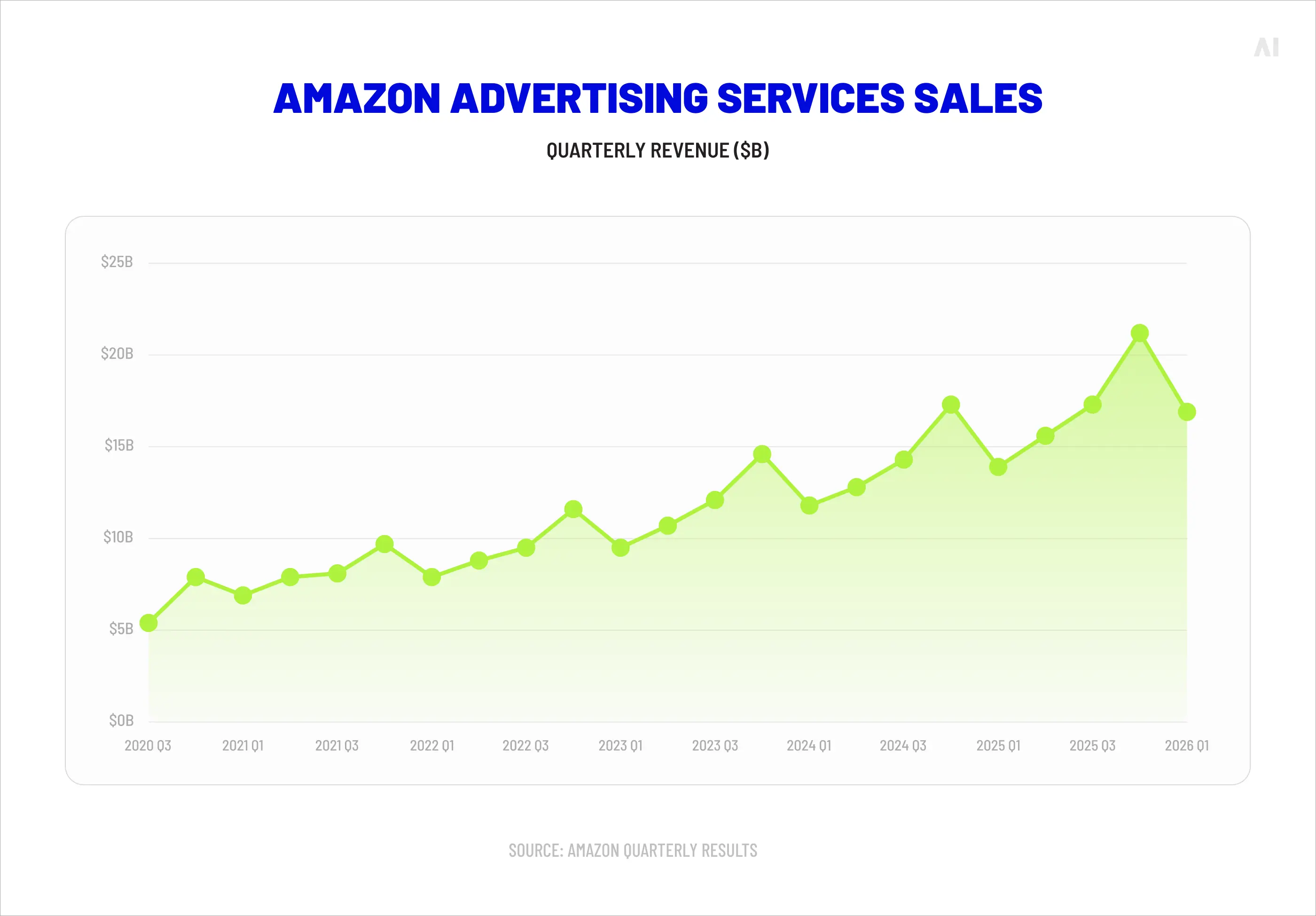
Amazon Ads is the default platform for brands where the goal is sales—online, in-store, or on Amazon itself. The combination of Amazon DSP plus Prime Video plus first-party retail data creates closed-loop attribution that no other platform can match for commerce brands. Prime Video alone now reaches 315 million ad-supported viewers globally, and Amazon's Q4 2025 advertising revenue hit $21.3 billion.
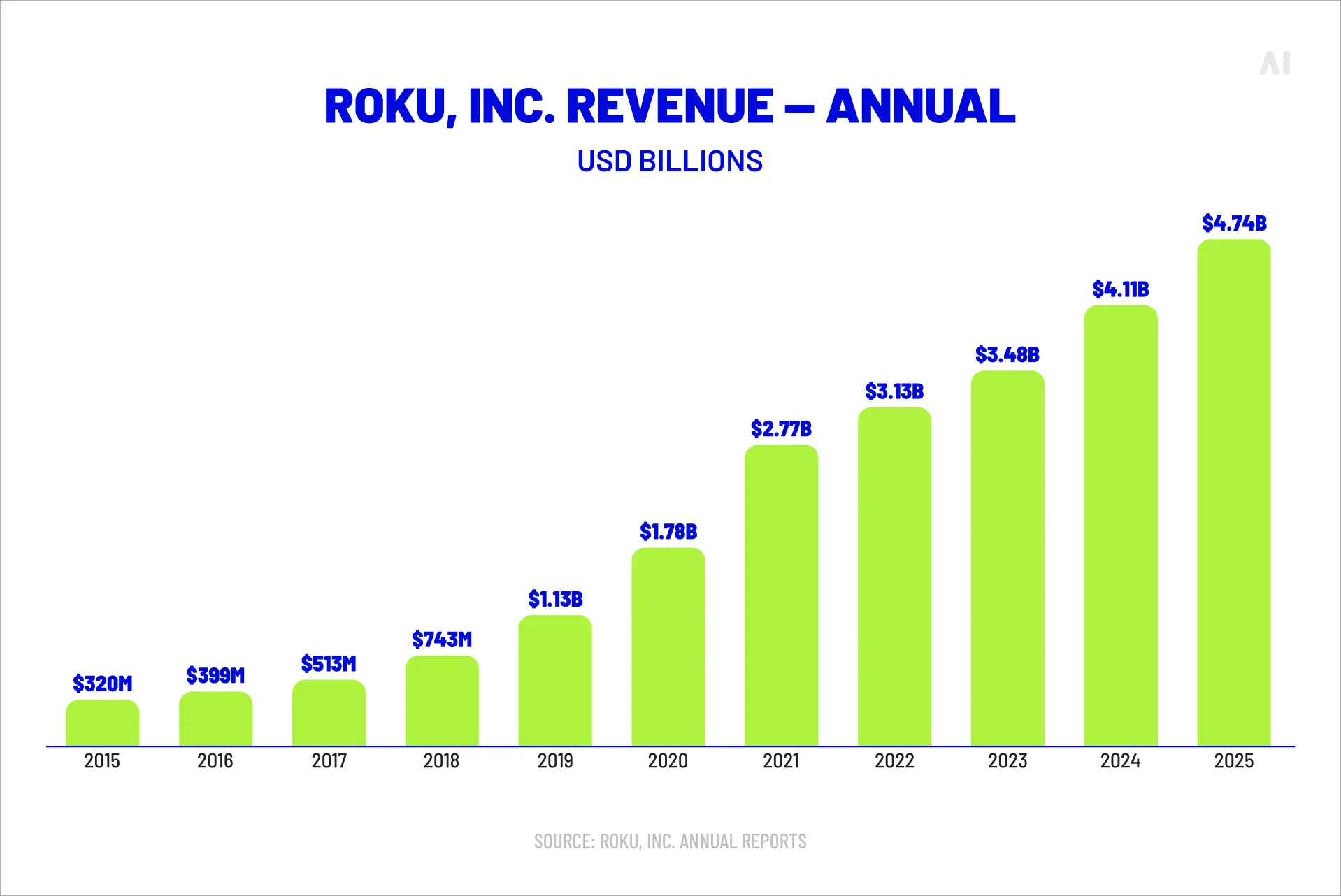
Roku Ads Manager is the most accessible self-serve CTV platform on the market. Campaigns can launch with a $500 minimum, creatives can be adapted from social via a built-in upscaler, and Action Ads plus Shopify integration let viewers transact directly from the remote. Roku also owns a major slice of CTV device share and operates The Roku Channel, one of the largest free ad-supported streaming services in the US.
What to know: Roku's biggest strength is also its biggest limitation—the inventory is concentrated in the Roku ecosystem. For advertisers looking for broad cross-publisher reach, Roku is a strong anchor but not a standalone solution. And the premium managed option, Roku OneView, sits at an entirely different price point (minimums starting in the tens of thousands), so there is a gap between "small test budget" and "enterprise buy" that needs to be navigated deliberately.
Samsung Ads
Samsung Ads leverages deterministic data from one of the largest smart TV installed bases in the US—77 million active Samsung smart TVs feeding ACR data into audience segments. This gives Samsung an unusually accurate view of what real viewers actually watch, across linear and streaming, on the biggest screen in the home. Samsung Ads works especially well for advertisers who want to target households based on viewing behavior rather than declared interests.
What to know: Samsung's data advantage is meaningful, but it is also walled. To access the richest ACR-based audiences and the OS-level ad formats, advertisers generally need a direct relationship with Samsung Ads or a specific DSP integration. That adds operational complexity if you are trying to centralize all TV buying in one tool.
LG Ads Solutions
LG Ad Solutions uses ACR data from its own webOS-powered smart TVs to understand viewing behavior and deliver relevant ads. Its strengths sit in cross-screen targeting, linear-plus-streaming measurement, and a set of interactive formats native to the LG home screen. For advertisers looking to reach audiences on the second-largest smart TV installed base in the US, LG is the direct route.
What to know: Like Samsung, LG's richest capabilities depend on its own data and inventory, which means cross-platform reach requires pairing it with other tools. LG's self-serve access is also less mature than Roku's—it skews more toward managed and direct partnerships for now.
StackAdapt
StackAdapt is a multi-channel self-serve DSP that has found a strong niche among performance-focused marketers. It is known for a clean interface, fast onboarding, and a predictive-AI engine that handles bidding and audience optimization without heavy manual intervention. For teams that want programmatic CTV alongside display, native, video and audio in a single tool, StackAdapt is a practical choice.
What to know: StackAdapt is built for speed of execution and is less configurable than the largest enterprise DSPs. Advanced users sometimes hit ceilings on granular bid logic or custom algorithms. It is best thought of as a platform that optimizes quickly within sensible defaults—not one that gives you infinite levers to pull.
Basis Technologies
Basis Technologies focuses on the operational side of programmatic advertising: planning, workflow, billing, reporting and campaign organization across multiple channels and partners. Its appeal is strongest among agencies and in-house teams managing large portfolios of campaigns where the cost of operational overhead is itself a material line item.
What to know: Basis is less about cutting-edge CTV optimization and more about running a tidy shop. If your primary challenge is that campaign management itself is eating your team's time, Basis addresses that directly. If you are looking for bleeding-edge AI bidding or CTV-specific innovation, other platforms are more specialized.
Mediasmart (Affle)
Mediasmart, part of Affle, specializes in cross-device targeting—particularly the bridge between mobile and CTV. Its strength is in unified audience reach and frequency management across screens, which makes it a useful choice for advertisers running global campaigns where mobile is dominant but CTV is growing fast. It tends to punch above its weight in APAC and emerging markets.
What to know: Mediasmart's US-market footprint is smaller than the majors, and advertisers focused purely on premium US CTV inventory may find its depth in that specific segment less extensive than Roku, Amazon or The Trade Desk.
Adform
Adform positions itself as a privacy-first, ID-agnostic platform built for a cookieless world. It offers strong support for first-party data activation, contextual targeting, and operates with unusual transparency around its ad tech fees. For advertisers in regulated industries or markets where privacy compliance is non-negotiable, Adform's approach is a genuine asset.
What to know: Adform has stronger presence and inventory depth in Europe than in the US, so American advertisers evaluating it should pressure-test its US CTV inventory coverage against their specific market and audience requirements before committing.
How to choose the self-serve TV advertising platform
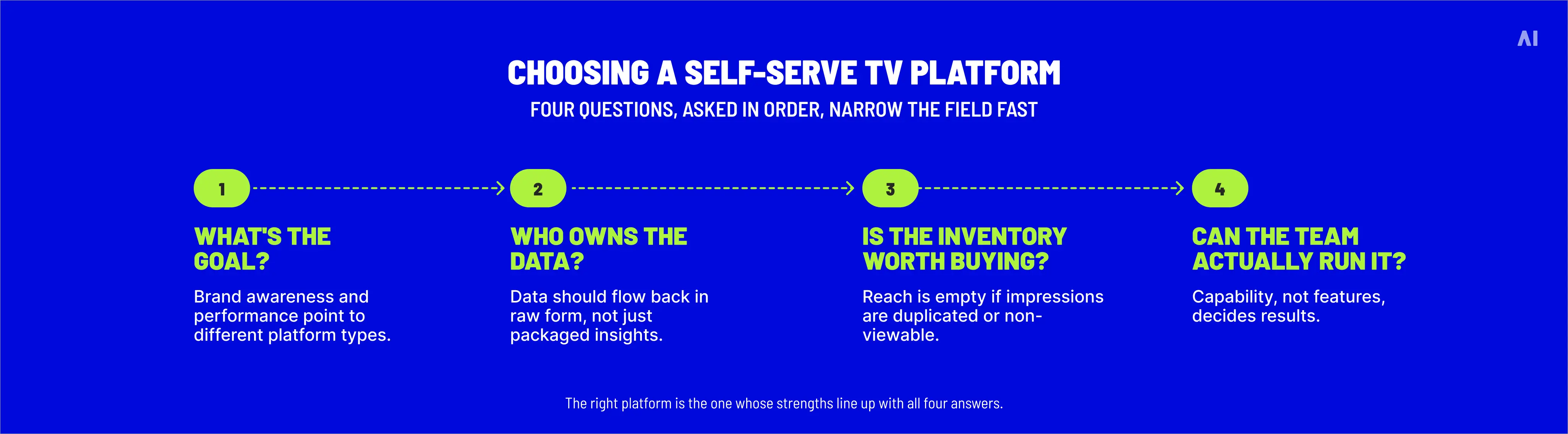
There is no best self serve platform. There is only the one whose strengths happen to match your business goal, your team's capacity, and the level of scrutiny your spend will have to survive. Four questions, taken in order, tend to narrow the field quickly.
Choosing a self-serve TV platform: four questions.
First, what is the primary goal? Brand awareness and performance marketing pull in different directions. If the job is to build broad, qualified reach across streaming households, platforms with deep inventory and ACR data—Samsung, LG, Roku, DV360—rise to the top. If the job is to drive measurable sales or sign-ups, platforms with strong attribution and commerce signals—Amazon, The Trade Desk, StackAdapt—are the stronger fit. A platform optimized for the wrong objective will deliver against its defaults, not yours.
Second, who owns the data? This is the single most important question and the one most often skipped. You want a platform where audience data, performance data and supply-path data flow back to you, ideally in raw form, and where you retain ownership of audiences you build. If the platform offers you "insights" but not data, assume you are renting, not owning, your marketing intelligence.
Third, is the inventory actually worth buying? CTV has a transparency problem. A platform's reach number is meaningless if a third of those impressions are non-viewable, duplicated across streaming services, or delivered through supply paths that absorb half the spend before it reaches the publisher. The ANA's Q2 2025 benchmark showed CTV's share of programmatic spend jumping to 44%, with private marketplaces now accounting for nearly 88% of spend—a sign that the market is moving toward curated, higher-quality environments. Pick platforms that are part of that shift.
Fourth, can your team actually drive the platform? This is where many self-serve deployments quietly fail. A powerful platform in the hands of a team without the time, training or analytical muscle to run it delivers worse results than a managed campaign. Be honest about the internal capability on day one—because the platform that looks most sophisticated on a demo is not always the one that produces results in your hands.
How to improve performance in self-service ads with AI decisions
Picking the right platform is half the job. Running it well is the other half—and this is where most self-serve programs plateau. Great performance on a self-serve ad platform is not the result of finding a magic setting. It is the product of three layered decisions: how you connect the platforms to each other, how you let AI handle the optimization, and how you control the quality of inventory you actually buy.
Strategy for self-serve platforms
The mistake many teams make with self-serve is treating each platform as its own campaign. Ten self-serve platforms running independently produce ten siloed optimizations, ten partial views of the audience, and zero unified performance picture.
AI Digital's Open Garden framework inverts the logic: it connects multiple self-serve platforms under a single KPI-driven strategy, unifying data, audience targeting and measurement across channels so that decisions made in one tool account for what is happening in the others.
As Mary Gabrielyan, Chief Strategy Officer at AI Digital, puts it:"Self-serve platforms give marketers control. A framework that connects them gives marketers compounding returns."
The point is not to strip teams of their platform choice—it is to make every platform more effective by putting it in context.
The second lever is intelligent optimization across the full campaign lifecycle—not just during the live campaign, but before it launches and after it ends.
AI Digital's Elevate platform is an AI-powered marketing intelligence layer that sits across self-serve platforms to unify research, planning, optimization and reporting. It draws on 150 billion data points monthly and more than 10,000 audience attributes to help teams define audiences, generate personas, build and refine media plans, model competitive activity and produce cross-platform reporting—all in one environment, and all platform-agnostic.
The pre-campaign side matters more than most teams realize:
Elevate's AI Audience Segments convert a plain-English audience brief into channel-specific segments ready for activation.
Its Audience Personas module turns a single prompt into evidence-backed personas for planning and creative.
Its competitive analysis surfaces what rivals are spending, where, and on what creative strategies.
Once a campaign is live, its reporting layer covers standard media KPIs plus marketing mix modelling and path-to-conversion analysis, letting teams see the full customer journey rather than just last-click outcomes.
The practical effect is that the AI does not replace the planner, trader or strategist. It removes the drudgery—the audience builds, the weekly reporting, the competitor audits—and returns those hours to the humans who need to be thinking about strategy and creative.
Inventory quality in self-serve advertising platforms
The final lever is the quality of inventory flowing into the platform in the first place. No optimization engine can make bad inventory perform well.
AI Digital's Smart Supply curates premium, brand-safe CTV and programmatic inventory, filters out non-viewable and fraudulent traffic before it reaches clients, and optimizes supply paths to reduce ad tech fees.
The industry context makes the case: MFA exposure has dropped to a median of 0.8% of spend in the latest ANA benchmark, but the $26.8 billion waste figure shows there is still a substantial efficiency gap most self-serve buyers are absorbing silently. Curated supply is how that gap closes.
Is a self-service ad platform right for your business
The honest answer: self-serve is a fit for teams that are ready to actively run the platform, and a poor fit for teams that want outcomes without internal ownership. There is no shame in either answer—but getting it right prevents a lot of expensive disappointment.
Self-serve makes sense if you have a performance marketing team already running paid search and paid social, if your leadership is comfortable with ongoing platform fees in exchange for lower agency costs, and if your team has the time to optimize campaigns continuously rather than set-and-forget.
Self-serve is less suited to teams without an in-house trader or analyst, teams that need campaign execution outsourced in order to focus on strategy, or teams whose budget is too small to justify the learning curve.
A productive middle path exists. Many of the most effective TV programs in 2026 combine self-serve platforms for execution flexibility with a layer of external strategy, intelligence and curation on top. AI Digital's Open Garden framework, Elevate intelligence platform and Smart Supply curation are built for exactly this hybrid model—supporting teams that want the control of self-serve with the outcomes of managed service. If you are navigating that decision for 2026 planning, get in touch—we can walk through where self-serve makes sense for your business and where an additional layer of intelligence will compound its impact.
• Platforms own AI models and train on proprietary data • Brands have little visibility into decision-making • "Walled gardens" restrict data access
• Inefficient ad spend • Limited strategic control • Eroded consumer trust • Potential budget mismanagement
Open Garden framework providing: • Complete transparency • DSP-agnostic execution • Cross-platform data & insights
Optimizing ads vs. optimizing impact
• AI excels at short-term metrics but may struggle with brand building • Consumers can detect AI-generated content • Efficiency might come at cost of authenticity
• Short-term gains at expense of brand health • Potential loss of authentic connection • Reduced effectiveness in storytelling
Smart Supply offering: • Human oversight of AI recommendations • Custom KPI alignment beyond clicks • Brand-safe inventory verification
The illusion of personalization
• Segment optimization rebranded as personalization • First-party data infrastructure challenges • Personalization vs. surveillance concerns
• Potential mismatch between promise and reality • Privacy concerns affecting consumer trust • Cost barriers for smaller businesses
Elevate platform features: • Real-time AI + human intelligence • First-party data activation • Ethical personalization strategies
AI-Driven efficiency vs. decision-making
• AI shifting from tool to decision-maker • Black box optimization like Google Performance Max • Human oversight limitations
• Strategic control loss • Difficulty questioning AI outputs • Inability to measure granular impact • Potential brand damage from mistakes
Managed Service with: • Human strategists overseeing AI • Custom KPI optimization • Complete campaign transparency
Fig. 1. Summary of AI blind spots in advertising
Dimension
Walled garden advantage
Walled garden limitation
Strategic impact
Audience access
Massive, engaged user bases
Limited visibility beyond platform
Reach without understanding
Data control
Sophisticated targeting tools
Data remains siloed within platform
Fragmented customer view
Measurement
Detailed in-platform metrics
Inconsistent cross-platform standards
Difficult performance comparison
Intelligence
Platform-specific insights
Limited data portability
Restricted strategic learning
Optimization
Powerful automated tools
Black-box algorithms
Reduced marketer control
Fig. 2. Strategic trade-offs in walled garden advertising.
Core issue
Platform priority
Walled garden limitation
Real-world example
Attribution opacity
Claiming maximum credit for conversions
Limited visibility into true conversion paths
Meta and TikTok's conflicting attribution models after iOS privacy updates
Data restrictions
Maintaining proprietary data control
Inability to combine platform data with other sources
Amazon DSP's limitations on detailed performance data exports
Cross-channel blindspots
Keeping advertisers within ecosystem
Fragmented view of customer journey
YouTube/DV360 campaigns lacking integration with non-Google platforms
Black box algorithms
Optimizing for platform revenue
Reduced control over campaign execution
Self-serve platforms using opaque ML models with little advertiser input
Performance reporting
Presenting platform in best light
Discrepancies between platform-reported and independently measured results
Consistently higher performance metrics in platform reports vs. third-party measurement
Fig. 1. The Walled garden misalignment: Platform interests vs. advertiser needs.
Key dimension
Challenge
Strategic imperative
ROAS volatility
Softer returns across digital channels
Shift from soft KPIs to measurable revenue impact
Media planning
Static plans no longer effective
Develop agile, modular approaches adaptable to changing conditions
Brand/performance
Traditional division dissolving
Create full-funnel strategies balancing long-term equity with short-term conversion
Capability
Key features
Benefits
Performance data
Elevate forecasting tool
• Vertical-specific insights • Historical data from past economic turbulence • "Cascade planning" functionality • Real-time adaptation
• Provides agility to adjust campaign strategy based on performance • Shows which media channels work best to drive efficient and effective performance • Confident budget reallocation • Reduces reaction time to market shifts
• Dataset from 10,000+ campaigns • Cuts response time from weeks to minutes
• Reaches people most likely to buy • Avoids wasted impressions and budgets on poor-performing placements • Context-aligned messaging
• 25+ billion bid requests analyzed daily • 18% improvement in working media efficiency • 26% increase in engagement during recessions
Full-funnel accountability
• Links awareness campaigns to lower funnel outcomes • Tests if ads actually drive new business • Measures brand perception changes • "Ask Elevate" AI Chat Assistant
• Upper-funnel to outcome connection • Sentiment shift tracking • Personalized messaging • Helps balance immediate sales vs. long-term brand building
• Natural language data queries • True business impact measurement
Open Garden approach
• Cross-platform and channel planning • Not locked into specific platforms • Unified cross-platform reach • Shows exactly where money is spent
• Reduces complexity across channels • Performance-based ad placement • Rapid budget reallocation • Eliminates platform-specific commitments and provides platform-based optimization and agility
• Coverage across all inventory sources • Provides full visibility into spending • Avoids the inability to pivot across platform as you’re not in a singular platform
Fig. 1. How AI Digital helps during economic uncertainty.
Trend
What it means for marketers
Supply & demand lines are blurring
Platforms from Google (P-Max) to Microsoft are merging optimization and inventory in one opaque box. Expect more bundled “best available” media where the algorithm, not the trader, decides channel and publisher mix.
Walled gardens get taller
Microsoft’s O&O set now spans Bing, Xbox, Outlook, Edge and LinkedIn, which just launched revenue-sharing video programs to lure creators and ad dollars. (Business Insider)
Retail & commerce media shape strategy
Microsoft’s Curate lets retailers and data owners package first-party segments, an echo of Amazon’s and Walmart’s approaches. Agencies must master seller-defined audiences as well as buyer-side tactics.
AI oversight becomes critical
Closed AI bidding means fewer levers for traders. Independent verification, incrementality testing and commercial guardrails rise in importance.
Fig. 1. Platform trends and their implications.
Metric
Connected TV (CTV)
Linear TV
Video Completion Rate
94.5%
70%
Purchase Rate After Ad
23%
12%
Ad Attention Rate
57% (prefer CTV ads)
54.5%
Viewer Reach (U.S.)
85% of households
228 million viewers
Retail Media Trends 2025
Access Complete consumer behaviour analyses and competitor benchmarks.
Identify and categorize audience groups based on behaviors, preferences, and characteristics
Michaels Stores: Implemented a genAI platform that increased email personalization from 20% to 95%, leading to a 41% boost in SMS click through rates and a 25% increase in engagement.
Estée Lauder: Partnered with Google Cloud to leverage genAI technologies for real-time consumer feedback monitoring and analyzing consumer sentiment across various channels.
High
Medium
Automated ad campaigns
Automate ad creation, placement, and optimization across various platforms
Showmax: Partnered with AI firms toautomate ad creation and testing, reducing production time by 70% while streamlining their quality assurance process.
Headway: Employed AI tools for ad creation and optimization, boosting performance by 40% and reaching 3.3 billion impressions while incorporating AI-generated content in 20% of their paid campaigns.
High
High
Brand sentiment tracking
Monitor and analyze public opinion about a brand across multiple channels in real time
L’Oréal: Analyzed millions of online comments, images, and videos to identify potential product innovation opportunities, effectively tracking brand sentiment and consumer trends.
Kellogg Company: Used AI to scan trending recipes featuring cereal, leveraging this data to launch targeted social campaigns that capitalize on positive brand sentiment and culinary trends.
High
Low
Campaign strategy optimization
Analyze data to predict optimal campaign approaches, channels, and timing
DoorDash: Leveraged Google’s AI-powered Demand Gen tool, which boosted its conversion rate by 15 times and improved cost per action efficiency by 50% compared with previous campaigns.
Kitsch: Employed Meta’s Advantage+ shopping campaigns with AI-powered tools to optimize campaigns, identifying and delivering top-performing ads to high-value consumers.
High
High
Content strategy
Generate content ideas, predict performance, and optimize distribution strategies
JPMorgan Chase: Collaborated with Persado to develop LLMs for marketing copy, achieving up to 450% higher clickthrough rates compared with human-written ads in pilot tests.
Hotel Chocolat: Employed genAI for concept development and production of its Velvetiser TV ad, which earned the highest-ever System1 score for adomestic appliance commercial.
High
High
Personalization strategy development
Create tailored messaging and experiences for consumers at scale
Stitch Fix: Uses genAI to help stylists interpret customer feedback and provide product recommendations, effectively personalizing shopping experiences.
Instacart: Uses genAI to offer customers personalized recipes, mealplanning ideas, and shopping lists based on individual preferences and habits.
Medium
Medium
Share article
Url copied to clipboard
No items found.
Subscribe to our Newsletter
THANK YOU FOR YOUR SUBSCRIPTION
Oops! Something went wrong while submitting the form.
Questions? We have answers
What is the best self-serve advertising platform for TV in 2026?
There is no single answer—the best self-serve ad platform depends on your goal. For enterprise-scale independent buying, The Trade Desk is the category leader. For commerce-driven brands, Amazon Ads is unmatched on closed-loop attribution. For mid-market or performance-first teams testing CTV with modest budgets, Roku Ads Manager and StackAdapt are the most accessible starting points. The platform that "wins" is the one whose strengths align with your specific objective, data access, and team capability.
How much does self-serve TV advertising actually cost?
Costs fall into two buckets: media and fees. Media on premium CTV typically runs in the $20–60 CPM range depending on platform, audience and daypart, with Prime Video and premium sports commanding higher rates. Platform fees vary widely—Roku's self-serve starts at a $500 campaign minimum, Amazon DSP's self-service recommends around $10,000, and The Trade Desk is generally an enterprise engagement with six- or seven-figure annual commitments. Beyond that, factor in creative production (though upscaling tools now let teams reuse social assets) and the internal team cost of running campaigns.
Are self-service ads worth it for small and mid-sized businesses?
They can be—far more than they were even two years ago. The arrival of self-serve tools like Roku Ads Manager with low minimums, combined with AI-powered creative upscaling that eliminates most production cost, has brought CTV within reach of mid-market budgets. The caveat is that small businesses typically have less capacity to optimize campaigns continuously, which means the gap between "launched a campaign" and "ran a campaign well" can be wide. Starting small, measuring rigorously, and scaling what works is the safest path.
Which self serve ad platforms deliver the highest ROI?
ROI is always a function of fit, not platform. In practice, commerce brands often see the highest immediate ROI on Amazon Ads because purchase-data attribution is closest to the sale. Performance brands running rigorous measurement across Roku, The Trade Desk or StackAdapt frequently report strong efficiency once their team has built platform-specific expertise. The common pattern: advertisers who measure outcomes rigorously and optimize weekly outperform those who treat TV as fire-and-forget—regardless of platform.
Can self-serve TV advertising replace agencies completely?
For some brands, yes. For most, no. Self-serve replaces the execution layer of an agency—the traders, the campaign managers, the reporting team. It does not replace strategic planning, media mix modelling, creative strategy, or the negotiating leverage an agency brings to publisher relationships. Many of the best-performing 2026 TV programs run on a hybrid model: self-serve platforms for execution, external strategy and intelligence on top.
How do you measure performance in self-serve TV campaigns?
Start with the business outcome, not the media metric. Useful measurement combines platform-level signals (impressions, completion rates, reach, frequency) with outcome signals—site visits, qualified leads, app installs, conversions, store visits, brand lift. Multi-touch attribution and marketing mix modelling are both gaining ground as advertisers push past last-click models that systematically under-credit TV. The highest-performing teams triangulate: platform data, analytics, incrementality testing and periodic MMM refreshes together produce a view no single measurement method provides alone.
What mistakes kill performance in self-serve advertising platforms?
The recurring ones: optimizing toward the wrong KPI (CPM instead of outcome), letting AI run unchecked against generic defaults, ignoring supply-path quality, failing to invest in creative testing, and treating each platform as a standalone campaign rather than part of a unified strategy. The thread running through all of them is the same—self-serve is only as strong as the decisions the team makes with it. The platform is the guitar, not the song.
Have other questions?
If you have more questions, contact us so we can help.
Questions? We have answers
This is some text inside of a div block.
Lorem ipsum dolor sit amet, consectetur adipiscing elit. Suspendisse varius enim in eros elementum tristique. Duis cursus, mi quis viverra ornare, eros dolor interdum nulla, ut commodo diam libero vitae erat. Aenean faucibus nibh et justo cursus id rutrum lorem imperdiet. Nunc ut sem vitae risus tristique posuere.
This is some text inside of a div block.
Lorem ipsum dolor sit amet, consectetur adipiscing elit. Suspendisse varius enim in eros elementum tristique. Duis cursus, mi quis viverra ornare, eros dolor interdum nulla, ut commodo diam libero vitae erat. Aenean faucibus nibh et justo cursus id rutrum lorem imperdiet. Nunc ut sem vitae risus tristique posuere.
This is some text inside of a div block.
Lorem ipsum dolor sit amet, consectetur adipiscing elit. Suspendisse varius enim in eros elementum tristique. Duis cursus, mi quis viverra ornare, eros dolor interdum nulla, ut commodo diam libero vitae erat. Aenean faucibus nibh et justo cursus id rutrum lorem imperdiet. Nunc ut sem vitae risus tristique posuere.
This is some text inside of a div block.
Lorem ipsum dolor sit amet, consectetur adipiscing elit. Suspendisse varius enim in eros elementum tristique. Duis cursus, mi quis viverra ornare, eros dolor interdum nulla, ut commodo diam libero vitae erat. Aenean faucibus nibh et justo cursus id rutrum lorem imperdiet. Nunc ut sem vitae risus tristique posuere.
This is some text inside of a div block.
Lorem ipsum dolor sit amet, consectetur adipiscing elit. Suspendisse varius enim in eros elementum tristique. Duis cursus, mi quis viverra ornare, eros dolor interdum nulla, ut commodo diam libero vitae erat. Aenean faucibus nibh et justo cursus id rutrum lorem imperdiet. Nunc ut sem vitae risus tristique posuere.
This is some text inside of a div block.
Lorem ipsum dolor sit amet, consectetur adipiscing elit. Suspendisse varius enim in eros elementum tristique. Duis cursus, mi quis viverra ornare, eros dolor interdum nulla, ut commodo diam libero vitae erat. Aenean faucibus nibh et justo cursus id rutrum lorem imperdiet. Nunc ut sem vitae risus tristique posuere.
This is some text inside of a div block.
Lorem ipsum dolor sit amet, consectetur adipiscing elit. Suspendisse varius enim in eros elementum tristique. Duis cursus, mi quis viverra ornare, eros dolor interdum nulla, ut commodo diam libero vitae erat. Aenean faucibus nibh et justo cursus id rutrum lorem imperdiet. Nunc ut sem vitae risus tristique posuere.

.svg)
.svg)