What Is Advertising Governance in a Fragmented Ecosystem?
Sarah Moss
April 1, 2026
9
minutes read
Advertising budgets keep growing, but the frameworks for managing them across platforms have not kept pace. In this article, we explain what advertising governance is, why it matters now, and what it includes in practice.
The digital advertising landscape has moved from relative simplicity to a complex, layered ecosystem spanning platforms, data environments, and optimization engines. That evolution has given rise to advertising governance—a discipline that brings strategic alignment, data visibility, and performance accountability into a single framework across an increasingly fragmented environment. For organizations that need to spend intelligently at scale, it has moved from useful to essential.
What follows explains what advertising governance involves, why the current moment demands it, what it includes in practice, and why it operates as a foundational model rather than a bolt-on.
Advertising governance refers to the strategic framework that aligns decision-making, measurement standards, data visibility, and optimization processes across all advertising platforms and partners an organization works with. It is not a single tool, dashboard, or compliance checklist. It is the connective tissue that ensures everyone involved in media planning, buying, and evaluation is operating from the same set of definitions, objectives, and accountability structures.
The distinction deserves emphasis. Governance is not about regulatory compliance—though compliance may be one of its outputs. It is about creating shared definitions of performance, ensuring consistent evaluation of results regardless of channel, and enabling coordinated campaign management even when campaigns span dozens of systems with incompatible reporting standards.
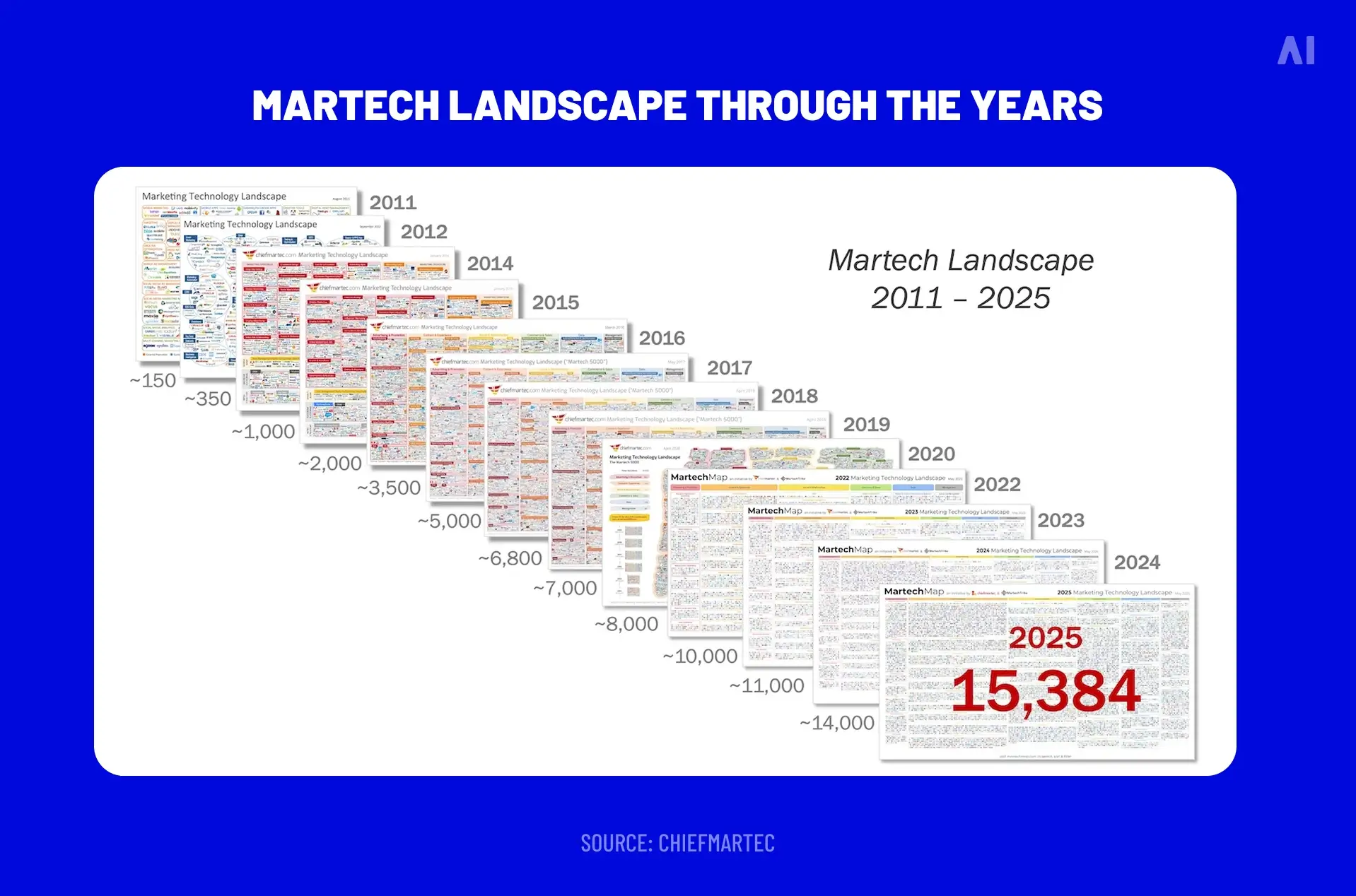
Structural forces drive the need. The martech landscape now contains over 15,000 commercial solutions. Yet according to Gartner, marketers are using just 33% of their stack's capabilities—down from 58% in 2020. Shortage of tools is not the problem any organization faces today. Shortage of the frameworks to align those tools is.
That gap is precisely where governance operates. It defines how data is interpreted, how success is measured, and how strategic decisions are coordinated across platforms, establishing the ground rules before a single dashboard is opened.
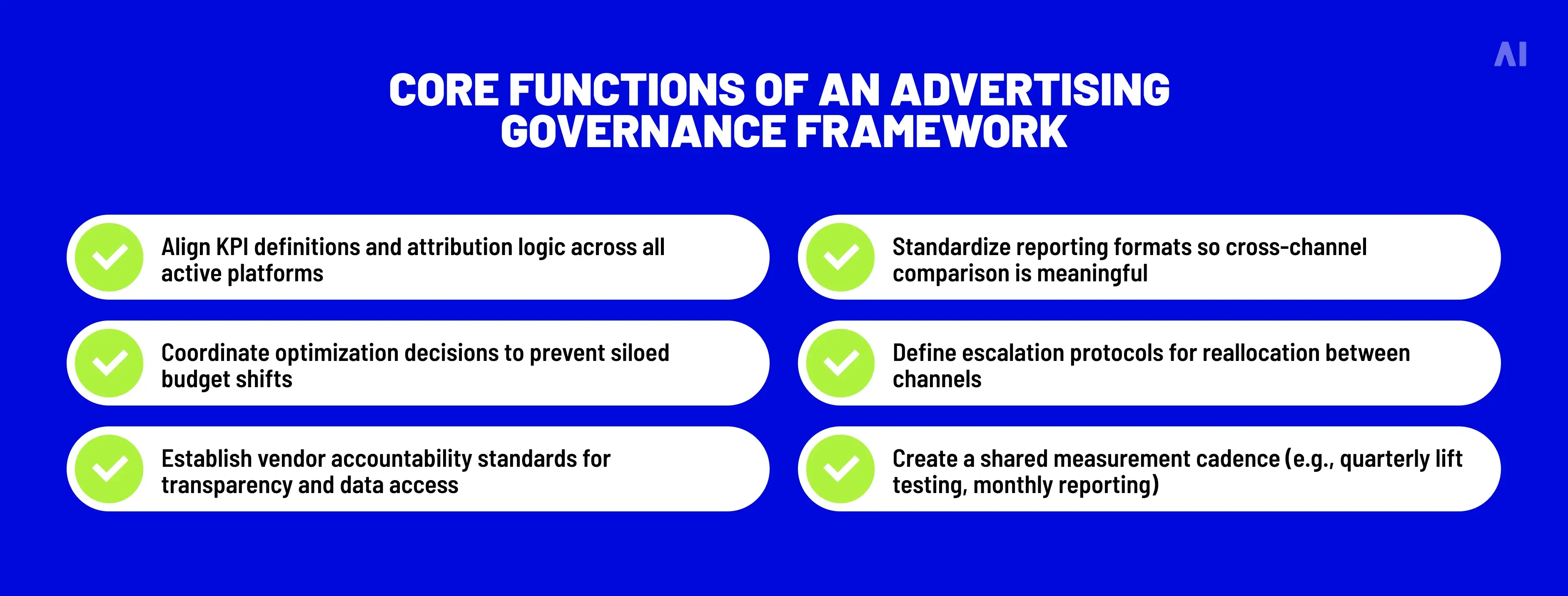
Core functions of an advertising governance framework
There is a persistent tendency in digital advertising to respond to complexity by adding more technology. A new dashboard. Another analytics layer. A different attribution platform. The assumption is that if the right tool exists, coordination will follow.
It rarely does.
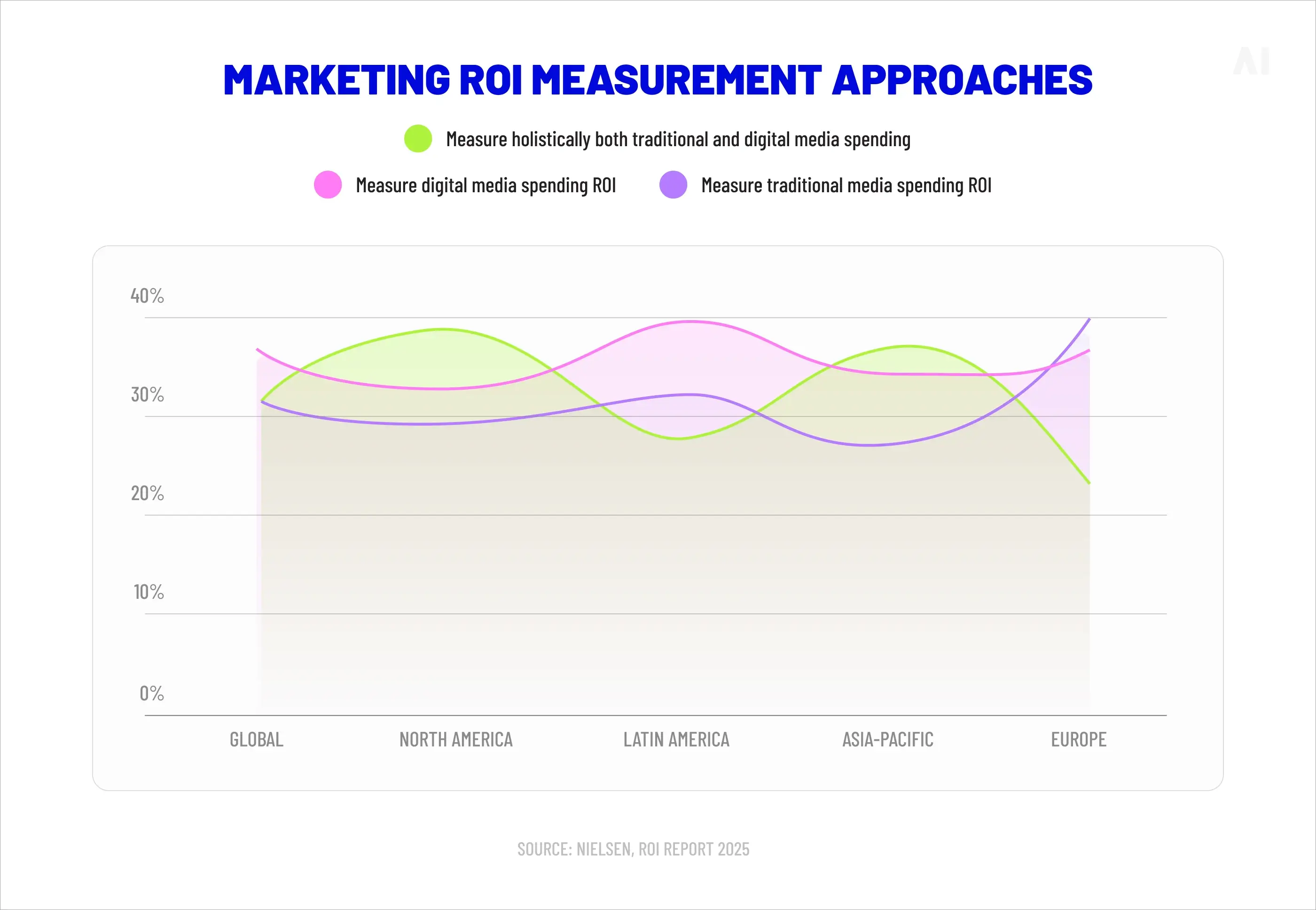
Confidence of having right tools and technology to measure ROI / Marketing ROI measurement approaches (Source)
Tools execute. Governance defines what those tools should be executing toward. A cross-platform reporting dashboard, for instance, can aggregate data from multiple sources—but it cannot tell a team whether a CTV impression and a paid social impression should be weighted equally against a shared KPI. It cannot resolve the fact that one platform attributes conversions on a seven-day click window while another uses a one-day view-through model. Mistaking these for technical problems leads to technical solutions that miss the point. The issues are definitional, and governance is how they get resolved.
According to industry analysis, 70% of marketers say that identifying audiences across touchpoints has become harder than ever. Adding another tool to a fragmented stack does not address this. Establishing a governance framework that standardizes identity resolution approaches, defines how audience overlap is measured, and aligns teams on a common methodology — that does.
The distinction has practical teeth. When organizations substitute tooling for governance, technology accumulates without coordination improving alongside it. The pattern repeats: higher costs, lower utilisation, and a persistent blind spot at the ecosystem level.
Why governance is emerging in fragmented digital ecosystems
Media investment today is distributed across programmatic display, CTV, retail media networks, paid social, audio, digital out-of-home, and a growing number of identity and data solutions. Each of these environments operates with its own measurement framework, its own optimization signals, and its own reporting standards. They do not share data easily, and in many cases, they are designed not to.
The scale of this fragmentation is significant. Walled gardens—led by Alphabet, Meta, and Amazon—generated approximately $422 billion in advertising revenue in 2024. By 2027, walled garden platforms are projected to capture 83% of global digital advertising revenue, leaving just 17% for the open internet. These platforms restrict cross-platform audience data, enforce proprietary attribution models, and limit how performance information can be exported or compared.
For brands and agencies operating across both walled and open environments, this creates an acute coordination problem. Each platform tells a version of the story that flatters its own role. Without governance, there is no mechanism to reconcile those versions—no shared framework for deciding which signals to trust, how to allocate budget based on genuine incremental value, or how to evaluate whether the overall media investment is performing as intended.
Digital advertising governance provides that mechanism. It does not eliminate fragmentation. It creates the structure required to operate within it: consistent measurement protocols, aligned definitions of success, and coordinated decision-making across environments that would otherwise remain siloed.
Every major advertising platform optimizes toward its own internal signals. Google maximizes outcomes within Google's ecosystem. Meta does the same within its family of apps. Amazon optimizes for its own retail and streaming environments. Individually, each platform's optimization logic is often quite effective. The problem arises when these isolated optimization efforts are treated as components of a single strategy.
They are not. They are parallel strategies, each pursuing channel-specific objectives that may or may not align with the advertiser's broader business goals.
This dynamic produces several well-documented inefficiencies:
Duplicated reach. The same user may be targeted across multiple platforms with no frequency management between them, inflating costs without proportionally increasing impact.
Inconsistent attribution. Each platform claims credit for conversions using its own model, often resulting in total attributed conversions that exceed actual sales—sometimes substantially.
Frequency overlap. Without cross-platform visibility, advertisers cannot control how many times a single user sees the same message across different environments.
Inefficient budget allocation. Platforms that report the strongest results within their own measurement framework attract more spend, regardless of whether that spend is generating genuine incremental value.
The financial cost of this misalignment is not trivial. The ANA's Q2 2025 Programmatic Transparency Benchmark found that $26.8 billion in global programmatic media value is lost annually to inefficiencies—a 34% increase from $20 billion just two years earlier. While not all of that waste stems from platform-level optimization gaps, a significant portion reflects the absence of ecosystem-level coordination: redundant supply paths, conflicting measurement, and budget flowing toward proxy metrics rather than genuine business outcomes.
Governance addresses this by aligning optimization decisions with broader campaign objectives. Rather than allowing each platform to optimize independently toward its own metrics, a governance framework establishes how performance is evaluated across the full media ecosystem—and ensures that budget allocation reflects that cross-platform view.
Advertising governance is often discussed in strategic terms, but it only works when it is operationalized. In practice, a governance framework for advertisers typically includes three interconnected components: shared performance definitions, cross-platform reporting standards, and coordinated optimization processes.
These are not aspirational principles. They are the structural elements that make governance operational—the mechanisms through which strategy translates into consistent execution across fragmented systems.
According to the 2025 Gartner Marketing Technology Survey, CMOs currently oversee an average of nine marketing channels, with 20% already in the process of adopting new ones. Managing that breadth without shared governance structures is the operational equivalent of running nine separate businesses under one brand—each with its own definition of success.
Shared performance definitions
Governance begins with alignment on what performance means. This sounds straightforward, but in practice it is anything but.
Different platforms measure success using fundamentally incompatible metrics. A video completion rate on CTV is not the same as a view-through conversion on display. A click on a retail media ad carries different intent signals than a click on a paid social placement. When each channel defines its own KPIs and attribution windows, cross-platform comparison becomes unreliable at best and misleading at worst.
A governance framework addresses this by establishing common KPI definitions that apply across all channels. This might include standardized definitions for what constitutes a completed view, how conversions are attributed, what lookback windows apply, and how incrementality is measured. The goal is not to impose a single metric on every channel—different channels serve different functions—but to ensure that when results are compared, the comparison is meaningful.
CTV's rapid growth makes this particularly urgent. CTV's share of programmatic spend jumped to 44.2% in Q2 2025, up from 30.4% the previous quarter. Yet the ANA's own data characterizes CTV as having lower media productivity rates and widening performance gaps relative to more established programmatic environments. Without shared performance definitions, brands risk pouring budget into a high-growth channel while lacking the measurement framework to evaluate whether that investment is delivering proportional value.
Once performance definitions are aligned, the next step is ensuring that reporting structures reflect that alignment. This is the difference between having data and having insight.
The typical organization today runs on isolated dashboards—one for programmatic display, another for paid social, another for CTV, and so on. Marketers now rely on dozens or more tools, many covering overlapping functions. Each generates its own reports. None were built to communicate with the others.
Cross-channel performance reporting under a governance framework introduces consistent structures that unify insights across platforms. This does not necessarily mean a single mega-dashboard—though it can. More fundamentally, it means standardizing how data is collected, normalized, and presented so that teams can evaluate ecosystem-level performance without manually reconciling conflicting reports.
The practical benefits are significant. When reporting is governed by shared standards, teams can identify true frequency across environments, understand how different channels interact along the customer journey, and make budget reallocation decisions based on a unified view rather than platform-specific claims. It is the difference between knowing how each channel performed in isolation and understanding how the entire media investment performed as a system.
The third component of operational governance is optimization coordination. This is where governance moves from measurement into action.
In the absence of governance, optimization happens in silos. The display team optimizes display. The CTV team optimizes CTV. The social team optimizes social. Each team may be doing excellent work within their channel. But without coordination, their collective efforts can produce contradictory outcomes: budget shifts that benefit one channel at the expense of the overall strategy, targeting overlaps that waste spend, or creative sequencing that makes no sense from the consumer's perspective.
Governance frameworks define how optimization decisions are made across platforms. They establish escalation protocols for budget reallocation, set rules for how targeting strategies interact across channels, and ensure that performance signals from one environment inform decisions in others. The result is a media operation that functions as an integrated system rather than a collection of independent efforts.
Operational implications for brands and agencies
Advertising governance resists the project mindset—a defined start, a defined end, a deliverable. It represents a deeper shift in how marketing organizations operate, reaching into team structures, vendor relationships, and daily workflows.
At the most basic level, governance requires teams to align on KPI definitions before campaigns launch, not after they report. It requires optimization strategies to be coordinated across platforms, with clear ownership of cross-channel decisions. It requires vendor and partner relationships to be managed within a shared accountability framework, rather than as independent service agreements.
This often means closer collaboration between marketing, analytics, and technology teams than most organizations are accustomed to. It also means evolving from a model where each channel is managed as a standalone function toward one where the broader advertising ecosystem is orchestrated as a whole.
And the results show up in the numbers. As mentioned earlier, the Gartner 2025 Marketing Technology Survey found that only 49% of martech tools are actively used, and just 15% of organizations qualify as high performers—defined as those meeting strategic goals and demonstrating positive ROI. High performers and the rest often run comparable technology. The gap lives in governance: the ability to align tools, teams, and processes toward common objectives.
At maturity, advertising governance operates as a strategic operating model rather than a checklist or quarterly review. It defines how brands orchestrate technology partners, media inventory, and data environments while retaining control over performance outcomes.
Positioning governance as continuous rather than finite is what makes this work. Markets evolve. Platforms alter their measurement frameworks. New channels surface. A mature governance framework absorbs these shifts without demanding that the organization tear down its evaluation standards and start over each time a platform rethinks its attribution approach.
And effective governance frameworks share several characteristics:
They are vendor-neutral, meaning they do not favor one platform's data or measurement approach over another's.
They are transparent, providing clear visibility into how budget is allocated, how performance is measured, and where inefficiencies exist.
And they are coordinated, ensuring that decisions made in one part of the ecosystem are informed by data and objectives from the rest of it.
The Open Garden Framework is one example of this approach in practice. Designed as a cross-platform governance model for programmatic advertising, it coordinates fragmented advertising systems while preserving transparency and strategic flexibility—enabling advertisers to operate across multiple DSPs, SSPs, and data environments without being locked into any single platform's proprietary ecosystem.
The next layer: cross-platform measurement governance
Once a governance framework is in place, the next challenge is ensuring that measurement itself is governed consistently across platforms. This is where many organizations discover the deepest gaps—not in their data, but in how that data is structured, interpreted, and acted upon.
Cross-platform measurement governance focuses on aligning attribution models, reporting standards, and performance metrics across all channels and environments. It ensures that when a CTV campaign reports a certain lift, that number is comparable to the lift reported by a display campaign, a paid social campaign, or a retail media activation. Without this layer, governance frameworks risk producing coordinated strategies that are still evaluated using incompatible measurement methodologies—a contradiction that undermines the entire exercise.
This represents the next stage in building a coordinated advertising ecosystem. It also represents a significant opportunity for brands and agencies willing to invest in the structural work required to make it function.
For organizations looking to explore how governance frameworks, cross-platform coordination, and vendor-neutral media execution can work together in practice, AI Digital's managed services, supply management, and intelligence platform are designed to support exactly this kind of ecosystem-level oversight—from media planning and DSP-agnostic execution to transparent performance evaluation across channels. Get in touch to discuss how these capabilities align with your specific media environment.
• Platforms own AI models and train on proprietary data • Brands have little visibility into decision-making • "Walled gardens" restrict data access
• Inefficient ad spend • Limited strategic control • Eroded consumer trust • Potential budget mismanagement
Open Garden framework providing: • Complete transparency • DSP-agnostic execution • Cross-platform data & insights
Optimizing ads vs. optimizing impact
• AI excels at short-term metrics but may struggle with brand building • Consumers can detect AI-generated content • Efficiency might come at cost of authenticity
• Short-term gains at expense of brand health • Potential loss of authentic connection • Reduced effectiveness in storytelling
Smart Supply offering: • Human oversight of AI recommendations • Custom KPI alignment beyond clicks • Brand-safe inventory verification
The illusion of personalization
• Segment optimization rebranded as personalization • First-party data infrastructure challenges • Personalization vs. surveillance concerns
• Potential mismatch between promise and reality • Privacy concerns affecting consumer trust • Cost barriers for smaller businesses
Elevate platform features: • Real-time AI + human intelligence • First-party data activation • Ethical personalization strategies
AI-Driven efficiency vs. decision-making
• AI shifting from tool to decision-maker • Black box optimization like Google Performance Max • Human oversight limitations
• Strategic control loss • Difficulty questioning AI outputs • Inability to measure granular impact • Potential brand damage from mistakes
Managed Service with: • Human strategists overseeing AI • Custom KPI optimization • Complete campaign transparency
Fig. 1. Summary of AI blind spots in advertising
Dimension
Walled garden advantage
Walled garden limitation
Strategic impact
Audience access
Massive, engaged user bases
Limited visibility beyond platform
Reach without understanding
Data control
Sophisticated targeting tools
Data remains siloed within platform
Fragmented customer view
Measurement
Detailed in-platform metrics
Inconsistent cross-platform standards
Difficult performance comparison
Intelligence
Platform-specific insights
Limited data portability
Restricted strategic learning
Optimization
Powerful automated tools
Black-box algorithms
Reduced marketer control
Fig. 2. Strategic trade-offs in walled garden advertising.
Core issue
Platform priority
Walled garden limitation
Real-world example
Attribution opacity
Claiming maximum credit for conversions
Limited visibility into true conversion paths
Meta and TikTok's conflicting attribution models after iOS privacy updates
Data restrictions
Maintaining proprietary data control
Inability to combine platform data with other sources
Amazon DSP's limitations on detailed performance data exports
Cross-channel blindspots
Keeping advertisers within ecosystem
Fragmented view of customer journey
YouTube/DV360 campaigns lacking integration with non-Google platforms
Black box algorithms
Optimizing for platform revenue
Reduced control over campaign execution
Self-serve platforms using opaque ML models with little advertiser input
Performance reporting
Presenting platform in best light
Discrepancies between platform-reported and independently measured results
Consistently higher performance metrics in platform reports vs. third-party measurement
Fig. 1. The Walled garden misalignment: Platform interests vs. advertiser needs.
Key dimension
Challenge
Strategic imperative
ROAS volatility
Softer returns across digital channels
Shift from soft KPIs to measurable revenue impact
Media planning
Static plans no longer effective
Develop agile, modular approaches adaptable to changing conditions
Brand/performance
Traditional division dissolving
Create full-funnel strategies balancing long-term equity with short-term conversion
Capability
Key features
Benefits
Performance data
Elevate forecasting tool
• Vertical-specific insights • Historical data from past economic turbulence • "Cascade planning" functionality • Real-time adaptation
• Provides agility to adjust campaign strategy based on performance • Shows which media channels work best to drive efficient and effective performance • Confident budget reallocation • Reduces reaction time to market shifts
• Dataset from 10,000+ campaigns • Cuts response time from weeks to minutes
• Reaches people most likely to buy • Avoids wasted impressions and budgets on poor-performing placements • Context-aligned messaging
• 25+ billion bid requests analyzed daily • 18% improvement in working media efficiency • 26% increase in engagement during recessions
Full-funnel accountability
• Links awareness campaigns to lower funnel outcomes • Tests if ads actually drive new business • Measures brand perception changes • "Ask Elevate" AI Chat Assistant
• Upper-funnel to outcome connection • Sentiment shift tracking • Personalized messaging • Helps balance immediate sales vs. long-term brand building
• Natural language data queries • True business impact measurement
Open Garden approach
• Cross-platform and channel planning • Not locked into specific platforms • Unified cross-platform reach • Shows exactly where money is spent
• Reduces complexity across channels • Performance-based ad placement • Rapid budget reallocation • Eliminates platform-specific commitments and provides platform-based optimization and agility
• Coverage across all inventory sources • Provides full visibility into spending • Avoids the inability to pivot across platform as you’re not in a singular platform
Fig. 1. How AI Digital helps during economic uncertainty.
Trend
What it means for marketers
Supply & demand lines are blurring
Platforms from Google (P-Max) to Microsoft are merging optimization and inventory in one opaque box. Expect more bundled “best available” media where the algorithm, not the trader, decides channel and publisher mix.
Walled gardens get taller
Microsoft’s O&O set now spans Bing, Xbox, Outlook, Edge and LinkedIn, which just launched revenue-sharing video programs to lure creators and ad dollars. (Business Insider)
Retail & commerce media shape strategy
Microsoft’s Curate lets retailers and data owners package first-party segments, an echo of Amazon’s and Walmart’s approaches. Agencies must master seller-defined audiences as well as buyer-side tactics.
AI oversight becomes critical
Closed AI bidding means fewer levers for traders. Independent verification, incrementality testing and commercial guardrails rise in importance.
Fig. 1. Platform trends and their implications.
Metric
Connected TV (CTV)
Linear TV
Video Completion Rate
94.5%
70%
Purchase Rate After Ad
23%
12%
Ad Attention Rate
57% (prefer CTV ads)
54.5%
Viewer Reach (U.S.)
85% of households
228 million viewers
Retail Media Trends 2025
Access Complete consumer behaviour analyses and competitor benchmarks.
Identify and categorize audience groups based on behaviors, preferences, and characteristics
Michaels Stores: Implemented a genAI platform that increased email personalization from 20% to 95%, leading to a 41% boost in SMS click through rates and a 25% increase in engagement.
Estée Lauder: Partnered with Google Cloud to leverage genAI technologies for real-time consumer feedback monitoring and analyzing consumer sentiment across various channels.
High
Medium
Automated ad campaigns
Automate ad creation, placement, and optimization across various platforms
Showmax: Partnered with AI firms toautomate ad creation and testing, reducing production time by 70% while streamlining their quality assurance process.
Headway: Employed AI tools for ad creation and optimization, boosting performance by 40% and reaching 3.3 billion impressions while incorporating AI-generated content in 20% of their paid campaigns.
High
High
Brand sentiment tracking
Monitor and analyze public opinion about a brand across multiple channels in real time
L’Oréal: Analyzed millions of online comments, images, and videos to identify potential product innovation opportunities, effectively tracking brand sentiment and consumer trends.
Kellogg Company: Used AI to scan trending recipes featuring cereal, leveraging this data to launch targeted social campaigns that capitalize on positive brand sentiment and culinary trends.
High
Low
Campaign strategy optimization
Analyze data to predict optimal campaign approaches, channels, and timing
DoorDash: Leveraged Google’s AI-powered Demand Gen tool, which boosted its conversion rate by 15 times and improved cost per action efficiency by 50% compared with previous campaigns.
Kitsch: Employed Meta’s Advantage+ shopping campaigns with AI-powered tools to optimize campaigns, identifying and delivering top-performing ads to high-value consumers.
High
High
Content strategy
Generate content ideas, predict performance, and optimize distribution strategies
JPMorgan Chase: Collaborated with Persado to develop LLMs for marketing copy, achieving up to 450% higher clickthrough rates compared with human-written ads in pilot tests.
Hotel Chocolat: Employed genAI for concept development and production of its Velvetiser TV ad, which earned the highest-ever System1 score for adomestic appliance commercial.
High
High
Personalization strategy development
Create tailored messaging and experiences for consumers at scale
Stitch Fix: Uses genAI to help stylists interpret customer feedback and provide product recommendations, effectively personalizing shopping experiences.
Instacart: Uses genAI to offer customers personalized recipes, mealplanning ideas, and shopping lists based on individual preferences and habits.
Medium
Medium
Share article
Url copied to clipboard
No items found.
Subscribe to our Newsletter
THANK YOU FOR YOUR SUBSCRIPTION
Oops! Something went wrong while submitting the form.
Questions? We have answers
How does advertising governance improve cross-platform reporting?
Governance establishes shared reporting standards, common KPI definitions, and consistent attribution frameworks that apply across all platforms. Instead of relying on isolated dashboards that each tell a different version of campaign performance, teams operate with unified reporting structures. This makes it possible to compare results across channels meaningfully, identify frequency overlap, and evaluate how different environments contribute to overall marketing outcomes—rather than treating each platform's self-reported metrics as the final word.
How can brands implement an advertising governance framework?
Implementation typically starts with an audit: mapping every platform, partner, and data source in the current ecosystem, then identifying where definitions diverge and reporting conflicts. From there, brands establish shared KPI definitions, align attribution models across platforms, and define clear ownership for cross-channel optimization decisions. The process usually requires collaboration between marketing, analytics, and technology teams—and often benefits from working with a partner experienced in cross-platform coordination to accelerate the alignment process.
What problems does advertising governance solve?
Governance addresses the coordination failures that fragmentation produces: inconsistent attribution, duplicated reach, frequency overlap, conflicting performance narratives, and budget allocation based on platform-specific metrics rather than genuine incremental value. It also tackles the organizational challenge of managing multiple channels, vendors, and data environments without a shared framework for evaluating whether the collective investment is performing as intended.
Is advertising governance only relevant for large brands?
No, though the complexity of governance scales with the complexity of the media ecosystem. Any organization running campaigns across more than two or three platforms faces some degree of fragmentation—and therefore benefits from governance, even in a simplified form. A mid-sized brand running programmatic display, paid social, and CTV still needs shared definitions for how it evaluates success across those channels. The scale of the framework differs; the principle does not.
What role does data transparency play in governance?
Transparency is foundational. Governance cannot function if teams lack visibility into where budget is being spent, how inventory is being selected, what fees are being charged across the supply chain, or how performance data is being generated. Transparent reporting—including clear supply path visibility and access to impression-level data—is what allows governance frameworks to identify inefficiencies and make informed optimization decisions.
Can governance work across walled gardens?
Partially. Walled gardens restrict data portability and enforce proprietary measurement models, which limits the degree to which governance frameworks can standardize reporting and attribution across those environments. However, governance can still define how walled garden data is interpreted relative to open web data, establish rules for how budget is allocated between walled and open environments, and create frameworks for evaluating the relative contribution of each. The goal is not to force walled gardens into full interoperability—that is a structural constraint outside any advertiser's control—but to ensure that the limitations of walled garden reporting are accounted for in ecosystem-level decision-making.
How does AI support advertising governance at scale?
As campaigns grow more complex and span more environments, manual governance becomes impractical. AI advertising governance applies machine learning to the operational layer — automating tasks like cross-platform frequency monitoring, flagging attribution conflicts between channels, and identifying budget allocation patterns that diverge from agreed frameworks. The role of AI in this context is not to replace strategic oversight but to make governance enforceable in real time, across dozens of platforms simultaneously, at a speed and consistency that human teams alone cannot sustain.
Have other questions?
If you have more questions, contact us so we can help.
Questions? We have answers
This is some text inside of a div block.
Lorem ipsum dolor sit amet, consectetur adipiscing elit. Suspendisse varius enim in eros elementum tristique. Duis cursus, mi quis viverra ornare, eros dolor interdum nulla, ut commodo diam libero vitae erat. Aenean faucibus nibh et justo cursus id rutrum lorem imperdiet. Nunc ut sem vitae risus tristique posuere.
This is some text inside of a div block.
Lorem ipsum dolor sit amet, consectetur adipiscing elit. Suspendisse varius enim in eros elementum tristique. Duis cursus, mi quis viverra ornare, eros dolor interdum nulla, ut commodo diam libero vitae erat. Aenean faucibus nibh et justo cursus id rutrum lorem imperdiet. Nunc ut sem vitae risus tristique posuere.
This is some text inside of a div block.
Lorem ipsum dolor sit amet, consectetur adipiscing elit. Suspendisse varius enim in eros elementum tristique. Duis cursus, mi quis viverra ornare, eros dolor interdum nulla, ut commodo diam libero vitae erat. Aenean faucibus nibh et justo cursus id rutrum lorem imperdiet. Nunc ut sem vitae risus tristique posuere.
This is some text inside of a div block.
Lorem ipsum dolor sit amet, consectetur adipiscing elit. Suspendisse varius enim in eros elementum tristique. Duis cursus, mi quis viverra ornare, eros dolor interdum nulla, ut commodo diam libero vitae erat. Aenean faucibus nibh et justo cursus id rutrum lorem imperdiet. Nunc ut sem vitae risus tristique posuere.
This is some text inside of a div block.
Lorem ipsum dolor sit amet, consectetur adipiscing elit. Suspendisse varius enim in eros elementum tristique. Duis cursus, mi quis viverra ornare, eros dolor interdum nulla, ut commodo diam libero vitae erat. Aenean faucibus nibh et justo cursus id rutrum lorem imperdiet. Nunc ut sem vitae risus tristique posuere.
This is some text inside of a div block.
Lorem ipsum dolor sit amet, consectetur adipiscing elit. Suspendisse varius enim in eros elementum tristique. Duis cursus, mi quis viverra ornare, eros dolor interdum nulla, ut commodo diam libero vitae erat. Aenean faucibus nibh et justo cursus id rutrum lorem imperdiet. Nunc ut sem vitae risus tristique posuere.
This is some text inside of a div block.
Lorem ipsum dolor sit amet, consectetur adipiscing elit. Suspendisse varius enim in eros elementum tristique. Duis cursus, mi quis viverra ornare, eros dolor interdum nulla, ut commodo diam libero vitae erat. Aenean faucibus nibh et justo cursus id rutrum lorem imperdiet. Nunc ut sem vitae risus tristique posuere.


.svg)
.svg)