How AI Transforms Performance Marketing: From Data to Optimization
Sarah Moss
June 7, 2026
24
minutes read
Performance marketing has always rewarded measurable behavior, but rising acquisition costs, fractured customer journeys and a steady erosion of identity signal now demand a different operating discipline. This article examines how AI in performance marketing is reorganizing the work—targeting, bidding, creative, attribution and measurement—and where it quietly fails when the data underneath it is not in order.
Global advertising spend will pass one trillion dollars for the first time in 2026, according to Dentsu's December 2025 forecast, with more than 71 percent of that spend already directed by algorithms rather than by people choosing inventory by hand. Most of the day-to-day decisions performance marketers used to make—which audience to bid on, what to spend, how to weight a creative variant against another — are now resolved at machine speed inside platforms most marketing teams cannot directly see into. The job has not got smaller. It has moved.
Where it has moved is to a layer above the bidding logic: into how data is collected, how it is connected, how the right outcomes are measured, and how the automation that buys against those outcomes is governed. AI tools for performance marketing are not, in any useful sense, a substitute for that work. They are an amplifier of whatever underlying discipline a business brings to its measurement, its data infrastructure and its definition of success. A team that knows what it is optimizing toward will get a multiplier from AI. A team that does not will get fast, expensive failure.
What follows is a working map of how AI changes the actual practice of performance marketing across the funnel, where its limits sit, and what businesses need to have in place for the gains to compound rather than evaporate.
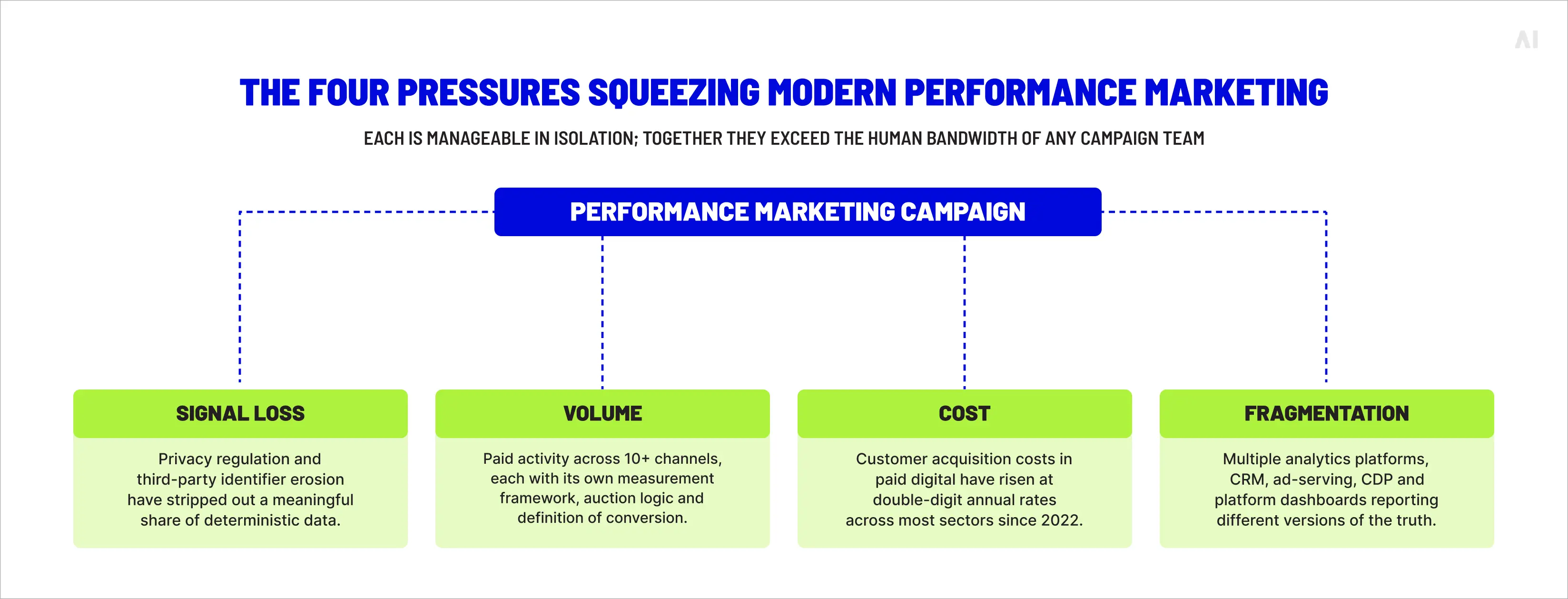
The pressure points are familiar by now, but they have accumulated into something more structural than any single one suggests.
Acquisition costsare rising in absolute terms—WordStream's 2025 analysis of more than 16,000 Google Ads accounts recorded a 5.13 percent increase in cost per lead, taking the average to $70.11.
Customer journeys now stretch across more channels and more devices than any single platform can reliably measure.
Third-party identifiers continue to degrade in real terms, regardless of Google's April 2025 decision to keep cookies in Chrome by default; over 80 percent of companies have already restructured operations to absorb the consequences, according to the IAB's State of Data research.
Manual optimization has not kept pace with any of this. A team adjusting bids, audiences and creative weightings by hand on a Monday is, by Friday, working on a four-day-old picture of demand. The cumulative cost of that lag—over a quarter, across a multi-million-dollar account—is the difference between a campaign that paid for itself and one that did not. AI does not solve attribution, fix data quality or replace strategic judgment. What it does, when the conditions are right, is compress the loop between a performance signal arriving and a decision being made about it from days to minutes.
The four pressures squeezing modern performance marketing.
How AI improves performance marketing
AI in marketing has accumulated more vocabulary than meaning over the past few years. Stripped of the vendor language, the operational definition is narrower and more useful: a set of techniques that ingest large volumes of campaign and customer data, identify patterns inside it, generate predictions about future behavior, and either recommend or directly execute decisions based on those predictions. Performance marketing AI does this against goals the business has set—revenue, qualified pipeline, retained customers—rather than against intermediary metrics the platform finds convenient.
Adoption is no longer experimental. Eighty-one percent of marketing technology leaders were either piloting or had implemented AI agents in their organizations as of mid-2025, according to Gartner. Whether that activity translates into business outcomes is a separate question, examined later in this piece. The capability itself, though, is now widely available; what differentiates one performance program from another is increasingly how AI is governed and integrated, not whether it is used.
The most under-appreciated AI use case in performance marketing is the one that happens before money is spent. Predictive models trained on historical campaign data, seasonality patterns, conversion rates, audience saturation curves and external demand indicators can model the likely outcome of a budget decision before that budget is committed. Forecasting in this sense is not an extrapolation of last quarter's numbers; it is a probability distribution across a set of possible futures, narrowed by the specifics of the brand, the channel, the audience and the spend level.
The practical use is allocation discipline. A finance director asking whether an additional $500K against a paid social channel will deliver pipeline, or whether the channel is already past its diminishing-return inflection point, can be answered with a defensible model rather than an instinct. The same logic applies to product-launch planning, retail seasonality and category-shift forecasting—anywhere a budget decision precedes the activity it is meant to drive.
In-flight optimization is where AI's compounding effect is most visible. Every active campaign generates a stream of behavioral, contextual and outcome signals—a creative running hot in one geography, bid prices softening in another, an audience cluster converting at a rate the original plan did not anticipate. A human team responds to those signals on a cycle of hours or days. A model trained on the same signals responds in minutes, reweighting bids, reallocating spend across audiences, and pulling underperforming variants before they exhaust budget that was meant for the variants that are working.
The change is not magical. It is a function of frequency. A media plan optimized fifty times a day across two thousand audience-creative combinations will outperform the same plan optimized once a day across the same combinations, provided the optimization is pointed at a metric that genuinely correlates with business outcome. The compound interest is in the cadence, not the cleverness.
AI in audience targeting and segmentation
Demographic targeting was always a proxy. The marketer assigning a campaign to women, 25 to 44, in major metropolitan markets was not really after that group as such; they were after the buying behavior the group is correlated with. AI in audience targeting collapses that proxy step. Models can work directly with the behavioral, contextual and intent signals that demographic targeting was approximating, and refine those signals continuously against actual conversions rather than assumed ones.
Behavioral segmentation puts users into clusters defined by what they do rather than who they are demographically. Browsing patterns, content engagement, dwell times, return visits, cart-abandonment behavior, search terms and platform-specific signals together generate a much richer picture of intent than any demographic field. AI's role is to do this clustering at a scale and speed that make the segments operational rather than academic—refreshing daily or hourly, surfacing micro-segments that hand-built audiences would miss, and validating which clusters actually convert before serious budget moves toward them.
The difference between behavioral segmentation that works and behavioral segmentation that does not is the same difference that runs through the rest of this article: the quality of the underlying data and the clarity of the outcome the model is being trained against. A behavioral cluster that looks predictive on engagement metrics but does not show up in revenue is a sophisticated way of finding people who like reading about the product without ever buying it.
Predicting purchase intent
Intent prediction is behavioral segmentation pointed at a particular question: which users in the addressable population are most likely to convert in the next defined window. The model takes signals—searches, content engagement, page sequences, comparison-shopping behavior, exposure to competitor advertising—and produces a probability score for each user against the chosen action. Marketers prioritize budget toward the high-probability segments, and away from segments where conversion would have happened with or without the additional spend.
A second-order benefit, often overlooked, is the model's identification of what high-intent looks like in aggregate. The features the model weights most heavily—the page sequences, the time-on-site thresholds, the specific content that precedes purchase—become a brief for the rest of the marketing organization. Content teams know what to make more of. CRM teams know which behaviors predict expansion or retention. Product teams know which onboarding moments have outsize impact on activation.
Eliminating low-quality traffic
Performance marketing has always wasted money on inventory that was never going to deliver. The newer dimension is that AI can identify the patterns of waste—invalid traffic, low-attention placements, fraud signals, audiences that look targetable but never convert—and route around them in real time rather than in post-campaign post-mortems. The optimization gain is partly about doing more of what works; it is more often about doing less of what does not. The biggest efficiency gains in mature accounts tend to come from subtraction.
AI in media buying and budget optimization
Media buying is where the algorithmic share of advertising is most concentrated. The buying decision itself—which impression to bid on, at what price, against what audience—has been algorithmic for some time. What has changed is the layer above: how budgets move between platforms, how performance signals are reconciled across them, and how a brand's commercial logic is encoded into the optimization rather than absorbed into a platform's defaults.
Automated bid optimization
Real-time bidding has been the dominant programmatic transaction model for more than a decade, but the bidding logic itself has changed substantially. Static rules—a maximum CPM, a fixed bid for a particular audience—have given way to dynamic models that reprice every impression based on its predicted conversion likelihood, the audience's value to the brand, the inventory's quality, and the marginal return on the next dollar of spend. Done well, this lifts efficiency without lifting budget. Done badly, it concentrates spend on impressions that the platform finds easy to measure, regardless of whether they were the impressions the brand actually needed.
The risk lives in the reward function.
A bidder optimizing toward platform-reported conversions will bid hardest for the conversions the platform is best at measuring, which is not the same as the conversions that drove revenue.
A bidder optimizing toward server-side conversions tied back to revenue performs differently, sometimes radically so.
The choice of what to optimize against is, in this sense, a more consequential decision than the choice of bidder.
Budget allocation across channels used to be an annual or quarterly exercise. AI compresses it to a continuous one. Models track marginal performance across paid search, social, display, CTV, audio and retail media, and reallocate spend toward channels where the next dollar buys more incremental conversion. The reallocation is bounded—finance departments still set quarterly envelopes, and brand commitments still reserve specific budgets for specific work—but inside those constraints, the optimization runs without weekly intervention.
The benefit again accrues from frequency. A budget rebalanced fifty times in a quarter against accurate signal will outperform the same budget rebalanced four times against the same signal.
The catch is the modifier: against accurate signal. Reallocating against compromised attribution accelerates the misallocation rather than fixing it.
⚡ The compound interest in performance marketing AI is in the cadence of optimization, not the cleverness of any single model. A campaign optimized fifty times a day will out-earn the same campaign optimized once, provided the signal it is optimizing against is real.
AI and creative performance
The creative side of performance marketing has historically lagged the targeting and buying sides on automation, partly because creative production was hand-built and slow, partly because the testing surface was narrow.
Generative AI has changed both ends of that constraint, and the change is now reflected in adoption: a 2025 Forrester study found that more than 60 percent of US agency decision-makers were using generative AI, with adoption rising to 78 percent among large agencies, while the IAB's 2025 Digital Video Ad Spend & Strategy report recorded that close to nine in ten US video buyers were either using or planning to use AI in their video ad workflows.
AI-generated ad creatives
What generative AI changes is the unit economics of creative production. A campaign that previously launched with three or four creative concepts now launches with thirty or three hundred—modular variations across headline, hook, image, voice-over, length and format, generated against a brief and a brand-voice constraint rather than from scratch each time. The cost per variant collapses; the volume of testable hypotheses grows accordingly.
Brands like Mondelez have publicly attributed up to 50 percent reductions in video production cost to generative tooling, freeing budget that previously sat in production for redeployment into media.
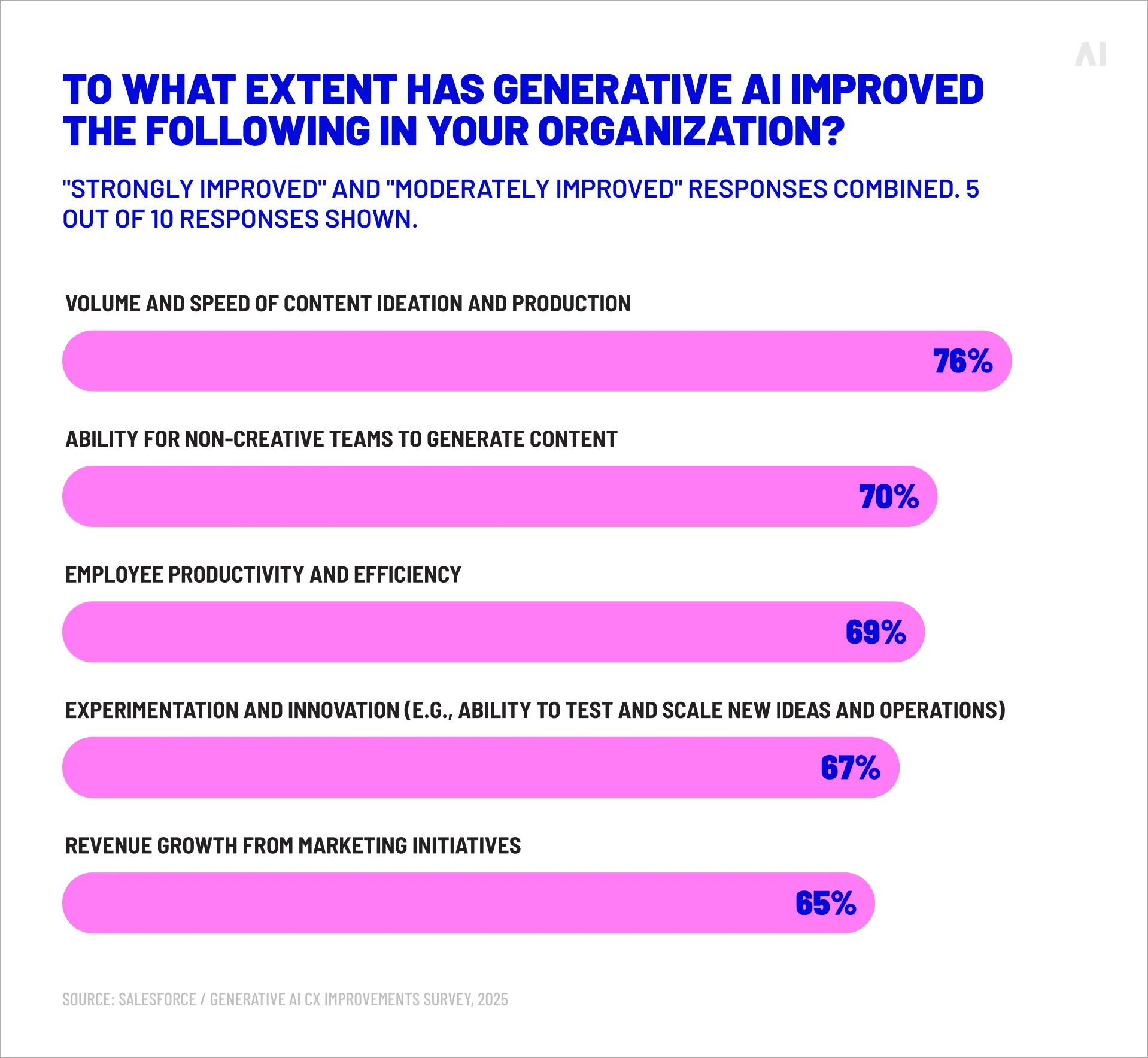
Generative AI delivering improvements across CX workflows (Source)
The risk is the predictable one: variation without judgment produces volume without distinction. The brands seeing real lift from gen AI in creative are those treating the model output as a draft surface rather than a finished asset—using it to compress the slow, repetitive parts of production, then reinvesting the saved hours in casting, copywriting and the strategic decisions that determine whether a campaign cuts through at all.
Dynamic creative optimization
Dynamic creative optimization (DCO) takes the modular components—headlines, images, calls to action, end-cards—and assembles them at impression time against the user, the context and the platform signal. A user in Chicago who arrived from a comparison-shopping site sees a different version of the ad from a user in Phoenix who has visited the brand's site before. The assembly logic is run by the model; the components are governed by the brand. AI improves DCO in two specific ways: it reduces the manual work of building component libraries and asset matrices, and it learns which combinations work for which contexts faster than a human optimization team can.
The discipline that separates effective DCO from creative drift is the same discipline that separates effective audience targeting from waste. Without a clear hypothesis about what should work and a measurement framework that can tell whether it actually did, DCO becomes a way of making more advertising rather than better advertising.
Detecting creative fatigue
Creative fatigue is the slow decay of an ad's performance as repeated exposure depletes its impact on the audiences that have already seen it. Historically, fatigue was identified retrospectively — a CTR slipping below benchmark for two weeks before anyone refreshed the asset.
AI shortens the lag substantially. Models track engagement curves at the audience-creative-frequency level and surface fatigue as a forward-looking signal: this asset has another four days of useful life against this audience before its incremental return turns negative. Refresh now, or accept the decline.
What the alert is worth depends entirely on what the brand can do about it. A creative refresh queue that takes six weeks to clear cannot benefit from a four-day forward signal. AI fatigue detection paired with AI-supported variant production turns the detection signal into an actionable rotation. Without the production capability behind it, the alert is information without leverage.
Attribution is the part of performance marketing where the stated capability and the operational reality have diverged most sharply. Last-click models still dominate platform reporting, but they bear progressively less resemblance to how customers actually buy—through long, multi-channel, multi-device journeys in which the last click is often a brand search that the user would have made regardless. AI does not fix attribution, in the sense of producing a single source of truth that every team can agree on. It does meaningfully improve the accuracy with which credit is distributed across the journey, and it does so in ways that traditional models cannot.
Multi-touch attribution distributes conversion credit across the touchpoints a customer encountered before converting, weighting each by its modeled contribution rather than by its position in the path. AI strengthens MTA in two ways. First, the modeling itself is more sophisticated: data-driven approaches use machine learning to estimate counterfactual probability—what would have happened without each touchpoint—rather than applying a static linear or U-shaped weighting rule. Second, the data feeding the model is broader; signals from CTV exposures, server-side conversions, offline purchases and CRM events can be reconciled in ways that platform-native attribution cannot reach.
The IAB's 2024 research found that 76 percent of advertising decision-makers were investing in new forms of multi-touch attribution alongside first-party data infrastructure and AI tooling. The investment recognizes that attribution under signal loss is no longer a question of one perfect model but of triangulation between multiple imperfect ones—MTA for tactical optimization, marketing mix modeling for strategic allocation, incrementality testing for causal validation. AI lets each of those run more frequently and on richer inputs than was previously practical.
Connecting cross-channel journeys
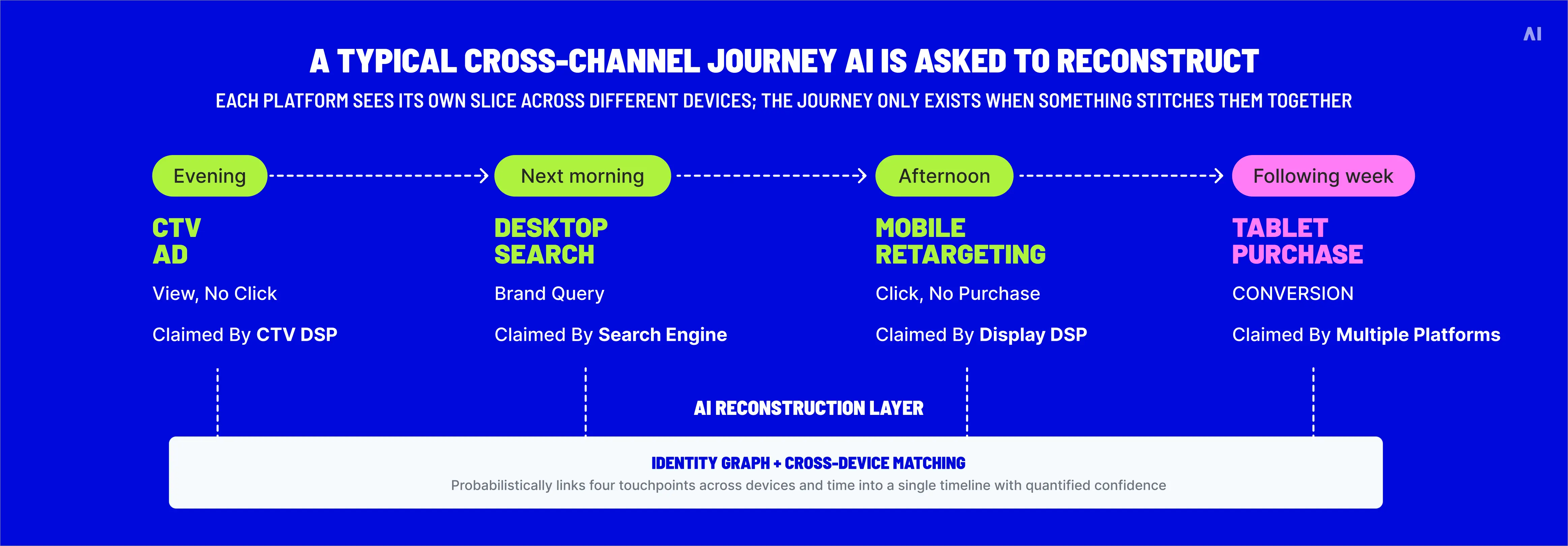
The cross-channel reconciliation problem is harder than the modeling problem. A customer might encounter a brand on CTV in the evening, search the brand on a desktop the next morning, click a retargeting ad on a mobile device in the afternoon, and complete the purchase the following week from a tablet.
A typical cross-channel journey AI is asked to reconstruct.
Stitching that journey back together requires identity resolution work that does not happen automatically. AI plays a useful role in probabilistic matching—connecting devices, sessions and signals that almost certainly belong to the same individual without requiring a deterministic identifier—but the underlying data infrastructure has to support the work.
The signal environment is degrading regardless of how the cookie story ends. Apple's tracking restrictions, browser-level blocking outside Chrome, mature ad-blocking adoption and consent-mode mismatches all reduce the proportion of conversions that can be attributed deterministically.
AI fills part of the gap through modeled conversions — using known conversions to predict unknown ones—and through privacy-preserving measurement approaches such as data clean rooms, where two parties' first-party data can be matched without either side seeing the other's user-level records. Two-thirds of US data and ad professionals now use clean rooms in some form, according to IAB and BWG Strategy research.
Modeled conversion is not free of consequence. The model is, by definition, an estimate, and its accuracy depends on the quality of the labeled data used to train it. A brand that has lost forty percent of its conversion signal and now models the gap is not getting that signal back; it is getting a probabilistic reconstruction of it. The reconstruction is usually better than the alternative, but it is not the same thing as ground truth. Treating modeled conversions as if they were observed conversions is the most common attribution error of the post-cookie period.
AI for lead generation and conversion optimization
Lead generation and conversion optimization sit further down the funnel from media buying, but the same logic applies: AI provides lift on processes that used to depend on human review and slow iteration, provided the signals it works with are accurate.
Predictive lead scoring
Lead scoring used to be a rules-based exercise—title, company size, source, behavior—that produced a linear score and a binary judgement about whether sales should call. Predictive lead scoring uses a model trained on past closed-won and closed-lost outcomes to weight inputs by their actual contribution to conversion. The model finds patterns that hand-built rules miss: a particular content path that predicts higher pipeline value, a job title that looks marginal in isolation but converts strongly when paired with a specific industry signal, an engagement cadence that correlates with deal size.
The operational gain is concentrated on sales capacity. A team that can only realistically follow up with twenty leads per rep per week wants the right twenty, not the first twenty. Lead scoring that predicts conversion probability with reasonable accuracy is the difference between a sales floor working from a list and a sales floor working from a queue.
Landing page personalization
Personalization at the landing-page level is the lowest-friction conversion lever most performance programs have. The user has already arrived; the cost of acquisition has already been paid; the only remaining question is whether the page they land on speaks to the intent that brought them there. AI handles the matching: a user arriving from a comparison-shopping search sees a page emphasizing competitive differentiation; a user arriving from a brand search sees a page emphasizing depth and proof; a returning user sees a page that picks up where they left off. The components are built and approved in advance; the assembly is automated.
The technique works best for businesses with enough traffic volume to test variations and enough product depth to make the variations meaningful. It works least well for brands whose value proposition is identical across audiences, where personalization adds complexity without lift.
Funnel optimization has always been about identifying friction. AI shortens the cycle between friction occurring and friction being addressed. Models trained on session data identify drop-off points, surface the upstream behaviors that predict abandonment, and recommend interventions—a different headline, a removed form field, a clearer pricing display, a repositioned proof point—that reduce loss at the specific step where it concentrates.
What AI does not do is choose the right funnel for the business. A business optimizing the wrong funnel—a high-volume self-serve flow when the buying behavior is actually consultative, or vice versa—gets a more efficient version of a strategy that does not fit. The diagnostic work upstream of optimization remains a human responsibility.
The hidden risk: AI amplifies bad data
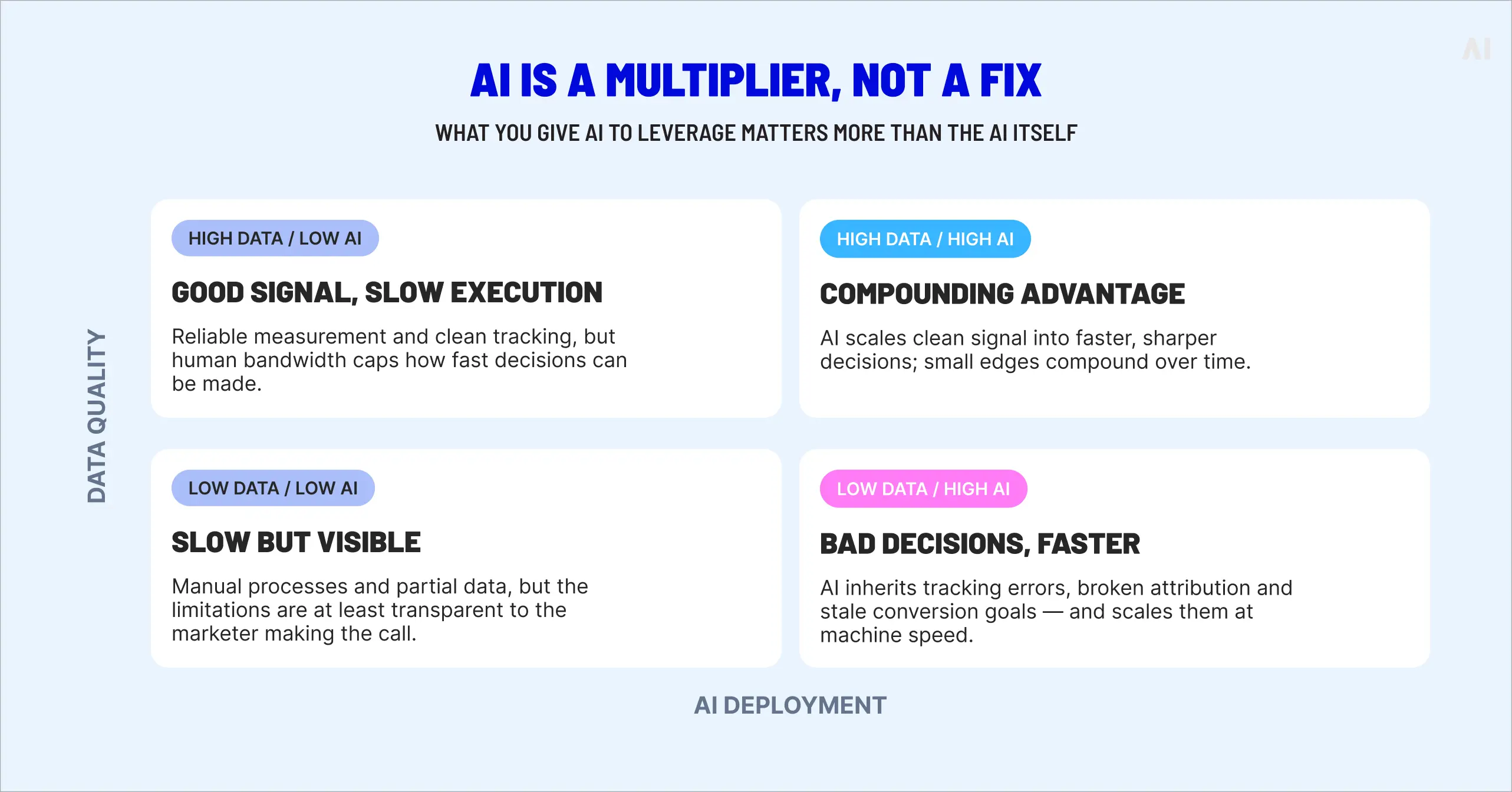
This is the section the brochures skip. AI in performance marketing operates on signal—measured conversions, attributed touchpoints, captured behaviors, observed outcomes—and the quality of its decisions is bounded above by the quality of that signal. The most expensive mistake businesses make in this category is buying AI capability before fixing what it is being asked to optimize against. The result is a faster, more confident execution of strategy built on data the team would not, on close inspection, trust.
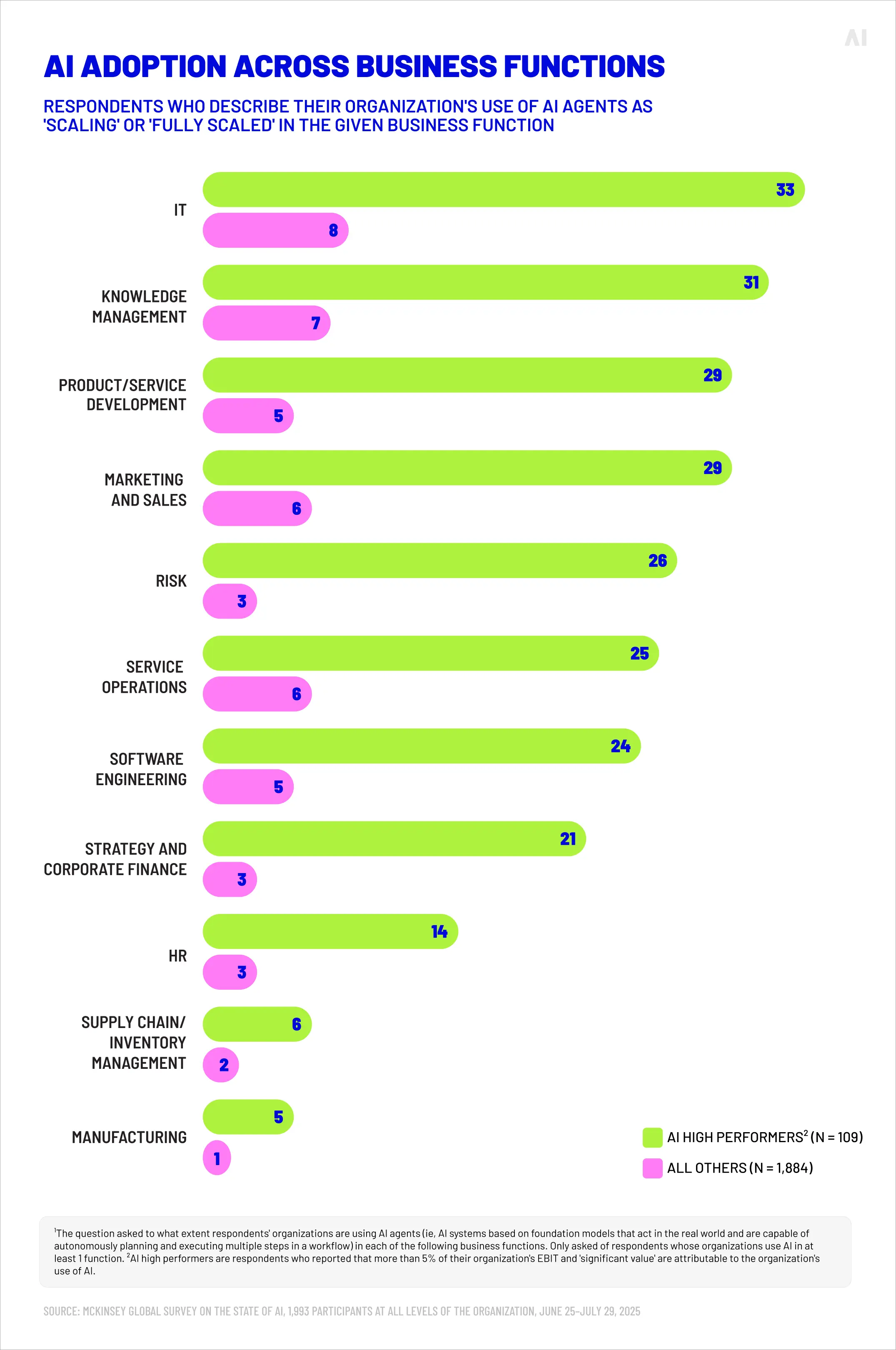
McKinsey's research on the AI productivity paradox sharpens the picture. As of late 2025, almost nine in ten companies had deployed AI in at least one business function, but ninety-four percent of respondents reported not seeing significant value from those investments. The gap between deployment and value is not principally an AI problem. It is a measurement, integration and workflow problem that AI cannot solve on its own. A jet engine bolted to a shopping cart will get you somewhere quickly. It will not be where you wanted to go.
Tracking is the foundation underneath everything else in this article, and it is rarely as solid as the dashboards built on it imply. Missing conversion events, inconsistent UTM parameters, server-side tags that did not fire, consent-mode signals that silently failed, duplicate firing on certain platforms, mobile sessions that orphaned mid-purchase—every one of these creates a small inaccuracy, and the inaccuracies compound. An AI optimizer running against a measurement layer with even modest gaps will optimize toward the campaigns and audiences whose conversions happen to be tracked best, regardless of which campaigns and audiences actually produce the most revenue.
The investment with the highest return in most performance programs is rarely a new tool. It is the disciplined audit of the existing tracking—server-side tagging, consent management, conversion deduplication, attribution windows, offline reconciliation—that the team has been meaning to do for two quarters. The work is unglamorous and the results show up everywhere downstream.
Data quality and governance
Tracking is one input. Data quality more broadly covers the full set of conditions that make AI usable: standardized definitions across systems, consistent identifier resolution, clean joins between marketing and revenue data, accurate first-party records, and a documented governance model that determines who can change what and how changes propagate. Brands that have done this work tend to underestimate it; brands that have not done it tend to underestimate how much it matters.
A useful test: ask three teams in the same organization what counts as a qualified lead, what defines a conversion, and how long the attribution window is. If the three answers diverge by more than a small margin, no amount of AI will produce reliable optimization, because the optimization is being trained against an inconsistent target.
A black-box system is one whose decisions cannot be inspected, validated or explained by the people relying on them. Most platform-native AI optimization sits closer to this end of the spectrum than vendors prefer to advertise. The decisions are made; the rationale is partial; the input weights are proprietary; the optimization metric is nominally configurable but practically constrained. Brands cannot tell, in operationally useful detail, why a particular budget shift happened, why a creative was paused, or which audience cluster captured the additional spend.
The risk is twofold.
Operationally, a system the team cannot interrogate is a system the team cannot improve when it makes the wrong call.
Strategically, a brand that depends on optimization logic it does not understand has, in effect, outsourced part of its commercial decision-making to a vendor whose interests may not be perfectly aligned with its own.
Why human oversight still matters
Human oversight of AI in performance marketing is not nostalgia. It is the part of the system that sets the goal, defines the success metric, watches for drift, validates outputs against business context the model does not see, and intervenes when the optimizer is doing the right work against the wrong target.
Gartner's late-2025 research is direct on this point: only five percent of marketing leaders who use generative AI solely as a tool report significant gains in business outcomes. The leaders seeing real value are the ones treating AI as something to be governed and integrated into a redesigned workflow, not as a tool that answers questions automatically.
The work the human side is doing has shifted. Less time on bid management and creative production; more time on hypothesis design, governance, signal validation and the strategic questions that determine what the optimization is for in the first place. The job is harder, not easier.
Why AI fails without the right stack
If the data quality argument explains why AI underperforms inside a single team's work, the stack argument explains why it underperforms across the marketing function as a whole. AI tools sit on top of an information substrate—a customer data platform, a data warehouse, an analytics layer, an attribution model, a media operating layer, a CRM. When those pieces do not connect, AI in any one of them cannot see what is happening in any of the others. The optimization in paid social does not know what closed in CRM. The CDP does not know what is being tested in creative. The reporting layer reconciles after the fact, if at all.
CDPs, data warehouses, and intelligence platforms
The substrate question has three layers.
A customer data platform unifies first-party data from product, marketing, sales and service into a single profile-keyed repository.
A data warehouse—increasingly a cloud data warehouse with marketing-specific extensions—holds the underlying tables that the CDP and analytics tools query against, and is the system of record for joining marketing data with revenue data.
An intelligence platform, the newer category, sits above both and runs the planning, optimization and reporting work against the unified data.
The three are complementary rather than substitutable; brands that try to compress them into a single tool generally end up doing one job well and the others badly.
Integration is where the strategy meets the operational reality. Connecting an AI tool to the bidding layer is straightforward. Connecting it to the analytics layer, the CRM, the data warehouse, the consent management platform, the offline conversion sources and the brand-safety toolchain—and ensuring it stays connected through schema changes and vendor updates—is sustained engineering work. The brands that get this right tend to have explicit data-engineering capacity inside or directly available to the marketing function, rather than treating integration as a quarterly initiative for an external agency.
⚡ AI cannot tell a brand what its strategy should be. It can only execute whatever strategy it has been pointed at, with a great deal more efficiency than anyone realises until it's too late.
Measuring AI's real business impact
Measurement is where most AI investments quietly fail or quietly succeed without anyone noticing. The platform metrics that AI tooling produces—impressions optimized, bids placed, predictions made, creatives generated — are activity metrics; they do not establish whether the activity translated into anything the business cares about. A program judged on its activity will reliably look successful. A program judged on incremental revenue, customer profitability and operational efficiency may look very different.
Return on ad spend is the most cited metric in performance marketing, and the most quietly misleading. Platform-reported ROAS reflects the conversions the platform can see and claims credit for, weighted toward the activity the platform optimized for. It does not separate incremental revenue—the revenue that would not have happened without the spend—from revenue the brand would have captured anyway. A campaign reporting a 6:1 ROAS may, on holdout testing, be delivering a 1.4:1 incremental return. The platform is not lying. It is reporting the wrong number for the question the CFO is asking.
The discipline that separates serious performance measurement from optimistic dashboarding is the use ofincrementality testing —controlled experiments designed to isolate the causal contribution of a campaign—alongside ROAS, MMM and MTA. None of the four is sufficient on its own. Together, they triangulate.
Customer acquisition cost, lifetime value, payback period, retention and contribution margin are the metrics that actually determine whether a performance marketing program is creating value at the business level. Holding an AI investment accountable to these—rather than to its activity output—is the difference between AI as marketing theater and AI as commercial discipline.
The relevant questions are operational and unforgiving.
Is CAC for the cohort acquired through AI-optimized campaigns lower than for the cohort acquired through previous methods, controlling for channel mix?
Is the LTV of those cohorts comparable, or did the optimizer find cheaper customers who churn faster?
Is the payback period shortening or lengthening?
An AI program that improves CAC at the expense of LTV is not improving the business; it is cycling worse customers through the funnel more efficiently.
The mistake patterns are recognizable across the businesses that have tried AI in performance marketing and not got the return they expected. They are not technical failures; they are strategic and operational ones.
Treating AI as a shortcut
The first and most common mistake is treating AI as a substitute for the work that should precede it. A business with weak measurement, fragmented data and unclear strategic priorities will not be saved by an intelligent optimizer; it will accelerate its existing problems. AI is leverage, and leverage applied to a poorly aligned system multiplies misalignment. The teams that succeed with AI tend to have spent the preceding year on their data foundation, their attribution methodology and their internal alignment on what success means.
Automating without strategy
The related mistake is automating activity without examining whether the activity is the right activity. A campaign that was inefficient by hand is a campaign that is more efficiently inefficient when automated. Scaling does not interrogate; it executes. Brands that automate badly performing programs end up with worse outcomes faster, and often with more confidence in the dashboards reporting on them.
Platform-native AI is convenient. It is also non-neutral. A platform's optimizer is built to maximize the metrics the platform chooses to optimize for, on the inventory the platform owns or prefers, with reporting the platform controls. Brands that rely entirely on platform algorithms and the data the platforms supply are, in effect, asking the seller to grade its own homework. The work of independent measurement, governed automation and cross-platform validation does not become less important under AI; it becomes more important.
How AI Digital helps transform performance marketing
AI Digital works with brands and agencies on the operational layer this article has been describing: connected data infrastructure, governed AI optimization, cross-channel attribution and a measurement framework grounded in business outcomes rather than platform-reported metrics. The orientation is consultative and channel-agnostic, structured around three components — Open Garden as the connective philosophy, Elevate as the marketing intelligence platform, Smart Supply as the supply-side optimization engine—that work alongside whatever martech a brand already has in place.
Unified data and visibility
Disconnected data is the root cause of most of the failure modes in this piece. Optimization at the channel level is bounded by what the channel can see, and channels by design cannot see one another. AI Digital's Open Garden Framework is the response to that constraint: a vendor-agnostic operating model that connects 15+ DSPs and 9+ SSPs into a single visibility layer, and reconciles paid media data with first-party customer data, analytics, CRM and offline outcomes inside a single intelligence environment.
The framework is philosophical as well as technical—the working principle is that brand decisions should be made on a brand's full picture, not on the partial picture any single platform is willing to share.
AI optimization with human validation
AI without human validation accelerates whatever direction it is pointed in. AI Digital's Elevate is built around the inverse premise: AI-powered planning, optimization and reporting embedded in a workflow where strategists shape the inputs and validate the outputs. The platform pulls from over a million audience profiles and more than eight thousand campaigns of historical performance data across twelve-plus DSPs, generating media plans, audience segments and in-flight optimization recommendations that are reviewed by human planners before they go live.
The platform's MMM, path-to-conversion and cookieless-targeting modules sit inside the same environment, which means the strategy, the execution and the measurement are not stitched together across vendors but operate against a shared evidence base.
⚡ The brands seeing real return from AI in performance marketing are the ones investing in the governance layer at the same pace as the deployment layer. Most of what looks like an AI failure, on close inspection, is the absence of that investment showing up downstream.
Cross-channel attribution
Attribution is the part of the work that most reliably exposes whether a brand's data infrastructure is doing its job. AI Digital builds attribution frameworks that combine data-driven multi-touch modeling, marketing mix modeling and incrementality testing—the triangulation discussed earlier in this piece—into a coordinated measurement program rather than three disconnected exercises.
The reconciliation between paid media performance, CRM revenue, retention data and offline outcomes is what makes the optimization work; without it, the model is making confident decisions on a partial view.
Scalable marketing intelligence
Scalable optimization depends on a clean supply-side layer underneath the buying logic. AI Digital's Smart Supply is the operational answer to that requirement: a supply-side intelligence and selection capability that filters out invalid traffic, prunes low-performing publishers, eliminates unnecessary bid hops and aligns deal IDs to the specific KPIs of each campaign. It is DSP-agnostic, has no minimum spend, no platform fees, and operates as a free tool inside whichever buying environments the client already uses.
The performance gain is partly cleaner inventory and partly removed waste—bids that previously inflated through midstream hops now reach supply directly, and the savings recompound into the working media layer.
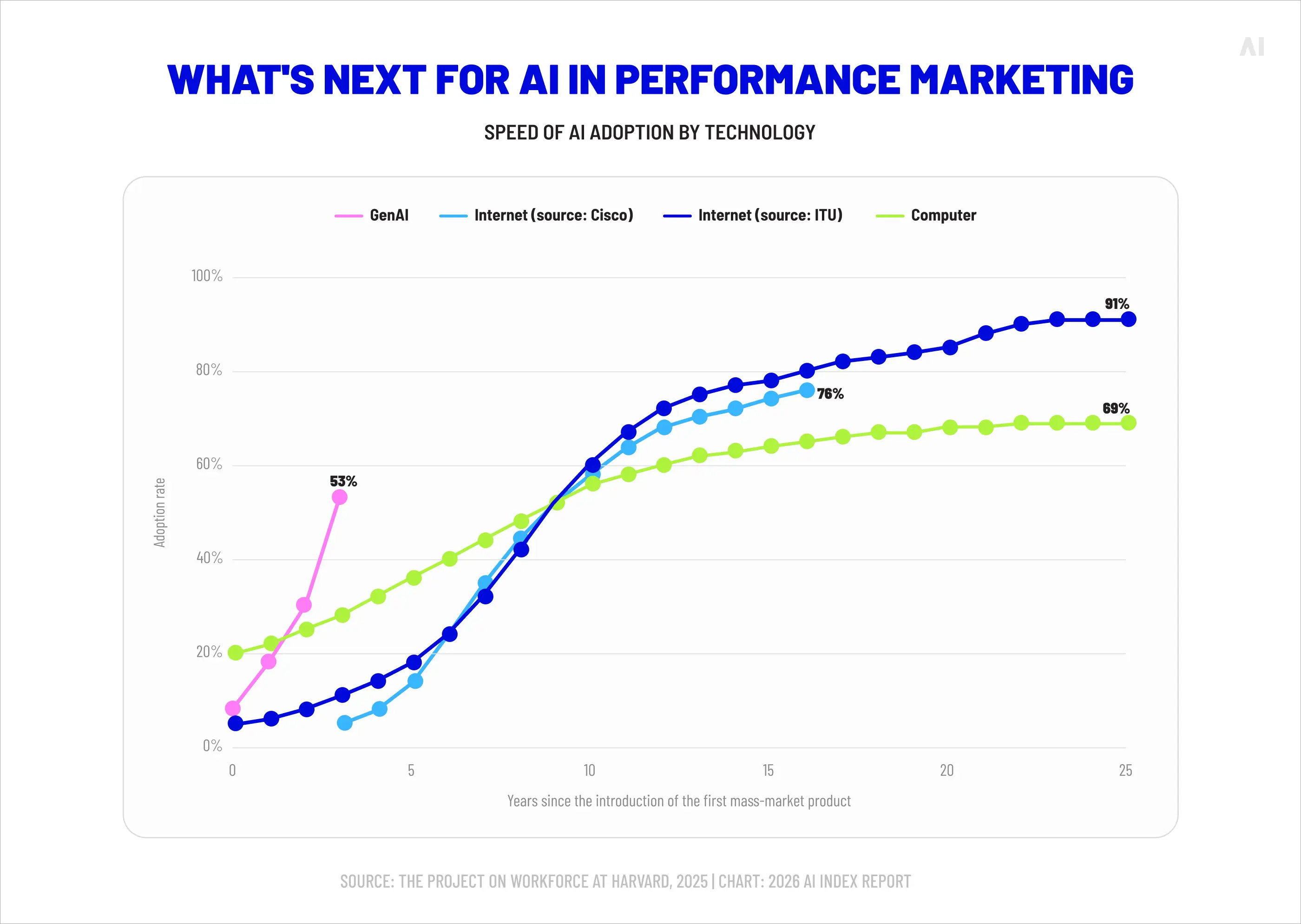
Generative AI adoption curve vs prior consumer technologies (Source)
The current moment in AI marketing is dominated by feature announcements. The next moment will be dominated by integration, measurement and governance—the unglamorous infrastructure work that determines whether the features deliver real value. Several shifts are already visible.
The first is the move from automated optimization to autonomous optimization, where AI agents handle multi-step decisions across planning, buying, creative and reporting without per-step human authorization.
The second is the slow displacement of session-based attribution by privacy-preserving causal measurement, with clean rooms, modeled conversions and incrementality testing absorbing more of the attribution burden as deterministic signal continues to degrade.
The third is the migration of intelligence from the bidding layer up into the planning layer—predictive forecasting, scenario modeling and budget allocation handled by models trained on far broader inputs than any single platform can offer.
Location-based marketing is one of the more concrete near-term opportunities, particularly as DOOH inventory becomes programmatically available and offline-online attribution improves. CTV continues its absorption of premium video, and the addressability advantages of streaming-first inventory are increasingly material for performance programs that have historically been dominated by lower-funnel formats.
The boundaries between brand and performance, never as clean as the org charts suggested, will continue to soften as AI lets a single optimization decision incorporate signals from both ends of the funnel.
The brands building durable advantage in performance marketing are not the ones automating the most. They are the ones designing the data infrastructure, governance and measurement frameworks the automation operates inside, and treating AI as leverage on disciplined work rather than a substitute for it. The lift compounds over years; the missteps compound just as quickly in the other direction.
AI Digital partners with marketing teams on exactly this work—the connective infrastructure between Open Garden's vendor-agnostic execution layer, Elevate's marketing intelligence platform, Smart Supply's supply-side optimization, and the managed-service capability that ties them together across paid media. If you are building toward AI-driven performance marketing and want to talk through how the parts fit together for your specific stack, we're here.
Blind spot
Key issues
Business impact
AI Digital solution
Lack of transparency in AI models
• Platforms own AI models and train on proprietary data • Brands have little visibility into decision-making • "Walled gardens" restrict data access
• Inefficient ad spend • Limited strategic control • Eroded consumer trust • Potential budget mismanagement
Open Garden framework providing: • Complete transparency • DSP-agnostic execution • Cross-platform data & insights
Optimizing ads vs. optimizing impact
• AI excels at short-term metrics but may struggle with brand building • Consumers can detect AI-generated content • Efficiency might come at cost of authenticity
• Short-term gains at expense of brand health • Potential loss of authentic connection • Reduced effectiveness in storytelling
Smart Supply offering: • Human oversight of AI recommendations • Custom KPI alignment beyond clicks • Brand-safe inventory verification
The illusion of personalization
• Segment optimization rebranded as personalization • First-party data infrastructure challenges • Personalization vs. surveillance concerns
• Potential mismatch between promise and reality • Privacy concerns affecting consumer trust • Cost barriers for smaller businesses
Elevate platform features: • Real-time AI + human intelligence • First-party data activation • Ethical personalization strategies
AI-Driven efficiency vs. decision-making
• AI shifting from tool to decision-maker • Black box optimization like Google Performance Max • Human oversight limitations
• Strategic control loss • Difficulty questioning AI outputs • Inability to measure granular impact • Potential brand damage from mistakes
Managed Service with: • Human strategists overseeing AI • Custom KPI optimization • Complete campaign transparency
Fig. 1. Summary of AI blind spots in advertising
Dimension
Walled garden advantage
Walled garden limitation
Strategic impact
Audience access
Massive, engaged user bases
Limited visibility beyond platform
Reach without understanding
Data control
Sophisticated targeting tools
Data remains siloed within platform
Fragmented customer view
Measurement
Detailed in-platform metrics
Inconsistent cross-platform standards
Difficult performance comparison
Intelligence
Platform-specific insights
Limited data portability
Restricted strategic learning
Optimization
Powerful automated tools
Black-box algorithms
Reduced marketer control
Fig. 2. Strategic trade-offs in walled garden advertising.
Core issue
Platform priority
Walled garden limitation
Real-world example
Attribution opacity
Claiming maximum credit for conversions
Limited visibility into true conversion paths
Meta and TikTok's conflicting attribution models after iOS privacy updates
Data restrictions
Maintaining proprietary data control
Inability to combine platform data with other sources
Amazon DSP's limitations on detailed performance data exports
Cross-channel blindspots
Keeping advertisers within ecosystem
Fragmented view of customer journey
YouTube/DV360 campaigns lacking integration with non-Google platforms
Black box algorithms
Optimizing for platform revenue
Reduced control over campaign execution
Self-serve platforms using opaque ML models with little advertiser input
Performance reporting
Presenting platform in best light
Discrepancies between platform-reported and independently measured results
Consistently higher performance metrics in platform reports vs. third-party measurement
Fig. 1. The Walled garden misalignment: Platform interests vs. advertiser needs.
Key dimension
Challenge
Strategic imperative
ROAS volatility
Softer returns across digital channels
Shift from soft KPIs to measurable revenue impact
Media planning
Static plans no longer effective
Develop agile, modular approaches adaptable to changing conditions
Brand/performance
Traditional division dissolving
Create full-funnel strategies balancing long-term equity with short-term conversion
Capability
Key features
Benefits
Performance data
Elevate forecasting tool
• Vertical-specific insights • Historical data from past economic turbulence • "Cascade planning" functionality • Real-time adaptation
• Provides agility to adjust campaign strategy based on performance • Shows which media channels work best to drive efficient and effective performance • Confident budget reallocation • Reduces reaction time to market shifts
• Dataset from 10,000+ campaigns • Cuts response time from weeks to minutes
• Reaches people most likely to buy • Avoids wasted impressions and budgets on poor-performing placements • Context-aligned messaging
• 25+ billion bid requests analyzed daily • 18% improvement in working media efficiency • 26% increase in engagement during recessions
Full-funnel accountability
• Links awareness campaigns to lower funnel outcomes • Tests if ads actually drive new business • Measures brand perception changes • "Ask Elevate" AI Chat Assistant
• Upper-funnel to outcome connection • Sentiment shift tracking • Personalized messaging • Helps balance immediate sales vs. long-term brand building
• Natural language data queries • True business impact measurement
Open Garden approach
• Cross-platform and channel planning • Not locked into specific platforms • Unified cross-platform reach • Shows exactly where money is spent
• Reduces complexity across channels • Performance-based ad placement • Rapid budget reallocation • Eliminates platform-specific commitments and provides platform-based optimization and agility
• Coverage across all inventory sources • Provides full visibility into spending • Avoids the inability to pivot across platform as you’re not in a singular platform
Fig. 1. How AI Digital helps during economic uncertainty.
Trend
What it means for marketers
Supply & demand lines are blurring
Platforms from Google (P-Max) to Microsoft are merging optimization and inventory in one opaque box. Expect more bundled “best available” media where the algorithm, not the trader, decides channel and publisher mix.
Walled gardens get taller
Microsoft’s O&O set now spans Bing, Xbox, Outlook, Edge and LinkedIn, which just launched revenue-sharing video programs to lure creators and ad dollars. (Business Insider)
Retail & commerce media shape strategy
Microsoft’s Curate lets retailers and data owners package first-party segments, an echo of Amazon’s and Walmart’s approaches. Agencies must master seller-defined audiences as well as buyer-side tactics.
AI oversight becomes critical
Closed AI bidding means fewer levers for traders. Independent verification, incrementality testing and commercial guardrails rise in importance.
Fig. 1. Platform trends and their implications.
Metric
Connected TV (CTV)
Linear TV
Video Completion Rate
94.5%
70%
Purchase Rate After Ad
23%
12%
Ad Attention Rate
57% (prefer CTV ads)
54.5%
Viewer Reach (U.S.)
85% of households
228 million viewers
Retail Media Trends 2025
Access Complete consumer behaviour analyses and competitor benchmarks.
Identify and categorize audience groups based on behaviors, preferences, and characteristics
Michaels Stores: Implemented a genAI platform that increased email personalization from 20% to 95%, leading to a 41% boost in SMS click through rates and a 25% increase in engagement.
Estée Lauder: Partnered with Google Cloud to leverage genAI technologies for real-time consumer feedback monitoring and analyzing consumer sentiment across various channels.
High
Medium
Automated ad campaigns
Automate ad creation, placement, and optimization across various platforms
Showmax: Partnered with AI firms toautomate ad creation and testing, reducing production time by 70% while streamlining their quality assurance process.
Headway: Employed AI tools for ad creation and optimization, boosting performance by 40% and reaching 3.3 billion impressions while incorporating AI-generated content in 20% of their paid campaigns.
High
High
Brand sentiment tracking
Monitor and analyze public opinion about a brand across multiple channels in real time
L’Oréal: Analyzed millions of online comments, images, and videos to identify potential product innovation opportunities, effectively tracking brand sentiment and consumer trends.
Kellogg Company: Used AI to scan trending recipes featuring cereal, leveraging this data to launch targeted social campaigns that capitalize on positive brand sentiment and culinary trends.
High
Low
Campaign strategy optimization
Analyze data to predict optimal campaign approaches, channels, and timing
DoorDash: Leveraged Google’s AI-powered Demand Gen tool, which boosted its conversion rate by 15 times and improved cost per action efficiency by 50% compared with previous campaigns.
Kitsch: Employed Meta’s Advantage+ shopping campaigns with AI-powered tools to optimize campaigns, identifying and delivering top-performing ads to high-value consumers.
High
High
Content strategy
Generate content ideas, predict performance, and optimize distribution strategies
JPMorgan Chase: Collaborated with Persado to develop LLMs for marketing copy, achieving up to 450% higher clickthrough rates compared with human-written ads in pilot tests.
Hotel Chocolat: Employed genAI for concept development and production of its Velvetiser TV ad, which earned the highest-ever System1 score for adomestic appliance commercial.
High
High
Personalization strategy development
Create tailored messaging and experiences for consumers at scale
Stitch Fix: Uses genAI to help stylists interpret customer feedback and provide product recommendations, effectively personalizing shopping experiences.
Instacart: Uses genAI to offer customers personalized recipes, mealplanning ideas, and shopping lists based on individual preferences and habits.
Medium
Medium
Share article
Url copied to clipboard
No items found.
Subscribe to our Newsletter
THANK YOU FOR YOUR SUBSCRIPTION
Oops! Something went wrong while submitting the form.
Questions? We have answers
How is AI used in performance marketing?
AI is now embedded across most of the operational stack: predictive forecasting and budget modeling before campaigns launch; automated bidding, dynamic budget allocation and audience refinement during execution; generative creative production and dynamic creative optimization in the asset layer; data-driven attribution and incrementality measurement after the fact. The common thread is that AI compresses cycles that used to depend on human review, allowing decisions to be made more frequently and on richer inputs. The performance gain depends entirely on what the AI is being pointed at—strong signal compounds, weak signal compounds in the wrong direction.
What are the risks of AI in digital advertising?
The most material risks are operational rather than technological. AI optimizers running against poor measurement amplify the errors in the measurement; black-box platform algorithms make decisions brands cannot inspect or improve; over-reliance on platform-reported attribution distorts the picture of what is actually working; and automated activity at scale can scale inefficiency as easily as it scales efficiency. Privacy, brand-safety and regulatory exposure are real but secondary to the measurement and governance risks for most performance programs.
What tools are needed for AI-driven performance marketing?
The tooling list matters less than the architecture. A first-party data foundation—typically a customer data platform feeding a cloud data warehouse—sits underneath everything. A measurement layer combining MTA, MMM and incrementality testing produces the signal the optimizer learns from. A planning and intelligence platform handles forecasting, audience definition and cross-channel optimization. The DSPs, SSPs and creative tools sit beneath that. Brands that buy individual tools without thinking through how they connect tend to end up with capability without coherence.
Is AI replacing performance marketers?
The work has changed more than the headcount. Routine bid management, manual audience building, and asset-level creative production have largely moved to automation. The human role has concentrated upstream—on hypothesis design, signal validation, governance, strategic measurement, and the integration work that determines whether the automation has the right data underneath it. The question is not whether AI replaces performance marketers but whether performance marketers reinvest the time they no longer spend on execution into the work AI cannot do.
How can businesses prepare their marketing stack for AI?
The order matters. Start with a tracking and consent audit, because every downstream model depends on the conversion data quality. Standardize the definitions across teams—what counts as a lead, a conversion, a qualified opportunity—so the optimization target is consistent. Build or consolidate a unified data layer that holds first-party customer data, paid media performance and revenue data in a single environment. Then add the AI tooling, choosing platforms that integrate with what is already in place rather than replacing it. Brands that follow this sequence tend to get value from AI; brands that buy the tooling first tend not to.
What is the difference between automation and AI in marketing?
Automation executes predefined rules without intervention. AI generates the rules—or, more precisely, learns the patterns the rules are approximations of—from data. A scheduled email send is automation; an email send timed to the moment a model predicts the recipient will be receptive is AI. A bid cap is automation; a bid that adjusts continuously against modeled conversion probability is AI. The distinction matters because the failure modes are different: automation fails when the rules are wrong, while AI fails when the data is wrong. Most modern performance stacks combine both, and the discipline of governing them well is now the central craft of the function.
Have other questions?
If you have more questions, contact us so we can help.
Questions? We have answers
This is some text inside of a div block.
Lorem ipsum dolor sit amet, consectetur adipiscing elit. Suspendisse varius enim in eros elementum tristique. Duis cursus, mi quis viverra ornare, eros dolor interdum nulla, ut commodo diam libero vitae erat. Aenean faucibus nibh et justo cursus id rutrum lorem imperdiet. Nunc ut sem vitae risus tristique posuere.
This is some text inside of a div block.
Lorem ipsum dolor sit amet, consectetur adipiscing elit. Suspendisse varius enim in eros elementum tristique. Duis cursus, mi quis viverra ornare, eros dolor interdum nulla, ut commodo diam libero vitae erat. Aenean faucibus nibh et justo cursus id rutrum lorem imperdiet. Nunc ut sem vitae risus tristique posuere.
This is some text inside of a div block.
Lorem ipsum dolor sit amet, consectetur adipiscing elit. Suspendisse varius enim in eros elementum tristique. Duis cursus, mi quis viverra ornare, eros dolor interdum nulla, ut commodo diam libero vitae erat. Aenean faucibus nibh et justo cursus id rutrum lorem imperdiet. Nunc ut sem vitae risus tristique posuere.
This is some text inside of a div block.
Lorem ipsum dolor sit amet, consectetur adipiscing elit. Suspendisse varius enim in eros elementum tristique. Duis cursus, mi quis viverra ornare, eros dolor interdum nulla, ut commodo diam libero vitae erat. Aenean faucibus nibh et justo cursus id rutrum lorem imperdiet. Nunc ut sem vitae risus tristique posuere.
This is some text inside of a div block.
Lorem ipsum dolor sit amet, consectetur adipiscing elit. Suspendisse varius enim in eros elementum tristique. Duis cursus, mi quis viverra ornare, eros dolor interdum nulla, ut commodo diam libero vitae erat. Aenean faucibus nibh et justo cursus id rutrum lorem imperdiet. Nunc ut sem vitae risus tristique posuere.
This is some text inside of a div block.
Lorem ipsum dolor sit amet, consectetur adipiscing elit. Suspendisse varius enim in eros elementum tristique. Duis cursus, mi quis viverra ornare, eros dolor interdum nulla, ut commodo diam libero vitae erat. Aenean faucibus nibh et justo cursus id rutrum lorem imperdiet. Nunc ut sem vitae risus tristique posuere.
This is some text inside of a div block.
Lorem ipsum dolor sit amet, consectetur adipiscing elit. Suspendisse varius enim in eros elementum tristique. Duis cursus, mi quis viverra ornare, eros dolor interdum nulla, ut commodo diam libero vitae erat. Aenean faucibus nibh et justo cursus id rutrum lorem imperdiet. Nunc ut sem vitae risus tristique posuere.
.svg)
.svg)



.webp)