Hyper-Personalization in Marketing: How Brands Deliver Real-Time Experiences
Sarah Moss
February 16, 2026
15
minutes read
For years, “personalized marketing” has largely meant static segments, rule-based logic, and generic recommendations applied at the campaign level. While these approaches once improved efficiency, they no longer reflect how customers actually behave. Modern journeys are fragmented across devices, channels, and moments, and customer intent can shift in seconds. As a result, many experiences labeled as personalized still feel delayed, repetitive, or irrelevant—creating a clear gap between expectation and delivery. This gap is accelerating the shift toward hyper-personalization, as evidenced by market growth projections showing the global hyper-personalisation market expanding from approximately $21.8 billion in 2024 to $25.7 billion at a CAGR of 18.1%, and reaching nearly $49.6 billion by 2029, driven by digital adoption and demand for truly individualized experiences.
Personalization in marketing is undergoing a transformative evolution. What once meant inserting a first name in an email now involves real-time analysis of individual behavior, context, and intent. This evolution has culminated in hyper personalization—a hyper-personalized approach that harnesses AI, machine learning, and real-time data to deliver tailored experiences at scale across every touchpoint. In 2026, brands that adopt hyper-personalization strategies achieve measurable advantages in engagement, conversion, and customer loyalty because they meet consumers’ heightened expectations for relevance and responsiveness.
According to industry forecasts, the global hyper personalisation market is projected to grow from approximately $21.8 billion in 2024 to $25.7 billion in 2025 at a compound annual growth rate (CAGR) of 18.1%, and then expand to nearly $49.6 billion by 2029, driven by rising digital adoption and demand for individualized experiences.
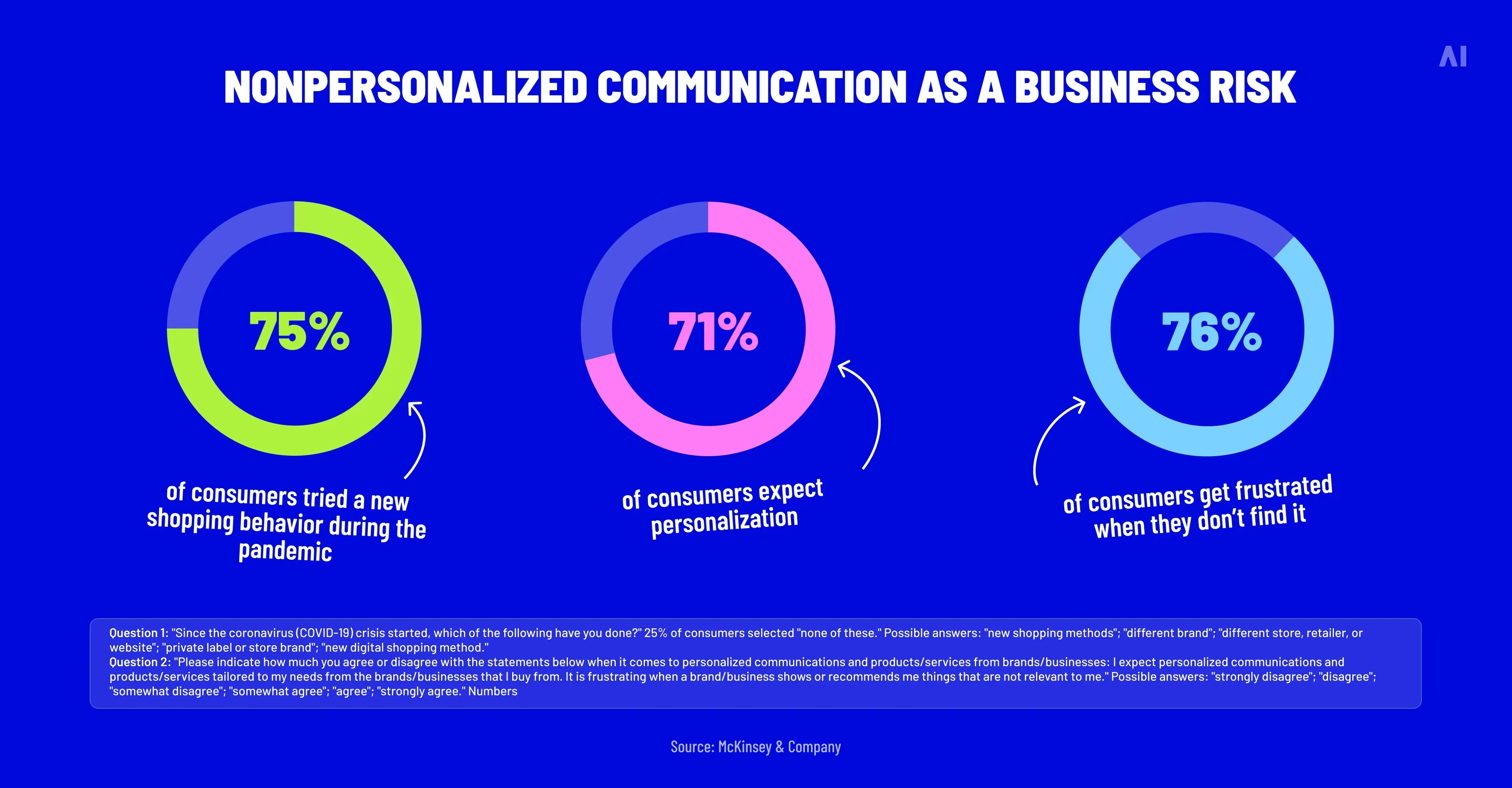
Traditional, rule-based personalization, such as broad segments and static contentstruggles to deliver the depth and immediacy that modern consumers expect. Data shows that 71% of customers now expect personalized interactions, and 76% express frustration when brands fail to deliver them, underscoring the performance gap that legacy approaches leave unaddressed.
💡In contrast, hyper-personalization marketing uses sophisticated data processing and AI to serve contextually relevant experiences in real time, enhancing customer experience and business outcomes. Brands using AI-powered persoalization report up to 2× higher engagement and other compelling performance lifts when comparing hyper-personalized content with generic messaging.
What is hyper-personalization?
Hyper-personalization is an advanced marketing approach that uses real-time data, artificial intelligence (AI), machine learning, and behavioral signals to deliver highly relevant, individualized experiences across all customer touchpoints. Unlike traditional personalized marketing—which often relies on static attributes such as name, age or basic segmentation—hyper-personalization continuously analyzes customer interactions, preferences, context, and intent to tailor content, offers, and recommendations that feel bespoke to each individual. This approach harnesses dynamic insights from browsing behavior, purchase patterns, location, and other contextual cues to adapt messaging in the moment, enhancing relevance and engagement far beyond conventional tactics.
The use of AI personalization and predictive analytics enables brands to anticipate customer needs, automate decision-making at scale, and orchestrate real-time personalization across channels such as email, websites, mobile apps, and advertising platforms. By integrating data streams and advanced algorithms, hyper-personalized experiences can meet customers where they are with the right message at precisely the right time, significantly improving customer experience and marketing performance compared to traditional approaches.
Hyper-personalization vs traditional personalization
As digital channels proliferate and consumer expectations rise, the difference between hyper-personalization and traditional personalization becomes increasingly consequential for marketing performance. Traditional personalization typically uses basic customer attributes and predefined rules to tailor messaging at a broad segment level. In contrast, hyper-personalization applies AI-driven, real-time context and behavioral data to tailor interactions for each individual across channels dynamically. Hyper-personalization integrates advanced data sources and machine learning to understand intent and preferences continuously, while traditional approaches remain static, reactive, and less adaptive.
The table below highlights core distinctions between the two approaches across key dimensions of execution and impact:
{{26-How-Brands-Deliver-Real-Time-1="/tables"}}
Traditional personalization relies on segmenting audiences by pre-defined attributes and then applying basic rules or templates to those segments. Examples include inserting a customer’s name into an email or recommending products based solely on past purchases.
Hyper-personalization, by contrast, continuously ingests real-time signals, such as browsing actions, current context, and engagement patterns, to adapt content, timing, and offers for each individual.
⚡️For brands navigating today’s sophisticated customer journey landscape, the shift from traditional personalization to hyper-personalization represents not simply a technological upgrade but a strategic redesign of how experiences are delivered at scale. To understand how this trend intersects with broader AI advancements in marketing, see AI-Driven Personalization Explained.
How hyper-personalization works
Hyper-personalization transforms modern marketing by combining unified data systems, AI and machine learning, and real-time decisioning to deliver individualized experiences that drive measurable outcomes. Rather than relying on static customer profiles or scheduled campaigns, hyper-personalization continuously updates understanding of each customer’s behavior and context, enabling brands to tailor content, offers, and interactions at the moment of engagement. This real-time responsiveness enhances customer experience, increases conversion rates, and supports long-term loyalty by meeting consumer expectations for relevance and timeliness—capabilities that traditional marketing tactics cannot match.
Data collection and unification
The foundation of hyper-personalization is comprehensive data collection and unification from all customer touchpoints. This includes first-party data (e.g., CRM information, purchase history), behavioral signals (e.g., browsing activity, app usage), and contextual inputs (e.g., device type, time of day). By integrating these disparate sources into a unified customer profile through systems such as customer data platforms (CDPs) or composable data architectures, brands can generate a holistic, up-to--the-moment view of each individual. These unified profiles enable more accurate insights and reduce the fragmentation that undermines relevance and personalization at scale.
AI and machine learning models
With unified data in place, AI and machine learning models analyze patterns, detect preferences, and generate predictions that inform personalization. Machine learning algorithms continuously learn from incoming data to refine models of customer intent and behavior, enabling systems to tailor experiences without manual rule setting. These models support functions such as next-best-offer recommendation, dynamic content selection, and predictive segmentation—capabilities that static rule-based engines cannot replicate. The result is an AI-driven personalization framework that adapts and scales in real time.
AI Digital’s AI services are designed to operationalize these capabilities for brands seeking measurable performance outcomes. Through its proprietary AI platform and advisory services, AI Digital helps organizations unify first-party data, apply machine learning insights, and automate real-time decisioning for campaigns that respond to individual user signals. For example, AI Digital’s Elevate platform leverages predictive planning and real-time optimization to align personalization with key business outcomes, enabling 15-minute optimization cycles that improve cost efficiency and audience relevance. Early adopters of Elevate have reported measurable performance gains, such as expanded reach, reduced cost per acquisition, and improved media efficiency, by combining machine learning-driven insights with transparent optimization logic that keeps strategic control in the marketer’s hands.
💡This blend of advanced analytics and practical execution underscores how AI-powered personalization can move beyond theoretical value into concrete performance improvements—enhancing customer experience, conversion rates, and long-term engagement by making each interaction feel uniquely tailored to the individual.
⚡️For a complementary view on how targeted insights and AI drive optimized advertising outcomes within broader marketing strategies, see our expert insight, AI Targeted Advertising Explained.
Real-time decisioning and content delivery
At execution, real-time decisioning engines operationalize insights from unified data and AI models to deliver the most relevant content, offers, and experiences at each moment of engagement. Real-time personalization uses instant data signals, such as current browsing behavior, recent interactions, and contextual cues, to adapt messaging, creative, and call-to-action in the moment, which drives higher engagement and conversion rates compared with static campaign schedules that refresh only periodically.
AI Digital combines machine learning-powered real-time optimization with expert oversight to ensure that decisions are informed by both predictive models and strategic business objectives. Its proprietary approaches, such as AI-enhanced forecasting and rapid optimization cycles, allow brands to adjust targeting and creative logic based on live performance signals and operational KPIs, rather than waiting for end-of-day or weekly reporting. This real-time responsiveness is critical in today’s fragmented media ecosystem, where consumer attention shifts quickly across channels and moments.
By unifying real-time insights with adaptive delivery mechanisms, AI Digital helps organizations improve key performance indicators, including engagement, conversion, and return on ad spend, by ensuring that each interaction reflects the most up-to-date understanding of user intent and context.
⚡️This real-time adaptability is a cornerstone of effective AI-powered personalization, which enables brands to deliver experiences that feel both timely and individually relevant across digital touchpoints.
Key technologies enabling hyper-personalization
Executing hyper-personalization at scale depends on an orchestrated technology stack that enables interoperability, real-time insights, and seamless activation across channels, not isolated tools working in silos. Modern hyper-personalization requires systems that ingest, unify, analyze, and activate data in real time to tailor experiences at the individual level, while also respecting privacy constraints and cookieless realities.
Customer data platforms (CDPs)
At the core of hyper-personalization is the Customer Data Platform (CDP), which consolidates first-party data from across touchpoints—web, mobile, CRM, email, offline sales—and constructs a unified customer profile accessible to activation systems. CDPs eliminate fragmentation and ensure consistent identity resolution across channels, which is crucial for real-time personalization. According to industry analysts, by 2026, 80% of enterprises will have adopted a CDP as essential infrastructure for unified customer context and real-time action, and CDPs can increase marketing efficiency and engagement by up to 30% when implemented effectively.
A robust CDP supports deterministic and probabilistic identity matching to link disparate identifiers into a coherent profile, providing the single source of truth that downstream personalization engines rely upon.
Marketing automation and orchestration tools
Hyper-personalization requires more than data storage; it depends on marketing automation and orchestration tools that execute personalized interactions across channels based on unified profiles and triggers.
These tools coordinate complex cross-channel journeys (email, SMS, push notifications, web personalization, paid media) and define logic for when and how customer signals drive specific actions. They also manage consent, preference capture, and campaign delivery while maintaining synchronized state across systems. This orchestration layer ensures that personalization is both timely and contextually relevant as customers move through touchpoints.
AI-driven analytics and personalization engines
AI-driven analytics and personalization engines are the intelligence layer that turns unified customer data into actionable decisions. These systems apply machine learning and predictive models to detect patterns, predict preferences, and power next-best-offer recommendations, dynamic content selection, and propensity scoring. By continuously learning from new data, AI personalization engines enable real-time adaptation of experiences at the individual level.
From an expert perspective at AI Digital, advertising intelligence and analytics are fundamental to transforming this raw data into measurable performance outcomes. AI Digital’s approaches integrate advanced analytics with media activation and feedback loops—ensuring that models are not only predictive but also tied to business KPIs (e.g., conversion lift, engagement rates, retention). This integration supports closed-loop optimization where insights inform ongoing personalization logic rather than static rules.
⚡️For how these analytics practices underpin smarter advertising and performance measurement in modern marketing, see օur guide, Advertising Intelligence.
Identity resolution in a cookieless environment
As third-party cookies continue to fade and privacy regulations tighten, identity resolution has become a strategic technology for hyper-personalization. Identity resolution reconciles multiple identifiers (e.g., email, device IDs, login data) into persistent, privacy-compliant customer profiles so that personalization can function reliably across devices and sessions without third-party tracking. In a cookieless world, reliance on first-party and zero-party data, consented signal capture, and clean identity graphs drives both personalization accuracy and privacy assurance.
⚡️This shift toward privacy-first identity systems also highlights the importance of transparent data governance, consent management, and privacy compliance in personalization strategies—as discussed in In a Cookie-Less World: New Challenges and Opportunities.
💡Together, these technologies form the backbone of scalable, responsive hyper-personalization—enabling brands to tailor experiences that are timely, relevant, and respectful of user privacy.
Benefits of hyper-personalization
Brands are investing heavily in hyper-personalization strategies because they drive measurable improvements across key performance metrics — transforming customer engagement, conversion efficiency, long-term loyalty, and media utilization.
As consumer expectations continue to rise, companies that can deliver relevant, individualized experiences in real time are gaining competitive advantage and driving stronger business outcomes. According to recent industry data, 71% of consumers expect personalized interactions, and 76% report frustration when brands fail to deliver them, illustrating why relevance has become a fundamental performance driver rather than a marketing luxury.
Higher engagement and conversion rates
Hyper-personalization significantly increases engagement and conversion performance by matching content, offers, and recommendations to individual preferences and contextual signals in real time. Studies show that personalized messaging and next-best-offer strategies can yield conversion uplifts of more than 20–30% compared with generic campaigns, and hyper-personalized experiences often outperform traditional approaches by even larger margins. This outcome stems from delivering the right message to the right person at the right moment, which substantially improves relevance and click-through performance.
Delivering individualized experiences at scale enhances the customer experience by making interactions feel intuitive and contextually appropriate. When brands understand and respond to customer preferences—such as recent behavior, preferred channels, and purchase intent—consumers are more likely to perceive the brand as relevant and responsive. This enriched experience fosters satisfaction and builds brand trust, which are critical differentiators in markets where consumers increasingly expect seamless, cross-channel coherence.
Increased retention and lifetime value
Hyper-personalization supports stronger retention and customer lifetime value (CLV) by reinforcing ongoing relevance across the customer journey. Data indicates that personalization drives not only initial conversions but also repeat engagement and loyalty. For example, customers who receive experiences tailored to their individual behavior and preferences are more likely to remain active and make additional purchases over time, reducing churn and increasing the average revenue per user. Tools that track retention and CLV allow marketers to quantify this impact and optimize strategies for long-term growth.
More efficient media and content utilization
By focusing resources on experiences and audiences with the highest relevance, hyper-personalization improves media and content utilization efficiency. Instead of broad, untargeted campaigns that generate wasted impressions, hyper-personalized strategies allocate spend toward segments and moments with the greatest propensity to convert. This level of precision reduces inefficiencies in both paid media and organic content efforts, aligning media delivery with business outcomes and enhancing return on ad spend (ROAS) through sharper targeting and reduced waste.
Collectively, these benefits highlight why brands across industries, from retail to digital services, are accelerating investment in hyper-personalization technologies and strategies: it translates customer insight into tangible performance gains across engagement, conversion, loyalty, and operational efficiency.
Hyper-personalization across marketing channels
Hyper-personalization is not confined to a single medium or message type—it pervades every major marketing touchpoint. By applying real-time data, AI models, and contextual triggers, brands can tailor experiences that feel individually crafted across digital environments.
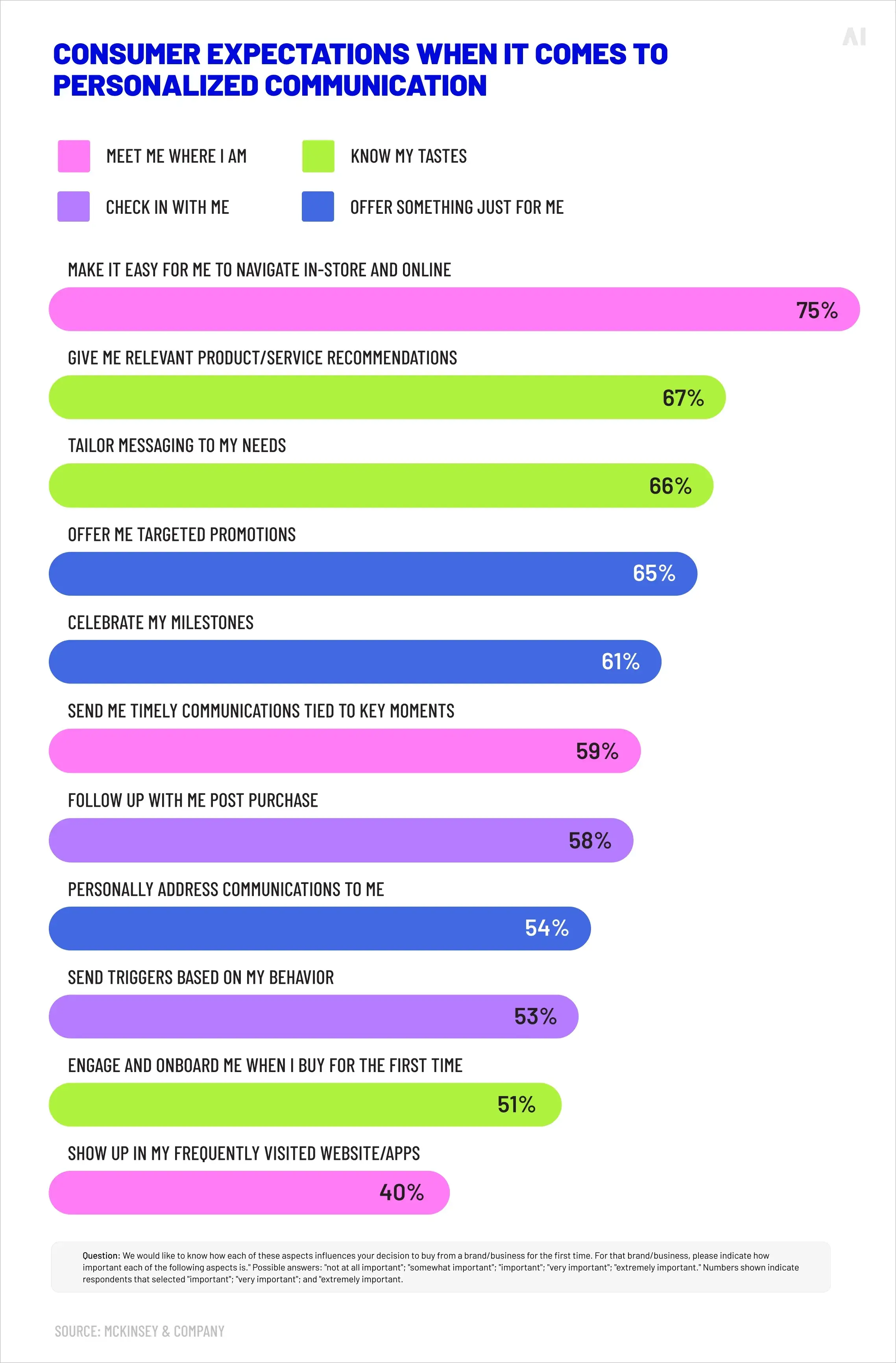
According to recent industry research, 73% of customers expect brands to understand their needs and preferences, and organizations that excel at personalization generate up to 40% more revenue from these initiatives versus average performers.
Website and app experiences
On websites and mobile apps, hyper-personalization manifests as dynamic content, personalized recommendations, and contextual interactions that reflect a visitor’s recent behavior, shopping history, or expressed interests. For example, AI-driven engines can present custom landing pages, product suggestions, and workflow pathways that adjust in real time as users navigate. This drastically reduces friction and enhances relevance—when customers see content that aligns with their intent, engagement and conversion outcomes improve measurably.
Email and lifecycle marketing
In email and lifecycle journeys, hyper-personalization uses behavioral triggers (e.g., cart abandonment, browsing patterns, loyalty status) to send tailored messaging at optimal moments. Hyper-personalized emails deliver far higher ROI than batch or blast sends—experiments show that incorporating behavior-based triggers into email campaigns can raise transaction rates by up to 6× compared with generic messaging.
Paid media and programmatic advertising
Hyper-personalization extends into paid media through programmatic advertising and audience targeting that adjusts in real time. By integrating first-party data and predictive insights, DSPs can serve ads tailored to individual users’ preferences, purchase likelihood, and contextual cues, increasing relevance and reducing wasted spend. Dynamic creative optimization (DCO) further enhances this process by automatically adapting ad creative based on performance signals and audience behavior, yielding higher engagement and ROI than static ads.
CTV and digital video personalization
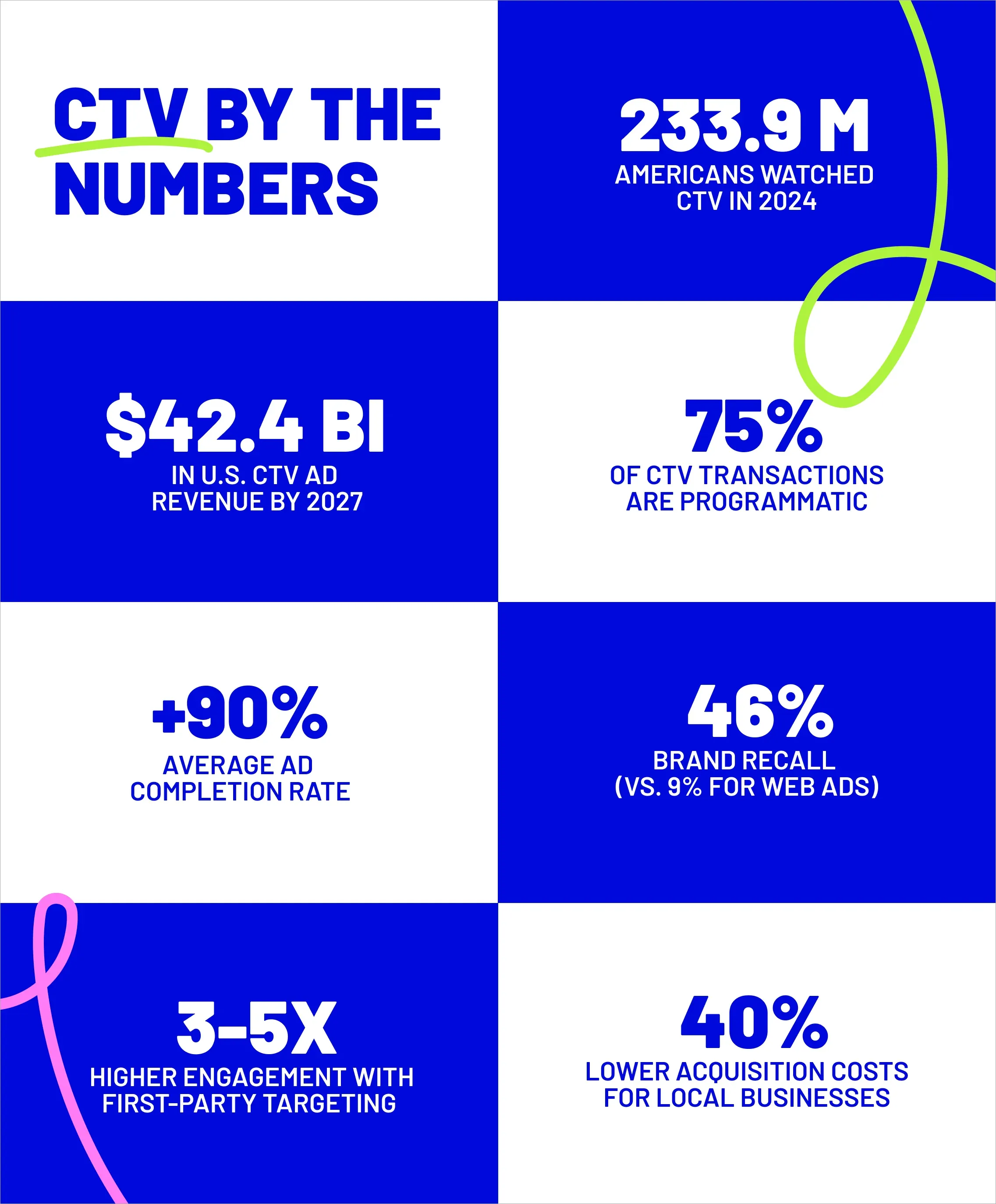
Connected TV (CTV) and digital video channels offer one of the most impactful arenas for hyper-personalized marketing due to their blend of broad audience reach and data-driven segmentation. Unlike traditional television, CTV platforms use viewer data—such as viewing habits, household characteristics, and engagement patterns—to deliver tailored ad experiences in real time. This precision targeting enables advertisers to align content with viewer interests and context, improving completion rates and viewer engagement far beyond generic TV ads.
Hyper-personalization is applied across industries to address specific business goals—such as increasing conversion, enhancing customer experience, reducing churn, and boosting value per customer. Across sectors, brands leverage real-time data, AI, and predictive analytics to tailor interactions and create experiences that feel uniquely relevant to each individual. According to recent industry research, companies that adopt hyper-personalization report significant business growth, with 78% experiencing revenue increases tied to personalized strategies and leading performers generating 40% more revenue than competitors with traditional approaches.
{{26-How-Brands-Deliver-Real-Time-2="/tables"}}
Hyper-personalization is driving measurable commercial impact in retail—retailers using real-time, AI-driven personalization see higher conversion and engagement because customers increasingly expect experiences uniquely tailored to their behaviors and preferences.
💡For example, 67% of consumers expect personalized online shopping experiences, and retailers that embrace AI for predictive personalization are positioned to enhance both relevance and revenue.
Challenges and limitations of hyper-personalization
While hyper-personalization offers clear performance advantages, it also introduces practical, ethical, and technical challenges that brands must address in order to realize its full potential effectively and responsibly. These concerns range from the foundational quality of data to consumer trust and operational complexity.
Data quality and fragmentation
Effective hyper-personalization depends on high-quality, unified data from multiple sources. However, many organizations struggle with fragmented or inconsistent data spread across CRM systems, web and mobile platforms, point-of-sale systems, and third-party sources. In fact, personalization initiatives often stall because businesses lack reliable data pipelines and unified customer profiles—issues that degrade the accuracy of real-time recommendations and predictive models. Poor data quality not only reduces personalization precision but also increases the risk of erroneous insights that can harm customer experience and decisioning performance.
Privacy, consent, and compliance
Hyper-personalization raises significant privacy and regulatory concerns. Brands collect and process detailed behavioral, contextual, and personal information, prompting tension between delivering relevant experiences and respecting consumer privacy. This “privacy-personalization paradox” reflects how consumers want tailored experiences but simultaneously worry about how their data is used and protected. Marketers must navigate evolving frameworks such as GDPR, CCPA, and emerging AI regulations while ensuring users provide informed consent and transparent opt-in/out choices. Failure to align personalization practices with regulatory standards can undermine trust and expose organizations to compliance risk.
Over-personalization and customer fatigue
While relevance enhances engagement, over-personalization can lead to customer fatigue and perceived intrusion. Excessive targeting, repetitive messaging, or overly granular recommendations may make customers feel watched or overwhelmed rather than understood, diminishing trust and satisfaction. There is a fine line between helpful personalization and intrusive interaction; crossing it can erode customer goodwill and reduce long-term engagement.
Technology and operational complexity
Implementing hyper-personalization requires robust infrastructure and sophisticated technology stacks capable of ingesting, processing, and acting on large volumes of real-time data. Organizations must integrate multiple platforms (e.g., CDPs, AI analytics, orchestration tools), maintain scalable cloud or edge computing environments, and ensure interoperability among systems. These requirements introduce operational complexity and demand investment in talent, governance frameworks, and continuous optimization. Many companies find the technical integration and scaling of real-time personalization engines to be a significant barrier to execution.
Addressing these challenges requires a strategic approach that balances data sophistication, ethical usage, regulatory compliance, and operational readiness—all while maintaining customer trust and experience at the center of hyper-personalization efforts.
Best practices for successful hyper-personalization
To implement hyper-personalization effectively, marketers should adopt systematic, measurable, and customer-centric practices. Sophisticated technology alone does not guarantee results; strategic planning, continual refinement, and alignment with customer expectations and brand values are equally essential.
Industry benchmarks show that brands with disciplined personalization frameworks drive more consistent engagement and long-term loyalty.
Start with clear use cases and KPIs
Develop hyper-personalization strategies around well-defined business goals and key performance indicators (KPIs) rather than treating personalization as a generic optimization effort. Establish measurable outcomes such as increased conversion, retention, or average revenue per user and track them against real-time and aggregated performance. Clear KPIs enable marketers to attribute value to personalization efforts and refine strategies over time.
Hyper-personalization leverages AI and automation to scale relevance, but human oversight remains critical to ensure that automated decisions align with brand voice, ethics, and customer expectations.
Use AI and automation to scale decisioning, not to replace strategic judgment.
Maintain human review loops for messaging logic, brand voice, and ethical boundaries.
Regularly audit models for bias, drift, and unintended personalization outcomes.
Treat AI as an augmentation layer, not an autonomous decision authority.
Test, learn, and optimize continuously
Continuous experimentation and optimization are core to sustaining performance in hyper-personalization.
Validate personalization logic incrementally before full-scale rollout.
Use real-time performance signals to refine models, creatives, and delivery rules.
Retire underperforming personalization rules quickly to avoid experience fatigue.
This iterative approach enables teams to refine targeting rules, AI models, and content strategies as customer behaviors evolve and new data becomes available.
Align personalization with brand trust
Successful hyper-personalization respects customer expectations for privacy and transparency.
Design personalization around consented, first-party data.
Be transparent about how data is collected and used.
When executed with discipline, hyper-personalization becomes a repeatable performance system, not a one-off technology initiative—driving relevance, efficiency, and long-term customer value.
The future of hyper-personalization
The trajectory of hyper-personalization in 2026 extends well beyond incremental improvements; it is becoming a core expectation for modern marketing systems as AI, real-time data, and predictive context converge. Market research shows that over 92% of businesses are leveraging AI-driven personalization to drive growth, and 73% of leaders agree AI will fundamentally reshape personalization strategies, signaling that this trend is critical to competitive performance. Additionally, real-time adaptability and context-aware personalization are among the defining capabilities marketers are prioritizing for 2026 and beyond.
Generative AI–enhanced experiences that tailor not only recommendations but also creative elements, such as personalized media, messaging, and adaptive interfaces.
Predictive engagement where systems anticipate next best actions and proactively surface the most relevant message or offer.
Cross-channel coordination that links behavioral signals across digital touchpoints into a unified, real-time personalization engine.
Context-aware suggestions that integrate location, device context, and customer state into decisioning logic.
⚡️These advancements reflect how hyper-personalization increasingly blends AI automation with strategic performance insights to create truly responsive customer journeys. For how this intersects with generative AI’s role in creative and media strategy, see GenAI in Creative Media Strategy.
Conclusion: why hyper-personalization is becoming a marketing standard
Hyper-personalization is transforming from a differentiator into a baseline expectation for brands that seek relevance, efficiency, and trust. As consumer expectations evolve—with 71% expecting personalized interactions and 90% wanting greater relevance—the value of tailored experiences becomes inseparable from marketing performance.
From an expert execution standpoint, AI Digital’s Smart Supply plays a critical role in making hyper-personalization scalable and accountable. Smart Supply connects real-time signals, predictive intelligence, and supply-side optimization to ensure that personalized decisions are not only relevant but also delivered in controlled, high-quality media environments. Rather than treating personalization as a creative layer alone, Smart Supply operationalizes it across inventory selection, pacing, and performance feedback loops—closing the gap between insight and outcome.
Key Takeaways
When hyper-personalization makes sense
Use it where real-time signals materially influence outcomes: high-intent moments, complex journeys, performance-sensitive channels, and environments where relevance directly impacts conversion or retention.
How to measure success
Focus on outcome-driven KPIs—conversion lift, incremental reach quality, retention, LTV, and media efficiency—rather than surface-level engagement alone. Smart Supply reinforces this by aligning personalization logic with supply-level performance signals.
How Smart Supply contributes
Smart Supply enables hyper-personalization at scale by pairing AI-driven decisioning with transparent, optimized supply access, ensuring personalized delivery happens in brand-safe, high-performance environments with measurable impact.
How to avoid over-personalization
Balance automation with governance. Smart Supply supports controlled execution by prioritizing signal quality, frequency discipline, and relevance thresholds—reducing fatigue and preserving customer trust.
Why relevance beats volume
Precision consistently outperforms reach without context. Hyper-personalization, when supported by intelligent supply orchestration, replaces wasted impressions with meaningful interactions that drive sustainable performance. 💡In practice, hyper-personalization succeeds when data, AI, and supply strategy operate as a single system. Smart Supply is designed to make that system executable — turning personalization from a concept into a repeatable, performance-grade standard.
Blind spot
Key issues
Business impact
AI Digital solution
Lack of transparency in AI models
• Platforms own AI models and train on proprietary data • Brands have little visibility into decision-making • "Walled gardens" restrict data access
• Inefficient ad spend • Limited strategic control • Eroded consumer trust • Potential budget mismanagement
Open Garden framework providing: • Complete transparency • DSP-agnostic execution • Cross-platform data & insights
Optimizing ads vs. optimizing impact
• AI excels at short-term metrics but may struggle with brand building • Consumers can detect AI-generated content • Efficiency might come at cost of authenticity
• Short-term gains at expense of brand health • Potential loss of authentic connection • Reduced effectiveness in storytelling
Smart Supply offering: • Human oversight of AI recommendations • Custom KPI alignment beyond clicks • Brand-safe inventory verification
The illusion of personalization
• Segment optimization rebranded as personalization • First-party data infrastructure challenges • Personalization vs. surveillance concerns
• Potential mismatch between promise and reality • Privacy concerns affecting consumer trust • Cost barriers for smaller businesses
Elevate platform features: • Real-time AI + human intelligence • First-party data activation • Ethical personalization strategies
AI-Driven efficiency vs. decision-making
• AI shifting from tool to decision-maker • Black box optimization like Google Performance Max • Human oversight limitations
• Strategic control loss • Difficulty questioning AI outputs • Inability to measure granular impact • Potential brand damage from mistakes
Managed Service with: • Human strategists overseeing AI • Custom KPI optimization • Complete campaign transparency
Fig. 1. Summary of AI blind spots in advertising
Dimension
Walled garden advantage
Walled garden limitation
Strategic impact
Audience access
Massive, engaged user bases
Limited visibility beyond platform
Reach without understanding
Data control
Sophisticated targeting tools
Data remains siloed within platform
Fragmented customer view
Measurement
Detailed in-platform metrics
Inconsistent cross-platform standards
Difficult performance comparison
Intelligence
Platform-specific insights
Limited data portability
Restricted strategic learning
Optimization
Powerful automated tools
Black-box algorithms
Reduced marketer control
Fig. 2. Strategic trade-offs in walled garden advertising.
Core issue
Platform priority
Walled garden limitation
Real-world example
Attribution opacity
Claiming maximum credit for conversions
Limited visibility into true conversion paths
Meta and TikTok's conflicting attribution models after iOS privacy updates
Data restrictions
Maintaining proprietary data control
Inability to combine platform data with other sources
Amazon DSP's limitations on detailed performance data exports
Cross-channel blindspots
Keeping advertisers within ecosystem
Fragmented view of customer journey
YouTube/DV360 campaigns lacking integration with non-Google platforms
Black box algorithms
Optimizing for platform revenue
Reduced control over campaign execution
Self-serve platforms using opaque ML models with little advertiser input
Performance reporting
Presenting platform in best light
Discrepancies between platform-reported and independently measured results
Consistently higher performance metrics in platform reports vs. third-party measurement
Fig. 1. The Walled garden misalignment: Platform interests vs. advertiser needs.
Key dimension
Challenge
Strategic imperative
ROAS volatility
Softer returns across digital channels
Shift from soft KPIs to measurable revenue impact
Media planning
Static plans no longer effective
Develop agile, modular approaches adaptable to changing conditions
Brand/performance
Traditional division dissolving
Create full-funnel strategies balancing long-term equity with short-term conversion
Capability
Key features
Benefits
Performance data
Elevate forecasting tool
• Vertical-specific insights • Historical data from past economic turbulence • "Cascade planning" functionality • Real-time adaptation
• Provides agility to adjust campaign strategy based on performance • Shows which media channels work best to drive efficient and effective performance • Confident budget reallocation • Reduces reaction time to market shifts
• Dataset from 10,000+ campaigns • Cuts response time from weeks to minutes
• Reaches people most likely to buy • Avoids wasted impressions and budgets on poor-performing placements • Context-aligned messaging
• 25+ billion bid requests analyzed daily • 18% improvement in working media efficiency • 26% increase in engagement during recessions
Full-funnel accountability
• Links awareness campaigns to lower funnel outcomes • Tests if ads actually drive new business • Measures brand perception changes • "Ask Elevate" AI Chat Assistant
• Upper-funnel to outcome connection • Sentiment shift tracking • Personalized messaging • Helps balance immediate sales vs. long-term brand building
• Natural language data queries • True business impact measurement
Open Garden approach
• Cross-platform and channel planning • Not locked into specific platforms • Unified cross-platform reach • Shows exactly where money is spent
• Reduces complexity across channels • Performance-based ad placement • Rapid budget reallocation • Eliminates platform-specific commitments and provides platform-based optimization and agility
• Coverage across all inventory sources • Provides full visibility into spending • Avoids the inability to pivot across platform as you’re not in a singular platform
Fig. 1. How AI Digital helps during economic uncertainty.
Trend
What it means for marketers
Supply & demand lines are blurring
Platforms from Google (P-Max) to Microsoft are merging optimization and inventory in one opaque box. Expect more bundled “best available” media where the algorithm, not the trader, decides channel and publisher mix.
Walled gardens get taller
Microsoft’s O&O set now spans Bing, Xbox, Outlook, Edge and LinkedIn, which just launched revenue-sharing video programs to lure creators and ad dollars. (Business Insider)
Retail & commerce media shape strategy
Microsoft’s Curate lets retailers and data owners package first-party segments, an echo of Amazon’s and Walmart’s approaches. Agencies must master seller-defined audiences as well as buyer-side tactics.
AI oversight becomes critical
Closed AI bidding means fewer levers for traders. Independent verification, incrementality testing and commercial guardrails rise in importance.
Fig. 1. Platform trends and their implications.
Metric
Connected TV (CTV)
Linear TV
Video Completion Rate
94.5%
70%
Purchase Rate After Ad
23%
12%
Ad Attention Rate
57% (prefer CTV ads)
54.5%
Viewer Reach (U.S.)
85% of households
228 million viewers
Retail Media Trends 2025
Access Complete consumer behaviour analyses and competitor benchmarks.
Identify and categorize audience groups based on behaviors, preferences, and characteristics
Michaels Stores: Implemented a genAI platform that increased email personalization from 20% to 95%, leading to a 41% boost in SMS click through rates and a 25% increase in engagement.
Estée Lauder: Partnered with Google Cloud to leverage genAI technologies for real-time consumer feedback monitoring and analyzing consumer sentiment across various channels.
High
Medium
Automated ad campaigns
Automate ad creation, placement, and optimization across various platforms
Showmax: Partnered with AI firms toautomate ad creation and testing, reducing production time by 70% while streamlining their quality assurance process.
Headway: Employed AI tools for ad creation and optimization, boosting performance by 40% and reaching 3.3 billion impressions while incorporating AI-generated content in 20% of their paid campaigns.
High
High
Brand sentiment tracking
Monitor and analyze public opinion about a brand across multiple channels in real time
L’Oréal: Analyzed millions of online comments, images, and videos to identify potential product innovation opportunities, effectively tracking brand sentiment and consumer trends.
Kellogg Company: Used AI to scan trending recipes featuring cereal, leveraging this data to launch targeted social campaigns that capitalize on positive brand sentiment and culinary trends.
High
Low
Campaign strategy optimization
Analyze data to predict optimal campaign approaches, channels, and timing
DoorDash: Leveraged Google’s AI-powered Demand Gen tool, which boosted its conversion rate by 15 times and improved cost per action efficiency by 50% compared with previous campaigns.
Kitsch: Employed Meta’s Advantage+ shopping campaigns with AI-powered tools to optimize campaigns, identifying and delivering top-performing ads to high-value consumers.
High
High
Content strategy
Generate content ideas, predict performance, and optimize distribution strategies
JPMorgan Chase: Collaborated with Persado to develop LLMs for marketing copy, achieving up to 450% higher clickthrough rates compared with human-written ads in pilot tests.
Hotel Chocolat: Employed genAI for concept development and production of its Velvetiser TV ad, which earned the highest-ever System1 score for adomestic appliance commercial.
High
High
Personalization strategy development
Create tailored messaging and experiences for consumers at scale
Stitch Fix: Uses genAI to help stylists interpret customer feedback and provide product recommendations, effectively personalizing shopping experiences.
Instacart: Uses genAI to offer customers personalized recipes, mealplanning ideas, and shopping lists based on individual preferences and habits.
Medium
Medium
Share article
Url copied to clipboard
No items found.
Subscribe to our Newsletter
THANK YOU FOR YOUR SUBSCRIPTION
Oops! Something went wrong while submitting the form.
Questions? We have answers
What is an example of hyper-personalization?
A common example is an e-commerce experience that adapts in real time based on user behavior. A returning visitor may see a dynamically assembled homepage that reflects recently viewed products, current intent signals, location, device type, and predicted price sensitivity—while promotional messaging, recommendations, and timing adjust instantly as the session evolves. Unlike basic personalization, these decisions are made in the moment, not preconfigured in advance.
How can I implement hyper-personalization?
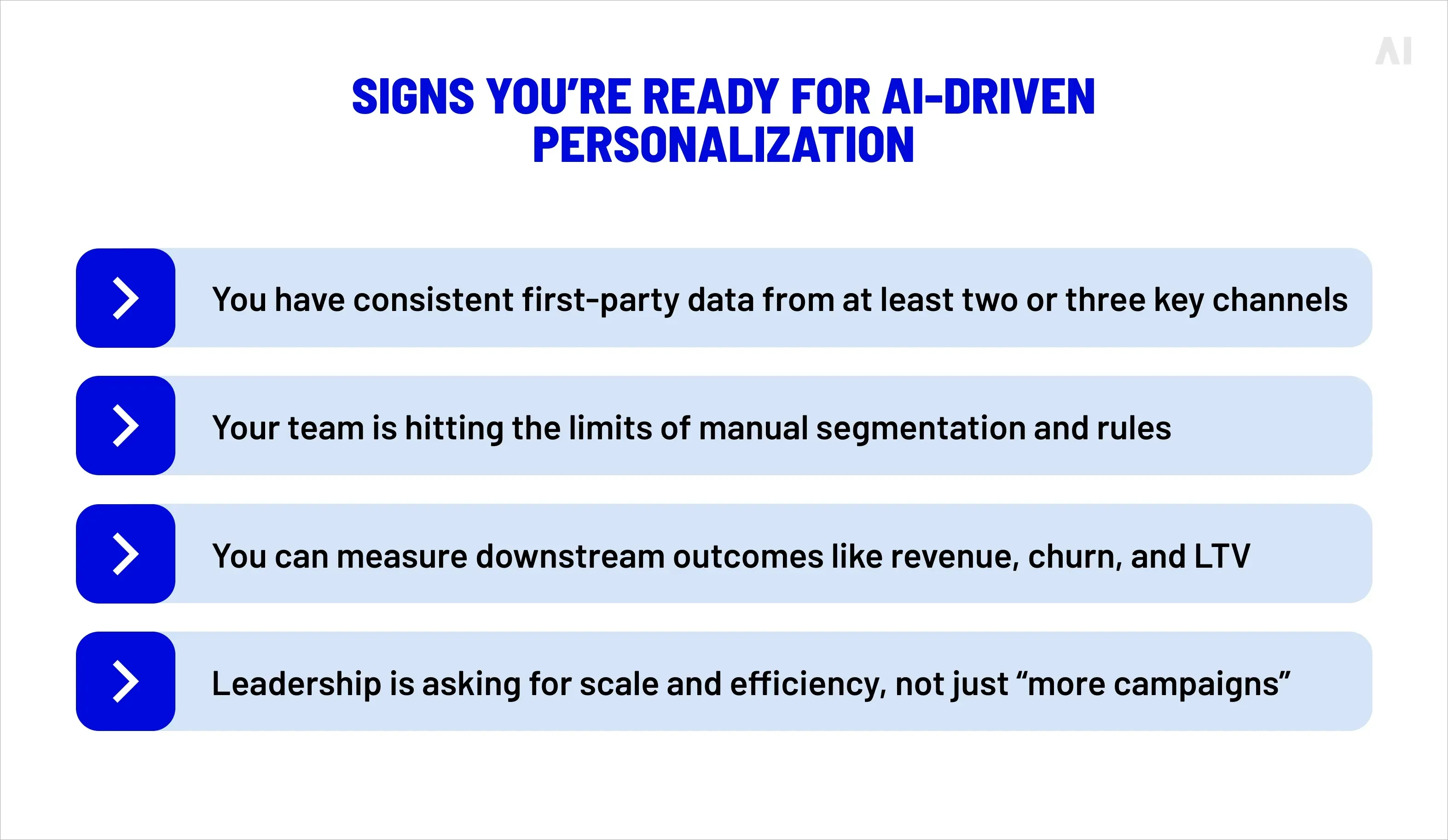
Hyper-personalization requires both strategy and infrastructure. At a minimum, brands need:
Unified first-party data across channels (often via a CDP)
AI and machine-learning models to interpret behavior and predict intent
Real-time decisioning and orchestration to activate insights immediately
Clear KPIs and governance to control relevance, frequency, and outcomes Successful implementations start with high-impact use cases, then scale incrementally as data quality, automation maturity, and measurement frameworks improve.
How is hyper-personalization different from personalization?
Traditional personalization typically relies on static segments and rule-based logic (e.g., demographic groups or past purchases). Hyper-personalization operates at the individual level, using real-time behavioral, contextual, and predictive signals to adapt experiences dynamically. In short, personalization is predefined and reactive; hyper-personalization is adaptive, predictive, and continuous.
Is hyper-personalization privacy compliant?
Hyper-personalization can be privacy compliant when built on consented, first-party data and governed by transparency, data minimization, and purpose limitation. Modern approaches emphasize privacy-first personalization, avoiding third-party cookies and opaque tracking while respecting regulations such as GDPR and CCPA. Compliance depends less on the concept itself and more on how data is collected, stored, and activated.
What data is used for hyper-personalization?
Hyper-personalization primarily relies on:
First-party data (CRM, transactions, subscriptions)
Behavioral signals (browsing, engagement, content interaction)
Contextual data (device, time, location, session state)
Predictive signals generated by AI models
The emphasis is on signal quality and timeliness, not sheer data volume.
Which industries benefit most from hyper-personalization?
Industries with complex journeys, frequent interactions, and performance sensitivity benefit the most, including:
- Retail and e-commerce
- Media, CTV, and digital advertising
- Financial services
- Travel and hospitality
- Telecommunications and subscription businesses
In these sectors, relevance directly impacts conversion, retention, and lifetime value—making hyper-personalization a strategic advantage rather than an optional enhancement.
Have other questions?
If you have more questions, contact us so we can help.
Questions? We have answers
This is some text inside of a div block.
Lorem ipsum dolor sit amet, consectetur adipiscing elit. Suspendisse varius enim in eros elementum tristique. Duis cursus, mi quis viverra ornare, eros dolor interdum nulla, ut commodo diam libero vitae erat. Aenean faucibus nibh et justo cursus id rutrum lorem imperdiet. Nunc ut sem vitae risus tristique posuere.
This is some text inside of a div block.
Lorem ipsum dolor sit amet, consectetur adipiscing elit. Suspendisse varius enim in eros elementum tristique. Duis cursus, mi quis viverra ornare, eros dolor interdum nulla, ut commodo diam libero vitae erat. Aenean faucibus nibh et justo cursus id rutrum lorem imperdiet. Nunc ut sem vitae risus tristique posuere.
This is some text inside of a div block.
Lorem ipsum dolor sit amet, consectetur adipiscing elit. Suspendisse varius enim in eros elementum tristique. Duis cursus, mi quis viverra ornare, eros dolor interdum nulla, ut commodo diam libero vitae erat. Aenean faucibus nibh et justo cursus id rutrum lorem imperdiet. Nunc ut sem vitae risus tristique posuere.
This is some text inside of a div block.
Lorem ipsum dolor sit amet, consectetur adipiscing elit. Suspendisse varius enim in eros elementum tristique. Duis cursus, mi quis viverra ornare, eros dolor interdum nulla, ut commodo diam libero vitae erat. Aenean faucibus nibh et justo cursus id rutrum lorem imperdiet. Nunc ut sem vitae risus tristique posuere.
This is some text inside of a div block.
Lorem ipsum dolor sit amet, consectetur adipiscing elit. Suspendisse varius enim in eros elementum tristique. Duis cursus, mi quis viverra ornare, eros dolor interdum nulla, ut commodo diam libero vitae erat. Aenean faucibus nibh et justo cursus id rutrum lorem imperdiet. Nunc ut sem vitae risus tristique posuere.
This is some text inside of a div block.
Lorem ipsum dolor sit amet, consectetur adipiscing elit. Suspendisse varius enim in eros elementum tristique. Duis cursus, mi quis viverra ornare, eros dolor interdum nulla, ut commodo diam libero vitae erat. Aenean faucibus nibh et justo cursus id rutrum lorem imperdiet. Nunc ut sem vitae risus tristique posuere.
This is some text inside of a div block.
Lorem ipsum dolor sit amet, consectetur adipiscing elit. Suspendisse varius enim in eros elementum tristique. Duis cursus, mi quis viverra ornare, eros dolor interdum nulla, ut commodo diam libero vitae erat. Aenean faucibus nibh et justo cursus id rutrum lorem imperdiet. Nunc ut sem vitae risus tristique posuere.

.svg)
.svg)