Reported performance and real business impact have drifted apart, and most attribution metrics flatter that gap rather than close it. This article sets out an incrementality testing framework step by step, so marketing teams can design, run, and read tests that measure causal growth and support sharper budget decisions.
Every dashboard tells a flattering story. Attribution platforms count conversions that pass through a tracked touchpoint and hand the credit to whichever ad sat closest to the sale, whether or not the ad did any persuading. The result is a number that looks like proof and behaves like a guess. A 2026 survey of US and UK marketing leaders captured the tension precisely: 70.4% said they were confident their budgets were deployed effectively, while 41.6% admitted that a portion of their investment was not delivering its full value, naming measurement limitations as the main reason. Both numbers come from the same people, describing the same budgets.
Incrementality testing answers the question attribution cannot: how much of the measured outcome would have happened anyway? By comparing a group exposed to advertising against a comparable group that was held back, an incrementality framework for marketing teams isolates the lift that advertising genuinely caused, then expresses it in terms a finance director recognizes — incremental revenue, incremental return on ad spend, customer acquisition cost.
What has changed is access. For years, rigorous causal measurement was a six-figure exercise reserved for the largest advertisers. That barrier has fallen. Google reduced the minimum budget for its incrementality experiments from roughly $100,000 to about $5,000 by adopting Bayesian statistical models, and says the redesign makes results up to 50% more conclusive. When a discipline gets that much cheaper to enter, the constraint stops being who can afford to test and becomes who can test well. The rest of this guide is about how to run incrementality tests in advertising well: designing experiments that survive scrutiny from a statistician and persuade a CFO.
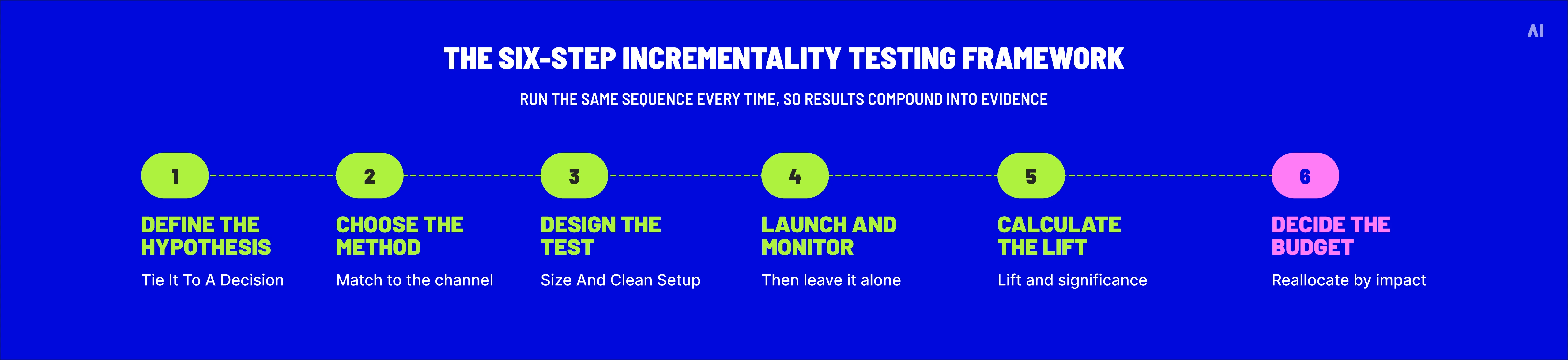
An incrementality testing framework is a structured, repeatable method for measuring the true causal impact of marketing activity. Rather than a single test, it is thediscipline a team applies every time it needs to separate outcomes that advertising created from outcomes it merely recorded. The framework runs in a fixed sequence — a commercial hypothesis, a chosen method, a sound design, a controlled launch, a lift calculation, and a budget decision — and the value comes from running it the same way each time, so results compound into a body of evidence instead of a scatter of one-off readings.
Used properly, an incrementality framework identifies the conversions, revenue, and business outcomes that would not have occurred without ad exposure. A retargeting campaign that reports a strong return on ad spend may be claiming credit for shoppers who had already chosen to buy; a brand video campaign that attribution barely registers may be doing the heavy lifting that later shows up as branded search. Incrementality testing replaces these assumptions with a measured difference between exposed and control audiences, which is the closest a marketing team can get to a controlled experiment in a live market.
Incrementality testing earns its place whenever a budget decision is too expensive to make on attributed numbers alone. Four situations make it close to mandatory.
The first is rising acquisition costs, where a team needs to know whether the next dollar is buying new customers or subsidizing inevitable ones.
The second is scaling spend, since a channel that looks efficient at $50,000 a month can stop producing incremental customers long before its reported return on ad spend falls.
The third is validating channel performance when two platforms both claim the same conversion.
The fourth is reallocation — deciding which channels deserve more budget and which are coasting on demand they did not generate.
Behind all four sits a credibility problem that has grown sharper. Gartner, surveying 426 senior marketing leaders, found that 84% of companies are caught in what it calls a "brand doom loop," underinvesting in measurement, lacking confidence in the results, and struggling to prove marketing's contribution to growth as a consequence. Incrementality testing is one of the few tools that breaks the loop, because it produces evidence a skeptical finance team will accept. And with controlled experiments now within reach of mid-market budgets, the older excuse that testing is only for enterprises no longer holds.
The six-step incrementality testing framework
Step 1: Define the hypothesis and business goal
A useful incrementality test starts with a commercial question, not a measurement one. Before anyone touches a campaign, the team should be able to complete a single sentence: "We believe that [channel or tactic] drives [a specific business outcome], and we will spend more, less, or the same depending on what the test shows." That sentence forces three things into the open — the channel under examination, the business outcome being judged, and the decision the result will trigger. A test that cannot change a decision is an expensive way to confirm what the dashboard already said.
From the hypothesis flows everything measurable.
Decide the success metric before launch and define it in business terms: incremental revenue, incremental return on ad spend (iROAS), customer acquisition cost, or conversion lift.
Set the expected size of the effect you are looking for, because that number drives how large and how long the test must be. A team hoping to detect a 3% lift needs a far bigger experiment than one expecting 15%, and pretending otherwise produces a test that cannot see its own target.
Write down the decision thresholds too: the lift at which you scale, the lift at which you hold, and the lift at which you cut. Agreeing those numbers in advance removes the temptation to rationalize a disappointing result after the fact.
⚡ A test that cannot change a budget decision is an expensive way to confirm what a dashboard already told you.
Step 2: Choose the right incrementality testing method
There is no universal method, and choosing well is a trade between three things that pull against each other: measurement accuracy, the speed of getting a usable read, and the operational load the test puts on the team. The right answer depends on campaign goals, channel mix, budget size, and how much clean first-party data a brand can bring to the experiment. Knowing how to run incrementality test campaigns starts with matching the method to the question, rather than defaulting to whatever a single platform offers.
Geo holdout testing
Geo holdout testing measures lift across regions instead of individuals. A campaign runs in a set of test markets while a matched set of control markets receives nothing, and the difference in sales, sign-ups, or store visits between them estimates the incremental effect. Because it needs no user-level tracking, geo testing works where individual data is thin or unavailable, which makes it the strongest option for large-scale and upper-funnel activity — connected TV, audio, out-of-home, and broad video.
The method has matured fast: Meta's open-source GeoLift builds a statistical counterfactual from pre-campaign data across untreated regions, and Google previewed Meridian GeoX in 2026 as a publisher-agnostic geo design supporting holdback, go-dark, and heavy-up tests.
The main demand it places on a team is market matching — control regions have to resemble test regions closely enough that the comparison holds.
Audience split testing
Audience split testing divides a single audience into exposed and control segments, usually inside a platform's own conversion-lift environment, then compares conversion rates between the two. Where the audience can be split cleanly and the volume is high enough, it gives a fast, granular read.
The limitation is structural: when a platform designs the holdout, runs the experiment, and reports the result, it is grading its own homework. Platform-native lift studies are a reasonable starting point, but a team relying on them should plan to validate the headline figure against first-party data before acting on it.
Synthetic controls and ghost bidding
Synthetic controls and ghost bidding exist for the environments where traditional holdouts are hardest to run — cookieless inventory and channels with little deterministic tracking.
A synthetic control constructs a model-based counterfactual from historical and parallel data, estimating what the exposed group would have done without the campaign rather than withholding ads from a real audience.
Ghost bidding takes a different route: the system enters the auction for the control group and records the users it would have served, without actually showing them an ad, producing a clean comparison group inside a live programmatic buy.
Both are built for a privacy-first setting, and both reward teams that have invested in their own data foundations.
Match testing methods to business goals and channels
The practical rule is to let the channel and the question choose the method.
Upper-funnel and offline-leaning channels point toward geo holdouts.
Lower-funnel digital activitywith high volume suits audience splits.
Cookieless or sparsely tracked inventory calls for synthetic controls or ghost bidding.
Budget sets the ceiling on ambition: a small test cannot detect a small effect, whichever method runs it.
Incrementality testing methods comparison
The table below summarizes how the main methods differ across the criteria that decide a choice, so a team can match a framework to its objectives and data environment before committing budget.
Step 3: Design the test correctly
Most failed incrementality tests break here, long before any dashboard appears. The campaign runs, the numbers come back, and only on inspection does it emerge that the experiment was never built to detect the effect it was looking for. Three design elements decide whether a result means anything: sample size, test duration, and the quality of the control group. Get these right and a modest test produces a trustworthy read; get them wrong and an expensive one produces noise dressed as insight.
Define sample size and test duration
Sample size and duration together determine whether a test can see the truth. The governing idea is the minimum detectable effect — the smallest lift the experiment is statistically powerful enough to catch. That figure depends directly on conversion volume: smaller audiences and lower conversion counts can only confirm larger effects, so a test built on thin data will return "inconclusive" not because the campaign failed but because the experiment was never able to detect success. Duration matters for the same reason and adds another: tests that end too early miss delayed conversions and seasonal noise, while tests that run too long invite contamination from everything else happening in the market. The disciplined move is to calculate the required sample and run length from the expected lift set in Step 1, then decline to launch if the available volume cannot support the question.
Prevent contamination between groups
Contamination is the most underestimated threat to validity. If members of the control group are exposed to the campaign through another channel, if targeting leaks between segments, or if a separate promotion runs across both groups mid-test, the difference the experiment measures stops being the difference the test was designed to isolate. Clean separation between exposed and control audiences is the single most important safeguard, and it has to be designed in rather than checked for afterward.
⚡ An underpowered test does not fail loudly. It returns a number that looks like an answer and means nothing.
Step 4: Launch and monitor the experiment
With the design fixed, knowing how to run incrementality lift tests well becomes largely amatter of restraint. Set up the treatment and control groups exactly as specified, confirm the split is holding before spend ramps, and then leave the experiment alone. The instinct to optimize mid-flight — pausing a weak creative, lifting budget on a strong audience, retargeting the control group "just for this week" — is the most common way a clean test is ruined after launch. Each of those changes alters the comparison the experiment depends on, and once the conditions move, the lift calculation at the end measures a campaign that no longer exists.
Monitoring should therefore watch for problems with the experiment, not with the campaign's performance. Check that the groups remain separate, that delivery is reaching the test audience, and that no external event has spilled across both groups. Resist the urge to read early results as a verdict; partial data in an incrementality test is frequently misleading, because the effect the test is built to measure accumulates over the full window. Having designed the test well, a team earns a trustworthy final number by leaving it alone.
Step 5: Calculate incremental lift and analyze the results
Incremental lift is the difference in outcomes between the exposed and control groups, expressed as a proportion of the control. Calculating it takes a moment; reading it correctly is where teams either earn a decision or talk themselves into the wrong one.
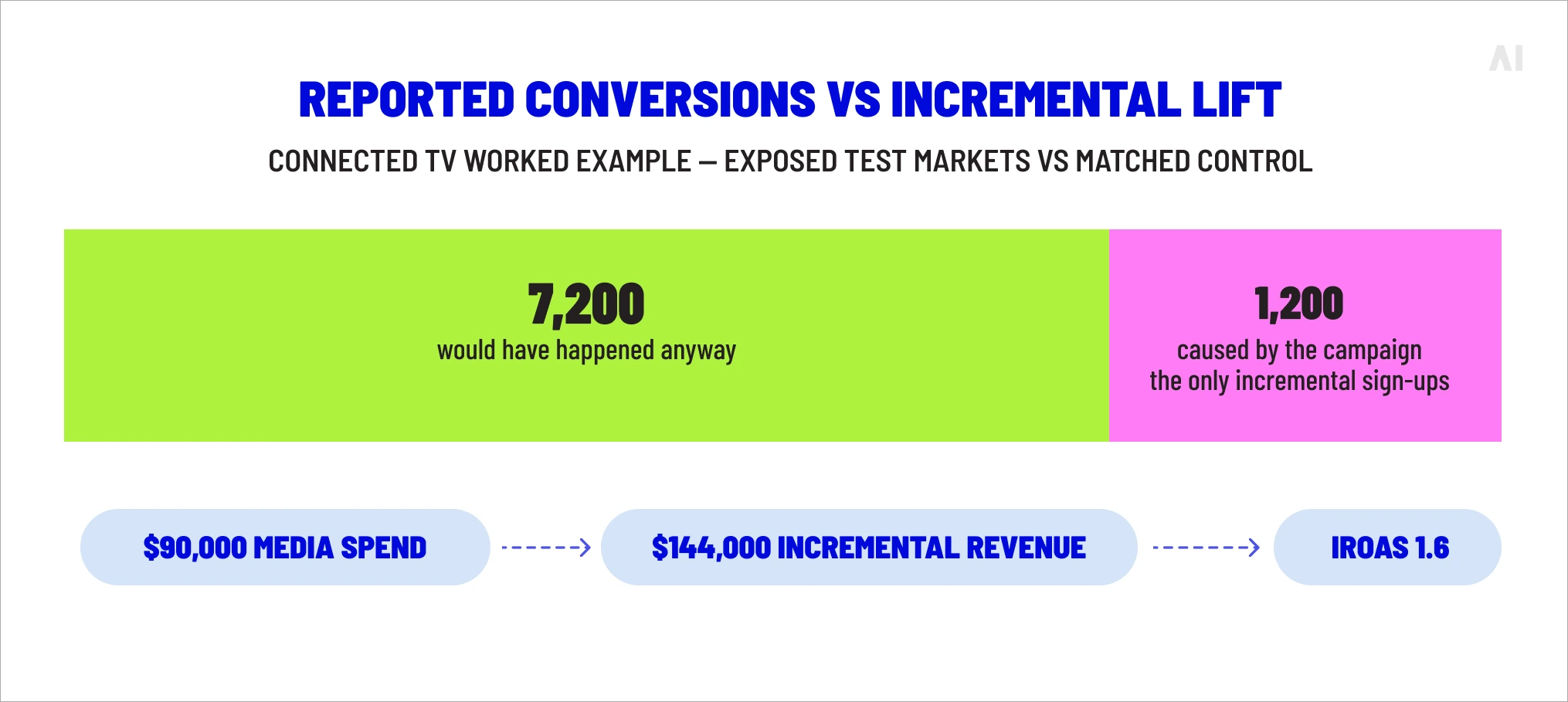
Take a worked example. A retailer runs a connected TV campaign across a set of test markets and holds out matched control markets. Over the test window, the test markets generate 8,400 new sign-ups; the matched control markets, scaled to the same population, imply a baseline of 7,200. The incremental sign-ups are 8,400 minus 7,200, or 1,200 — the conversions the campaign actually caused. At an average first-order value of $120, that is $144,000 in incremental revenue against $90,000 of media spend, an incremental return on ad spend of 1.6. Reported attribution might have credited the campaign with all 8,400 sign-ups and a far rosier figure; the incremental read is the one that holds up.
Reported conversions vs incremental lift
Before acting on any lift number, test it for significance and for meaning.
Statistical significance asks whether the measured difference is large enough, given the sample, to be unlikely to have arisen by chance — a result inside a wide confidence interval that straddles zero is not yet a finding.
Business significance asks whether the lift, even if real, is large enough to change what you do. And weak or null results deserve respect rather than reinterpretation: a channel that shows no incremental effect has told you something valuable about where your money should not go.
Treating an inconvenient result as a reason to rerun the test until it agrees with you is how measurement programs lose their credibility.
Step 6: Turn incrementality insights into budget decisions
A test that does not move a budget has not finished its job. The framework exists to turn a measured lift into a reallocation. A result that changes nobody's spending plan has stopped short of the goal.
Use iROAS to guide budget allocation
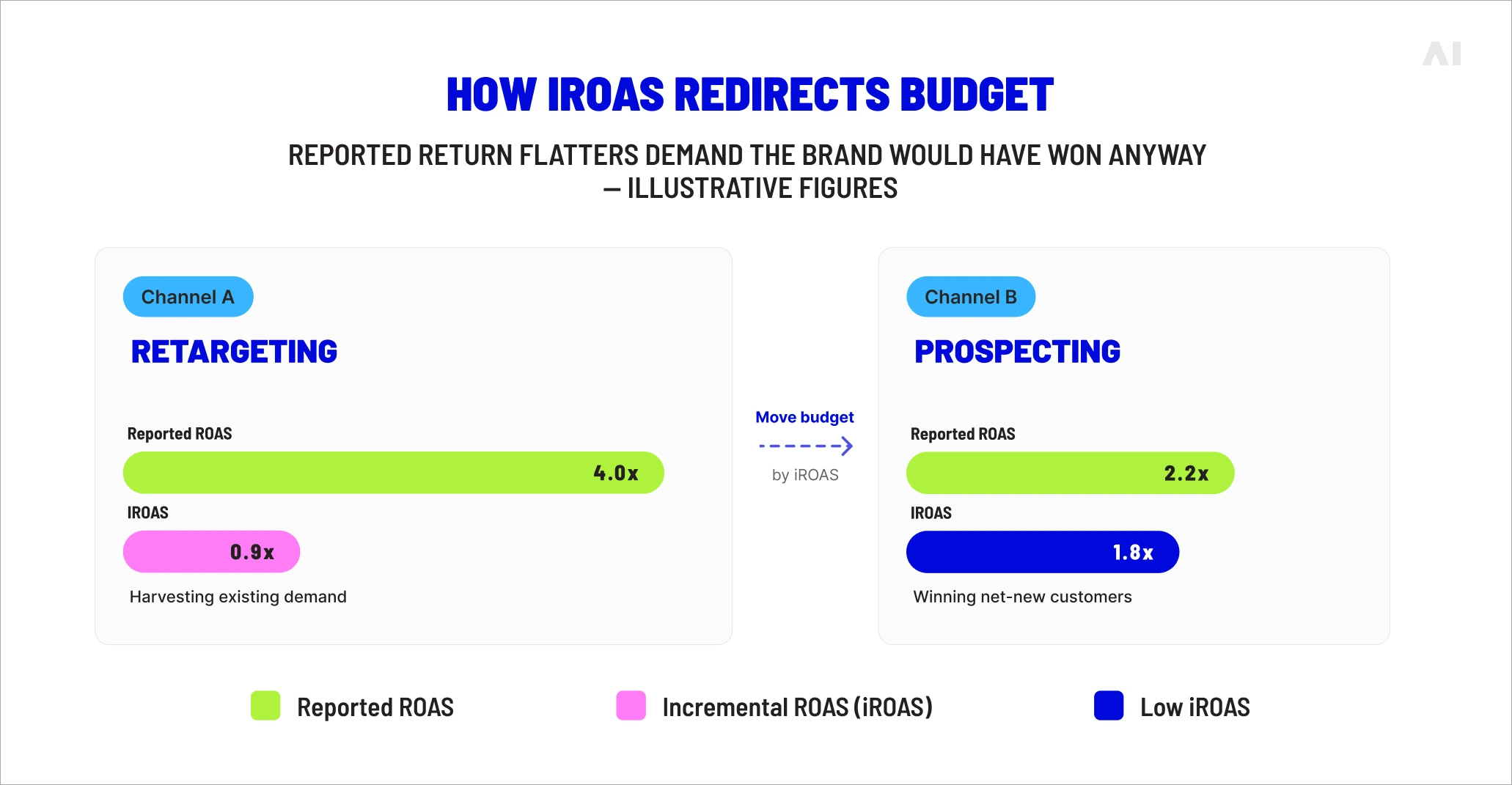
Incremental return on ad spend is the metric that connects measurement to money. Because it counts only the revenue advertising actually caused, iROAS ranks channels by the business impact each genuinely produces, rather than by the credit each captures in a reporting pipeline. A channel with a high reported return on ad spend but a low iROAS is largely harvesting demand that existed already; a channel with a modest reported return but a strong iROAS is generating net-new customers and deserves more budget, not less. Ranking channels by iROAS — and moving money toward the high-incrementality end — is the clearest way to raise the efficiency of a whole media mix.
How iROAS redirects budget.
⚡ Incremental ROAS is the figure that survives the meeting with finance, because it counts only the revenue advertising actually caused.
Fix channels with low incrementality
A low incrementality result points to a problem without dictating the response. Before cutting a channel, work through the alternatives in order. Reducing spend is right when the channel is genuinely harvesting demand and adding little. Adjusting targeting or creative is the better move when the incrementality is low because the campaign is reaching the wrong people or saying the wrong thing — a prospecting audience instead of a retargeting one, for instance. Restructuring the campaign suits cases where the format or funnel position is mismatched to the goal. And a fresh test is warranted when the first result was weak for design reasons rather than performance ones. The decision turns on why the lift was low, which is exactly what a well-built test should help reveal.
Combine incrementality with attribution and media mix modeling
No single method sees everything, and the strongest measurement programs run incrementality alongside attribution and media mix modeling instead of picking one.
Attribution supplies the granular, daily view that day-to-day optimization needs.
Media mix modeling supplies the aggregated, strategic view that finance teams use for planning.
Incrementality supplies the causal check that keeps both honest, calibrating the credit attribution assigns and grounding the coefficients a mix model estimates.
Run together, with each method correcting the others' blind spots, they produce a measurement picture that is both responsive and defensible — provided they reference a common data layer rather than three contradictory ones.
Tools to support incrementality testing frameworks
The tooling around incrementality testing has broadened from a handful of enterprise platforms into a layered marketthat serves every level of maturity.
At the entry pointsit platform-native lift studies — Meta Conversion Lift, Google's geo experiments — which are inexpensive and quick but confined to a single environment and self-reported.
Above them sit independent incrementality platforms such as Haus, Measured, and Rockerbox, which run experiments across channels and report without the conflict of interest that comes from measuring one's own inventory.
At the deepest level are marketing intelligence and analytics environments, including Google Ads Data Hub and BI or reporting platforms, which combine experimentation with broader data modeling for teams running continuous, cross-channel measurement.
Each layer improves audience control, lift analysis, and cross-channel visibility a little further, at the cost of a little more complexity.
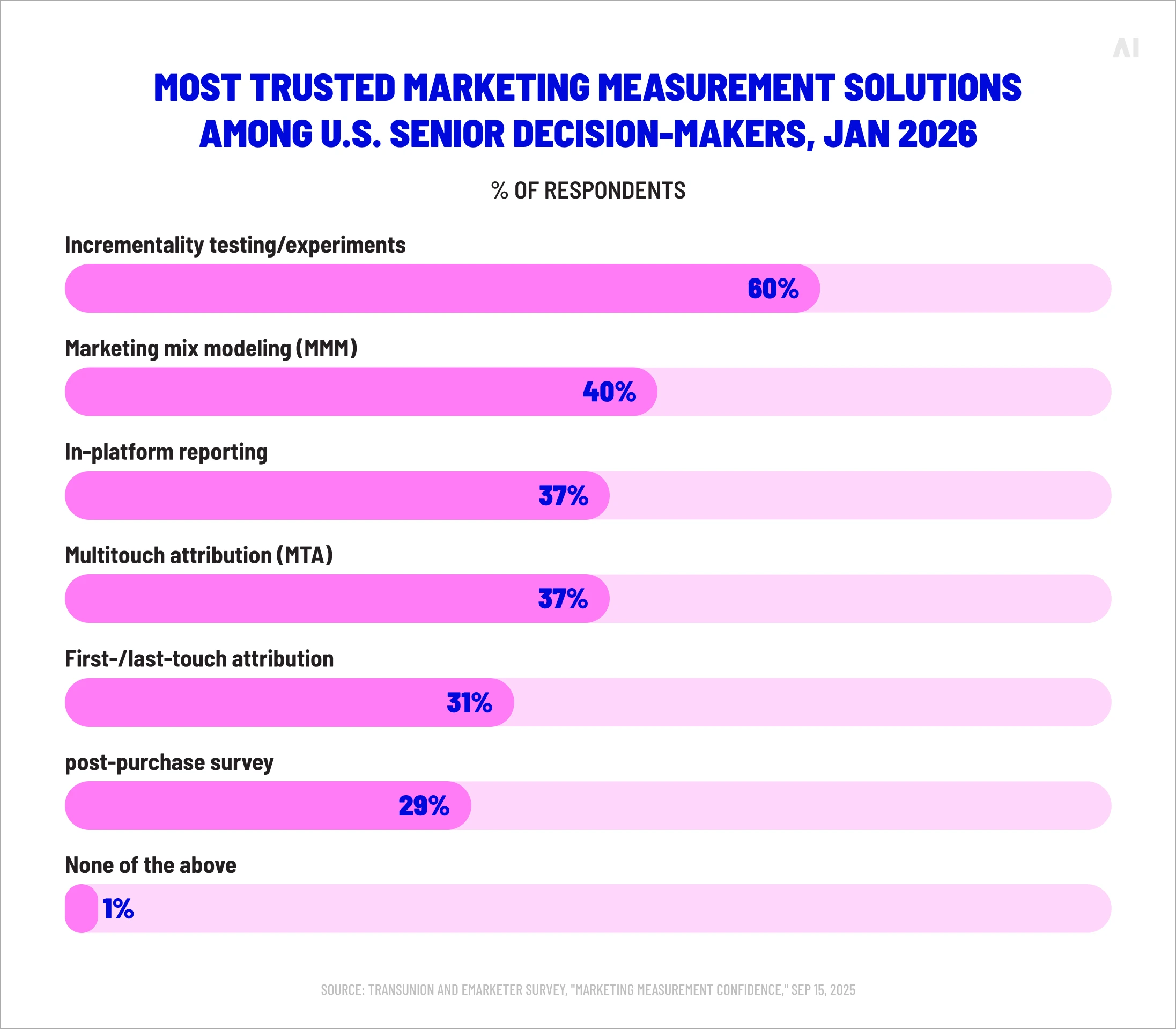
How marketers actually measure incrementality (Source)
Choosing the right tool for your testing maturity
Testing needs evolve as an organization grows. The right tool fits a team's current maturity, which is usually a step behind its ambitions. The table below maps the three tiers against the questions that should drive the choice.
Common framework mistakes in incrementality testing
The strategic mistakes that undermine incrementality testing are usually mistakes of judgment rather than arithmetic. Four recur often enough to be worth naming, because each turns a well-intentioned test into a misleading conclusion.
Run tests without enough data
The most common error is launching a test the data cannot support. Low conversion volume, small audiences, and short windows all reduce statistical reliability, and a test that lacks power does not announce its weakness — it returns a confident-looking number that will not survive a second run. The fix belongs in the design stage: calculate the minimum detectable effect, confirm the available volume can reach it, and postpone the test if it cannot.
Contaminated control and treatment groups
Audience overlap, cross-channel exposure, and mid-test campaign changes all distort the comparison between groups and weaken the lift calculation. A control group that sees the campaign somewhere else is no longer a control. This is a design-and-discipline problem rather than an analysis one, which means it cannot be corrected after the fact; the only remedy is to enforce clean separation from the outset and hold the test conditions steady until it ends.
Validating platform-reported lift
Platform-native lift studies are convenient, and they are also produced by the same companies whose budgets they justify. Treating a self-reported lift figure as final, without checking it against first-party data or an independent measurement method, invites exactly the reporting bias that incrementality testing is meant to remove. The discipline is to use platform studies as a first read and confirm the important ones independently before reallocating money on their say-so.
The subtlest mistake is running a technically sound test against the wrong question. An experiment optimized to prove a platform metric — clicks, viewable impressions, reported conversions — can succeed on its own terms while telling a team nothing about revenue, profitability, or customer acquisition efficiency. Everything depends on the question set in Step 1, and a test that drifts toward easier, more flattering metrics has stopped measuring what the business actually needed to know.
How AI Digital strengthens incrementality testing frameworks
A reliable framework depends on three things that sit outside the test itself: clean audience inputs, trustworthy measurement, and an unbiased view across channels. AI Digital supports each of them. One point should be clear up front — AI Digital does not run a brand's holdouts for it, and no tool replaces sound experimental design. What it does is reduce the noise and bias that distort a lift read, so the experiments a team runs produce signals it can trust.
Elevate: improving audience planning and lift analysis
Elevate strengthens the parts of an incrementality framework that happen before and after the test.
On the planning side, its audience intelligence helps build cleaner exposed and control groups by grounding segment definitions in behavioral, interest, and customer data rather than guesswork, which improves the comparability a valid test depends on.
Its cookieless targeting, built on an AI crawler that maps content across more than 100,000 sites, apps, and CTV environments, extends reach to audiences that traditional tracking misses — the same audiences that make synthetic and cookieless test designs necessary.
And on the analysis side, Elevate's marketing mix modeling and Path to Conversion give a team the complementary, cross-channel measurement that Step 6 calls for: the strategic and journey-level context that turns a single lift number into a budget decision.
Smart Supply and Open Garden: improving measurement transparency
An incrementality test is only as clean as the inventory underneath it. When a meaningful share of programmatic spend reaches non-viewable, fraudulent, or made-for-advertising inventory, the impressions feeding both test and control groups are contaminated before the experiment begins. The scale of the problem is documented: the ANA's Q1 2026 Programmatic Transparency Benchmark found that its market-level TrueAdSpend Index — the share of programmatic investment delivering fraud-free, measurable, viewable, MFA-free impressions — stood at 43.3%.Smart Supply's curated, verified supply paths and Open Garden's DSP-agnostic execution address this directly, removing the low-quality inventory and platform bias that would otherwise sit inside a lift calculation as unmeasured noise. Cleaner inputs make for cleaner reads, which is why supply transparency belongs in any serious measurement strategy.
Build a smarter incrementality framework for measurable growth
The case for incrementality testing turns on one distinction: the difference between the performance a campaign reports and the performance it caused. Attribution metrics measure the first and routinely inflate it. An incrementality testing framework measures the second, and gives a team the evidence to move budget toward the channels that generate real growth and away from those coasting on demand they did not create. In a privacy-first market where user-level tracking keeps eroding, that causal, experiment-based approach has become the practical foundation for measuring marketing efficiency and validating where every dollar goes.
The barrier to entry has fallen far enough that affordability is no longer the obstacle. The harder question is whether a team's current approach can tell credit apart from cause at all, and for most the answer is still no. Building the discipline — a clear hypothesis, the right method, a sound design, a controlled run, and a result that changes a decision — is what turns a measurement program from one that reports marketing's value into one that proves it.
That discipline is the work AI Digital is built to support: cleaner audience inputs, transparent supply paths, and the measurement layer that turns a lift number into a confident budget call. See what AI Digital does to understand how those pieces fit around a testing program, or get in touch to talk through where incrementality could sharpen your own measurement.
Blind spot
Key issues
Business impact
AI Digital solution
Lack of transparency in AI models
• Platforms own AI models and train on proprietary data • Brands have little visibility into decision-making • "Walled gardens" restrict data access
• Inefficient ad spend • Limited strategic control • Eroded consumer trust • Potential budget mismanagement
Open Garden framework providing: • Complete transparency • DSP-agnostic execution • Cross-platform data & insights
Optimizing ads vs. optimizing impact
• AI excels at short-term metrics but may struggle with brand building • Consumers can detect AI-generated content • Efficiency might come at cost of authenticity
• Short-term gains at expense of brand health • Potential loss of authentic connection • Reduced effectiveness in storytelling
Smart Supply offering: • Human oversight of AI recommendations • Custom KPI alignment beyond clicks • Brand-safe inventory verification
The illusion of personalization
• Segment optimization rebranded as personalization • First-party data infrastructure challenges • Personalization vs. surveillance concerns
• Potential mismatch between promise and reality • Privacy concerns affecting consumer trust • Cost barriers for smaller businesses
Elevate platform features: • Real-time AI + human intelligence • First-party data activation • Ethical personalization strategies
AI-Driven efficiency vs. decision-making
• AI shifting from tool to decision-maker • Black box optimization like Google Performance Max • Human oversight limitations
• Strategic control loss • Difficulty questioning AI outputs • Inability to measure granular impact • Potential brand damage from mistakes
Managed Service with: • Human strategists overseeing AI • Custom KPI optimization • Complete campaign transparency
Fig. 1. Summary of AI blind spots in advertising
Dimension
Walled garden advantage
Walled garden limitation
Strategic impact
Audience access
Massive, engaged user bases
Limited visibility beyond platform
Reach without understanding
Data control
Sophisticated targeting tools
Data remains siloed within platform
Fragmented customer view
Measurement
Detailed in-platform metrics
Inconsistent cross-platform standards
Difficult performance comparison
Intelligence
Platform-specific insights
Limited data portability
Restricted strategic learning
Optimization
Powerful automated tools
Black-box algorithms
Reduced marketer control
Fig. 2. Strategic trade-offs in walled garden advertising.
Core issue
Platform priority
Walled garden limitation
Real-world example
Attribution opacity
Claiming maximum credit for conversions
Limited visibility into true conversion paths
Meta and TikTok's conflicting attribution models after iOS privacy updates
Data restrictions
Maintaining proprietary data control
Inability to combine platform data with other sources
Amazon DSP's limitations on detailed performance data exports
Cross-channel blindspots
Keeping advertisers within ecosystem
Fragmented view of customer journey
YouTube/DV360 campaigns lacking integration with non-Google platforms
Black box algorithms
Optimizing for platform revenue
Reduced control over campaign execution
Self-serve platforms using opaque ML models with little advertiser input
Performance reporting
Presenting platform in best light
Discrepancies between platform-reported and independently measured results
Consistently higher performance metrics in platform reports vs. third-party measurement
Fig. 1. The Walled garden misalignment: Platform interests vs. advertiser needs.
Key dimension
Challenge
Strategic imperative
ROAS volatility
Softer returns across digital channels
Shift from soft KPIs to measurable revenue impact
Media planning
Static plans no longer effective
Develop agile, modular approaches adaptable to changing conditions
Brand/performance
Traditional division dissolving
Create full-funnel strategies balancing long-term equity with short-term conversion
Capability
Key features
Benefits
Performance data
Elevate forecasting tool
• Vertical-specific insights • Historical data from past economic turbulence • "Cascade planning" functionality • Real-time adaptation
• Provides agility to adjust campaign strategy based on performance • Shows which media channels work best to drive efficient and effective performance • Confident budget reallocation • Reduces reaction time to market shifts
• Dataset from 10,000+ campaigns • Cuts response time from weeks to minutes
• Reaches people most likely to buy • Avoids wasted impressions and budgets on poor-performing placements • Context-aligned messaging
• 25+ billion bid requests analyzed daily • 18% improvement in working media efficiency • 26% increase in engagement during recessions
Full-funnel accountability
• Links awareness campaigns to lower funnel outcomes • Tests if ads actually drive new business • Measures brand perception changes • "Ask Elevate" AI Chat Assistant
• Upper-funnel to outcome connection • Sentiment shift tracking • Personalized messaging • Helps balance immediate sales vs. long-term brand building
• Natural language data queries • True business impact measurement
Open Garden approach
• Cross-platform and channel planning • Not locked into specific platforms • Unified cross-platform reach • Shows exactly where money is spent
• Reduces complexity across channels • Performance-based ad placement • Rapid budget reallocation • Eliminates platform-specific commitments and provides platform-based optimization and agility
• Coverage across all inventory sources • Provides full visibility into spending • Avoids the inability to pivot across platform as you’re not in a singular platform
Fig. 1. How AI Digital helps during economic uncertainty.
Trend
What it means for marketers
Supply & demand lines are blurring
Platforms from Google (P-Max) to Microsoft are merging optimization and inventory in one opaque box. Expect more bundled “best available” media where the algorithm, not the trader, decides channel and publisher mix.
Walled gardens get taller
Microsoft’s O&O set now spans Bing, Xbox, Outlook, Edge and LinkedIn, which just launched revenue-sharing video programs to lure creators and ad dollars. (Business Insider)
Retail & commerce media shape strategy
Microsoft’s Curate lets retailers and data owners package first-party segments, an echo of Amazon’s and Walmart’s approaches. Agencies must master seller-defined audiences as well as buyer-side tactics.
AI oversight becomes critical
Closed AI bidding means fewer levers for traders. Independent verification, incrementality testing and commercial guardrails rise in importance.
Fig. 1. Platform trends and their implications.
Metric
Connected TV (CTV)
Linear TV
Video Completion Rate
94.5%
70%
Purchase Rate After Ad
23%
12%
Ad Attention Rate
57% (prefer CTV ads)
54.5%
Viewer Reach (U.S.)
85% of households
228 million viewers
Retail Media Trends 2025
Access Complete consumer behaviour analyses and competitor benchmarks.
Identify and categorize audience groups based on behaviors, preferences, and characteristics
Michaels Stores: Implemented a genAI platform that increased email personalization from 20% to 95%, leading to a 41% boost in SMS click through rates and a 25% increase in engagement.
Estée Lauder: Partnered with Google Cloud to leverage genAI technologies for real-time consumer feedback monitoring and analyzing consumer sentiment across various channels.
High
Medium
Automated ad campaigns
Automate ad creation, placement, and optimization across various platforms
Showmax: Partnered with AI firms toautomate ad creation and testing, reducing production time by 70% while streamlining their quality assurance process.
Headway: Employed AI tools for ad creation and optimization, boosting performance by 40% and reaching 3.3 billion impressions while incorporating AI-generated content in 20% of their paid campaigns.
High
High
Brand sentiment tracking
Monitor and analyze public opinion about a brand across multiple channels in real time
L’Oréal: Analyzed millions of online comments, images, and videos to identify potential product innovation opportunities, effectively tracking brand sentiment and consumer trends.
Kellogg Company: Used AI to scan trending recipes featuring cereal, leveraging this data to launch targeted social campaigns that capitalize on positive brand sentiment and culinary trends.
High
Low
Campaign strategy optimization
Analyze data to predict optimal campaign approaches, channels, and timing
DoorDash: Leveraged Google’s AI-powered Demand Gen tool, which boosted its conversion rate by 15 times and improved cost per action efficiency by 50% compared with previous campaigns.
Kitsch: Employed Meta’s Advantage+ shopping campaigns with AI-powered tools to optimize campaigns, identifying and delivering top-performing ads to high-value consumers.
High
High
Content strategy
Generate content ideas, predict performance, and optimize distribution strategies
JPMorgan Chase: Collaborated with Persado to develop LLMs for marketing copy, achieving up to 450% higher clickthrough rates compared with human-written ads in pilot tests.
Hotel Chocolat: Employed genAI for concept development and production of its Velvetiser TV ad, which earned the highest-ever System1 score for adomestic appliance commercial.
High
High
Personalization strategy development
Create tailored messaging and experiences for consumers at scale
Stitch Fix: Uses genAI to help stylists interpret customer feedback and provide product recommendations, effectively personalizing shopping experiences.
Instacart: Uses genAI to offer customers personalized recipes, mealplanning ideas, and shopping lists based on individual preferences and habits.
Medium
Medium
Share article
Url copied to clipboard
No items found.
Subscribe to our Newsletter
THANK YOU FOR YOUR SUBSCRIPTION
Oops! Something went wrong while submitting the form.
Questions? We have answers
How does incrementality testing differ from attribution modeling?
Attribution distributes credit for a conversion across the touchpoints that preceded it, which means it can only ever describe the path a converting customer took—not whether the advertising changed their behavior. Incrementality testing compares an exposed group against a held-back control to measure the conversions that would not have happened otherwise. Attribution answers "which touchpoints were involved?"; incrementality answers "did the advertising cause the outcome?"
Which incrementality testing method is the most accurate?
No method is universally most accurate; the best choice depends on the channel and the data available. Geo holdouts are strongest for upper-funnel and offline-leaning channels where user-level tracking is weak. Audience splits give precise reads on high-volume digital channels. Synthetic controls and ghost bidding fit cookieless environments. Within their right context, well-designed geo holdouts and randomized audience splits both produce highly reliable results.
How long should an incrementality test run?
Long enough to capture the full conversion window and reach statistical significance, but no longer than necessary, since extended tests invite contamination from other market activity. The right duration follows from the expected lift and conversion volume set during design — higher-volume tests reach significance faster, while smaller tests or longer purchase cycles need more time. Many teams run tests over two to six weeks, but the number should be calculated, not assumed.
How can marketers measure true incremental revenue from advertising?
Compare revenue in the exposed group against the control group over the same window, then attribute the difference to the campaign. The incremental conversions are the exposed total minus the control baseline; multiplied by average order value, they give incremental revenue, and divided into media spend they give incremental return on ad spend. The control group is what makes the figure causal rather than correlational.
Why are more brands replacing attribution-only measurement with incrementality testing?
Two pressures push in the same direction. Privacy regulation and signal loss have made user-level attribution less reliable, while finance teams have grown less willing to accept hypothetical credit as proof of impact. Incrementality testing answers both by producing causal evidence that holds up without user-level tracking — and with experiments now accessible at far lower budgets, the practical reasons to avoid it have largely disappeared.
Can incrementality testing work in cookieless environments?
Yes. Geo holdout testing needs no user-level data at all, comparing whole regions instead of individuals, which makes it inherently privacy-safe. Synthetic controls and ghost bidding were built specifically for cookieless and sparsely tracked inventory. These methods let teams keep measuring causal lift even as deterministic tracking continues to erode.
How do marketers run incrementality test campaigns successfully?
Work through the framework in order: define a commercial hypothesis and the decision it will drive, choose a method matched to the channel and data, design for adequate sample size and clean group separation, launch and then leave the test untouched, calculate lift and test it for significance, and convert the result into a budget move. The discipline of doing each step properly — especially the restraint not to interfere mid-test — is what produces a result worth acting on.
Have other questions?
If you have more questions, contact us so we can help.
Questions? We have answers
This is some text inside of a div block.
Lorem ipsum dolor sit amet, consectetur adipiscing elit. Suspendisse varius enim in eros elementum tristique. Duis cursus, mi quis viverra ornare, eros dolor interdum nulla, ut commodo diam libero vitae erat. Aenean faucibus nibh et justo cursus id rutrum lorem imperdiet. Nunc ut sem vitae risus tristique posuere.
This is some text inside of a div block.
Lorem ipsum dolor sit amet, consectetur adipiscing elit. Suspendisse varius enim in eros elementum tristique. Duis cursus, mi quis viverra ornare, eros dolor interdum nulla, ut commodo diam libero vitae erat. Aenean faucibus nibh et justo cursus id rutrum lorem imperdiet. Nunc ut sem vitae risus tristique posuere.
This is some text inside of a div block.
Lorem ipsum dolor sit amet, consectetur adipiscing elit. Suspendisse varius enim in eros elementum tristique. Duis cursus, mi quis viverra ornare, eros dolor interdum nulla, ut commodo diam libero vitae erat. Aenean faucibus nibh et justo cursus id rutrum lorem imperdiet. Nunc ut sem vitae risus tristique posuere.
This is some text inside of a div block.
Lorem ipsum dolor sit amet, consectetur adipiscing elit. Suspendisse varius enim in eros elementum tristique. Duis cursus, mi quis viverra ornare, eros dolor interdum nulla, ut commodo diam libero vitae erat. Aenean faucibus nibh et justo cursus id rutrum lorem imperdiet. Nunc ut sem vitae risus tristique posuere.
This is some text inside of a div block.
Lorem ipsum dolor sit amet, consectetur adipiscing elit. Suspendisse varius enim in eros elementum tristique. Duis cursus, mi quis viverra ornare, eros dolor interdum nulla, ut commodo diam libero vitae erat. Aenean faucibus nibh et justo cursus id rutrum lorem imperdiet. Nunc ut sem vitae risus tristique posuere.
This is some text inside of a div block.
Lorem ipsum dolor sit amet, consectetur adipiscing elit. Suspendisse varius enim in eros elementum tristique. Duis cursus, mi quis viverra ornare, eros dolor interdum nulla, ut commodo diam libero vitae erat. Aenean faucibus nibh et justo cursus id rutrum lorem imperdiet. Nunc ut sem vitae risus tristique posuere.
This is some text inside of a div block.
Lorem ipsum dolor sit amet, consectetur adipiscing elit. Suspendisse varius enim in eros elementum tristique. Duis cursus, mi quis viverra ornare, eros dolor interdum nulla, ut commodo diam libero vitae erat. Aenean faucibus nibh et justo cursus id rutrum lorem imperdiet. Nunc ut sem vitae risus tristique posuere.


.svg)
.svg)