Media Mix Modeling (MMM): Turning Mixed Media Strategy into Measurable Growth
Mary Gabrielyan
April 15, 2026
14
minutes read
Advertising budgets are spread across more platforms than ever, yet only 32% of marketers measure their media spending holistically across digital and traditional channels. In this article, we break down how media mix modeling turns fragmented multi-channel investment into a structured, financially accountable growth system.
Modern marketing operates across more channels, platforms, and formats than at any point in the industry's history. Brands run paid search alongside social campaigns, layer in connected TV (CTV) and retail media, invest in out-of-home (OOH), and still allocate meaningful spend to traditional formats. That breadth creates reach. It also creates a measurement problem. When every platform reports its own version of success, determining which channels actually drive revenue becomes an exercise in reconciling conflicting data rather than making strategic decisions.
Media mix modeling offers a way through. As a statistical discipline rooted in econometrics, media mix modeling (MMM) measures the incremental impact of each marketing investment on business outcomes such as revenue, profit, or customer acquisition. Rather than tracking individual clicks or user paths, it analyses aggregated historical data—spend, impressions, pricing, seasonality, competitive activity—to estimate how each channel contributes to the overall result. For marketing leaders under pressure to justify every dollar while budgets sit flat at 7.7% of company revenue, that kind of clarity has moved from useful to essential.
This article examines why multi-channel media strategies demand better measurement, how MMM works in practice, where it improves performance, how to implement it, and what mistakes to avoid along the way.
The shift toward multi-channel advertising is not new, but its scale and complexity have accelerated sharply. U.S. digital ad spending maintained double-digit annual growth for a sixteenth consecutive year in 2025, with total media ad spending on track to reach $422 billion under favourable economic conditions. Within that figure, CTV, social, retail media, and programmatic display all posted significant gains, each competing for a larger share of marketing budgets that, in real terms, have barely grown.
The driver behind this expansion is straightforward: audiences are no longer concentrated in a handful of places. Streaming now accounts for nearly half of all U.S. TV viewing. Social platforms command over 20% of daily media time. Retail media networks—led by Amazon and Walmart—have grown into a $58.79 billion channel in 2025. Consumers move fluidly between screens and contexts throughout the day, and advertisers have followed them, building media mixes that span five, ten, or more distinct platforms.
That fragmentation has practical consequences. A brand investing across paid search, Meta, TikTok, CTV, display, and OOH is managing six distinct reporting ecosystems, each with its own attribution logic, data format, and performance benchmarks. Coordination across these environments is operationally demanding. Measuring their combined effect on the business is harder still.
The composition of a modern media mix in advertising reflects the full breadth of the customer journey, from awareness through conversion and retention. Each channel plays a different role, and their relative weight varies by industry, audience, and campaign objective.
Paid searchremains the largest single allocation within digital budgets, accounting for 13.9% of digital spend. It captures demand at the point of intent, making it a reliable lower-funnel performer. Social media advertising—spanning Meta, TikTok, YouTube, and emerging platforms—is projected to exceed $121 billion in U.S. spend in 2026, serving both brand-building and performance objectives.
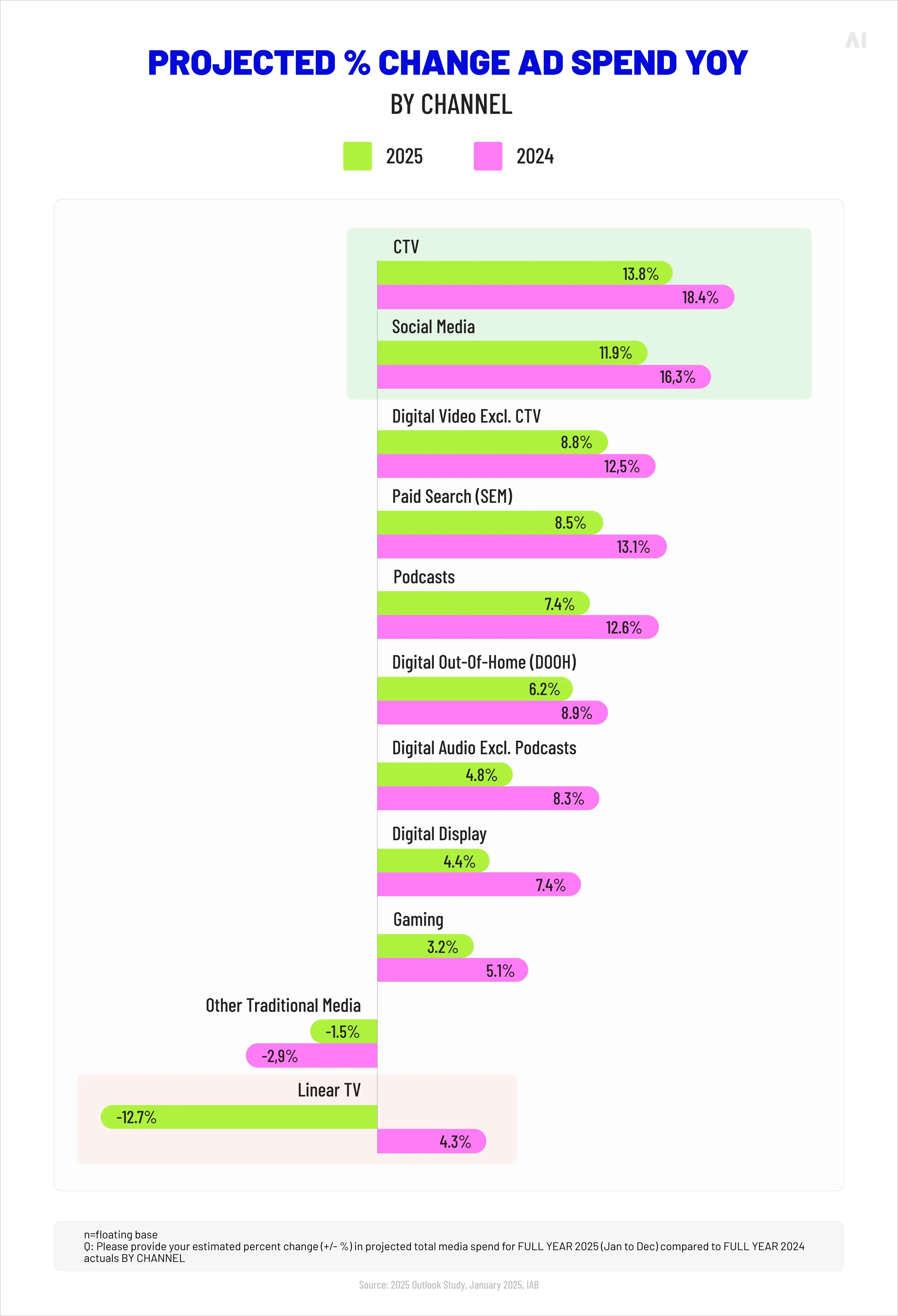
Connected TV has become one of the fastest-growing channels in the mix. U.S. CTV ad spending reached $33.35 billion in 2025 and is projected to grow roughly 14% to approximately $38 billion in 2026. The IAB's 2026 outlook forecasts CTV growth of 13.8% year over year, second only to social media at 14.6%. Meanwhile, retail media networks are extending their reach beyond on-site search ads into CTV and off-site display environments, with retail media CTV ad sales expected to more than double by 2028.
Display and native advertising continue to serve mid-funnel awareness and retargeting functions, while OEM (original equipment manufacturer) advertising—ads delivered through device-level integrations on smartphones and connected devices—is gaining traction as a privacy-compliant reach channel. Offline formats such as OOH, radio, and print still hold meaningful share in specific verticals, particularly for local or event-driven campaigns.
Projected % change US ad spend by channel (Source)
The point is not that every brand should invest in every channel. The point is that effective media mix marketing now requires coordinated execution across platforms that were, until recently, planned and measured in isolation.
Why mixed media strategies create measurement challenges
Scale creates opportunity. It also creates confusion. As brands distribute spend across more channels, the gap between what platforms report and what actually drives revenue grows wider.
The core issue is overlap. A consumer who sees a CTV ad, clicks a social retargeting ad the following day, and later converts through a branded search query will generate three separate "conversion" claims—one from each platform. Attribution models that rely on last-click or platform-specific tracking systematically over-credit lower-funnel touchpoints and under-credit upper-funnel channels that initiated interest in the first place.
Nielsen's 2025 Annual Marketing Report found that only 32% of marketers globally measure their media spending holistically across both digital and traditional channels. That figure dropped to 23% in Europe. The same report identified data fragmentation, weak measurement tools, and a lack of transparency across newer channels—particularly retail media networks—as the leading barriers to accurate cross-channel measurement.
⚡ When every platform grades its own homework, the sum of individual channel ROI always exceeds total business growth. That gap is where budget waste lives.
This measurement deficit has real financial consequences. Brands that cannot accurately attribute revenue to channels end up making allocation decisions based on incomplete or conflicting signals. High-performing but hard-to-measure channels like CTV or podcast advertising get underfunded. Well-tracked but over-attributed channels like paid search absorb disproportionate budget. The result is a media mix optimized for reporting convenience rather than business outcomes.
Media Mix Modeling is a statistical approach that measures the incremental impact of marketing and non-marketing variables on a defined business outcome — typically revenue, conversions, or profit. It works by analysing historical data across all channels and external factors simultaneously, using econometric regression models to isolate each variable's contribution to the result.
The media mix modeling definition, at its core, is deceptively simple: given everything that happened—every campaign, price change, seasonal shift, competitive action, and economic fluctuation—how much of the observed business outcome can be attributed to each factor? The answer provides a foundation for budget allocation, forecasting, and strategic planning that platform-level metrics alone cannot deliver.
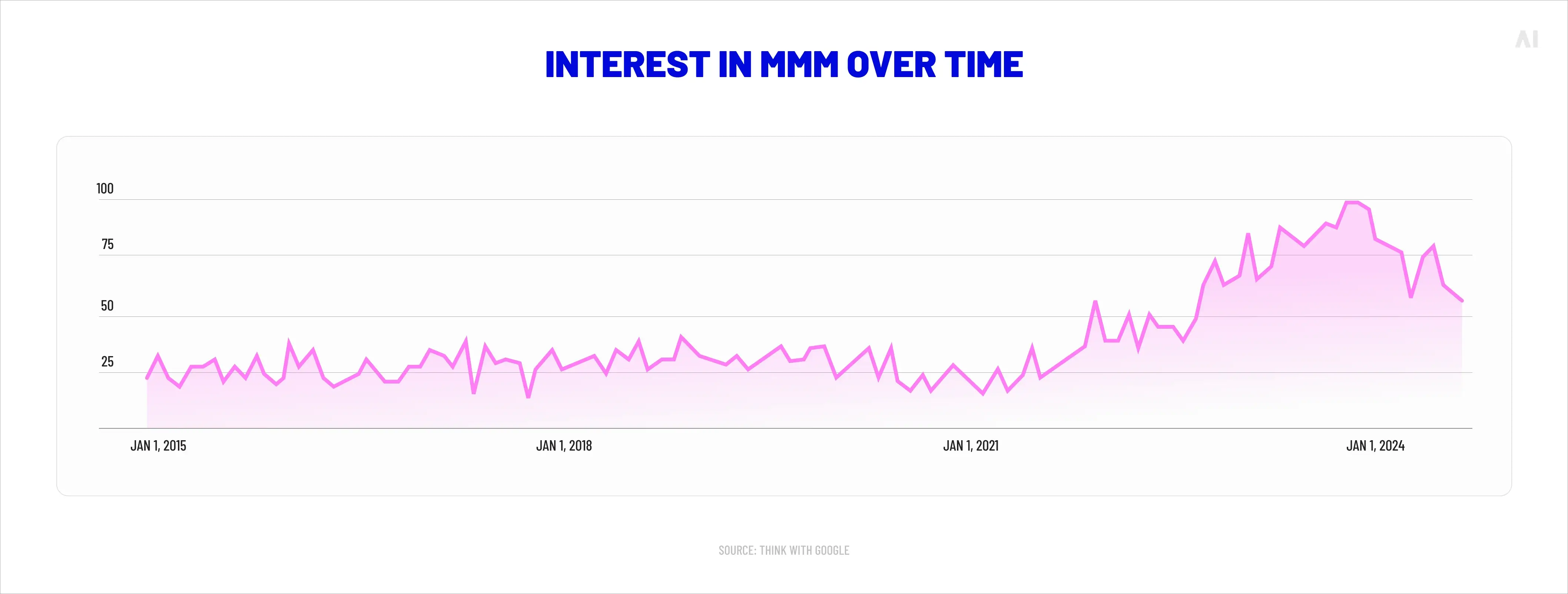
MMM has been a recognized discipline since the 1960s, originally developed for consumer packaged goods companies trying to measure the impact of TV and print advertising on retail sales. What has changed is the speed, precision, and accessibility of the methodology. As Gartner notes, the convergence of third-party data deprecation and open-source modelling tools has triggered a surge in MMM adoption, with the analyst firm launching its first dedicated Magic Quadrant for Marketing Mix Modeling Solutions in 2024 and expanding it in 2025. According to Forrester, MMM is now among the top five technologies marketers plan to deploy in the coming twelve months.
How MMM works
At the mechanical level, a media mix model ingests time-series data—typically weekly or monthly—covering media spend and volume by channel, business outcomes such as revenue or unit sales, pricing and promotional activity, seasonality indicators, and external variables like macroeconomic conditions, weather, or competitive behaviour.
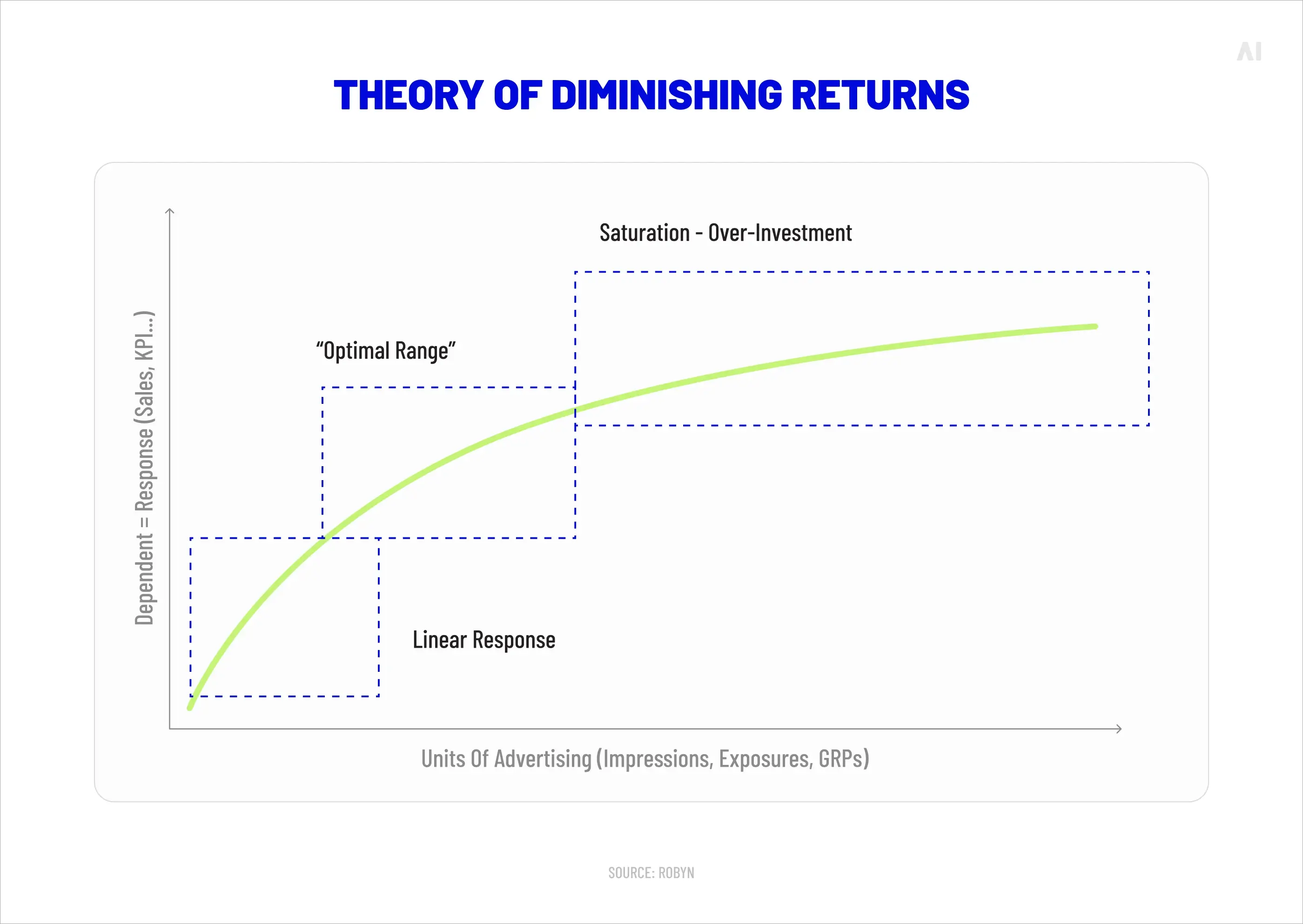
The model then applies regression analysis to estimate the coefficient—effectively, the impact weight—of each variable. Because marketing effects are not instantaneous, models incorporate two critical transformations. The first is adstock, which accounts for the carryover effect of advertising: a TV spot aired this week may influence purchases for several weeks afterward. The second is saturation modelling, typically using a Hill function or similar curve, which captures the diminishing returns that occur as spend in any single channel increases beyond its efficient threshold.
The output is a decomposition of total business performance into the contributions of each marketing channel, each non-marketing factor, and a baseline that represents organic demand. This decomposition tells marketers not just which channels contributed, but how efficiently they did so and at what spend level their returns begin to diminish.
Media Mix Modeling and attribution models address different questions, operate on different data, and serve different time horizons. Conflating them is one of the most common sources of confusion in marketing measurement.
Attribution models—whether last-click, multi-touch, or data-driven—track individual user interactions across digital touchpoints. They answer the question: which ad, email, or page visit within a user's journey deserves credit for this specific conversion? Attribution is useful for in-flight campaign optimization, particularly within digital channels where user-level tracking is available. Its limitations become apparent when measuring offline channels, upper-funnel activity, or anything that operates outside the tracking window of a single platform.
Media Mix Modeling operates at the aggregate level. It does not track individual users. Instead, it analyses the relationship between total spend, total impressions, and total business outcomes across time. This makes it well-suited for measuring long-term channel contribution, offline media, and the interaction effects between channels—none of which attribution models handle well.
The distinction matters because the two approaches frequently disagree. Attribution tends to over-credit channels that sit closest to the conversion event. MMM, by contrast, captures the full-funnel contribution of channels that build awareness and consideration but may not appear in a click path. Neither method is complete on its own. The strongest measurement frameworks—what practitioners increasingly call triangulation—combine MMM for strategic allocation with attribution for tactical optimization and incrementality testing for causal validation.
{{26-Media-Mix-Modeling-MMM-2="/tables"}}
⚡ Attribution tells you what happened inside the click path. MMM tells you what happened to the business.
How media mix modelling improves marketing performance
The strategic value of a media mix modeling strategy lies in its ability to connect marketing activity to financial outcomes at a level of granularity that neither gut instinct nor platform dashboards can match. For organizations spending tens or hundreds of millions annually on media, even modest improvements in allocation efficiency translate into significant revenue gains.
Identifying true incremental impact
The central promise of MMM is incrementality: measuring what would not have happened without a given marketing investment. This distinction is critical. Platform-reported conversions include users who would have purchased anyway—through organic search, direct navigation, or brand loyalty. MMM strips away that baseline and isolates the additional revenue each channel actually generated.
This is particularly valuable for channels where platform attribution is either unavailable or unreliable. CTV, for example, drives significant awareness and consideration but rarely receives last-click credit. OEM advertising, which reaches users at the device level, sits almost entirely outside traditional tracking frameworks. Retail media networks, as Nielsen's 2025 research highlighted, often require in-platform attribution tools that prevent cross-channel analysis. MMM provides a unified view that accounts for all these channels without depending on user-level data.
Every advertising channel saturates. The first million dollars in paid search may return four dollars in revenue per dollar spent. The second million may return two. The third may return less than one. This pattern—captured through response curves in the media mix model—is one of the most actionable outputs MMM produces.
Response curves reveal the marginal return at any spend level for each channel, showing marketers exactly where additional investment produces declining impact. For a media director managing a $50 million annual budget, knowing that paid social is saturated above $800,000 per month while CTV still has headroom at current spend levels is the difference between efficient allocation and waste.
MMM and response-curve analysis can reveal when additional spend is hitting diminishing returns. Industry evidence shows that channels such as paid social and online display tend to saturate relatively quickly, meaning each extra unit of spend can generate progressively lower incremental profit unless budgets are rebalanced.
Once a model has established incremental impact and response curves, it enables scenario planning—the ability to simulate how different budget allocations would affect total revenue before committing real spend. This is where MMM transforms from a retrospective analytical exercise into a forward-looking strategic tool.
Scenario planning answers questions that matter at the executive level. What happens to total revenue if CTV budget increases by 20% and display is reduced by an equivalent amount? How would a 10% overall budget cut affect outcomes, and which channels should absorb the reduction? What is the optimal spend level for each channel given a fixed total budget?
These simulations use the calibrated model's coefficients and response curves to predict outcomes under different conditions, turning budget planning from a political negotiation into an evidence-based process. For CFOs and CMOs alike, that shift from opinion to analysis materially changes how investment decisions are made and defended.
Aligning marketing with financial outcomes
One of the more persistent challenges for marketing leaders is translating campaign metrics into language that resonates in the boardroom. Impressions, click-through rates, and even ROAS are marketing constructs. Executive teams and finance partners think in terms of contribution margin, customer acquisition cost (CAC), customer lifetime value (CLV), and revenue growth.
MMM bridges this gap by expressing marketing impact in financial terms. When a model demonstrates that an incremental $5 million in CTV spend would generate $18 million in attributable revenue at a contribution margin of 35%, the conversation moves from "should we invest more in streaming" to "here is the expected return on that investment."
This financial alignment is increasingly important. The Gartner 2025 CMO Spend Survey found that 59% of CMOs report insufficient budget to execute their strategy—yet 61% of respondents said their company now views marketing as a profit centre rather than a cost centre, up from 53% the previous year. That shift in perception depends on marketing's ability to demonstrate measurable business impact. MMM provides the analytical framework to do so.
💡 The CMO who can quantify the marginal return on each media dollar speaks the same language as the CFO. That alignment is worth more than any budget increase.
Average marketing budget as a percent of total revenue (Source)
The traditional criticism of MMM—that models take months to build, require specialised econometricians, and deliver static results that are outdated by the time they reach decision-makers—is rapidly losing relevance. Machine learning and automation are compressing cycle times, expanding the range of variables models can process, and enabling continuous rather than periodic optimization.
Modern MMM platforms use machine learning to automate feature engineering, detect non-linear relationships between variables, and run thousands of scenario simulations in minutes rather than weeks. Bayesian inference methods, including those used in Google's open-source Meridian framework and Meta's Robyn, allow models to incorporate prior knowledge from incrementality experiments, producing more stable and interpretable results.
As Gartner's 2025 Magic Quadrant for MMM Solutions observed, leading providers are now investing in agentic and generative AI capabilities that support self-guided engagement with model outputs—making MMM accessible to marketing teams without requiring them to interpret raw regression tables. The result is a discipline that is evolving from a quarterly consulting deliverable into a dynamic decision-making system embedded in ongoing media operations.
Implementing MMM is not a technology procurement exercise. It is an organizational capability that requires structured data, cross-functional collaboration, and a disciplined process for converting analytical insight into allocation decisions. The following framework provides a practical starting point.
Step 1. Audit your current media investments
Before building a model, you need a clear picture of how budget is currently distributed and how performance is currently measured. This means documenting spend by channel, sub-channel, and campaign tier; identifying where attribution is platform-reported versus independently validated; and cataloguing the KPIs used to evaluate each channel.
The audit typically reveals inconsistencies: different teams measuring success differently, spend categories that lack clear performance tracking, and channels where reported ROI seems implausibly high or suspiciously low. These inconsistencies are not problems to be embarrassed about. They are precisely the gaps that MMM is designed to resolve.
Step 2. Consolidate historical marketing data
A reliable media mix model requires depth of data. Most practitioners recommend a minimum of 24 to 36 months of historical data at weekly granularity, covering media spend and volume by channel, revenue or conversion outcomes, pricing and promotional activity, and relevant external factors such as seasonality, competitor spend, or macroeconomic indicators.
Data consolidation is often the most time-consuming step in the process, particularly for organizations that have historically managed channels in silos. Spend data may live in DSP platforms, agency reports, and finance systems. Revenue data may sit in a separate BI environment. Aligning these sources into a single, consistent dataset is foundational work that pays dividends well beyond the initial model build.
Step 3. Build or partner for MMM expertise
Organisations face a build-versus-buy decision when it comes to modelling capability. Some—particularly those with in-house data science teams and large media budgets—develop proprietary models using open-source tools like Robyn, Meridian, or PyMC-Marketing. Others partner with specialised MMM providers or media analytics consultancies.
The right choice depends on internal resources, analytical maturity, and the complexity of the media mix. As Gartner notes, CMOs with programme and media budgets of $10 million or more typically find that the value of MMM recommendations justifies the investment in specialised capability, whether built or bought.
{{26-Media-Mix-Modeling-MMM-3="/tables"}}
Step 4. Translate model insights into budget strategy
A model is only as useful as the decisions it informs. Once initial outputs are available—channel-level incrementality estimates, response curves, and scenario simulations—the next step is translating those findings into concrete budget reallocation.
This requires collaboration between marketing, finance, and media execution teams. Model outputs should inform not just where to shift spend, but how quickly, with what guardrails, and against which performance benchmarks. A phased approach—reallocating 10–15% of budget based on model recommendations, measuring the result, and expanding from there—tends to build organizational confidence more effectively than wholesale restructuring.
Step 5. Establish continuous optimization
MMM should not be treated as a one-time project. Markets shift. Consumer behaviour evolves. New channels emerge. A model built on data from two years ago may not accurately reflect current dynamics, particularly in categories where media mix composition has changed significantly.
Best practice is to refresh models quarterly or monthly, validate findings through structured incrementality experiments (such as geo-holdout tests), and integrate model outputs into regular planning cycles. The organizations that extract the most value from MMM are those that treat it as a standing analytical capability, not a periodic research exercise.
Common mistakes when using media mix modeling
Even well-resourced organizations make avoidable errors when deploying MMM. The most frequent fall into five categories.
Relying exclusively on platform-reported metrics. Platforms have a structural incentive to attribute as many conversions as possible to their own inventory. Using platform data as the sole basis for budget decisions systematically over-credits certain channels and under-credits others. MMM exists precisely to provide an independent, aggregate view. Treating platform metrics as the source of truth undermines the purpose of modelling.
Optimising for short-term ROAS instead of profitability. ROAS is a useful metric, but it measures revenue per dollar spent, not profit per dollar spent. A channel with a 5:1 ROAS and a 15% contribution margin may generate less profit than a channel with a 3:1 ROAS and a 45% contribution margin. MMM provides the inputs to model profitability, but only if the business outcome variable is defined correctly.
Spreading budget across too many channels without allocation logic. Diversification is not inherently a strategy. A brand running campaigns across twelve channels without a clear understanding of each channel's marginal contribution is not diversified; it is diluted. MMM helps identify which channels warrant investment and which are consuming budget without generating meaningful incremental return.
Treating MMM as a one-time analysis. A model built once and never refreshed becomes a historical artefact, not a decision-making tool. Media dynamics change. New channels enter the mix. Consumer behaviour shifts with economic conditions. Organisations that invest in the initial model but do not commit to ongoing maintenance forfeit most of the discipline's long-term value.
Ignoring the need for experimental validation. MMM is a correlational method. It estimates the likely contribution of each variable, but it does not prove causation with the rigour of a controlled experiment. The strongest measurement programmes supplement MMM with geo-holdout tests, conversion lift studies, or matched-market experiments that validate whether model-estimated returns hold up under real-world conditions.
⚡ A model you build once is a report. A model you maintain continuously is a competitive advantage.
Media mix modeling: Turning marketing strategy into financial impact
The challenge facing marketing leaders in 2026 is not a lack of channels. There are more ways to reach consumers today than at any point in the history of advertising. The challenge is knowing which of those channels actually drives growth—and being able to prove it in terms that the rest of the business understands.
Media mix modeling provides that proof. By measuring the incremental contribution of each channel, revealing where diminishing returns erode efficiency, and enabling scenario-based budget optimization, MMM transforms mixed media strategy from a complex operational task into a measurable financial discipline. For CMOs defending budgets in an environment where 59% of their peers report insufficient funding, that capability is not a luxury. It is a prerequisite for strategic credibility.
The organizations that will lead in the years ahead are those that treat measurement as a continuous practice rather than a periodic project—those that connect media investment to financial outcomes, align marketing performance with enterprise growth objectives, and use data to make allocation decisions that are defensible, repeatable, and directly tied to revenue.
If you are looking to build or strengthen your media measurement capability, AI Digital provides cross-channel media execution, supply-side optimization, and AI-enhanced campaign intelligence designed to give advertisers full visibility into performance across the open internet.
Blind spot
Key issues
Business impact
AI Digital solution
Lack of transparency in AI models
• Platforms own AI models and train on proprietary data • Brands have little visibility into decision-making • "Walled gardens" restrict data access
• Inefficient ad spend • Limited strategic control • Eroded consumer trust • Potential budget mismanagement
Open Garden framework providing: • Complete transparency • DSP-agnostic execution • Cross-platform data & insights
Optimizing ads vs. optimizing impact
• AI excels at short-term metrics but may struggle with brand building • Consumers can detect AI-generated content • Efficiency might come at cost of authenticity
• Short-term gains at expense of brand health • Potential loss of authentic connection • Reduced effectiveness in storytelling
Smart Supply offering: • Human oversight of AI recommendations • Custom KPI alignment beyond clicks • Brand-safe inventory verification
The illusion of personalization
• Segment optimization rebranded as personalization • First-party data infrastructure challenges • Personalization vs. surveillance concerns
• Potential mismatch between promise and reality • Privacy concerns affecting consumer trust • Cost barriers for smaller businesses
Elevate platform features: • Real-time AI + human intelligence • First-party data activation • Ethical personalization strategies
AI-Driven efficiency vs. decision-making
• AI shifting from tool to decision-maker • Black box optimization like Google Performance Max • Human oversight limitations
• Strategic control loss • Difficulty questioning AI outputs • Inability to measure granular impact • Potential brand damage from mistakes
Managed Service with: • Human strategists overseeing AI • Custom KPI optimization • Complete campaign transparency
Fig. 1. Summary of AI blind spots in advertising
Dimension
Walled garden advantage
Walled garden limitation
Strategic impact
Audience access
Massive, engaged user bases
Limited visibility beyond platform
Reach without understanding
Data control
Sophisticated targeting tools
Data remains siloed within platform
Fragmented customer view
Measurement
Detailed in-platform metrics
Inconsistent cross-platform standards
Difficult performance comparison
Intelligence
Platform-specific insights
Limited data portability
Restricted strategic learning
Optimization
Powerful automated tools
Black-box algorithms
Reduced marketer control
Fig. 2. Strategic trade-offs in walled garden advertising.
Core issue
Platform priority
Walled garden limitation
Real-world example
Attribution opacity
Claiming maximum credit for conversions
Limited visibility into true conversion paths
Meta and TikTok's conflicting attribution models after iOS privacy updates
Data restrictions
Maintaining proprietary data control
Inability to combine platform data with other sources
Amazon DSP's limitations on detailed performance data exports
Cross-channel blindspots
Keeping advertisers within ecosystem
Fragmented view of customer journey
YouTube/DV360 campaigns lacking integration with non-Google platforms
Black box algorithms
Optimizing for platform revenue
Reduced control over campaign execution
Self-serve platforms using opaque ML models with little advertiser input
Performance reporting
Presenting platform in best light
Discrepancies between platform-reported and independently measured results
Consistently higher performance metrics in platform reports vs. third-party measurement
Fig. 1. The Walled garden misalignment: Platform interests vs. advertiser needs.
Key dimension
Challenge
Strategic imperative
ROAS volatility
Softer returns across digital channels
Shift from soft KPIs to measurable revenue impact
Media planning
Static plans no longer effective
Develop agile, modular approaches adaptable to changing conditions
Brand/performance
Traditional division dissolving
Create full-funnel strategies balancing long-term equity with short-term conversion
Capability
Key features
Benefits
Performance data
Elevate forecasting tool
• Vertical-specific insights • Historical data from past economic turbulence • "Cascade planning" functionality • Real-time adaptation
• Provides agility to adjust campaign strategy based on performance • Shows which media channels work best to drive efficient and effective performance • Confident budget reallocation • Reduces reaction time to market shifts
• Dataset from 10,000+ campaigns • Cuts response time from weeks to minutes
• Reaches people most likely to buy • Avoids wasted impressions and budgets on poor-performing placements • Context-aligned messaging
• 25+ billion bid requests analyzed daily • 18% improvement in working media efficiency • 26% increase in engagement during recessions
Full-funnel accountability
• Links awareness campaigns to lower funnel outcomes • Tests if ads actually drive new business • Measures brand perception changes • "Ask Elevate" AI Chat Assistant
• Upper-funnel to outcome connection • Sentiment shift tracking • Personalized messaging • Helps balance immediate sales vs. long-term brand building
• Natural language data queries • True business impact measurement
Open Garden approach
• Cross-platform and channel planning • Not locked into specific platforms • Unified cross-platform reach • Shows exactly where money is spent
• Reduces complexity across channels • Performance-based ad placement • Rapid budget reallocation • Eliminates platform-specific commitments and provides platform-based optimization and agility
• Coverage across all inventory sources • Provides full visibility into spending • Avoids the inability to pivot across platform as you’re not in a singular platform
Fig. 1. How AI Digital helps during economic uncertainty.
Trend
What it means for marketers
Supply & demand lines are blurring
Platforms from Google (P-Max) to Microsoft are merging optimization and inventory in one opaque box. Expect more bundled “best available” media where the algorithm, not the trader, decides channel and publisher mix.
Walled gardens get taller
Microsoft’s O&O set now spans Bing, Xbox, Outlook, Edge and LinkedIn, which just launched revenue-sharing video programs to lure creators and ad dollars. (Business Insider)
Retail & commerce media shape strategy
Microsoft’s Curate lets retailers and data owners package first-party segments, an echo of Amazon’s and Walmart’s approaches. Agencies must master seller-defined audiences as well as buyer-side tactics.
AI oversight becomes critical
Closed AI bidding means fewer levers for traders. Independent verification, incrementality testing and commercial guardrails rise in importance.
Fig. 1. Platform trends and their implications.
Metric
Connected TV (CTV)
Linear TV
Video Completion Rate
94.5%
70%
Purchase Rate After Ad
23%
12%
Ad Attention Rate
57% (prefer CTV ads)
54.5%
Viewer Reach (U.S.)
85% of households
228 million viewers
Retail Media Trends 2025
Access Complete consumer behaviour analyses and competitor benchmarks.
Identify and categorize audience groups based on behaviors, preferences, and characteristics
Michaels Stores: Implemented a genAI platform that increased email personalization from 20% to 95%, leading to a 41% boost in SMS click through rates and a 25% increase in engagement.
Estée Lauder: Partnered with Google Cloud to leverage genAI technologies for real-time consumer feedback monitoring and analyzing consumer sentiment across various channels.
High
Medium
Automated ad campaigns
Automate ad creation, placement, and optimization across various platforms
Showmax: Partnered with AI firms toautomate ad creation and testing, reducing production time by 70% while streamlining their quality assurance process.
Headway: Employed AI tools for ad creation and optimization, boosting performance by 40% and reaching 3.3 billion impressions while incorporating AI-generated content in 20% of their paid campaigns.
High
High
Brand sentiment tracking
Monitor and analyze public opinion about a brand across multiple channels in real time
L’Oréal: Analyzed millions of online comments, images, and videos to identify potential product innovation opportunities, effectively tracking brand sentiment and consumer trends.
Kellogg Company: Used AI to scan trending recipes featuring cereal, leveraging this data to launch targeted social campaigns that capitalize on positive brand sentiment and culinary trends.
High
Low
Campaign strategy optimization
Analyze data to predict optimal campaign approaches, channels, and timing
DoorDash: Leveraged Google’s AI-powered Demand Gen tool, which boosted its conversion rate by 15 times and improved cost per action efficiency by 50% compared with previous campaigns.
Kitsch: Employed Meta’s Advantage+ shopping campaigns with AI-powered tools to optimize campaigns, identifying and delivering top-performing ads to high-value consumers.
High
High
Content strategy
Generate content ideas, predict performance, and optimize distribution strategies
JPMorgan Chase: Collaborated with Persado to develop LLMs for marketing copy, achieving up to 450% higher clickthrough rates compared with human-written ads in pilot tests.
Hotel Chocolat: Employed genAI for concept development and production of its Velvetiser TV ad, which earned the highest-ever System1 score for adomestic appliance commercial.
High
High
Personalization strategy development
Create tailored messaging and experiences for consumers at scale
Stitch Fix: Uses genAI to help stylists interpret customer feedback and provide product recommendations, effectively personalizing shopping experiences.
Instacart: Uses genAI to offer customers personalized recipes, mealplanning ideas, and shopping lists based on individual preferences and habits.
Medium
Medium
Share article
Url copied to clipboard
No items found.
Subscribe to our Newsletter
THANK YOU FOR YOUR SUBSCRIPTION
Oops! Something went wrong while submitting the form.
Questions? We have answers
How does media mix modeling improve marketing performance?
MMM improves performance by measuring the incremental impact of each marketing channel on business outcomes, enabling marketers to shift spend from saturated or low-return channels to those with higher marginal efficiency. Rather than relying on platform-reported metrics, MMM provides an independent view of channel contribution that accounts for cross-channel interaction effects, seasonality, and external factors. The result is more informed budget allocation, reduced waste, and a clearer connection between media investment and revenue growth.
What marketing channels should be included in a media mix model?
A comprehensive model should include all channels that receive meaningful budget and could plausibly influence the business outcome being measured. This typically encompasses paid search, social media, display, CTV, OEM advertising, retail media, native, audio, OOH, and any offline formats such as print, direct mail, or linear TV. The model should also account for non-media variables including pricing, promotions, seasonality, and competitive activity. Omitting a significant channel risks misattributing its contribution to other variables.
What is the difference between media mix modeling and attribution?
Attribution models track individual user interactions across digital touchpoints to assign credit for specific conversions. They are useful for tactical optimization within digital channels. MMM operates at the aggregate level, analysing total spend and total outcomes over time to measure each channel's long-term incremental contribution—including offline media and upper-funnel activity that attribution cannot track. The two approaches are complementary: attribution guides in-flight decisions while MMM informs strategic allocation.
Can MMM measure CTV, OEM, and retail media performance?
Yes. Because MMM analyses aggregated data rather than user-level tracking, it is well-suited for channels where individual-level attribution is limited or unavailable. CTV, OEM advertising, and retail media—all of which operate with restricted cross-platform data sharing—can be measured through their aggregate spend and volume patterns alongside other channels. This is one of MMM's primary advantages over attribution-based measurement in today's privacy-constrained environment.
How does media mix advertising differ from media mix modelling?
Media mix advertising refers to the practical side of planning and running campaigns across different channels—for example, deciding how much budget to put into search, social, CTV, display, or offline media as part of a broader marketing strategy. Media mix modelling, by contrast, is the measurement method used to analyse how those channels actually influenced outcomes such as sales, leads, or revenue. In other words, media mix advertising is the execution of the mix, while media mix modelling is the analytical process that helps marketers understand which parts of that mix are working and where budget should move next.
Is media mix modeling suitable for mid-sized companies?
MMM is most commonly associated with enterprise-scale advertisers, and Gartner's guidance suggests that organizations with media budgets above $10 million are best positioned to extract value from the methodology. However, the emergence of open-source tools (such as Google's Meridian and Meta's Robyn) and self-service SaaS platforms has lowered the barrier to entry significantly. Mid-sized companies with well-structured historical data and a clear set of channels can benefit from MMM, particularly if they operate in competitive categories where allocation efficiency directly affects margin.
How often should media mix models be updated?
Most practitioners recommend refreshing models quarterly, with some organizations moving to monthly cycles as modelling platforms become faster and more automated. The appropriate cadence depends on how quickly the media mix changes, whether new channels are being tested, and how volatile external factors (pricing, competitive activity, economic conditions) are. In all cases, periodic validation through incrementality experiments is essential to maintaining model accuracy.
Have other questions?
If you have more questions, contact us so we can help.
Questions? We have answers
This is some text inside of a div block.
Lorem ipsum dolor sit amet, consectetur adipiscing elit. Suspendisse varius enim in eros elementum tristique. Duis cursus, mi quis viverra ornare, eros dolor interdum nulla, ut commodo diam libero vitae erat. Aenean faucibus nibh et justo cursus id rutrum lorem imperdiet. Nunc ut sem vitae risus tristique posuere.
This is some text inside of a div block.
Lorem ipsum dolor sit amet, consectetur adipiscing elit. Suspendisse varius enim in eros elementum tristique. Duis cursus, mi quis viverra ornare, eros dolor interdum nulla, ut commodo diam libero vitae erat. Aenean faucibus nibh et justo cursus id rutrum lorem imperdiet. Nunc ut sem vitae risus tristique posuere.
This is some text inside of a div block.
Lorem ipsum dolor sit amet, consectetur adipiscing elit. Suspendisse varius enim in eros elementum tristique. Duis cursus, mi quis viverra ornare, eros dolor interdum nulla, ut commodo diam libero vitae erat. Aenean faucibus nibh et justo cursus id rutrum lorem imperdiet. Nunc ut sem vitae risus tristique posuere.
This is some text inside of a div block.
Lorem ipsum dolor sit amet, consectetur adipiscing elit. Suspendisse varius enim in eros elementum tristique. Duis cursus, mi quis viverra ornare, eros dolor interdum nulla, ut commodo diam libero vitae erat. Aenean faucibus nibh et justo cursus id rutrum lorem imperdiet. Nunc ut sem vitae risus tristique posuere.
This is some text inside of a div block.
Lorem ipsum dolor sit amet, consectetur adipiscing elit. Suspendisse varius enim in eros elementum tristique. Duis cursus, mi quis viverra ornare, eros dolor interdum nulla, ut commodo diam libero vitae erat. Aenean faucibus nibh et justo cursus id rutrum lorem imperdiet. Nunc ut sem vitae risus tristique posuere.
This is some text inside of a div block.
Lorem ipsum dolor sit amet, consectetur adipiscing elit. Suspendisse varius enim in eros elementum tristique. Duis cursus, mi quis viverra ornare, eros dolor interdum nulla, ut commodo diam libero vitae erat. Aenean faucibus nibh et justo cursus id rutrum lorem imperdiet. Nunc ut sem vitae risus tristique posuere.
This is some text inside of a div block.
Lorem ipsum dolor sit amet, consectetur adipiscing elit. Suspendisse varius enim in eros elementum tristique. Duis cursus, mi quis viverra ornare, eros dolor interdum nulla, ut commodo diam libero vitae erat. Aenean faucibus nibh et justo cursus id rutrum lorem imperdiet. Nunc ut sem vitae risus tristique posuere.
_%20Turning%20Mixed%20Media%20Strategy%20into%20Measurable%20Growth.webp)

.svg)
.svg)