Programmatic native advertising in 2026: platforms, costs, and how to run campaigns
Mary Gabrielyan
November 24, 2025
16
minutes read
Originally published in November 2025. Updated and refreshed in July 2026.
Programmatic native advertising buys ads that match the content around them — automatically, in real time, and at a scale manual deals could never reach. This article explains how it works, what it costs, which platforms to buy it through, and how to run campaigns that perform in 2026.
Programmatic native advertising buys native ad placements — units that match the look and feel of their surroundings — through automated, real-time auctions rather than manual deals.
It's now the default way display trades: programmatic accounts for roughly 90% of display ad spend, and native is the fastest-growing display format.
Buyers reach it through DSPs (The Trade Desk, DV360, Amazon DSP) and native specialists (Taboola, Teads, TripleLift, Nativo, Sharethrough).
Costs run mid-range — native CPMs typically sit around $5–$12, with content-recommendation clicks far cheaper and premium in-feed higher.
The format earns attention where banners no longer can, and its reliance on context rather than cookies makes it durable as third-party identifiers fade.
Native in plain language
Before the technical detail, here is the whole idea in five plain points.
Match the platform. A native ad borrows the layout of wherever it appears, so it reads as part of the page rather than an interruption.
Blend into the feed. In-feed units scroll with the content around them instead of sitting in a fixed banner slot.
Look like content. The creative resembles an article, recommendation, or product listing — because that is the environment it lives in.
Label it clearly. Native is always marked "Sponsored" or "Promoted." Blending in is about format, not deception.
Lead with value. The best native ads inform or entertain first and sell second, which is why audiences engage with them.
Everything below is the machinery that delivers those five ideas at scale.
Programmatic native advertising is the automated buying of ads that match the look, feel, and function of the page they sit on. Instead of negotiating placements by hand, advertisers use data and real-time auctions to serve native units at scale — an in-feed card on a news site, a recommendation below an article, a sponsored product on a marketplace.
It has become the center of gravity in digital display. US programmatic display ad spend is set to pass the $200 billion mark in 2026, at roughly 92% of all display spending. Native is the format absorbing much of that growth: US native display ad spend is on track to reach about $148 billion in 2026, up 13.1% year over year. There's a clear reason. As third-party cookies fade and ad blockers spread, advertisers need formats that earn attention without depending on personal data. Native does both.
This guide covers what programmatic native is, how a campaign runs end to end, the formats and platforms available, what it costs, and how to get results from it in 2026.
What is programmatic native advertising?
Programmatic native advertising is the automated, data-driven buying and placement of ads designed to match the look, feel, and function of the media format they appear in.
It brings together two ideas:
Native advertising: the what — creative that doesn't look like a traditional ad. It fits the surrounding content on a site, feed, or app, giving a non-disruptive experience.
Programmatic advertising: the how — automated technology and data that buy ad space in real time, rather than through manual negotiation.
Together they let marketers deliver the right non-intrusive ad to the right person at the right moment, at scale and with real efficiency.
{{programmatic-native-advertising-1="/tables"}}
How programmatic native ads work
A programmatic native ad is a chain of automated events, from the moment a page loads to the final round of optimization. Here is the sequence.
Ad request and contextual inventory
When someone opens a webpage, the publisher's supply-side platform (SSP) sends an ad request to potential buyers through an ad exchange. That request describes the available slot — its size and placement — and, crucially, the context of the page: keywords, topic, sentiment, and semantic meaning. In milliseconds, the system reads whether the page is about marathon training, mortgage rates, or laptop reviews, so advertisers can match their message to the setting.
Contextual inventory is that available ad space sorted by content relevance rather than demographics alone. Modern AI-driven contextual analysis goes well past keyword matching, using natural language processing to read nuance, brand-safety signals, and tone. According to one study,contextually targeted ads can achieve 43% higher engagement than non-contextual placements — evidence that environmental relevance drives performance.
The "programmatic" part is often misread as just a buying tool. In practice, AI inside DSPs is an engine for creative optimization. Through Dynamic Creative Optimization (DCO), it assembles and tests thousands of native ad combinations — headlines, images, descriptions — to find what works for each audience segment.
💡 To understand the plumbing, stop treating DSPs, SSPs, and ad exchanges as separate technologies and start seeing them as one connected marketplace.
Real-time bidding and targeting logic
Real-time bidding (RTB) is the engine of the programmatic ecosystem — auctions that clear in the milliseconds between a page loading and an ad rendering. The distinction with programmatic vs RTB is worth holding onto: programmatic is the overall method of automated buying, while RTB is the specific auction that executes most of it.
When a user opens a site, information about the page and the impression goes to an ad exchange, which invites bids from demand-side platforms (DSPs). Each DSP runs that data through its targeting logic — context, behavior, purchase signals — and bids on behalf of advertisers. The result is precision at speed. Programmatic now accounts for roughly 90% of display ad spend worldwide, and for about 97% of every new display dollar — a measure of how completely automation has taken over the channel.
Native creative assembly
After a winning bid, native creative assembly begins. The advertiser's individual assets — headline, image, description, logo — are assembled on the fly into the publisher's native template.
This step is what preserves the native experience. The finished ad takes on the publisher's visual design and formatting, so it reads as a natural part of the feed. Because assembly is automated, different creative variations can be built and served to different users and contexts without anyone touching the campaign by hand.
Contextual ad delivery
Delivery then places that assembled ad where it fits thematically, reading the page's actual content — topics, sentiment, meaning — to find the right home. A native ad for running shoes lands in a marathon-training article, not next to unrelated content. Because this leans on the page rather than personal data, it holds up well as privacy rules tighten and identifiers disappear.
AI-driven optimization
The whole campaign runs on AI-driven optimization. Machine-learning models inside the DSP read performance in real time, adjusting bids, refining audiences, and moving budget toward what works. DCO extends this to creative, testing combinations of copy, imagery, and calls to action to see what resonates with each segment.
💡 As covered in our piece on AI in DSPs, that learning loop compounds — campaigns get more efficient the longer they run.
Cross-device reach
Finally, programmatic native works across devices. People move between phones, tablets, laptops, and connected TVs, and identity resolution lets programmatic systems recognize one person across those screens, hold a consistent message, and cap frequency. That is important in a market where attention is often won or lost on a phone screen. Mobile now drives around 63% of display impressions, so a format built to adapt to the small screen has a structural edge.
Key native ad formats and where they work best
Programmatic native spans several formats, each suited to different objectives. Knowing them helps buyers pick the right approach for a campaign.
In-Feed Native Ads
In-feed units are the most common native format, set inside a publisher's content stream. They appear as listings within social platforms like Facebook and Instagram, news sites, or discovery platforms like Taboola and Outbrain. Their strength is mirroring the surrounding editorial or social content, which lifts engagement and clicks.
In-feed works best for driving traffic, generating leads, and building awareness — especially when a strong headline and relevant image line up with the reader's intent and the page's context.
Content Recommendation Widgets
TUsually an "Around the web" or "Recommended for you" strip below or beside an article, these widgets suggest sponsored content based on page context or browsing behavior. They offer huge scale at low cost and suit content syndication and retargeting. They work best for amplifying blog posts, whitepapers, and other owned content to readers who've already shown relevant interest.
In-Ad and Custom Native Units
This hybrid delivers native-style content inside a standard IAB container. Because the unit is served into a reserved slot, it offers creative flexibility and guaranteed placement. Custom native units are bespoke integrations built for a specific publisher — premium, high-impact, and tightly controlled. Both suit brand-building and sponsorships on premium sites where presentation and brand safety come first.
Promoted Listings
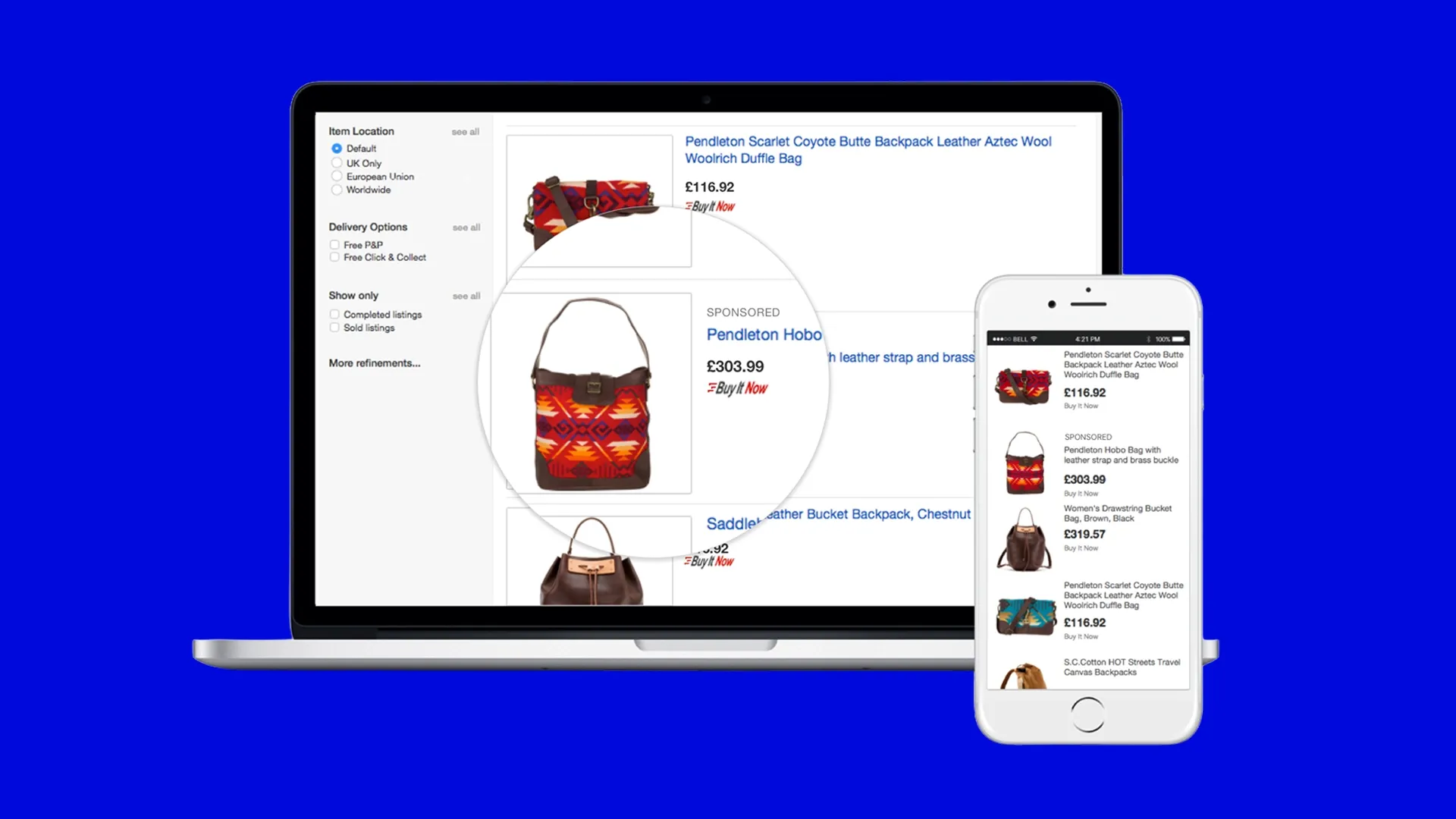
Common on marketplaces like Amazon and Etsy, promoted listings are native ads that blend into search results and category pages. They're performance-driven, aimed at users with clear buying intent, and work best for direct-response campaigns focused on sales. Success rests on strong product data and bidding that puts the listing in front of ready-to-buy shoppers.
OTT/CTV Native Advertising
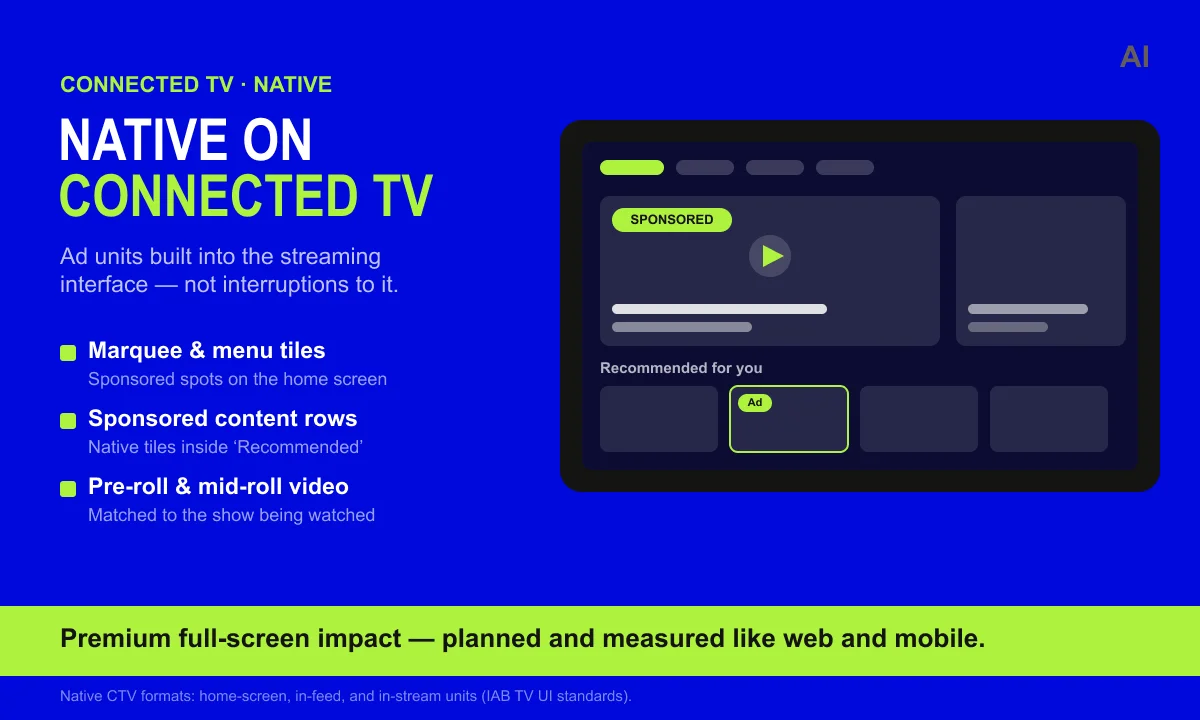
Native on CTV.
As viewing moves to streaming, OTT (over-the-top) has become a strong native channel. Delivered through connected TV (CTV) devices, these ads fit the viewing experience, often as pre-roll or mid-roll spots.
💡 As covered in our guide to what is OTT advertising, the format gives full-screen impact in a lean-back setting.
OTT native works best for reaching cord-cutters with quality brand storytelling and lifting upper-funnel metrics like recall and purchase intent. Sight, sound, and motion, paired with contextual relevance, make it exceptionally engaging.
Where to buy programmatic native: a platform comparison
One question the many guides skip is — where do you actually buy this? Programmatic native trades across two broad routes — general DSPs that reach native inventory alongside everything else, and native specialists built around the format. Most advertisers use a mix.
For most brands the decision isn't one platform but a role for each: a specialist like Taboola or Teads for discovery and scale, a DSP like The Trade Desk for open-web and CTV reach under one login, and Amazon DSP where commerce intent is the goal. AI Digital runs native across these routes through a single, DSP-agnostic layer — the thinking behind our Open Garden framework.
How much does programmatic native cost?
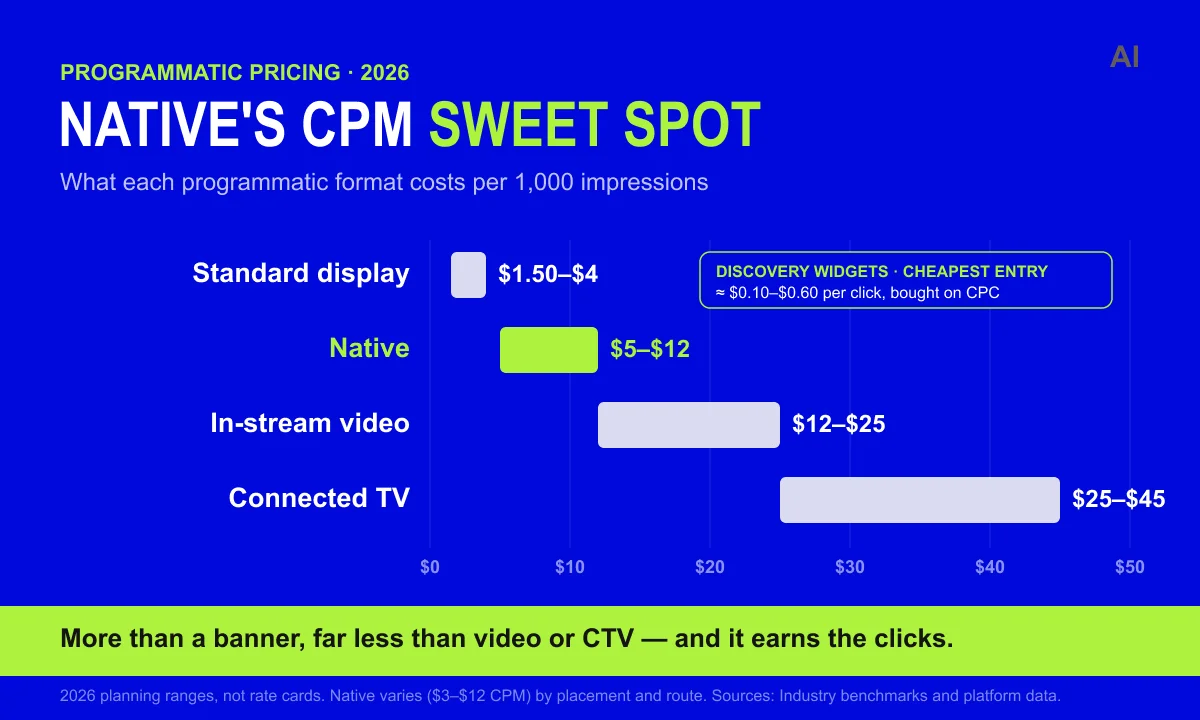
Native usually sits in the middle of the programmatic pricing range: more expensive than a standard banner, but cheaper than premium video or CTV. The exact number depends on format, publisher quality, audience targeting, buying route and market conditions, so 2026 benchmarks are best treated as planning ranges rather than rate cards.
As a rough guide, standard display banners often sit around $1.50–$4 CPM, while native placements are commonly benchmarked around $5–$12 CPM. In-stream video tends to sit higher, around $12–$25 CPM, and CTV higher still, often around $25–$45 CPM. Broader native estimates can be lower — around $3–$7 CPM in some industry roundups — so the safest reading is that native pricing varies widely by placement quality and intent.
Content-recommendation and discovery widgets are usually the cheapest entry point. These are often bought on a CPC basis, with broad native benchmarks around $0.10–$0.50 per click and Taboola-style discovery placements often cited around $0.30–$0.60. Premium in-feed, native video, sponsored editorial and custom publisher units cost more, especially when bought through curated deals or direct publisher relationships.
Two factors move the number most.
The first is inventory tier. Open-auction inventory is usually cheapest, while PMPs, curated marketplaces and direct publisher deals carry a premium in exchange for better control, stronger brand-safety assurances and higher-quality environments.
The second is targeting depth. More granular audience, contextual or first-party data targeting usually raises the CPM, but it can also improve downstream conversion quality.
There is no fixed minimum to start, but the test budget matters. Native platforms need enough spend and conversion volume for creative, placement and bidding optimization to learn. For most advertisers, the real question is (not only the CPM but) the effective cost of qualified traffic. Native earns its place when stronger click-through, longer engagement or better post-click conversion offsets the higher impression cost.
A few documented campaigns show where native earns its keep:
Optimization is the clearest gain. Native platforms now assemble and tune creative in flight rather than running one static asset, and the lifts are real: Yahoo's Gemini DCO research recorded a 53.5% lift in conversion rate over a control that rotated creative at random. Outbrain's Keystone reports 30–50% CTR lifts, though that's placement optimization, not advertiser-side creative. StackAdapt's own 2026 data shows DCO campaigns running 32% higher click-through and 56% lower CPC (platform figures, not a market average). Across all three, the same thing holds: native rewards optimization left to compound across creative, audience, placement and landing page.
On cost, native can undercut search where search is expensive or tapped out — though the proof lives in cases, not blanket benchmarks. Outbrain's dentolo campaign came in 33% below social on cost per lead and, at peak, 39% below paid search. Taboola's Ypê/Zmes case hit a cost per acquisition 49% under target, beating the search and social that had carried the media mix. Enough to say native can win on cost in the right conditions (not that it runs 40–65% cheaper everywhere).
The landing page decides as much as the buy. Advertorial pages and educational pre-landers work because they keep the promise the ad made, instead of dropping a cold reader into a hard sell. Plan for 5–10% conversion on a strong page — Unbounce's median is 6.6%, against low-single-digit rates for cold paid search — but treat that as a landing-page number, not a native average.
Native's edge is rarely the cheaper impression. It's the matched sequence — native creative, an editorial-style click, a relevant landing page, steady optimization — so the reader never feels the jerk from content into pitch.
The benefits of programmatic native advertising
Programmatic native moves digital advertising away from interruption and toward content people actually engage with. Pairing the non-intrusive native format with programmatic precision produces advantages across the whole campaign lifecycle. Here are the core ones.
Delivers native-level user experience at scale
The format solves a long-standing tension: how to stay non-disruptive while reaching real scale. Native ads match the form and function of the page around them, so they cut visual clutter and banner blindness. The programmatic layer then deploys that experience across thousands of sites and apps at once through RTB. A brand can run a sponsored article that reads like an organic post on a national news site, a social feed, and a niche blog simultaneously — no hand-negotiated deals, and the good experience of native no longer limited to a handful of publisher relationships.
Drives higher engagement and CTR than standard ads
The performance gap with traditional display is well documented. Where bannerclick-through rates sit below 0.1%, native units on the major discovery platforms typically clear 0.2–0.6% — several times higher — because they don't trigger the avoidance banners provoke. The landmarkSharethrough and IPG Media Lab eye-tracking study put numbers on why: consumers looked at native ads 52% more often than banner ads, and native drove an 18% lift in purchase intent and a 9% lift in brand affinity. Attention, not just clicks, is the underlying advantage.
Enables automation and data-driven personalization
This is the synergy at the heart of the format: efficient automated buying plus a flexible creative canvas. Programmatic platforms use large datasets and machine learning to decide which ad shows to which user, where, and at what price — removing the drag of manual media buying. DCO then tailors the creative, assembling native components for each segment, so one campaign can serve thousands of variations: beach getaways to one reader, mountain trips to another, all optimized automatically.
Less affected by ad blockers and aligned with privacy standards
Because native is served as content within the publisher's site, ad blockers — which mostly target standard display units — often don't catch it, so more of your message reaches its audience. The format also fits the privacy-first direction of travel. As third-party cookies fade, contextual targeting becomes central, and native's strength is exactly that: relevance drawn from the page rather than from personal tracking.
Native formats are responsive by design, so they hold up across desktop, phone, tablet, and CTV. Unlike fixed banners that break or load awkwardly on different screens, native adapts to its container. That consistency protects performance across the multi-screen journeys most customers now take.
Improves cost efficiency and ROI
The return comes from several directions at once.
Automationcuts the manual overhead of traditional buying.
Higher engagement lowers cost-per-click and raises return on ad spend — you pay for meaningful interactions, not ignored impressions.
And because the buying is data-driven, budget keeps moving toward the audiences, sites, and creatives that perform, trimming waste.
Programmatic vs. native advertising: Why the hybrid model works better
Each approach is strong alone but limited. Programmatic buys efficiently and targets well, yet often relies on interruptive formats people tune out. Standalone native gives a better experience and higher engagement but is hard to scale through manual publisher deals. Programmatic native closes that gap, taking the strengths of both.
{{programmatic-native-advertising-2="/tables"}}
The combination doesn't just add the two together — it solves the core dilemma of digital advertising: how to get scale and relevance at the same time.
Hybrid advantages
The power lies in pairing programmatic's scalability with native's experience. Through the automated bidding and targeting of DSPs, advertisers run large, complex campaigns across thousands of sites efficiently, deploying the same native format across the open web in real time — without the manual friction that used to hold native back.
💡 As explored in our analysis on rethinking the value proposition of DSPs, modern platforms have grown from simple bid managers into full optimization engines, which is what makes scaled native delivery genuinely effective.
At the same time, the native component keeps that scaled delivery from alienating audiences.
💡 Well-formatted native creative earns the engagement that drives performance, and AI decides which variations work best for each segment and context, as detailed in our piece on how AI is changing the programmatic game.
The result is a loop: programmatic supplies the data and efficiency for personalized delivery, and the native format ensures that personalization lands well, generating quality engagement that feeds back into the optimization. That's what maximizes ROI — less waste, better brand perception, higher conversion.
Any current picture of programmatic native has to account for retail media, now among the largest channels in all of advertising — retail media revenue passed $176 billion in 2025, overtaking linear TV. Most of it is programmatic native by another name: the sponsored product listings on Amazon, Walmart, and Instacart are native units, bought programmatically, matched to shopper intent.
What makes them work is first-party purchase data. Retailer networks use their own basket and loyalty signals to place sponsored listings against genuine buying intent, and the returns can be striking — retailer-run networks report average returns of around 12x and conversion rates near 24% for participating brands. eMarketer expects retailers' first-party data to attract over a quarter of every new programmatic display dollar through 2026. For advertisers, the takeaway is that a serious native strategy now includes commerce-native inventory, not just open-web discovery.
How the supply path changed: PMPs and SPO
Where native inventory is bought has changed as much as how. The open exchange is no longer the default. More than 91% of US programmatic display spend now flows through private marketplaces and programmatic direct, as buyers prioritize premium, brand-safe inventory with cleaner measurement over the cheapest possible reach.
For native, that shift favors quality. A curated private marketplace deal puts native units on known, verified publishers rather than the long tail — the difference shows up in results, not just reassurance. One documented Yahoo DSP PMP campaign drove a12.6% lift in purchase intent and a 28% more cost-effective CPC for a luxury retailer.
💡 This is also where supply-path optimization earns its keep: trimming the intermediaries between spend and impression so more of the budget reaches real, viewable native inventory — the logic behind our Smart Supply approach.
Best practices for successful programmatic native campaigns
Running native well takes more than budget — it takes a method that balances craft and data. These practices form that framework.
Align creative with context and audience
Native starts with fit: creative that suits both the publisher's context and the audience's interests. The same campaign should read differently on a financial news site than on a lifestyle blog. Use DCO to tailor messaging to contextual signals — page content, location, time of day — so the ad feels like an extension of what the reader is already consuming rather than an intrusion.
Test, optimize, repeat
Continuous testing is the engine of improvement. Go past basic headline and image A/B tests into multivariate testing that shows how creative elements interact with different segments. Set a testing calendar and focus on metrics that indicate real performance, not vanity numbers — what works at launch rarely sustains without ongoing work.
One native-specific nuance: test across content types before you optimize within them. A video native unit, a sponsored article, and a static in-feed card behave differently, so find the format that works for your audience first, then refine headlines and images inside the winner. Treating all native creative as one testing pool hides that first, larger difference.
Steady native performance comes from a rhythm, not constant fiddling. A workable cadence:
Daily — check pacing and budgets; catch any placements spending without returning.
Weekly — adjust bids, prune or add sites, and refresh creative showing fatigue.
Monthly — revisit audiences and contextual categories, and rebalance budget across formats and platforms.
The point is to separate quick operational fixes from the slower strategic calls, so you're not overreacting to daily noise.
Use authentic, non-intrusive messaging
Audiences spot and skip overt selling. The most effective native provides value first: solve a problem, explain something useful, or entertain. Avoid ad-speak and hard sells, and take on the tone of the publisher you're appearing in. Trust drives higher-quality engagement — a reader who feels respected converts more readily than one who feels ambushed.
Optimize landing pages
Even a perfect native ad is wasted on a weak landing page. Match the page's message, tone, and visual style to the ad, make it load fast and work on every device, and give it one clear call to action. Any friction — a slow load, a mismatched message, a cluttered layout — pushes up bounce rates and erodes return. The landing page is where the ad's promise is kept.
Leverage automation and AI
Running native well means going beyond rules-based automation to a system that plans, optimizes, and measures with real intelligence — across every channel, not just the programmatic buy. That is whereElevate fits: not another DSP, but the vendor-agnostic marketing intelligence platform that sits across them.
Elevate unifies research, planning, optimization, and reporting in one layer, connecting pre-campaign intelligence with live optimization and post-campaign analysis. Drawing on 150 billion data points a month and more than 10,000 audience attributes, it lets teams:
Build sharper audiences — turning a plain-language audience description into channel-specific segments from over a million audiences analyzed, then reaching cookieless inventory across 100,000+ sites, apps, and CTV that standard targeting misses.
Plan faster with AI — the AI-Assisted Media Planner turns campaign inputs into a structured plan drawn from 8,000+ campaigns across 12+ DSPs, with scenario testing and human verification before anything runs.
Prove business outcomes — marketing mix modeling and path-to-conversion show what actually moved results across the funnel, tying spend to sales and retention rather than mid-funnel clicks.
Where other platforms gate their tools, Elevate puts clients inside it — so a native campaign runs inside a full-funnel view rather than in isolation.
Conclusion: Why programmatic native ads work — today and tomorrow
Programmatic native advertising fits where consumer behavior, technology, and privacy rules are all heading. By combining automated, precise buying with a non-disruptive, contextually relevant format, it gives marketers what they most need now: engagement at scale and performance that lasts.
The evidence holds up. Native earns attention where banners have stopped working, it costs less per outcome further down the funnel, and its reliance on context rather than cookies makes it durable as identifiers disappear. It respects the reader while delivering the efficiency and optimization businesses expect.
Looking ahead, AI-driven optimization, contextual intelligence, and cross-device reach will only deepen the format's edge. The brands that do best will treat programmatic native not as a stopgap but as a foundation of modern strategy — balancing automation with authenticity and scale with relevance. As set out in our 2026 AI strategy checklist, that means investing in the right technology and expertise now.
💡 Every media mix is different, and where programmatic native fits — which platforms to start with, how to budget a first campaign, how to measure it against everything else you're running — depends on your goals. If the questions here line up with what you're working through, talk to AI Digital. We're glad to look at your setup and shape a plan around it.
Blind spot
Key issues
Business impact
AI Digital solution
Lack of transparency in AI models
• Platforms own AI models and train on proprietary data • Brands have little visibility into decision-making • "Walled gardens" restrict data access
• Inefficient ad spend • Limited strategic control • Eroded consumer trust • Potential budget mismanagement
Open Garden framework providing: • Complete transparency • DSP-agnostic execution • Cross-platform data & insights
Optimizing ads vs. optimizing impact
• AI excels at short-term metrics but may struggle with brand building • Consumers can detect AI-generated content • Efficiency might come at cost of authenticity
• Short-term gains at expense of brand health • Potential loss of authentic connection • Reduced effectiveness in storytelling
Smart Supply offering: • Human oversight of AI recommendations • Custom KPI alignment beyond clicks • Brand-safe inventory verification
The illusion of personalization
• Segment optimization rebranded as personalization • First-party data infrastructure challenges • Personalization vs. surveillance concerns
• Potential mismatch between promise and reality • Privacy concerns affecting consumer trust • Cost barriers for smaller businesses
Elevate platform features: • Real-time AI + human intelligence • First-party data activation • Ethical personalization strategies
AI-Driven efficiency vs. decision-making
• AI shifting from tool to decision-maker • Black box optimization like Google Performance Max • Human oversight limitations
• Strategic control loss • Difficulty questioning AI outputs • Inability to measure granular impact • Potential brand damage from mistakes
Managed Service with: • Human strategists overseeing AI • Custom KPI optimization • Complete campaign transparency
Fig. 1. Summary of AI blind spots in advertising
Dimension
Walled garden advantage
Walled garden limitation
Strategic impact
Audience access
Massive, engaged user bases
Limited visibility beyond platform
Reach without understanding
Data control
Sophisticated targeting tools
Data remains siloed within platform
Fragmented customer view
Measurement
Detailed in-platform metrics
Inconsistent cross-platform standards
Difficult performance comparison
Intelligence
Platform-specific insights
Limited data portability
Restricted strategic learning
Optimization
Powerful automated tools
Black-box algorithms
Reduced marketer control
Fig. 2. Strategic trade-offs in walled garden advertising.
Core issue
Platform priority
Walled garden limitation
Real-world example
Attribution opacity
Claiming maximum credit for conversions
Limited visibility into true conversion paths
Meta and TikTok's conflicting attribution models after iOS privacy updates
Data restrictions
Maintaining proprietary data control
Inability to combine platform data with other sources
Amazon DSP's limitations on detailed performance data exports
Cross-channel blindspots
Keeping advertisers within ecosystem
Fragmented view of customer journey
YouTube/DV360 campaigns lacking integration with non-Google platforms
Black box algorithms
Optimizing for platform revenue
Reduced control over campaign execution
Self-serve platforms using opaque ML models with little advertiser input
Performance reporting
Presenting platform in best light
Discrepancies between platform-reported and independently measured results
Consistently higher performance metrics in platform reports vs. third-party measurement
Fig. 1. The Walled garden misalignment: Platform interests vs. advertiser needs.
Key dimension
Challenge
Strategic imperative
ROAS volatility
Softer returns across digital channels
Shift from soft KPIs to measurable revenue impact
Media planning
Static plans no longer effective
Develop agile, modular approaches adaptable to changing conditions
Brand/performance
Traditional division dissolving
Create full-funnel strategies balancing long-term equity with short-term conversion
Capability
Key features
Benefits
Performance data
Elevate forecasting tool
• Vertical-specific insights • Historical data from past economic turbulence • "Cascade planning" functionality • Real-time adaptation
• Provides agility to adjust campaign strategy based on performance • Shows which media channels work best to drive efficient and effective performance • Confident budget reallocation • Reduces reaction time to market shifts
• Dataset from 10,000+ campaigns • Cuts response time from weeks to minutes
• Reaches people most likely to buy • Avoids wasted impressions and budgets on poor-performing placements • Context-aligned messaging
• 25+ billion bid requests analyzed daily • 18% improvement in working media efficiency • 26% increase in engagement during recessions
Full-funnel accountability
• Links awareness campaigns to lower funnel outcomes • Tests if ads actually drive new business • Measures brand perception changes • "Ask Elevate" AI Chat Assistant
• Upper-funnel to outcome connection • Sentiment shift tracking • Personalized messaging • Helps balance immediate sales vs. long-term brand building
• Natural language data queries • True business impact measurement
Open Garden approach
• Cross-platform and channel planning • Not locked into specific platforms • Unified cross-platform reach • Shows exactly where money is spent
• Reduces complexity across channels • Performance-based ad placement • Rapid budget reallocation • Eliminates platform-specific commitments and provides platform-based optimization and agility
• Coverage across all inventory sources • Provides full visibility into spending • Avoids the inability to pivot across platform as you’re not in a singular platform
Fig. 1. How AI Digital helps during economic uncertainty.
Trend
What it means for marketers
Supply & demand lines are blurring
Platforms from Google (P-Max) to Microsoft are merging optimization and inventory in one opaque box. Expect more bundled “best available” media where the algorithm, not the trader, decides channel and publisher mix.
Walled gardens get taller
Microsoft’s O&O set now spans Bing, Xbox, Outlook, Edge and LinkedIn, which just launched revenue-sharing video programs to lure creators and ad dollars. (Business Insider)
Retail & commerce media shape strategy
Microsoft’s Curate lets retailers and data owners package first-party segments, an echo of Amazon’s and Walmart’s approaches. Agencies must master seller-defined audiences as well as buyer-side tactics.
AI oversight becomes critical
Closed AI bidding means fewer levers for traders. Independent verification, incrementality testing and commercial guardrails rise in importance.
Fig. 1. Platform trends and their implications.
Metric
Connected TV (CTV)
Linear TV
Video Completion Rate
94.5%
70%
Purchase Rate After Ad
23%
12%
Ad Attention Rate
57% (prefer CTV ads)
54.5%
Viewer Reach (U.S.)
85% of households
228 million viewers
Retail Media Trends 2025
Access Complete consumer behaviour analyses and competitor benchmarks.
Identify and categorize audience groups based on behaviors, preferences, and characteristics
Michaels Stores: Implemented a genAI platform that increased email personalization from 20% to 95%, leading to a 41% boost in SMS click through rates and a 25% increase in engagement.
Estée Lauder: Partnered with Google Cloud to leverage genAI technologies for real-time consumer feedback monitoring and analyzing consumer sentiment across various channels.
High
Medium
Automated ad campaigns
Automate ad creation, placement, and optimization across various platforms
Showmax: Partnered with AI firms toautomate ad creation and testing, reducing production time by 70% while streamlining their quality assurance process.
Headway: Employed AI tools for ad creation and optimization, boosting performance by 40% and reaching 3.3 billion impressions while incorporating AI-generated content in 20% of their paid campaigns.
High
High
Brand sentiment tracking
Monitor and analyze public opinion about a brand across multiple channels in real time
L’Oréal: Analyzed millions of online comments, images, and videos to identify potential product innovation opportunities, effectively tracking brand sentiment and consumer trends.
Kellogg Company: Used AI to scan trending recipes featuring cereal, leveraging this data to launch targeted social campaigns that capitalize on positive brand sentiment and culinary trends.
High
Low
Campaign strategy optimization
Analyze data to predict optimal campaign approaches, channels, and timing
DoorDash: Leveraged Google’s AI-powered Demand Gen tool, which boosted its conversion rate by 15 times and improved cost per action efficiency by 50% compared with previous campaigns.
Kitsch: Employed Meta’s Advantage+ shopping campaigns with AI-powered tools to optimize campaigns, identifying and delivering top-performing ads to high-value consumers.
High
High
Content strategy
Generate content ideas, predict performance, and optimize distribution strategies
JPMorgan Chase: Collaborated with Persado to develop LLMs for marketing copy, achieving up to 450% higher clickthrough rates compared with human-written ads in pilot tests.
Hotel Chocolat: Employed genAI for concept development and production of its Velvetiser TV ad, which earned the highest-ever System1 score for adomestic appliance commercial.
High
High
Personalization strategy development
Create tailored messaging and experiences for consumers at scale
Stitch Fix: Uses genAI to help stylists interpret customer feedback and provide product recommendations, effectively personalizing shopping experiences.
Instacart: Uses genAI to offer customers personalized recipes, mealplanning ideas, and shopping lists based on individual preferences and habits.
Medium
Medium
Share article
Url copied to clipboard
No items found.
Subscribe to our Newsletter
THANK YOU FOR YOUR SUBSCRIPTION
Oops! Something went wrong while submitting the form.
Questions? We have answers
Who should use programmatic native advertising?
It suits brands focused on both performance and experience: performance marketers chasing higher CTR and conversions than display; brand managers building affinity through non-disruptive placements; content marketers promoting articles, whitepapers, and video at scale; e-commerce brands using promoted listings to drive sales; and any marketer working through privacy changes, since native's contextual strength reduces reliance on personal data.
How do you measure campaign success?
Look past clicks and impressions. Engagement: CTR, scroll depth, time spent, shares. Brand lift: purchase intent, recall, and message association from post-campaign surveys. Conversion: cost-per-acquisition, return on ad spend, landing-page conversions. And viewability and attention: measured viewable rates plus attention metrics like hover and dwell time.
Can programmatic native ads work on mobile and OTT?
Yes — these are its strongest environments. On mobile, native adapts to fit in-feed on social, news apps, and mobile sites, outperforming intrusive banners. On OTT/CTV, native video runs as pre-roll or mid-roll inside streaming content, matching the full-screen experience and offering real brand-building potential.
How are they different from traditional digital ads?
The difference is integration and reception. Traditional display sits around content as banners or pop-ups and gets ignored. Programmatic native lives inside the content feed, matching the platform's design, so it reads as a recommendation rather than an ad — which lifts engagement and trust.
Which platforms support programmatic native?
Native trades across most major platforms: DSPs such as The Trade Desk, Google DV360, and Amazon DSP, which reach native inventory at scale; native specialists such as Taboola, Teads, TripleLift, Nativo, and Sharethrough, built around the format; and major publisher inventory through Google Ad Manager and Yahoo.
Do they comply with privacy standards?
Yes, and inherently so. Contextual targeting places ads by page content rather than personal data, easing reliance on third-party cookies. Native units are clearly labeled "Sponsored" or "Promoted," meeting disclosure guidelines. And because performance comes from format and placement, the format depends less on extensive user tracking.
Have other questions?
If you have more questions, contact us so we can help.
Questions? We have answers
This is some text inside of a div block.
Lorem ipsum dolor sit amet, consectetur adipiscing elit. Suspendisse varius enim in eros elementum tristique. Duis cursus, mi quis viverra ornare, eros dolor interdum nulla, ut commodo diam libero vitae erat. Aenean faucibus nibh et justo cursus id rutrum lorem imperdiet. Nunc ut sem vitae risus tristique posuere.
This is some text inside of a div block.
Lorem ipsum dolor sit amet, consectetur adipiscing elit. Suspendisse varius enim in eros elementum tristique. Duis cursus, mi quis viverra ornare, eros dolor interdum nulla, ut commodo diam libero vitae erat. Aenean faucibus nibh et justo cursus id rutrum lorem imperdiet. Nunc ut sem vitae risus tristique posuere.
This is some text inside of a div block.
Lorem ipsum dolor sit amet, consectetur adipiscing elit. Suspendisse varius enim in eros elementum tristique. Duis cursus, mi quis viverra ornare, eros dolor interdum nulla, ut commodo diam libero vitae erat. Aenean faucibus nibh et justo cursus id rutrum lorem imperdiet. Nunc ut sem vitae risus tristique posuere.
This is some text inside of a div block.
Lorem ipsum dolor sit amet, consectetur adipiscing elit. Suspendisse varius enim in eros elementum tristique. Duis cursus, mi quis viverra ornare, eros dolor interdum nulla, ut commodo diam libero vitae erat. Aenean faucibus nibh et justo cursus id rutrum lorem imperdiet. Nunc ut sem vitae risus tristique posuere.
This is some text inside of a div block.
Lorem ipsum dolor sit amet, consectetur adipiscing elit. Suspendisse varius enim in eros elementum tristique. Duis cursus, mi quis viverra ornare, eros dolor interdum nulla, ut commodo diam libero vitae erat. Aenean faucibus nibh et justo cursus id rutrum lorem imperdiet. Nunc ut sem vitae risus tristique posuere.
This is some text inside of a div block.
Lorem ipsum dolor sit amet, consectetur adipiscing elit. Suspendisse varius enim in eros elementum tristique. Duis cursus, mi quis viverra ornare, eros dolor interdum nulla, ut commodo diam libero vitae erat. Aenean faucibus nibh et justo cursus id rutrum lorem imperdiet. Nunc ut sem vitae risus tristique posuere.
This is some text inside of a div block.
Lorem ipsum dolor sit amet, consectetur adipiscing elit. Suspendisse varius enim in eros elementum tristique. Duis cursus, mi quis viverra ornare, eros dolor interdum nulla, ut commodo diam libero vitae erat. Aenean faucibus nibh et justo cursus id rutrum lorem imperdiet. Nunc ut sem vitae risus tristique posuere.


.svg)
.svg)