sGeotargeting after MODPA: what Maryland marketers need to change now
Amy Murray
March 5, 2026
12
minutes read
I’m based in Maryland, and most days I’m in conversations with agencies and brands that are actively in-market, making real-time decisions with budgets on the line. Lately, one pattern shows up in almost every conversation: location, once a dependable lever, is suddenly a question mark.
Local marketing isn’t going away. But the assumptions behind tactics many teams relied on—geo-fencing, visit-based attribution, and foot-traffic reporting—are being challenged by Maryland’s Online Data Privacy Act (MODPA).
This piece is not legal advice. It’s a marketer’s view of what’s shifting, why it’s causing confusion, and how to keep using location signals without defaulting to surveillance.
What MODPA changes, in plain English
MODPA’s most disruptive move is also the simplest to explain: it treats precise location as sensitive data, and it sets a clear bar for what “precise” means.
In the statute, “precise geolocation data” is information derived from technology that can identify a consumer’s specific location within a radius of 1,750 feet, including GPS-level latitude and longitude coordinates. A 1,750-foot radius is roughly a third of a mile, so a lot of mobile signals can fall inside that range.
MODPA lists precise geolocation as “sensitive data.” And two provisions drive most of the operational change:
Sensitive data can only be collected, processed, or shared when it’s strictly necessary to provide or maintain a product or service the consumer requested, and the controller obtains the consumer’s consent.
The law prohibits the sale of sensitive data.
Multiple analyses flag MODPA’s unusually strict approach to data minimization and sensitive data compared with other state privacy laws.
Timing matters, too. MODPA took effect on October 1, 2025, and several compliance guides note Maryland’s Attorney General enforcement begins April 1, 2026 (with some describing that regulatory actions apply to processing after that date).
There’s one more detail that matters for location teams: geofencing around sensitive health locations. MODPA defines “geofence” broadly (GPS, cell tower connectivity, cellular data, Wi-Fi, RFID, and other location determination technologies). In its consumer health data provisions, it prohibits using a geofence within 1,750 feet of a mental health facility or a reproductive or sexual health facility for the purpose of identifying, tracking, collecting data from, or sending notifications to a consumer regarding the consumer’s consumer health data.
Even if your brand has nothing to do with health, this signals how seriously Maryland views location risk near real-world places that can reveal something sensitive.
Recently, an agency told me they’d Googled “MODPA and geo-fencing,” copied the first AI-generated summary they saw, and walked away with a simple takeaway: “Geo-fencing is only restricted near certain health facilities, so housing targets should be fine.”
That’s exactly how confusion spreads. Yes, MODPA has a highly specific restriction around geofencing near certain health facilities for consumer health data. But the bigger operational shift is broader: precise geolocation is treated as sensitive data, and the law prohibits the sale of sensitive data.
For many “geo-fencing” tactics, the practical risk isn’t whether a state official can prove an ad hit your phone. It’s whether the upstream location supply chain can still exist in the same form—data collection, classification, sharing, and resale included. When that chain changes, “we’ll keep running the same campaign” stops being a given.
Why geo-fencing and foot-traffic reporting are in the blast radius
Most location-based tactics sit on a chain of assumptions: we can access device-level location signals (often via apps), match them to ad exposure or audiences, and then move those signals between partners to report “visits” or other outcomes.
{{26-geo-targeting-POV-1="/tables"}}
MODPA challenges that chain. If precise location is involved, the question isn’t just “do we have permission?” It’s also “is this strictly necessary for a consumer-requested service?” and “is any sensitive data being sold along the path?”
That’s why two advertisers can run what looks like the same “local” campaign and have very different risk profiles. One might be using broad geography and contextual local signals. Another might be leaning on a mobile location feed designed for high-frequency tracking.
And it’s not just Maryland. In 2024, the FTC finalized an order with InMarket that prohibits selling, sharing, or licensing precise location data and also bans products that categorize or target consumers based on sensitive location data. The direction of travel is clear: location is being treated more like a sensitive identifier than a neutral ad signal.
How to talk about “location-based” now
One reason MODPA is causing so much confusion is that “location-based advertising” has always been an umbrella term. In practice, it usually covers three separate activities:
Location-based targeting: deciding where ads are delivered (DMA, ZIP, neighborhood, within-radius, venue-level).
Location-based measurement: tying exposure to outcomes, including store visits or trade-area lift.
Location-based reporting: insights dashboards that summarize what happened in local markets.
{{26-geo-targeting-POV-2="/tables"}}
Under MODPA, those three buckets can have very different risk profiles. A campaign targeted to a metro area can be “location-based” without touching precise geolocation. A foot-traffic report, on the other hand, can require device-level signals depending on how it’s built. That’s why “we aren’t geo-fencing” doesn’t automatically mean “we aren’t using sensitive location.”
If you take nothing else from this piece, take this: stop evaluating local tactics by what they’re called. Evaluate them by what data they require.
Three mistakes I’m seeing in Maryland right now
Before we get into solutions, it’s worth calling out where campaigns tend to go sideways. These aren’t edge cases. They’re patterns I’m seeing across otherwise thoughtful teams, usually because “location” gets treated as one big bucket instead of a few very different practices.
Mistake #1: Treating “local” as synonymous with “precise location”
Local targeting can be done without precise geolocation. The problem is that many teams default to the most granular option because it used to produce a tidy story: build a fence, show an ad, count a visit.
Under MODPA, that default is risky. “Local” is a strategy. “Precise location data” is a data type with special rules.
Mistake #2: Assuming aggregation makes everything safe
Aggregation and de-identification can reduce risk, but they don’t automatically neutralize how data was collected or transferred. If a location feed conflicts with sensitive-data restrictions upstream, a dashboard summary later doesn’t fix it.
Mistake #3: Treating compliance as a vendor checkbox
I’m not anti-vendor. I’m anti-black-box.
If a partner can’t explain where location data comes from, how it’s classified, what “sale” means in their contracts, and how state privacy signals are honored, you’re being asked to carry risk without visibility.
And I hear the pushback that usually follows: “Even if it’s restricted, how would anyone prove where an ad came from?” It’s the wrong frame. Enforcement pressure tends to show up upstream—on the parties collecting, packaging, and selling data, and on the contracts and technical signals that govern how that data moves. When sensitive-location supply gets filtered, withheld, or reclassified, campaigns don’t blow up with a dramatic headline. They just stop matching the way they used to.
That’s also why standards are shifting in the background. In late 2025, IAB Tech Lab added a Maryland state section to its GPP updates, continuing the push to standardize how consent and opt-out signals travel through the ecosystem. If your partners aren’t keeping up, reporting becomes unstable fast—even when the creative is doing its job.
The shift I’m recommending: from “where people go” to “how places perform”
Here’s the mindset change that makes the rest manageable:
Stop thinking of location as an identity signal. Start thinking of it as a market signal.
In a privacy-first model, the core question becomes: “How is this place, this trade area, this group of ZIPs, this context performing?” You can still plan locally and learn locally. You just stop needing to follow a person’s phone to do it.
A practical playbook for privacy-first, location-informed advertising
The good news: there are clear, workable ways to keep local performance strong without leaning on the riskiest forms of location data. Think of the steps below as building blocks. You don’t have to adopt all of them at once, but the more you layer, the more resilient your strategy becomes under MODPA and beyond.
Prioritize first-party, permissioned location where it’s genuinely part of the experience
If you have an app, a loyalty program, a store locator, appointment scheduling, or logged-in journeys, you may already have permissioned signals tied to a user-requested service. Use those insights to guide planning and creative, then activate media without exporting sensitive location into an opaque chain.
In practice, this often means using first-party geography to answer questions like: Where are our best customers coming from? Where do repeat buyers cluster? Which trade areas deserve heavier investment? You can plan smarter without needing device-level tracking to be the engine.
Use contextual and place-based buying that doesn’t depend on tracking individuals
Contextual is not a consolation prize. For geotargeting, it can look like buying into local environments that signal intent without device-level tracking: local news and weather, regional sports, event coverage, and publisher packages tied to a DMA or metro.
Two quick examples:
A home services brand can prioritize context tied to seasonal and local triggers (weather coverage, local lifestyle content) while targeting at city or DMA level.
A QSR brand can align creative to local events and time windows, then evaluate lift at market level instead of forcing a visit-based narrative.
Replace “foot-traffic attribution” with incrementality and modeled lift
If your local strategy lives or dies on a single foot-traffic number, MODPA is going to expose the fragility.
As privacy constraints increase, choose methodologies that are defensible:
Geo experiments and holdouts
Modeled lift that blends multiple signals (media exposure, sales, site traffic, store data)
Calibration against truth sets where you have permissioned data
Also reconsider the KPI itself. “Visits” is a proxy. In many categories, incremental sales, store-level revenue, CRM growth, inbound calls, or appointment completions are stronger anchors.
Treat privacy signals as part of campaign operations
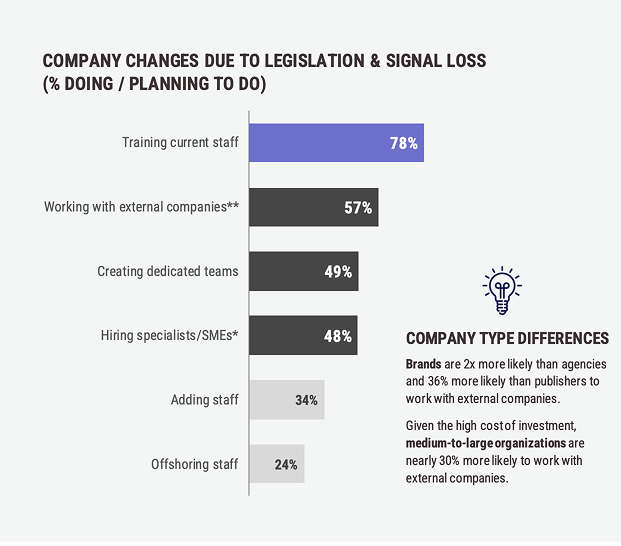
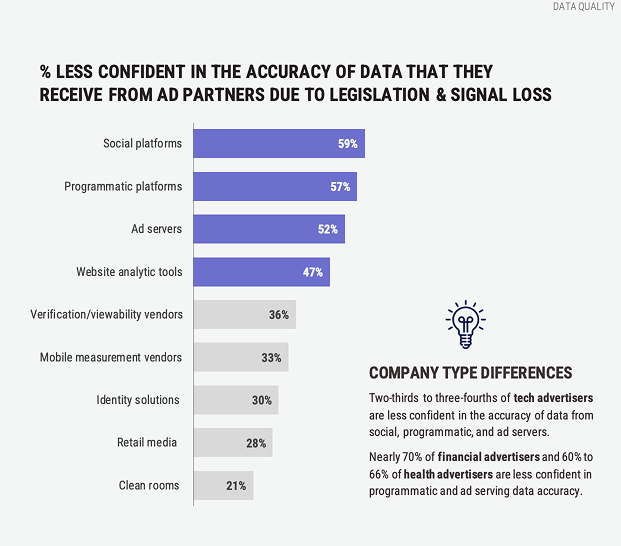
Maryland is one state, but it’s part of a growing patchwork. The IAB’s State of Data 2024 report found that 95% of data and advertising decision-makers at U.S. brands, agencies, and publishers expect continued legislation and signal loss years to come. That expectation should be built into how you run campaigns, not bolted on after a contract is signed.
Pic. Confidence in accuracy of data due to signal loss (Source).
Make trust a feature, not a talking point
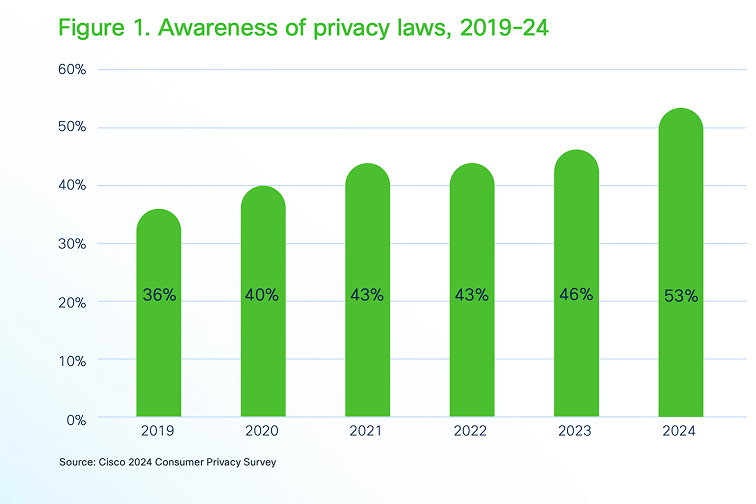
PwC’s 2024 Voice of the Consumer survey reports that 83% of consumers say protecting personal data is crucial to earning their trust, and 80% want assurances their personal information won’t be shared. Cisco’s 2024 Consumer Privacy Survey reports that 53% of respondents said they were aware of privacy laws.
Consumers are paying attention, and they will use the controls they’re given.
If you’re running geo-fencing, visit-based attribution, or foot-traffic reporting in Maryland, ask every partner these questions. If they can’t answer cleanly, pause.
What location signals do you use (GPS, Wi-Fi, cell tower, app SDK data, etc.), and do they meet MODPA’s “precise geolocation” definition (within 1,750 feet)?
Do you classify precise location as sensitive data under MODPA, and what controls do you apply as a result?
Are you selling sensitive data or enabling any transfer that could be considered a sale?
If you rely on consent, whose consent is it, how is it captured, and is the collection/processing also “strictly necessary” to provide a product or service requested by the consumer?
How do you honor opt-out preference signals and state privacy signals (including Maryland via GPP)?
What is your policy on sensitive points of interest, and do you follow any industry standards (such as NAI’s enhanced standards)?
What is your retention period for location data, and what’s your deletion process?
Can you provide a high-level map of data flows: collection, processing, sharing, retention, deletion?
{{26-geo-targeting-POV-3="/tables"}}
A short Maryland-ready action plan
If you want a simple 30-day plan that reduces risk and keeps performance moving:
Inventory: list every campaign and report that references location, visits, foot traffic, store proximity, or geo-fencing. Flag anything using device-level visitation audiences.
Classify: separate “broad local” (DMA/ZIP/city + contextual) from “precise location” (device-level signals, visit-based attribution). Treat them differently.
Replace fragile tactics: where possible, swap hyper-granular fences for broader geographies and contextual local buys.
Rebuild measurement: design at least one geo holdout test and define a KPI basket that isn’t anchored to “visits” alone.
Update operations: require documentation of data handling, and make sure partners can support modern privacy signaling.
Where AI Digital fits (and how we’re helping Maryland teams)
At AI Digital, our job is to help brands and agencies keep performance strong while the rules and the signals keep shifting.
Our Open Garden framework is built for cross-platform planning and execution without getting trapped inside a single ecosystem’s constraints. For MODPA-era geotargeting, two pieces are especially relevant:
Smart Supply: premium supply selection designed to lean into quality inventory and contextual environments with more transparency and control.
Elevate: an AI-powered software layer built to surface real-time insights, forecasting, and attribution analysis when deterministic signals get weaker.
The goal isn’t to “replace geotargeting.” It’s to rebuild it around durable inputs and defensible measurement.
A final thought, from one Maryland marketer to another
MODPA doesn’t shut the door on location-informed advertising; it raises the bar on how responsibly it’s done.
If you’re a marketer, agency, or brand in Maryland and you’re unsure whether your current geo-fencing, visit attribution, or foot-traffic reporting is still on solid ground, I’d love to chat. AI Digital is helping partners pressure-test current approaches and build compliant alternatives that still drive outcomes.
You don’t have to stop advertising locally. You just have to get more precise about what “location-based” really means now.
Blind spot
Key issues
Business impact
AI Digital solution
Lack of transparency in AI models
• Platforms own AI models and train on proprietary data • Brands have little visibility into decision-making • "Walled gardens" restrict data access
• Inefficient ad spend • Limited strategic control • Eroded consumer trust • Potential budget mismanagement
Open Garden framework providing: • Complete transparency • DSP-agnostic execution • Cross-platform data & insights
Optimizing ads vs. optimizing impact
• AI excels at short-term metrics but may struggle with brand building • Consumers can detect AI-generated content • Efficiency might come at cost of authenticity
• Short-term gains at expense of brand health • Potential loss of authentic connection • Reduced effectiveness in storytelling
Smart Supply offering: • Human oversight of AI recommendations • Custom KPI alignment beyond clicks • Brand-safe inventory verification
The illusion of personalization
• Segment optimization rebranded as personalization • First-party data infrastructure challenges • Personalization vs. surveillance concerns
• Potential mismatch between promise and reality • Privacy concerns affecting consumer trust • Cost barriers for smaller businesses
Elevate platform features: • Real-time AI + human intelligence • First-party data activation • Ethical personalization strategies
AI-Driven efficiency vs. decision-making
• AI shifting from tool to decision-maker • Black box optimization like Google Performance Max • Human oversight limitations
• Strategic control loss • Difficulty questioning AI outputs • Inability to measure granular impact • Potential brand damage from mistakes
Managed Service with: • Human strategists overseeing AI • Custom KPI optimization • Complete campaign transparency
Fig. 1. Summary of AI blind spots in advertising
Dimension
Walled garden advantage
Walled garden limitation
Strategic impact
Audience access
Massive, engaged user bases
Limited visibility beyond platform
Reach without understanding
Data control
Sophisticated targeting tools
Data remains siloed within platform
Fragmented customer view
Measurement
Detailed in-platform metrics
Inconsistent cross-platform standards
Difficult performance comparison
Intelligence
Platform-specific insights
Limited data portability
Restricted strategic learning
Optimization
Powerful automated tools
Black-box algorithms
Reduced marketer control
Fig. 2. Strategic trade-offs in walled garden advertising.
Core issue
Platform priority
Walled garden limitation
Real-world example
Attribution opacity
Claiming maximum credit for conversions
Limited visibility into true conversion paths
Meta and TikTok's conflicting attribution models after iOS privacy updates
Data restrictions
Maintaining proprietary data control
Inability to combine platform data with other sources
Amazon DSP's limitations on detailed performance data exports
Cross-channel blindspots
Keeping advertisers within ecosystem
Fragmented view of customer journey
YouTube/DV360 campaigns lacking integration with non-Google platforms
Black box algorithms
Optimizing for platform revenue
Reduced control over campaign execution
Self-serve platforms using opaque ML models with little advertiser input
Performance reporting
Presenting platform in best light
Discrepancies between platform-reported and independently measured results
Consistently higher performance metrics in platform reports vs. third-party measurement
Fig. 1. The Walled garden misalignment: Platform interests vs. advertiser needs.
Key dimension
Challenge
Strategic imperative
ROAS volatility
Softer returns across digital channels
Shift from soft KPIs to measurable revenue impact
Media planning
Static plans no longer effective
Develop agile, modular approaches adaptable to changing conditions
Brand/performance
Traditional division dissolving
Create full-funnel strategies balancing long-term equity with short-term conversion
Capability
Key features
Benefits
Performance data
Elevate forecasting tool
• Vertical-specific insights • Historical data from past economic turbulence • "Cascade planning" functionality • Real-time adaptation
• Provides agility to adjust campaign strategy based on performance • Shows which media channels work best to drive efficient and effective performance • Confident budget reallocation • Reduces reaction time to market shifts
• Dataset from 10,000+ campaigns • Cuts response time from weeks to minutes
• Reaches people most likely to buy • Avoids wasted impressions and budgets on poor-performing placements • Context-aligned messaging
• 25+ billion bid requests analyzed daily • 18% improvement in working media efficiency • 26% increase in engagement during recessions
Full-funnel accountability
• Links awareness campaigns to lower funnel outcomes • Tests if ads actually drive new business • Measures brand perception changes • "Ask Elevate" AI Chat Assistant
• Upper-funnel to outcome connection • Sentiment shift tracking • Personalized messaging • Helps balance immediate sales vs. long-term brand building
• Natural language data queries • True business impact measurement
Open Garden approach
• Cross-platform and channel planning • Not locked into specific platforms • Unified cross-platform reach • Shows exactly where money is spent
• Reduces complexity across channels • Performance-based ad placement • Rapid budget reallocation • Eliminates platform-specific commitments and provides platform-based optimization and agility
• Coverage across all inventory sources • Provides full visibility into spending • Avoids the inability to pivot across platform as you’re not in a singular platform
Fig. 1. How AI Digital helps during economic uncertainty.
Trend
What it means for marketers
Supply & demand lines are blurring
Platforms from Google (P-Max) to Microsoft are merging optimization and inventory in one opaque box. Expect more bundled “best available” media where the algorithm, not the trader, decides channel and publisher mix.
Walled gardens get taller
Microsoft’s O&O set now spans Bing, Xbox, Outlook, Edge and LinkedIn, which just launched revenue-sharing video programs to lure creators and ad dollars. (Business Insider)
Retail & commerce media shape strategy
Microsoft’s Curate lets retailers and data owners package first-party segments, an echo of Amazon’s and Walmart’s approaches. Agencies must master seller-defined audiences as well as buyer-side tactics.
AI oversight becomes critical
Closed AI bidding means fewer levers for traders. Independent verification, incrementality testing and commercial guardrails rise in importance.
Fig. 1. Platform trends and their implications.
Metric
Connected TV (CTV)
Linear TV
Video Completion Rate
94.5%
70%
Purchase Rate After Ad
23%
12%
Ad Attention Rate
57% (prefer CTV ads)
54.5%
Viewer Reach (U.S.)
85% of households
228 million viewers
Retail Media Trends 2025
Access Complete consumer behaviour analyses and competitor benchmarks.
Identify and categorize audience groups based on behaviors, preferences, and characteristics
Michaels Stores: Implemented a genAI platform that increased email personalization from 20% to 95%, leading to a 41% boost in SMS click through rates and a 25% increase in engagement.
Estée Lauder: Partnered with Google Cloud to leverage genAI technologies for real-time consumer feedback monitoring and analyzing consumer sentiment across various channels.
High
Medium
Automated ad campaigns
Automate ad creation, placement, and optimization across various platforms
Showmax: Partnered with AI firms toautomate ad creation and testing, reducing production time by 70% while streamlining their quality assurance process.
Headway: Employed AI tools for ad creation and optimization, boosting performance by 40% and reaching 3.3 billion impressions while incorporating AI-generated content in 20% of their paid campaigns.
High
High
Brand sentiment tracking
Monitor and analyze public opinion about a brand across multiple channels in real time
L’Oréal: Analyzed millions of online comments, images, and videos to identify potential product innovation opportunities, effectively tracking brand sentiment and consumer trends.
Kellogg Company: Used AI to scan trending recipes featuring cereal, leveraging this data to launch targeted social campaigns that capitalize on positive brand sentiment and culinary trends.
High
Low
Campaign strategy optimization
Analyze data to predict optimal campaign approaches, channels, and timing
DoorDash: Leveraged Google’s AI-powered Demand Gen tool, which boosted its conversion rate by 15 times and improved cost per action efficiency by 50% compared with previous campaigns.
Kitsch: Employed Meta’s Advantage+ shopping campaigns with AI-powered tools to optimize campaigns, identifying and delivering top-performing ads to high-value consumers.
High
High
Content strategy
Generate content ideas, predict performance, and optimize distribution strategies
JPMorgan Chase: Collaborated with Persado to develop LLMs for marketing copy, achieving up to 450% higher clickthrough rates compared with human-written ads in pilot tests.
Hotel Chocolat: Employed genAI for concept development and production of its Velvetiser TV ad, which earned the highest-ever System1 score for adomestic appliance commercial.
High
High
Personalization strategy development
Create tailored messaging and experiences for consumers at scale
Stitch Fix: Uses genAI to help stylists interpret customer feedback and provide product recommendations, effectively personalizing shopping experiences.
Instacart: Uses genAI to offer customers personalized recipes, mealplanning ideas, and shopping lists based on individual preferences and habits.
Medium
Medium
Share article
Url copied to clipboard
No items found.
Subscribe to our Newsletter
THANK YOU FOR YOUR SUBSCRIPTION
Oops! Something went wrong while submitting the form.
Questions? We have answers
Have other questions?
If you have more questions, contact us so we can help.
Questions? We have answers
This is some text inside of a div block.
Lorem ipsum dolor sit amet, consectetur adipiscing elit. Suspendisse varius enim in eros elementum tristique. Duis cursus, mi quis viverra ornare, eros dolor interdum nulla, ut commodo diam libero vitae erat. Aenean faucibus nibh et justo cursus id rutrum lorem imperdiet. Nunc ut sem vitae risus tristique posuere.
This is some text inside of a div block.
Lorem ipsum dolor sit amet, consectetur adipiscing elit. Suspendisse varius enim in eros elementum tristique. Duis cursus, mi quis viverra ornare, eros dolor interdum nulla, ut commodo diam libero vitae erat. Aenean faucibus nibh et justo cursus id rutrum lorem imperdiet. Nunc ut sem vitae risus tristique posuere.
This is some text inside of a div block.
Lorem ipsum dolor sit amet, consectetur adipiscing elit. Suspendisse varius enim in eros elementum tristique. Duis cursus, mi quis viverra ornare, eros dolor interdum nulla, ut commodo diam libero vitae erat. Aenean faucibus nibh et justo cursus id rutrum lorem imperdiet. Nunc ut sem vitae risus tristique posuere.
This is some text inside of a div block.
Lorem ipsum dolor sit amet, consectetur adipiscing elit. Suspendisse varius enim in eros elementum tristique. Duis cursus, mi quis viverra ornare, eros dolor interdum nulla, ut commodo diam libero vitae erat. Aenean faucibus nibh et justo cursus id rutrum lorem imperdiet. Nunc ut sem vitae risus tristique posuere.
This is some text inside of a div block.
Lorem ipsum dolor sit amet, consectetur adipiscing elit. Suspendisse varius enim in eros elementum tristique. Duis cursus, mi quis viverra ornare, eros dolor interdum nulla, ut commodo diam libero vitae erat. Aenean faucibus nibh et justo cursus id rutrum lorem imperdiet. Nunc ut sem vitae risus tristique posuere.
This is some text inside of a div block.
Lorem ipsum dolor sit amet, consectetur adipiscing elit. Suspendisse varius enim in eros elementum tristique. Duis cursus, mi quis viverra ornare, eros dolor interdum nulla, ut commodo diam libero vitae erat. Aenean faucibus nibh et justo cursus id rutrum lorem imperdiet. Nunc ut sem vitae risus tristique posuere.
This is some text inside of a div block.
Lorem ipsum dolor sit amet, consectetur adipiscing elit. Suspendisse varius enim in eros elementum tristique. Duis cursus, mi quis viverra ornare, eros dolor interdum nulla, ut commodo diam libero vitae erat. Aenean faucibus nibh et justo cursus id rutrum lorem imperdiet. Nunc ut sem vitae risus tristique posuere.

.svg)
.svg)