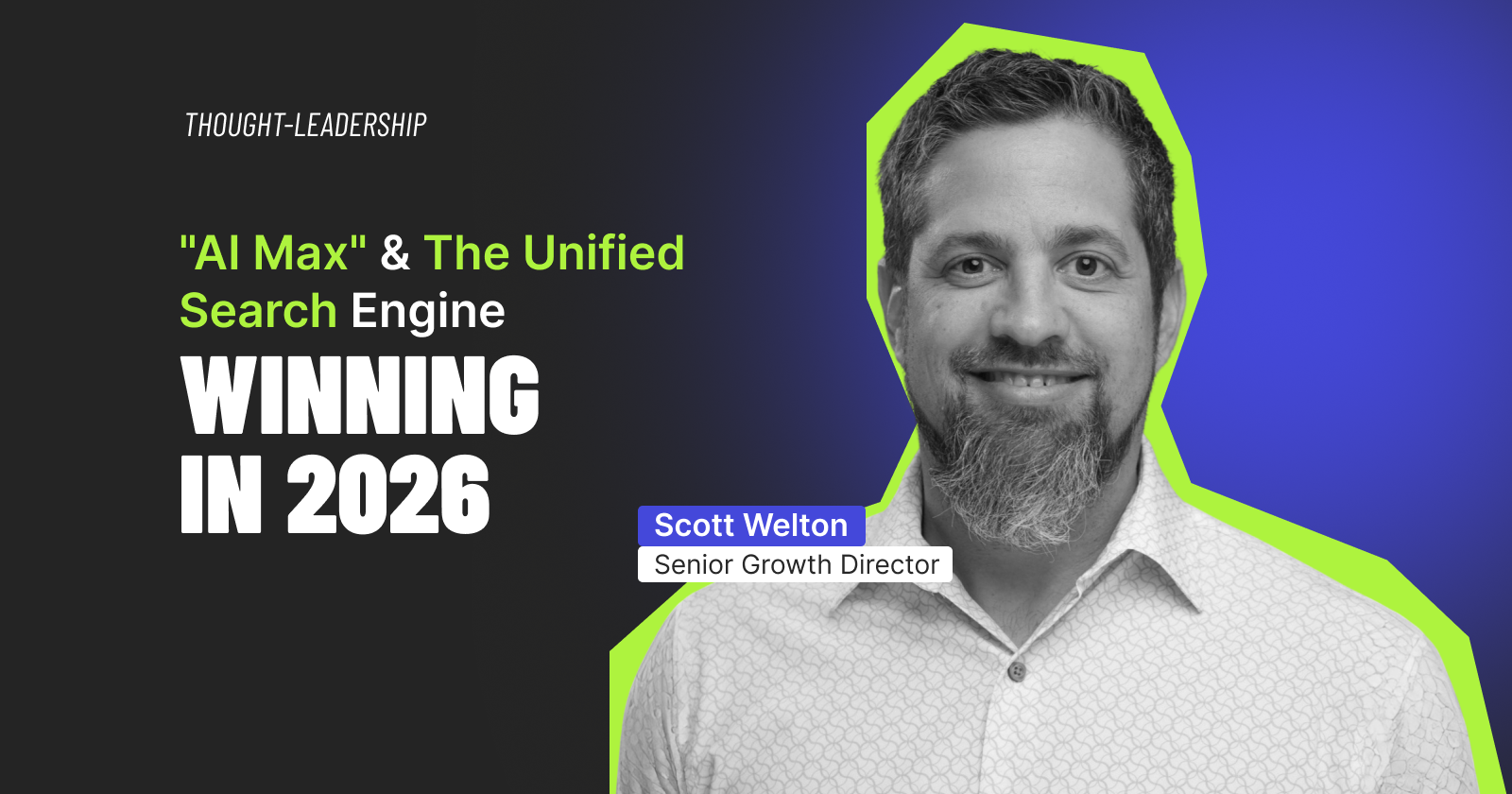
The Fastest Game on Earth: Notes from Our Programmatic AI Keynote in Las Vegas
AI Digital
May 28, 2026
6
minutes read

AI Digital
May 28, 2026
6
minutes read
Park MGM, mid-May. Digital leaders all in one room for AdExchanger's new spring fixture, an event built on the premise that the AI conversation has finally moved past slideware and into the actual work—no vaporware, as the organizers put it. David Mainiero used his slot to press a discussion we keep running into on the road: the agencies pulling ahead on AI have built the footwork to act, while everyone else is still polishing the strategy document.
He opened with a distinction borrowed from Andrej Karpathy, a founding member of OpenAI. There are, roughly, two camps.
What makes this awkward is that both camps often sit in the same building, sometimes at the same leadership table. There is the creative who insists a machine could never do what they do, and the analyst three desks away who quietly let a machine do a good chunk of it last Tuesday. David's point was not that the skeptics are foolish. It is that the dramatic gains so far have landed unevenly—strongest in domains with verifiable outputs like code and math, slower in strategy and creative—so plenty of people simply haven't had their moment yet.
Then the survey. We polled more than 50+ senior agency executives, and the finding was a gap.
The roughly 28% of daylight between conviction and confidence is the whole problem in miniature. Clients are already raising AI in pitches and quarterly reviews, and an agency that believes far more than it can articulate tends to lose the room in those conversations, and before long the business.
The two barriers executives named most were a skills gap and being too busy with daily work to close it. Neither has much to do with technology or budget. The constraint is people and time, which makes this a matter of leadership rather than procurement.
David's name for where that leaves most of the industry is pilot purgatory, and around two-thirds of agencies are in it. They have done things—formed a committee, run a couple of tool trials, circulated two pages of guidance, rebranded an existing service as "AI-enabled" and built a slide about it. What they have not done is change how the work actually gets made. Seen from outside, an agency busy in exactly this way is indistinguishable from one doing nothing at all. He was generous about it; we have all spent time there.
The pressure, he argued, comes from both directions.
The intuitive response is to assume all this means fewer people. David spent a good stretch of the talk arguing the reverse. In 1865 William Stanley Jevons noticed that as steam engines grew more efficient, Britain burned not less coal but far more, because cheap power kept finding uses nobody had foreseen. Cheaper ATMs produced more bank branches and more tellers, not fewer. The same logic is about to reach marketing. Show a client work that once took six weeks and took an afternoon instead, and they do not thank you and go home—they ask for twenty more, then another. Falling costs tend to enlarge the work rather than retire it, and the agencies built to absorb that demand are the ones who come out ahead.
He closed the argument on a figure he called frightening and encouraging in equal measure: 84% of agencies cannot tell a distinctive story about their own use of AI. A deck that promises to "use AI to optimize outcomes" and "take a human-plus-AI approach" reads like every other deck in the pile. The corollary is the opportunity. The 16% with a real, working, demonstrable AI story are not competing against the entire market, only against one another. That window is wide, and in his reading it is already closing.
The keynote took its title from sport, and ended there too. Marketing has always run on trends; what has changed is the speed of the cycles and the tightness of the margins. The agencies that come out ahead will be the ones with the footwork to reach every ball—the ones who did the conditioning long before the match started. Plenty of people talk about artificial intelligence, David noted, but intelligence on its own settles nothing. Intelligence that can act is what counts, and there is a word for the ability to act on what you know. It happens to be the one printed on everyone's business card: agency.
He left the room with a challenge rather than a pitch—name the one AI tool or workflow you wish existed for your team, and the best idea would be built into a working prototype, free. It is the same thing we spend our days doing alongside our partners: building the thing that moves the next campaign forward. If you missed us in Vegas and want the longer version, come and find us.
.svg)
.svg)


Inefficiency
Description
Use case
Description of use case
Examples of companies using AI
Ease of implementation
Impact
Audience segmentation and insights
Identify and categorize audience groups based on behaviors, preferences, and characteristics
Automated ad campaigns
Automate ad creation, placement, and optimization across various platforms
Brand sentiment tracking
Monitor and analyze public opinion about a brand across multiple channels in real time
Campaign strategy optimization
Analyze data to predict optimal campaign approaches, channels, and timing
Content strategy
Generate content ideas, predict performance, and optimize distribution strategies
Personalization strategy development
Create tailored messaging and experiences for consumers at scale
Lorem ipsum dolor sit amet, consectetur adipiscing elit. Suspendisse varius enim in eros elementum tristique. Duis cursus, mi quis viverra ornare, eros dolor interdum nulla, ut commodo diam libero vitae erat. Aenean faucibus nibh et justo cursus id rutrum lorem imperdiet. Nunc ut sem vitae risus tristique posuere.
Lorem ipsum dolor sit amet, consectetur adipiscing elit. Suspendisse varius enim in eros elementum tristique. Duis cursus, mi quis viverra ornare, eros dolor interdum nulla, ut commodo diam libero vitae erat. Aenean faucibus nibh et justo cursus id rutrum lorem imperdiet. Nunc ut sem vitae risus tristique posuere.
Lorem ipsum dolor sit amet, consectetur adipiscing elit. Suspendisse varius enim in eros elementum tristique. Duis cursus, mi quis viverra ornare, eros dolor interdum nulla, ut commodo diam libero vitae erat. Aenean faucibus nibh et justo cursus id rutrum lorem imperdiet. Nunc ut sem vitae risus tristique posuere.
Lorem ipsum dolor sit amet, consectetur adipiscing elit. Suspendisse varius enim in eros elementum tristique. Duis cursus, mi quis viverra ornare, eros dolor interdum nulla, ut commodo diam libero vitae erat. Aenean faucibus nibh et justo cursus id rutrum lorem imperdiet. Nunc ut sem vitae risus tristique posuere.
Lorem ipsum dolor sit amet, consectetur adipiscing elit. Suspendisse varius enim in eros elementum tristique. Duis cursus, mi quis viverra ornare, eros dolor interdum nulla, ut commodo diam libero vitae erat. Aenean faucibus nibh et justo cursus id rutrum lorem imperdiet. Nunc ut sem vitae risus tristique posuere.
Lorem ipsum dolor sit amet, consectetur adipiscing elit. Suspendisse varius enim in eros elementum tristique. Duis cursus, mi quis viverra ornare, eros dolor interdum nulla, ut commodo diam libero vitae erat. Aenean faucibus nibh et justo cursus id rutrum lorem imperdiet. Nunc ut sem vitae risus tristique posuere.
Lorem ipsum dolor sit amet, consectetur adipiscing elit. Suspendisse varius enim in eros elementum tristique. Duis cursus, mi quis viverra ornare, eros dolor interdum nulla, ut commodo diam libero vitae erat. Aenean faucibus nibh et justo cursus id rutrum lorem imperdiet. Nunc ut sem vitae risus tristique posuere.