The Human Harvest: Why High-Touch Is the New High-Tech in Ag-Marketing
Amy O'Hara
May 8, 2026
7
minutes read
American farmers are spending 2026 cutting capital expenditure to the bone, deferring equipment purchases, and refusing anything not strictly necessary. Their marketing partners, meanwhile, are doing the opposite, and the gap between the two is the most important problem in ag-marketing this year.
There is a particular tone American farmers have been using this winter, and marketers ought to be listening to it. When Farm Journal's economists asked producers what success would look like in 2026, the answers came back terse and almost defiant. Zero capital spending where possible. Nothing bought that wasn't necessary. The full picture, set out inAgWeb's Crisis of Confidence dispatch, is of a sector deciding to subtract its way out of trouble—a decision made under the weight ofnet farm income running roughly $48 billion below its 2022 peak.
What is striking is how poorly ag-marketing has matched the mood. While producers have been stripping their operations to essentials, the agencies and brands serving them have been doing the opposite—accumulating channels, automation layers, AI assistants, dashboards, retainers. There is something structurally off about it—a growth industry feeding on a contracting one. The producer has spent the past eighteen months demonstrating, in real time, what disciplined decision-making under pressure looks like. Most marketing organizations have yet to take the lesson.
The productivity mirage
For much of the past decade the MarTech industry has operated on a single, unexamined assumption—that more would mean better. More tools, more channels, more automation, more touchpoints. The Content Marketing Institute's most recent B2B benchmarks suggest the assumption is failing in the field. Most teams now describe their content efforts as merely moderate, and only a small minority report genuine effectiveness. The bottleneck has migrated from execution to attention; teams spend so much time managing their machinery that the work itself has nowhere to go.
The teams escaping this trap are making a deliberate choice—they are getting smaller, on purpose. Wynter's working-tactics 2025 research profiled a B2B team that generated thirty million impressions on a half-million-dollar budget by walking away from underperforming channels and concentrating on the few that paid. Their advantage was temperamental—a willingness to leave reach on the table in pursuit of conviction.
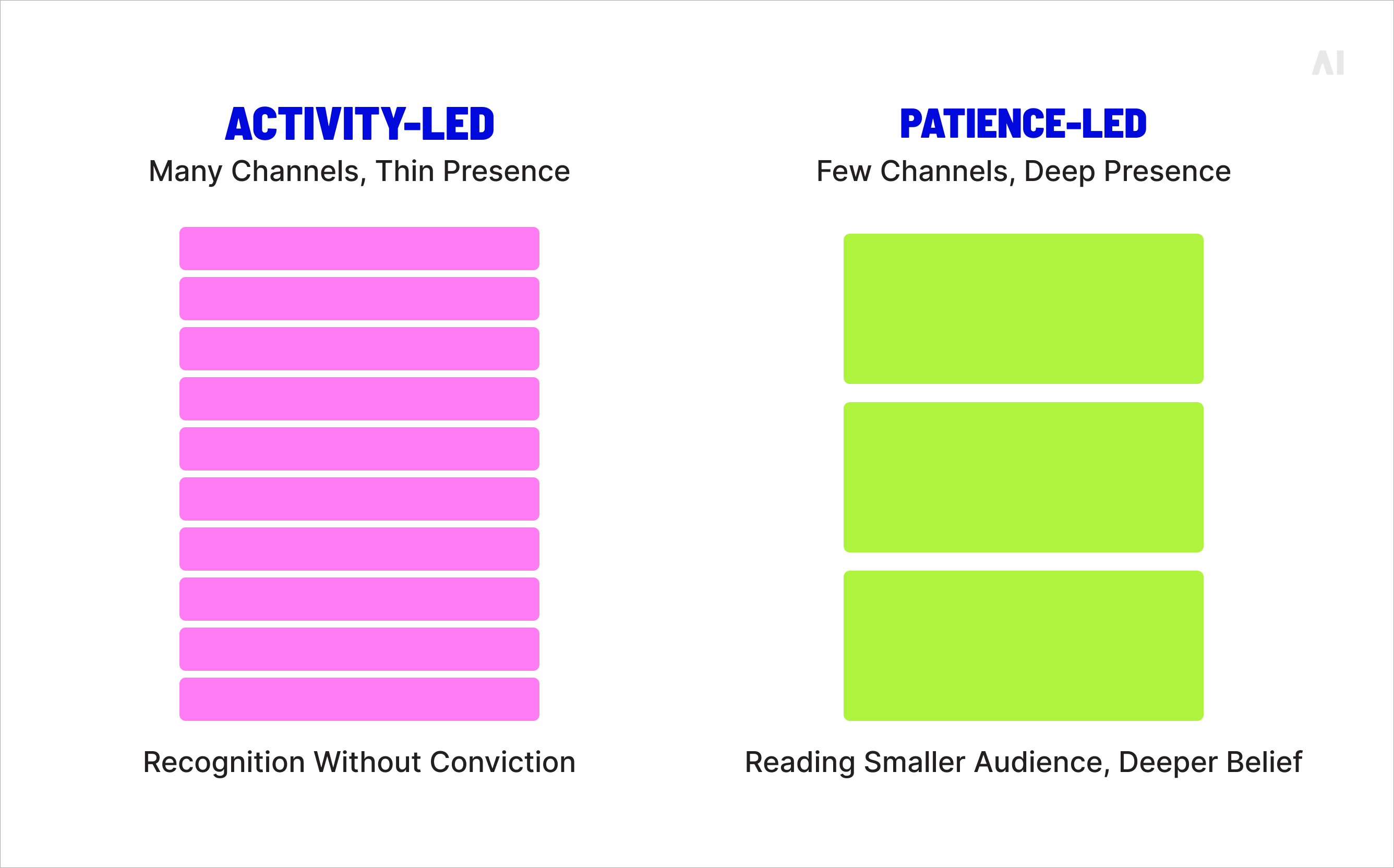
Translated into agricultural terms, the lesson is straightforward. A campaign that turns up in two trusted places carrying a real argument will reliably outwork one that turns up in twelve generic ones with nothing to say. Strategic patience, properly understood, is not a slower version of marketing but a more selective one.
There is now a word for what happens when an industry chases volume past the point of usefulness. Slop, named Merriam-Webster's 2025 Word of the Year, has become the shorthand for the AI-generated, mass-produced material now flooding the open web. It is not a purely aesthetic complaint. Raptive's research published last summer found consumers were measurably less likely—by some 14%—to consider buying products advertised alongside content they suspected was machine-made. The consequences are not abstract. They are concrete, and they show up where they hurt most: in the pipeline.
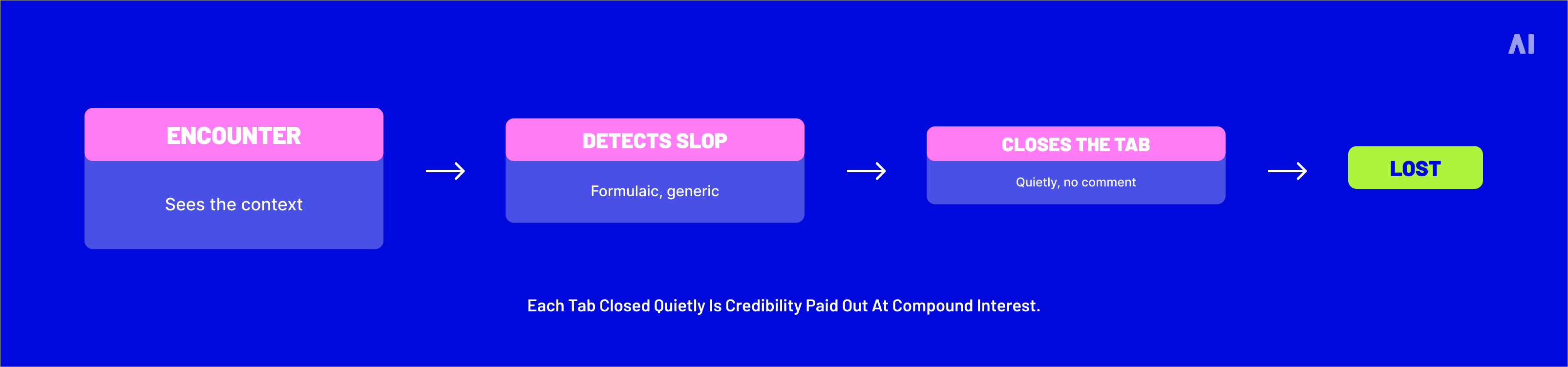
In agriculture, the penalty hits harder than almost anywhere else. Producers are by reputation and by research some of the most private buyers in any category, depending on a small and carefully curated set of trusted sources. They do not write angry comments under bad content. They simply close the tab and they do not come back. A column of formulaic copy, an AI-illustrated banner, a sponsored post that reads as though no one quite remembered who it was for—each of these is its own small forfeit of credibility, paid out at compound interest.
The only campaign worth running in 2026 is one a fifth-generation row-cropper would willingly read twice. Speed, cost, and scale are how you get there—they aren't what you're aiming for.
Pic. The quality tax.
Trust travels through people
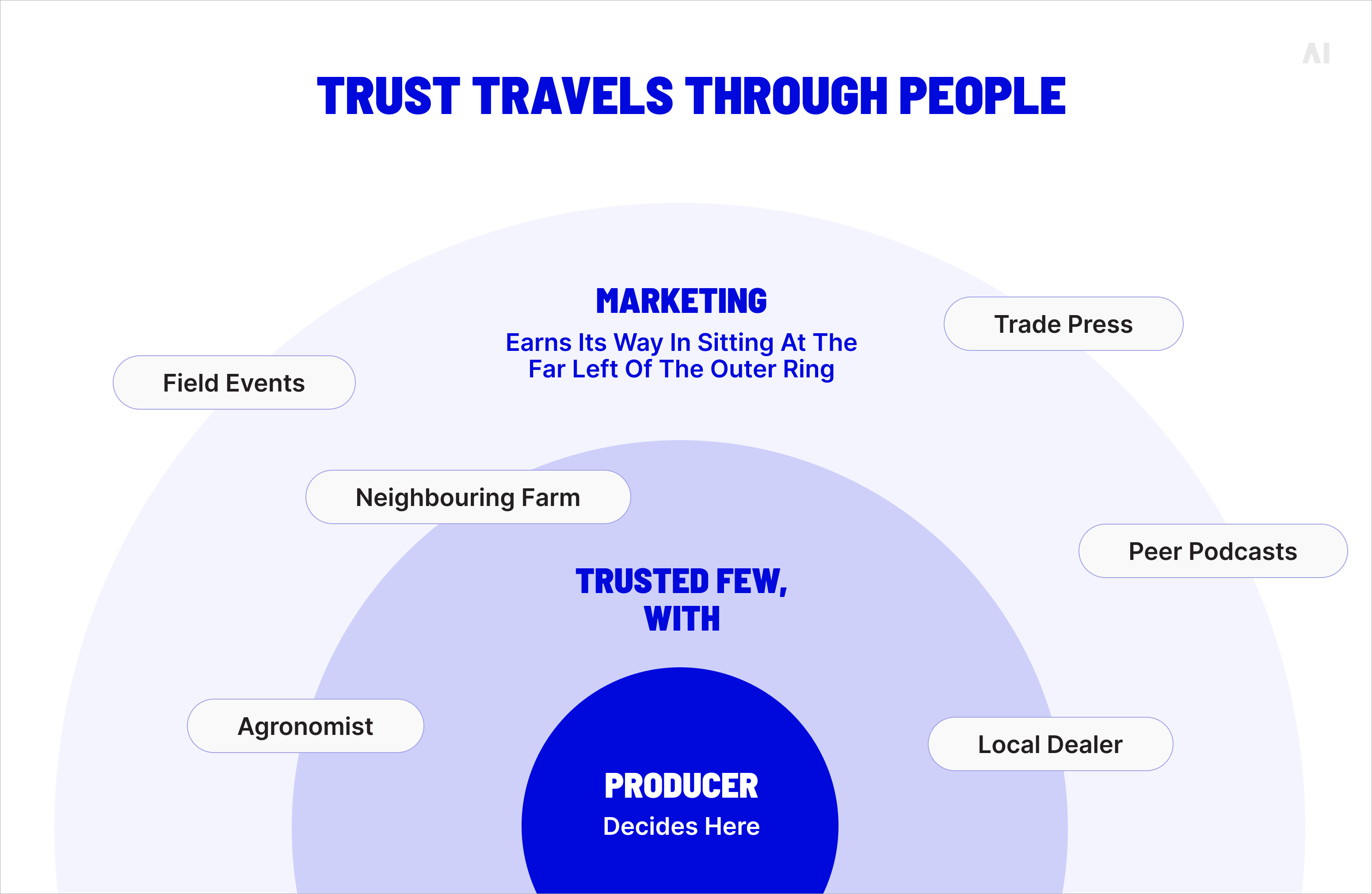
The single most telling number in B2B research this year is buried in Noble & Wynter's 2025 State of Social Proof: 63% of B2B executives now begin vendor research by asking their network rather than searching online. The implication is unflattering for marketers and unsurprising to anyone who has spent time in farm country. The most consequential conversations about what to buy are happening in places marketing cannot directly reach—in private group chats, in dealer texts, at kitchen tables.
Pic. Trust travels through people.
Agriculture has lived with this reality for generations.
McKinsey's grower research finds that somewhere between half and two-thirds of US farmers rank agronomists and peer farmers as their most valuable sources of product information.
At last year's Precision Farming Dealer Summit the producers Mike Starkey and Loran Steinlage made the case in the most unsentimental terms available—dealers earn trust through responsive service, hands-on demonstration, and ongoing training, and long-term relationships outlast quick sales.
Bushel's most recent State of the Farm survey shows the pattern holding even as the sector digitizes.
The tools are new. The trust still moves through the same channels—the local retailer, the agronomist, the neighbouring farm.
What this calls for, from marketers, is something closer to curation than to broadcasting. The work of 2026 is identifying the rooms where producers already trust each other, and earning a seat in them, not staging louder versions of conversations that ought to be happening over coffee.
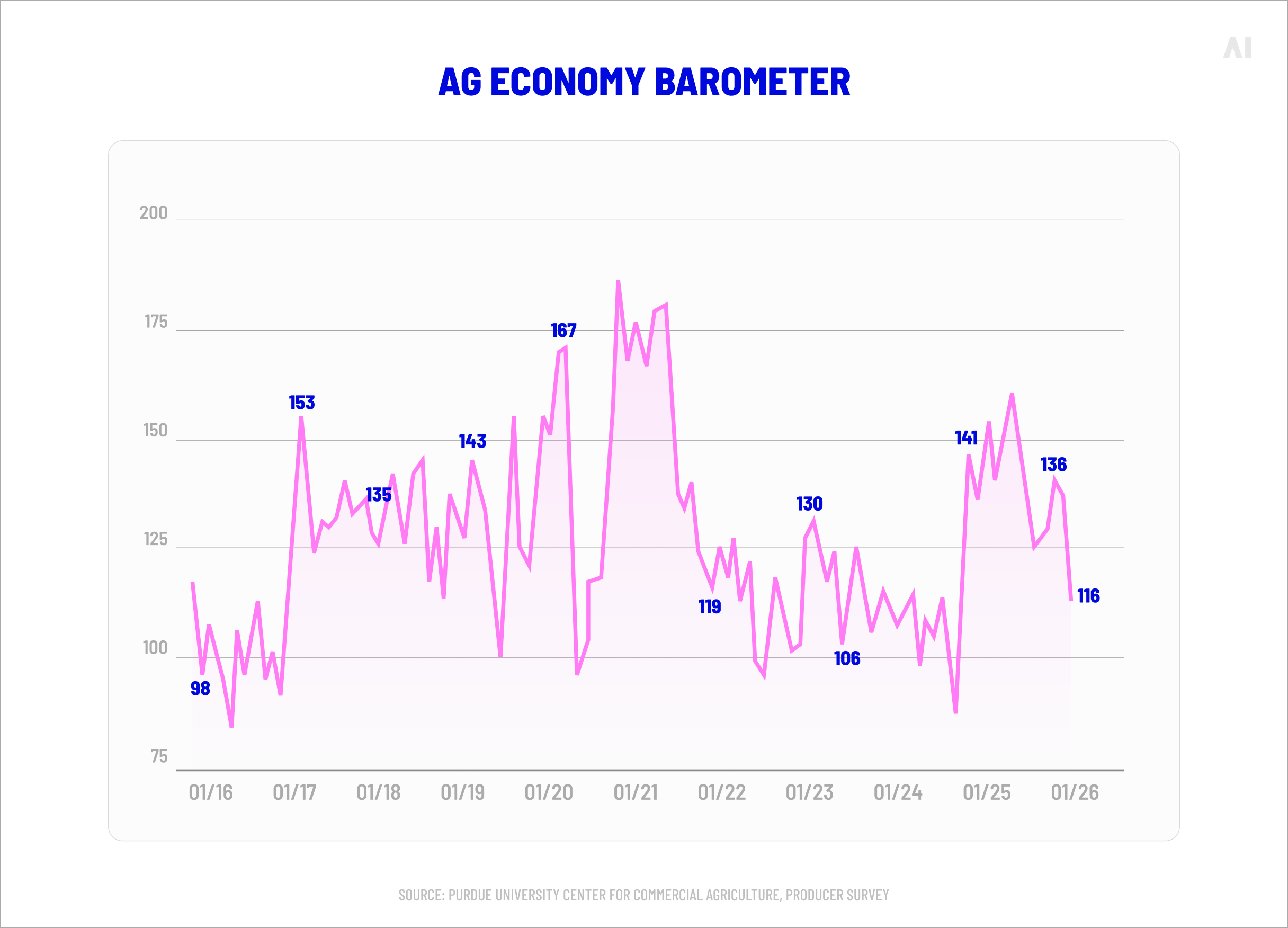
There is a useful yardstick available to marketing teams this year, and they have not had to invent it. When a farmer defers a six-figure equipment upgrade because the return doesn't pencil out, that decision sets the standard for what counts as discipline. Marketing dollars now answer to the same logic the customer is already applying to their own input bill. A campaign that cannot survive that scrutiny is not really a campaign; it is overhead in nicer packaging.
Pic. Ag economy barometer, October 2015–January 2026 (Source).
What gets called a championship mindset in marketing decks tends to be a fairly soft idea. In 2026 it ought to harden. The discipline worth practising is narrower and harder: skip a trend, mute a channel, decline a tool, kill a campaign that has not earned its keep over three quarters. Activity has never been quite the same as achievement. In tight years the gap between them turns brutal.
The closing argument
The advantage in 2026 will belong to ag-marketing teams willing to do fewer things, with more conviction, for the people who already trust them. There is nothing conservative about this position. It is, very precisely, the posture producers themselves have already adopted, and it is the only posture worth taking into a year their customers are spending in retreat.
At AI Digital, this is the kind of marketing our Open Garden framework was built to support—transparent, DSP-agnostic media buying that gives teams the visibility to know what is working and the discipline to remove what is not. If you are auditing your 2026 approach against the standard your customers are setting for themselves, we would welcome the conversation.
Blind spot
Key issues
Business impact
AI Digital solution
Lack of transparency in AI models
• Platforms own AI models and train on proprietary data • Brands have little visibility into decision-making • "Walled gardens" restrict data access
• Inefficient ad spend • Limited strategic control • Eroded consumer trust • Potential budget mismanagement
Open Garden framework providing: • Complete transparency • DSP-agnostic execution • Cross-platform data & insights
Optimizing ads vs. optimizing impact
• AI excels at short-term metrics but may struggle with brand building • Consumers can detect AI-generated content • Efficiency might come at cost of authenticity
• Short-term gains at expense of brand health • Potential loss of authentic connection • Reduced effectiveness in storytelling
Smart Supply offering: • Human oversight of AI recommendations • Custom KPI alignment beyond clicks • Brand-safe inventory verification
The illusion of personalization
• Segment optimization rebranded as personalization • First-party data infrastructure challenges • Personalization vs. surveillance concerns
• Potential mismatch between promise and reality • Privacy concerns affecting consumer trust • Cost barriers for smaller businesses
Elevate platform features: • Real-time AI + human intelligence • First-party data activation • Ethical personalization strategies
AI-Driven efficiency vs. decision-making
• AI shifting from tool to decision-maker • Black box optimization like Google Performance Max • Human oversight limitations
• Strategic control loss • Difficulty questioning AI outputs • Inability to measure granular impact • Potential brand damage from mistakes
Managed Service with: • Human strategists overseeing AI • Custom KPI optimization • Complete campaign transparency
Fig. 1. Summary of AI blind spots in advertising
Dimension
Walled garden advantage
Walled garden limitation
Strategic impact
Audience access
Massive, engaged user bases
Limited visibility beyond platform
Reach without understanding
Data control
Sophisticated targeting tools
Data remains siloed within platform
Fragmented customer view
Measurement
Detailed in-platform metrics
Inconsistent cross-platform standards
Difficult performance comparison
Intelligence
Platform-specific insights
Limited data portability
Restricted strategic learning
Optimization
Powerful automated tools
Black-box algorithms
Reduced marketer control
Fig. 2. Strategic trade-offs in walled garden advertising.
Core issue
Platform priority
Walled garden limitation
Real-world example
Attribution opacity
Claiming maximum credit for conversions
Limited visibility into true conversion paths
Meta and TikTok's conflicting attribution models after iOS privacy updates
Data restrictions
Maintaining proprietary data control
Inability to combine platform data with other sources
Amazon DSP's limitations on detailed performance data exports
Cross-channel blindspots
Keeping advertisers within ecosystem
Fragmented view of customer journey
YouTube/DV360 campaigns lacking integration with non-Google platforms
Black box algorithms
Optimizing for platform revenue
Reduced control over campaign execution
Self-serve platforms using opaque ML models with little advertiser input
Performance reporting
Presenting platform in best light
Discrepancies between platform-reported and independently measured results
Consistently higher performance metrics in platform reports vs. third-party measurement
Fig. 1. The Walled garden misalignment: Platform interests vs. advertiser needs.
Key dimension
Challenge
Strategic imperative
ROAS volatility
Softer returns across digital channels
Shift from soft KPIs to measurable revenue impact
Media planning
Static plans no longer effective
Develop agile, modular approaches adaptable to changing conditions
Brand/performance
Traditional division dissolving
Create full-funnel strategies balancing long-term equity with short-term conversion
Capability
Key features
Benefits
Performance data
Elevate forecasting tool
• Vertical-specific insights • Historical data from past economic turbulence • "Cascade planning" functionality • Real-time adaptation
• Provides agility to adjust campaign strategy based on performance • Shows which media channels work best to drive efficient and effective performance • Confident budget reallocation • Reduces reaction time to market shifts
• Dataset from 10,000+ campaigns • Cuts response time from weeks to minutes
• Reaches people most likely to buy • Avoids wasted impressions and budgets on poor-performing placements • Context-aligned messaging
• 25+ billion bid requests analyzed daily • 18% improvement in working media efficiency • 26% increase in engagement during recessions
Full-funnel accountability
• Links awareness campaigns to lower funnel outcomes • Tests if ads actually drive new business • Measures brand perception changes • "Ask Elevate" AI Chat Assistant
• Upper-funnel to outcome connection • Sentiment shift tracking • Personalized messaging • Helps balance immediate sales vs. long-term brand building
• Natural language data queries • True business impact measurement
Open Garden approach
• Cross-platform and channel planning • Not locked into specific platforms • Unified cross-platform reach • Shows exactly where money is spent
• Reduces complexity across channels • Performance-based ad placement • Rapid budget reallocation • Eliminates platform-specific commitments and provides platform-based optimization and agility
• Coverage across all inventory sources • Provides full visibility into spending • Avoids the inability to pivot across platform as you’re not in a singular platform
Fig. 1. How AI Digital helps during economic uncertainty.
Trend
What it means for marketers
Supply & demand lines are blurring
Platforms from Google (P-Max) to Microsoft are merging optimization and inventory in one opaque box. Expect more bundled “best available” media where the algorithm, not the trader, decides channel and publisher mix.
Walled gardens get taller
Microsoft’s O&O set now spans Bing, Xbox, Outlook, Edge and LinkedIn, which just launched revenue-sharing video programs to lure creators and ad dollars. (Business Insider)
Retail & commerce media shape strategy
Microsoft’s Curate lets retailers and data owners package first-party segments, an echo of Amazon’s and Walmart’s approaches. Agencies must master seller-defined audiences as well as buyer-side tactics.
AI oversight becomes critical
Closed AI bidding means fewer levers for traders. Independent verification, incrementality testing and commercial guardrails rise in importance.
Fig. 1. Platform trends and their implications.
Metric
Connected TV (CTV)
Linear TV
Video Completion Rate
94.5%
70%
Purchase Rate After Ad
23%
12%
Ad Attention Rate
57% (prefer CTV ads)
54.5%
Viewer Reach (U.S.)
85% of households
228 million viewers
Retail Media Trends 2025
Access Complete consumer behaviour analyses and competitor benchmarks.
Identify and categorize audience groups based on behaviors, preferences, and characteristics
Michaels Stores: Implemented a genAI platform that increased email personalization from 20% to 95%, leading to a 41% boost in SMS click through rates and a 25% increase in engagement.
Estée Lauder: Partnered with Google Cloud to leverage genAI technologies for real-time consumer feedback monitoring and analyzing consumer sentiment across various channels.
High
Medium
Automated ad campaigns
Automate ad creation, placement, and optimization across various platforms
Showmax: Partnered with AI firms toautomate ad creation and testing, reducing production time by 70% while streamlining their quality assurance process.
Headway: Employed AI tools for ad creation and optimization, boosting performance by 40% and reaching 3.3 billion impressions while incorporating AI-generated content in 20% of their paid campaigns.
High
High
Brand sentiment tracking
Monitor and analyze public opinion about a brand across multiple channels in real time
L’Oréal: Analyzed millions of online comments, images, and videos to identify potential product innovation opportunities, effectively tracking brand sentiment and consumer trends.
Kellogg Company: Used AI to scan trending recipes featuring cereal, leveraging this data to launch targeted social campaigns that capitalize on positive brand sentiment and culinary trends.
High
Low
Campaign strategy optimization
Analyze data to predict optimal campaign approaches, channels, and timing
DoorDash: Leveraged Google’s AI-powered Demand Gen tool, which boosted its conversion rate by 15 times and improved cost per action efficiency by 50% compared with previous campaigns.
Kitsch: Employed Meta’s Advantage+ shopping campaigns with AI-powered tools to optimize campaigns, identifying and delivering top-performing ads to high-value consumers.
High
High
Content strategy
Generate content ideas, predict performance, and optimize distribution strategies
JPMorgan Chase: Collaborated with Persado to develop LLMs for marketing copy, achieving up to 450% higher clickthrough rates compared with human-written ads in pilot tests.
Hotel Chocolat: Employed genAI for concept development and production of its Velvetiser TV ad, which earned the highest-ever System1 score for adomestic appliance commercial.
High
High
Personalization strategy development
Create tailored messaging and experiences for consumers at scale
Stitch Fix: Uses genAI to help stylists interpret customer feedback and provide product recommendations, effectively personalizing shopping experiences.
Instacart: Uses genAI to offer customers personalized recipes, mealplanning ideas, and shopping lists based on individual preferences and habits.
Medium
Medium
Share article
Url copied to clipboard
No items found.
Subscribe to our Newsletter
THANK YOU FOR YOUR SUBSCRIPTION
Oops! Something went wrong while submitting the form.
Questions? We have answers
Have other questions?
If you have more questions, contact us so we can help.
Questions? We have answers
This is some text inside of a div block.
Lorem ipsum dolor sit amet, consectetur adipiscing elit. Suspendisse varius enim in eros elementum tristique. Duis cursus, mi quis viverra ornare, eros dolor interdum nulla, ut commodo diam libero vitae erat. Aenean faucibus nibh et justo cursus id rutrum lorem imperdiet. Nunc ut sem vitae risus tristique posuere.
This is some text inside of a div block.
Lorem ipsum dolor sit amet, consectetur adipiscing elit. Suspendisse varius enim in eros elementum tristique. Duis cursus, mi quis viverra ornare, eros dolor interdum nulla, ut commodo diam libero vitae erat. Aenean faucibus nibh et justo cursus id rutrum lorem imperdiet. Nunc ut sem vitae risus tristique posuere.
This is some text inside of a div block.
Lorem ipsum dolor sit amet, consectetur adipiscing elit. Suspendisse varius enim in eros elementum tristique. Duis cursus, mi quis viverra ornare, eros dolor interdum nulla, ut commodo diam libero vitae erat. Aenean faucibus nibh et justo cursus id rutrum lorem imperdiet. Nunc ut sem vitae risus tristique posuere.
This is some text inside of a div block.
Lorem ipsum dolor sit amet, consectetur adipiscing elit. Suspendisse varius enim in eros elementum tristique. Duis cursus, mi quis viverra ornare, eros dolor interdum nulla, ut commodo diam libero vitae erat. Aenean faucibus nibh et justo cursus id rutrum lorem imperdiet. Nunc ut sem vitae risus tristique posuere.
This is some text inside of a div block.
Lorem ipsum dolor sit amet, consectetur adipiscing elit. Suspendisse varius enim in eros elementum tristique. Duis cursus, mi quis viverra ornare, eros dolor interdum nulla, ut commodo diam libero vitae erat. Aenean faucibus nibh et justo cursus id rutrum lorem imperdiet. Nunc ut sem vitae risus tristique posuere.
This is some text inside of a div block.
Lorem ipsum dolor sit amet, consectetur adipiscing elit. Suspendisse varius enim in eros elementum tristique. Duis cursus, mi quis viverra ornare, eros dolor interdum nulla, ut commodo diam libero vitae erat. Aenean faucibus nibh et justo cursus id rutrum lorem imperdiet. Nunc ut sem vitae risus tristique posuere.
This is some text inside of a div block.
Lorem ipsum dolor sit amet, consectetur adipiscing elit. Suspendisse varius enim in eros elementum tristique. Duis cursus, mi quis viverra ornare, eros dolor interdum nulla, ut commodo diam libero vitae erat. Aenean faucibus nibh et justo cursus id rutrum lorem imperdiet. Nunc ut sem vitae risus tristique posuere.
.svg)
.svg)