The Future of Location-Based Marketing: From Geo-Targeting to Location Intelligence
Sarah Moss
February 25, 2026
15
minutes read
Location-based marketing is the connective tissue between omnichannel media and real-world outcomes, from store visits to service calls and local revenue. In 2026, the advantage comes from turning consented location signals into location intelligence that can plan, activate, and measure across mobile, CTV, social, and DOOH without drifting into privacy risk.
Location-based marketing has matured from “target people near my store” into something closer to a decision layer that sits across channels. It helps teams answer practical questions: Where are our customers right now? Where do they typically go? Which places signal intent? That shift matters because location is one of the few signals that still translates cleanly across the messy reality of modern media: mobile, in-app, CTV, DOOH, social, and local search.
In 2026, this matters for a simple reason. Nearly all U.S. adults carry a location-capable device — Pew reports 91% of U.S. adults own a smartphone. At the same time, privacy expectations have hardened, state regulation has expanded, and “precision” has become a high-risk asset unless it’s consented, governed, and used with discipline. So the winners are not the brands collecting the most location data. They’re the ones turning permissioned signals into location intelligence and using it to improve targeting, creative relevance, budget allocation, and measurement.
Below is a practical, business-oriented guide: what location-based marketing is today, how it evolved, the core strategies that still work, how the plumbing works in 2026, and the trends that will shape what “good” looks like next.
⚡ Location is not a magic targeting layer; it’s a planning constraint that keeps budgets honest. When your geo framework is clear, everything downstream—creative, allocation, measurement—gets easier.
What is location-based marketing today?
Location-based marketing is the practice of using where someone is (or has been)—at a market, city, neighborhood, store, or point of interest—to shape advertising and messaging. In 2026, the best programs go beyond targeting. They connect four jobs:
Find demand (where high-intent audiences cluster)
Reach them (across mobile, in-app, CTV, social, local search, and DOOH)
The most important change is philosophical: location-based marketing is less about “pin accuracy” and more about “decision usefulness.” A brand does not need to know someone’s exact coordinates to make strong decisions. It often needs to know: Are they in this market? Near this competitor? In a place that signals category intent? That’s why many teams are moving from raw location data to models and segments that behave like “intent maps.”
What counts as “location” now?
In 2026, “location” typically shows up as one (or several) of these inputs:
Geography: DMA, city, ZIP, census tract, neighborhood polygons
Place: point of interest (POI) lists, venue categories (gym, dealership, clinic), competitor locations
Movement patterns: frequent visitors, commuters, weekend shoppers, travelers
Context: local events, weather shifts, daypart, traffic patterns (used carefully and aggregated)
The point is not to use everything. The point is to pick the lowest-risk, highest-signal option that still supports the business outcome you’re optimizing.
Location-based marketing didn’t “arrive” in one moment. It moved in waves, and each wave changed what was possible—and what was acceptable.
Wave 1: Mobile reach (early mobile + app era)
Brands used broad geo targeting (city/ZIP) to localize offers, route traffic to stores, and support “near me” behavior. The value came from relevance and convenience, not precision.
Wave 2: Precision tactics (beacons, tight geofences, and aggressive retargeting)
As apps and SDKs proliferated, marketers could build POI lists, fence competitors, and retarget visitors. This produced some real wins, but it also created a long-term problem: precision became synonymous with creepiness when it wasn’t permissioned or explained.
Wave 3: Programmatic scale + omnichannel
Location targeting moved into mainstream programmatic buying, then expanded into DOOH and, later, CTV. The strategy shifted from isolated mobile tactics to coordinated omnichannel plans.
Now the center of gravity is consent, governance, and aggregation. Regulation, enforcement, and consumer expectations have tightened. In practice, this is forcing a more mature approach: fewer “gotcha” tactics, more measurement discipline, and more reliance on modeled or aggregated insights.
Core location-based strategies
Location-based marketing in 2026 is not one tactic. It’s a toolkit. Below are the strategies that most often show up in high-performing programs, plus the decisions each one is best at supporting.
Geotargeting targets ads by broad areas: states, cities, DMAs, ZIP codes, or radii. It’s less about precision and more about controlling spend, relevance, and distribution.
Where it fits:
Market expansion and market defense (where you want to grow vs. protect)
Franchise, dealer, multi-location coverage (fairness and efficiency across locations)
Local creative versioning (store-specific messaging, service availability, regional offers)
How to use it well:
Start with business truth: where you can fulfill demand, where you have inventory, where you have service capacity.
Set geo “guardrails” first (what markets are in-bounds), then layer additional signals (interest, behavior, first-party lists).
Use geo to improve measurement sanity, not just targeting. If you cannot define “market A vs market B,” you cannot credibly compare performance.
KPIs that match the tactic:
Reach and frequency by market
Incremental lift by market (preferred)
Local conversions: calls, directions, appointments, orders
Geofencing defines a virtual boundary around a specific place (store, competitor, venue type). People who enter (or dwell) inside that boundary can be used for targeting, suppression, sequencing, or measurement—depending on consent and rules.
⚡ If your geofence is sloppy, your conclusions will be, too. A clean boundary and a defensible visit definition beat “more precision” every time.
Where it fits
Conquest and defense (competitor areas, category clusters)
Store-level optimization (which locations deserve more budget)
How geofencing actually works in practice A strong geofence strategy is never just “draw a circle.” It’s usually:
A polygon, not a simple radius (to avoid roads, parking spillover, and shared buildings)
A dwell-time rule (to filter drive-by pings)
A recency window (how long a visit implies intent)
A sensitivity filter (avoid restricted categories/locations; more on this later)
KPIs that match the tactic
Store visits or qualified visits (if measured responsibly)
Incremental lift vs. control groups (best)
Cost per incremental visit (when methodology is transparent)
Mobile and in-app activation
Even with CTV growth, mobile and in-app remain the operational backbone for location-based marketing because they tie directly to movement, local intent, and immediate action.
A useful mental model is to split mobile location-based work into three roles:
Capture intent: “near me” searches, map actions, local discovery behaviors
Measure outcomes: visit lift (carefully), conversion lift, and local cohort performance
Local channel mix showing mobile as the biggest slice (Source)
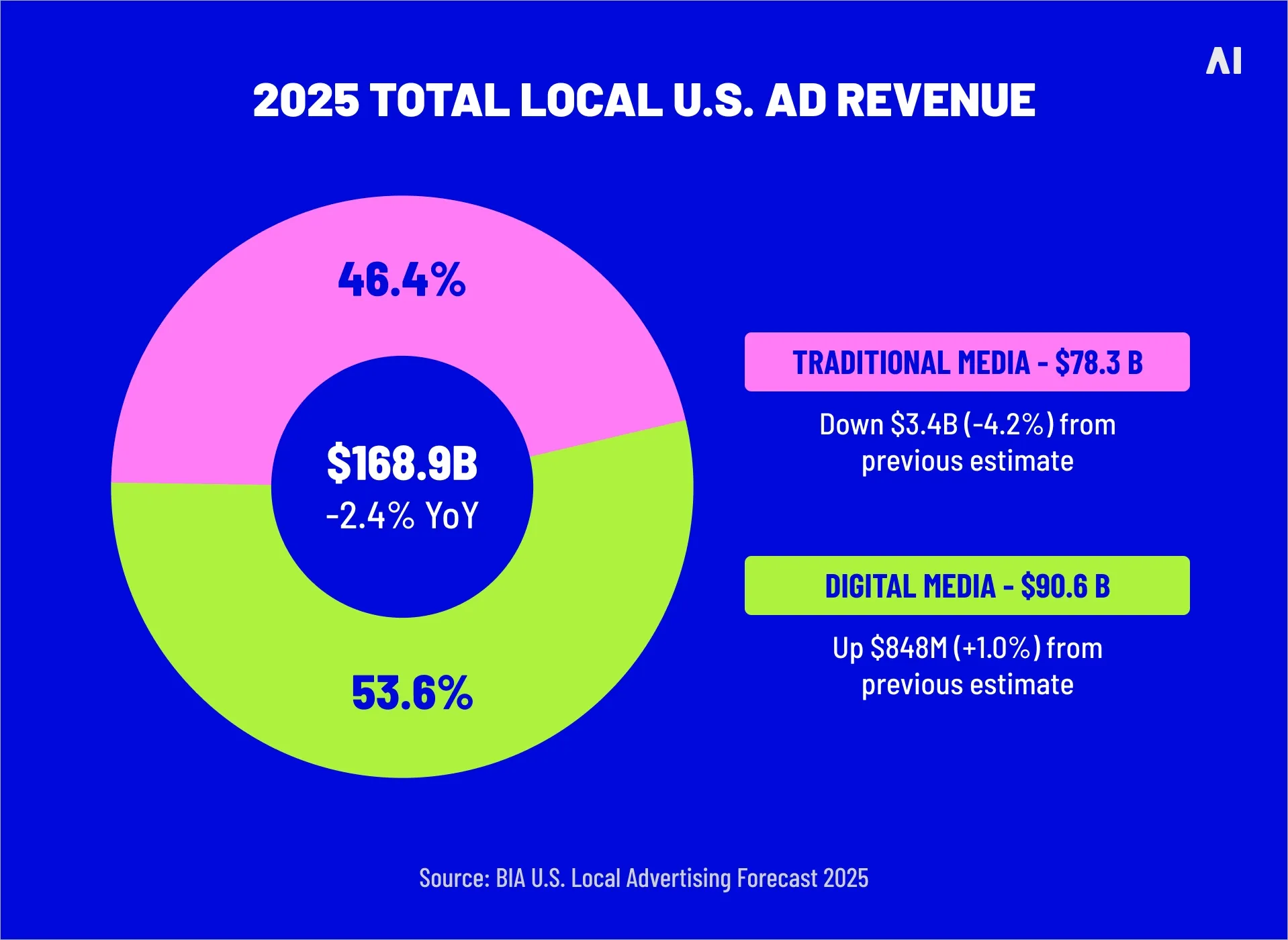
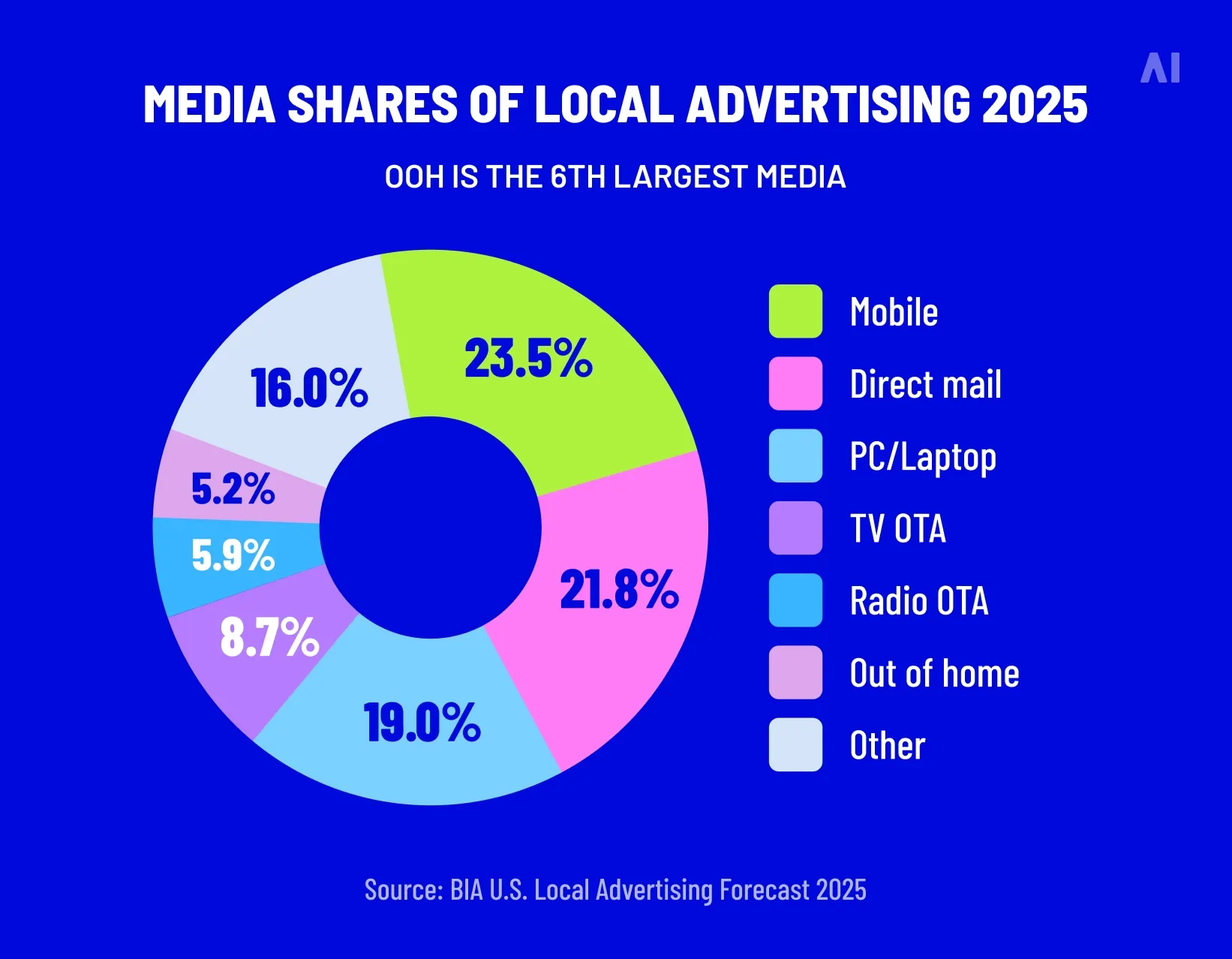
One reason this remains central is budget reality. Local advertising in the U.S. is still massive, and mobile is the single largest slice. BIA projects U.S. local ad revenue of about $168.9B in 2025, with mobile representing roughly 23.5%—the biggest share among tracked channels.
Most social platforms already support geo constraints (country, DMA, city, radius) and local relevance formats. The smartest 2026 play is not to chase ever-tighter geo. It’s to use location for:
Creative relevance (local proof, local inventory, local offers)
Sequencing (message A in-market, message B after store interaction)
Exclusions (stop spending where you can’t fulfill or where you’re saturated)
This is where “location intelligence” starts to beat “location data.” A neighborhood-level strategy with strong creative often outperforms a hyper-precise strategy with generic messaging.
CTV is where location-based marketing becomes genuinely interesting in 2026, because it combines three things that used to be hard to get at the same time:
Premium attention (TV-like viewing)
Data-driven buying (household and audience-based)
Geo control at meaningful scales (market, ZIP clusters, service areas)
BIA forecasts rapid growth for local CTV/OTT: it’s still a smaller share of total local ad revenue, but projected to grow quickly (BIA’s 2025 outlook pegs local CTV/OTT growth at roughly 19% in 2025).
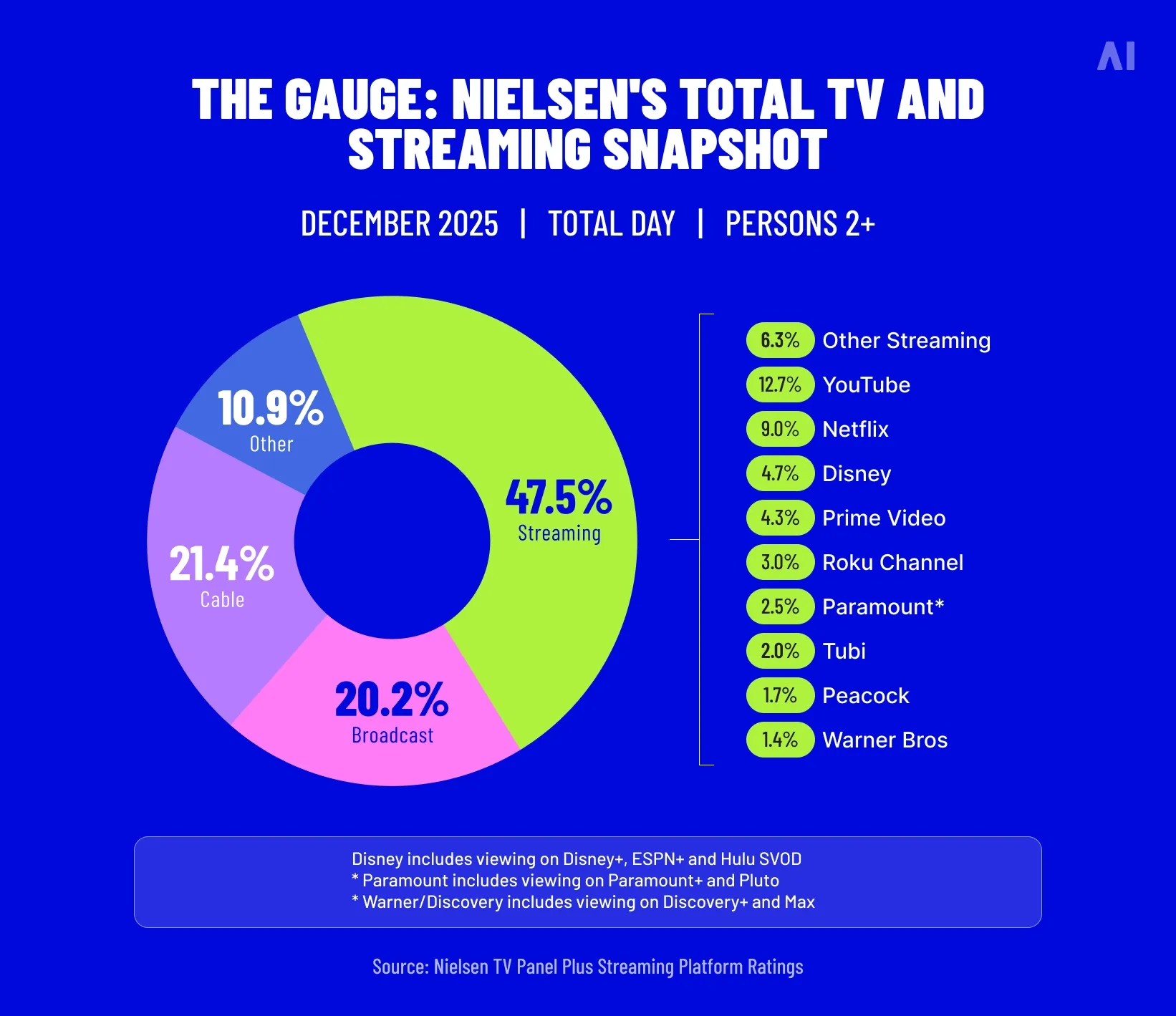
⚡ In December 2025, streaming captured 47.5% of total TV viewing, the largest share ever reported in Nielsen’s The Gauge. Christmas Day alone drove 55.1B streaming minutes, which is a reminder that “TV attention” is increasingly digital by default.
How “location-powered CTV” usually works
You constrain delivery by DMA/ZIP/service area, then layer audiences (first-party, modeled segments).
You coordinate with mobile and in-app to handle the “response” layer (clicks, calls, store actions).
You evaluate lift using geo split tests or matched market designs when possible.
Where it shines
Local retail and QSR (market-level reach with measurable response)
Auto (dealer-level coverage with household targeting)
Home services (tight service radius, high intent, call-based conversion)
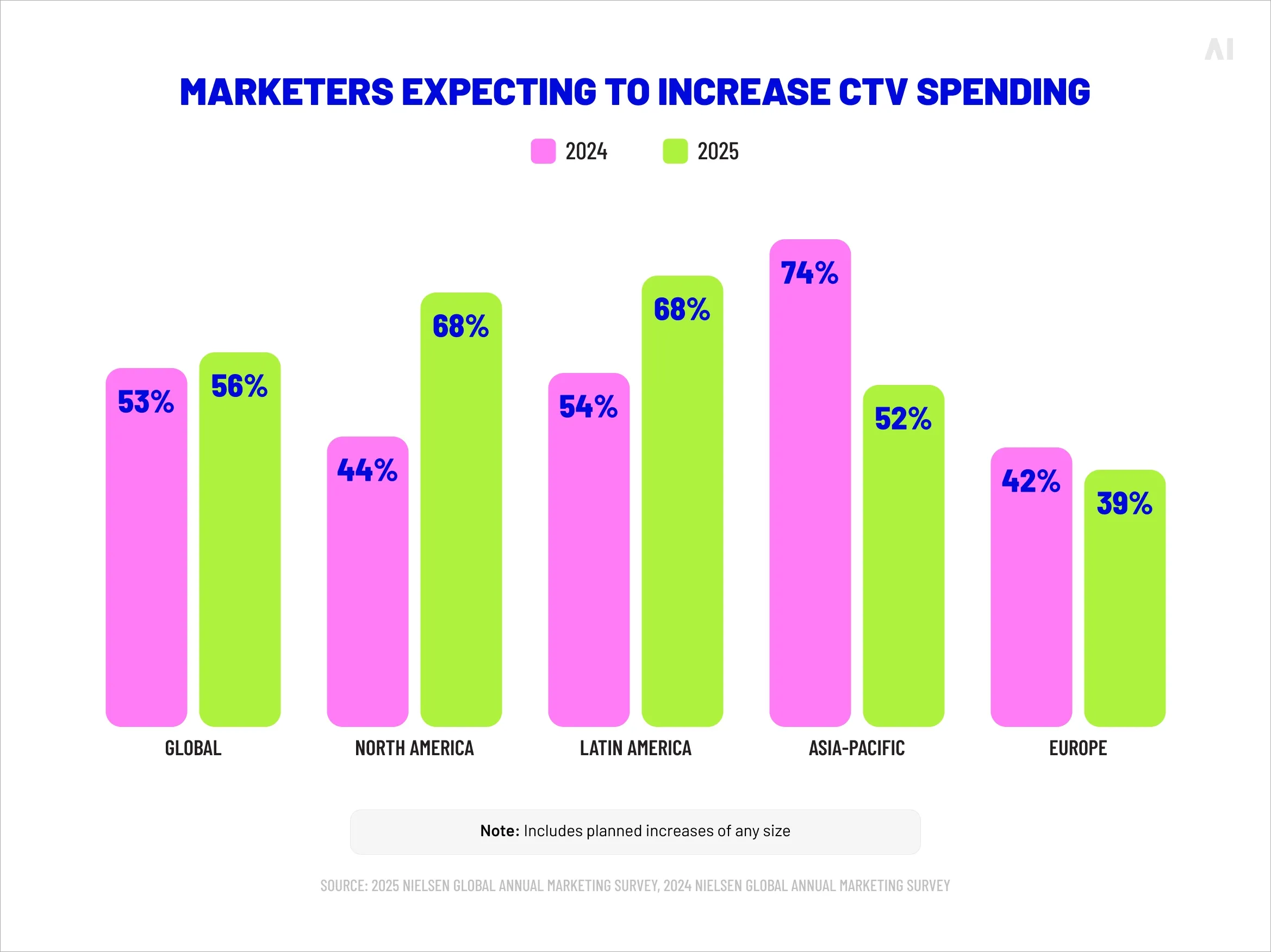
Marketers expecting to increase CTV spending (Source)
⚡ 56% of marketers globallyreported planning to increase OTT/CTV spend in 2025, and the report notes the biggest growth is concentrated in the Americas. That’s why location-based advertising on CTV is shifting from “test budget” to a real line item in omnichannel plans.
If you want location-based marketing to perform, you need a clear view of the plumbing. Not the vendor pitch version, but the operational version. In 2026, it typically looks like this:
Signals are collected (with consent and governance)
Signals are processed into usable features (place visits, cohorts, segments)
Segments are activated across platforms (DSPs, social, CTV, DOOH)
A lot of teams misuse “real-time.” They treat it as inherently better. It isn’t.
Real-time is valuable when timing is the strategy: same-day visits, event-driven messaging, urgent service availability.
Historical is valuable when patterns are the strategy: frequent visitors, trade areas, competitor overlap, seasonal movement, lifestyle signals.
⚡ Real-time signals help when timing is the strategy; otherwise they often create noise. Historical patterns are what make location useful for planning, because they reveal repeatable behavior you can actually budget against.
Most high-performing programs blend both:
Use historical patterns to define cohorts and markets.
Use near-real-time triggers selectively, where it’s genuinely useful and permissioned.
This also aligns with consumer expectations. PwC’s 2025 U.S. customer data research shows willingness to share certain sensitive data types can be low; for example, only a minority of consumers express comfort sharing real-time location data.
Platform integration in the real world
Integration is where location-based marketing either becomes a compounding advantage or dies in spreadsheets.
In 2026, practical integration usually means:
A shared location taxonomy (markets, store IDs, POIs, trade areas)
Consistent naming and rules across platforms (so you can compare)
A measurement plan that defines what success means (before launch)
A governance model for location use (what’s allowed, what’s off-limits)
Without these, teams end up with “location chaos”: different geo boundaries per channel, different definitions of a visit, and reporting that cannot be reconciled.
AI and automation: where it helps, and where it hurts
AI is genuinely useful in location-based marketing when it reduces operational friction:
Clustering geos into meaningful trade areas
Identifying under-served markets
Forecasting reach and frequency at market level
Detecting anomalies (sudden visit spikes that look like noise)
Automating budget shifts within defined guardrails
Trends shaping the future of location-based marketing
Three trends are defining what “good” looks like now and what will matter most over the next few years. The common thread is straightforward: less reliance on raw, sensitive signals and more emphasis on governed intelligence and lift-based proof.
Privacy-first is no longer a slogan. It’s being shaped by regulation, consumer expectations, and enforcement—and location data sits squarely in the “handle with care” category.
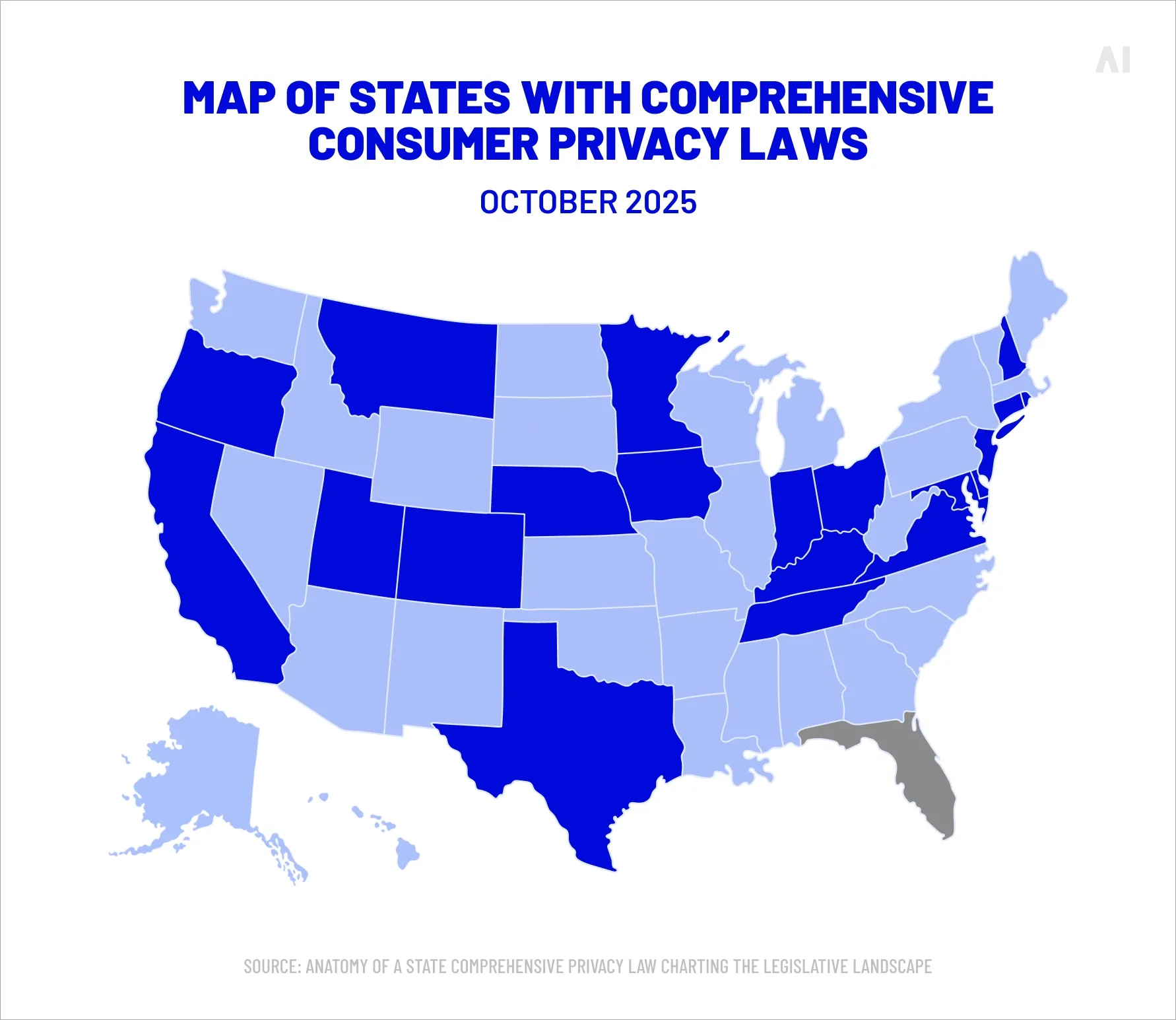
The state privacy patchwork is still expanding in scope, even when it slows in new “comprehensive law” count. Future of Privacy Forum notes that no new state comprehensive privacy laws were enacted in 2025, but multiple states amended existing laws, and the overall landscape continues to evolve in ways that raise the compliance bar.
Legislation volume is massive and ongoing. National Conference of State Legislatures reports that in 2025, 49 states and D.C. introduced or considered 800+ consumer privacy bills, and 30+ states enacted 100+ new laws across privacy-related categories.
Enforcement is increasingly concrete, not theoretical. The Federal Trade Commission’s finalized order against Mobilewalla is a clean example. The FTC describes the case as involving sensitive location data (including visits to healthcare facilities and places of worship) and the final order includes restrictions tied to how the company collected data via real-time bidding environments, as well as prohibitions related to sensitive locations.
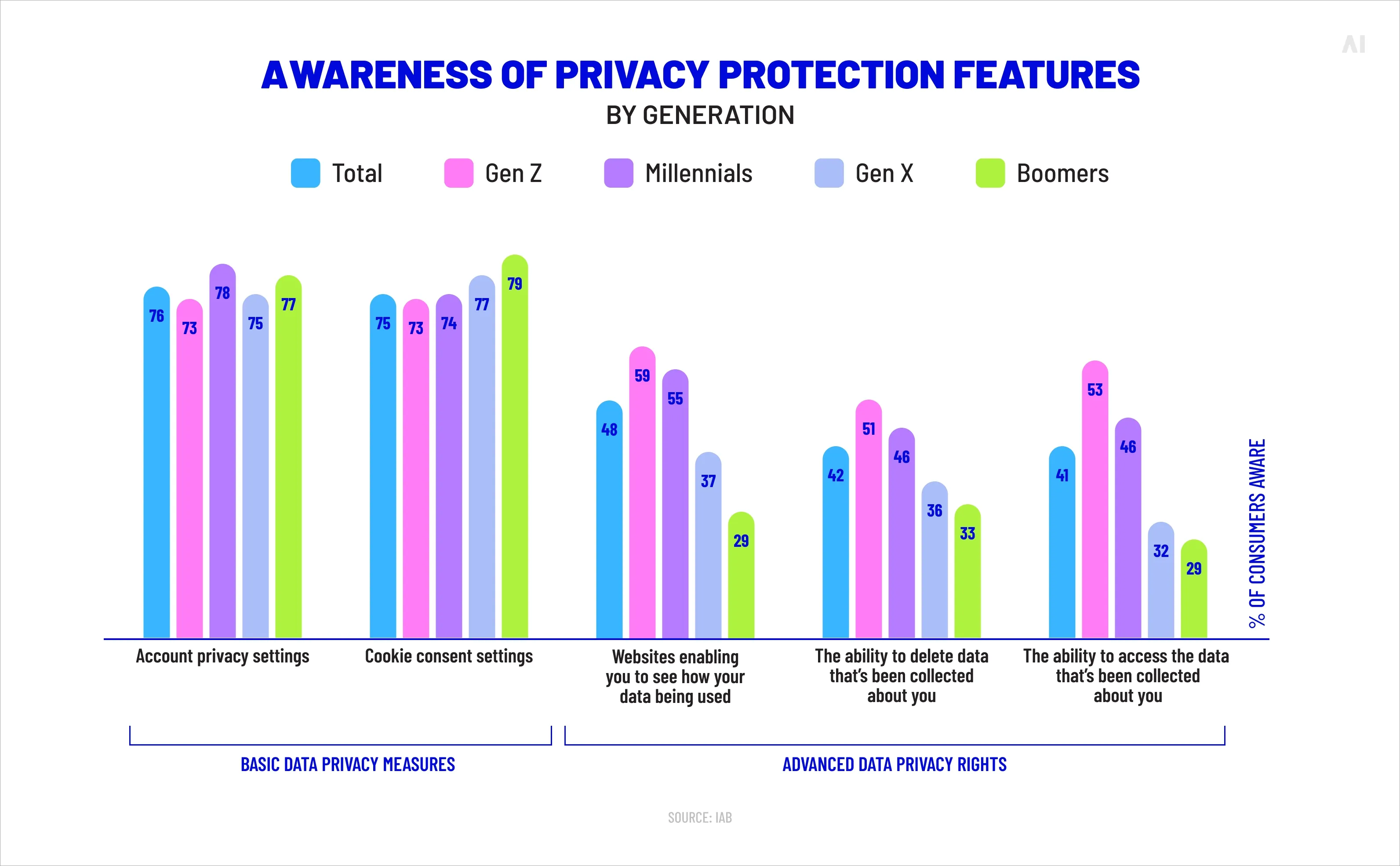
Consumers want control, but they’re also overwhelmed by the mechanics of privacy management. In its 2025 research, IAB reports that about 60% of consumers find privacy management complex/confusing/inconvenient, which is a practical warning for marketers: even when you “do it right,” you still need to explain it simply.
⚡ In a 2025 consumer study from IAB, 70% of U.S. consumers said they were familiar with state privacy laws, yet only 40% knew they could access/delete collected data. That gap is exactly why privacy-first location-based marketing needs plain-language consent, not legalese.
What this means for marketers:
Treat precise location as sensitive by default and use the least granular signal that still supports the decision you’re making.
Operationalize consent and vendor due diligence (where data came from, what “consent” means in that context, how opt-outs are handled, retention rules, and audit rights).
Create clear no-go categories (sensitive locations and vulnerable audiences) and enforce them consistently across partners, platforms, and measurement workflows. The FTC’s Mobilewalla action is a useful reality check on what regulators view as out of bounds.
This is not only legal risk. It’s also brand risk, especially when location is involved.
From location data to location intelligence
Raw pings are not the asset. Decision-grade intelligence is. In 2026, “better” location-based marketing is less about collecting more data and more about turning permissioned signals into planning and measurement inputs a business can actually defend.
Two forces are accelerating this shift:
Signal constraints are real. IAB highlights that deterministic identifiers are becoming more restricted, pushing organizations toward centralized cross-channel data, predictive modeling, and more disciplined analytics.
Privacy laws are expanding what counts as sensitive and what requires additional protections. Future of Privacy Forum explicitly calls out trends such as expanding definitions of sensitive data and heightened protections that can include location-related data.
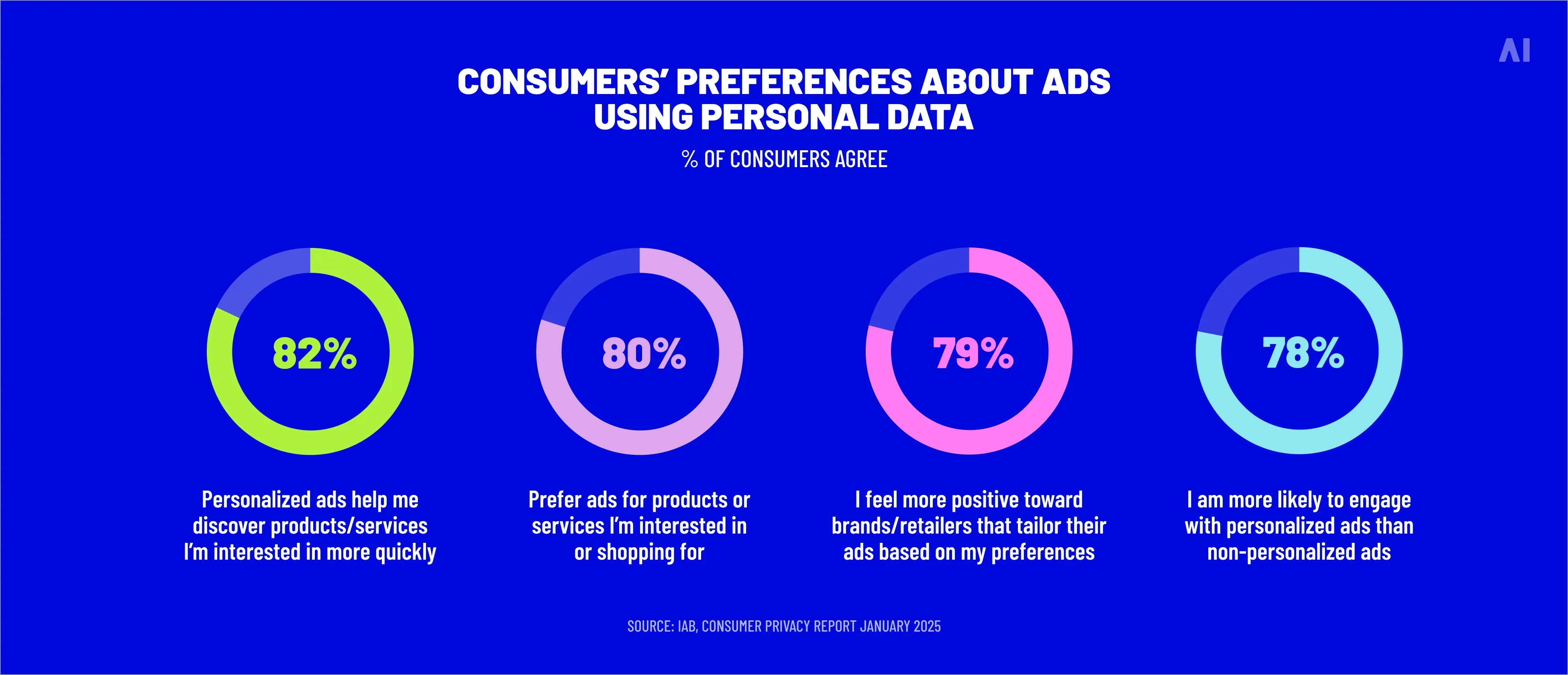
Consumers’ preferences about ads using personal data (Source)
So “location intelligence” increasingly looks like this:
Segments and cohorts, not coordinates (frequent visitors, trade-area audiences, category-intent visitors).
Trade areas and market maps that help you allocate budget, tailor creative, and set realistic expectations per region.
Transparent definitions (especially for “visit,” “dwell,” “exposed,” and “incremental”) so location becomes evidence you can explain, not a metric you have to defend after the fact.
A useful litmus test still holds: if a marketer can’t explain how a “visit” is defined and validated, they do not have location intelligence. They have a metric.
Performance-driven omnichannel measurement
The future of location-based marketing is inseparable from measurement reform. Leaders are moving away from “credit” and toward “impact,” especially as campaigns span mobile, CTV, DOOH, and retail media.
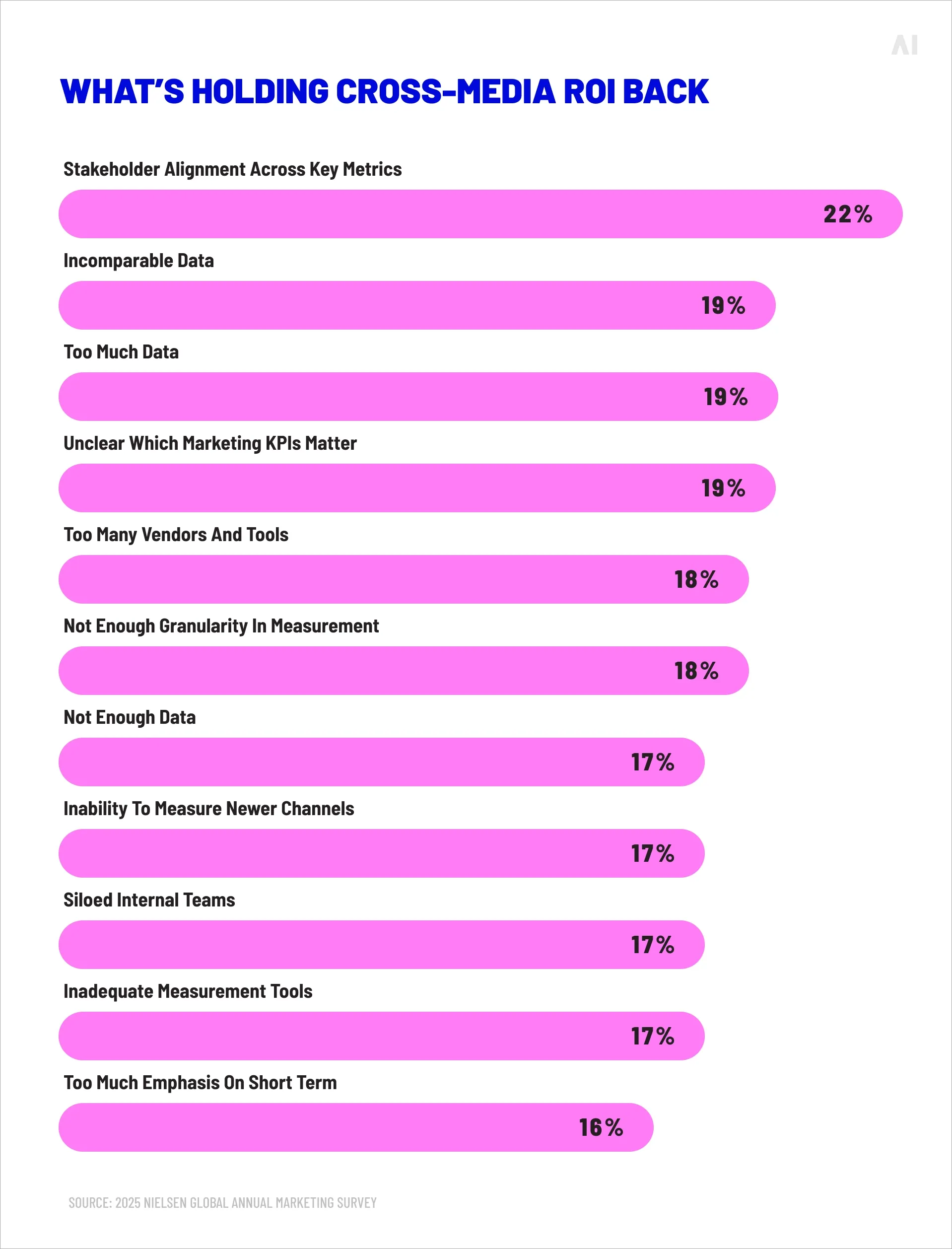
Cross-media ROI is still hard, and teams know it. Nielsen notes that marketers cite major challenges when calculating cross-media ROI, including the amount of data and the incomparability of data across channels.
Incrementality testing is already mainstreaming. EMARKETER reports that 52% of U.S. brand and agency marketers use incrementality testing/experiments (July 2025 data from EMARKETER and TransUnion), and that expanding incrementality testing is a stated priority for a meaningful share of respondents.
Best-practice measurement is converging on experiments + modeling, not one or the other. IAB’s guidance on modern MMM emphasizes using experiments to estimate incrementality while also being disciplined about noise, uncertainty, and what a single experiment can and can’t prove.
In practice, this trend pushes location-based marketing toward measurement approaches like:
Holdouts (people or areas not exposed vs exposed)
Geo experiments (market A vs market B, or matched-market designs)
Incremental lift (what changed because of advertising)
This is where location-based marketing can be more credible than many digital tactics. It can anchor analysis in real-world movement and outcomes, as long as methodology is transparent, conservative, and designed before campaigns launch—not after.
When location-based marketing is designed well, it produces benefits that are hard to replicate with interest targeting alone.
More relevant targeting without pretending to know everything
Location is a constraint on real behavior. People can claim they are “in-market,” but visiting a dealership cluster, a big-box category store, or a medical office corridor often signals something stronger than a clicked interest.
Better local budget efficiency
Geo control lets teams avoid wasting spend where fulfillment is weak, where stores are over-capacity, or where the brand simply does not compete.
This matters at the macro level too. As mentioned previously, BIA expects U.S. local ad spend to remain enormous in 2025, with mobile leading the channel mix.
Stronger creative relevance
Location-based creative can be concrete: local inventory, local events, local proof, local service guarantees. This is often the fastest way to improve conversion rate without any new targeting at all.
Cleaner measurement conversations
Location-based programs can be structured around markets and places. That makes lift tests more feasible than many purely audience-based approaches.
Industries driving results with location-based marketing
Location-based marketing performs best in categories where place strongly influences purchase or where service areas are real constraints.
Retail and grocery are where location signals become genuinely actionable. Trade areas are visible, shopping patterns repeat, and you can align targeting with real-world constraints like inventory, store density, and local competition.
Trade areas and competitor overlap are measurable.
Store visits and loyalty behavior can be tied back to markets.
Promo calendars align naturally with geo targeting.
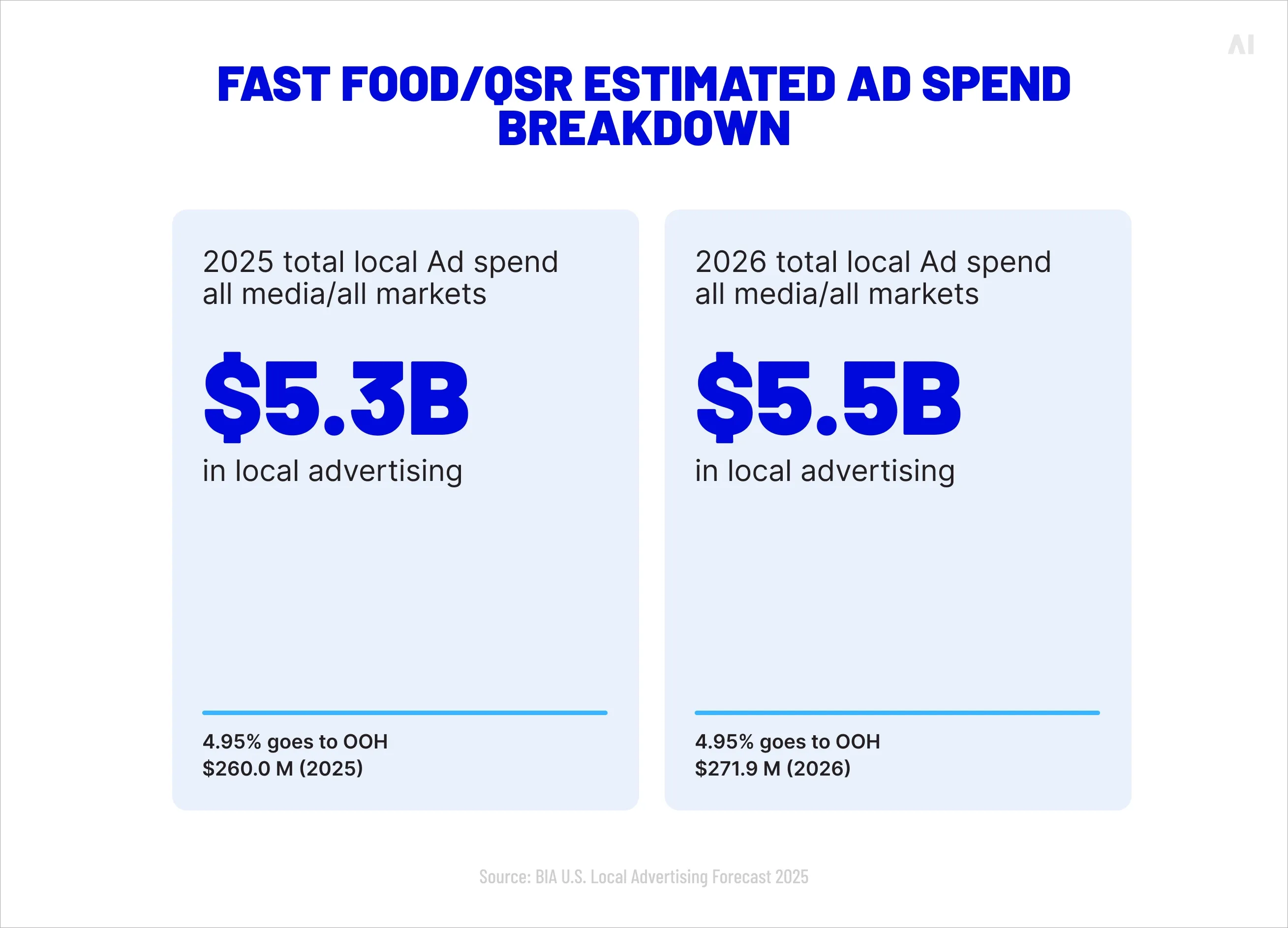
QSR and convenience win when location is treated as timing plus proximity, not just geography. Small shifts in distance, daypart, and message relevance can change whether a customer converts now or scrolls past.
Daypart + proximity + offer relevance is a proven combination.
The operational win is often suppression: stop showing ads to people too far away to convert.
Fast food/QSR estimated ad spend breakdown (Source)
Automotive (dealer ecosystems)
Automotive is a strong fit because geography is built into the business model. Dealers compete within defined catchment areas, and location-based planning helps brands balance coverage, fairness, and efficiency across a network.
Dealers need market-level coverage with fairness.
Household-level CTV plus mobile response is a natural pairing.
Healthcare providers
Healthcare is high-potential and high-risk. The best programs stay conservative:
Service-area targeting
Content-first messaging
Strict avoidance of sensitive inferences and categories
Real estate, home services, and local professional services
These categories benefit from service radius logic and call/appointment outcomes.
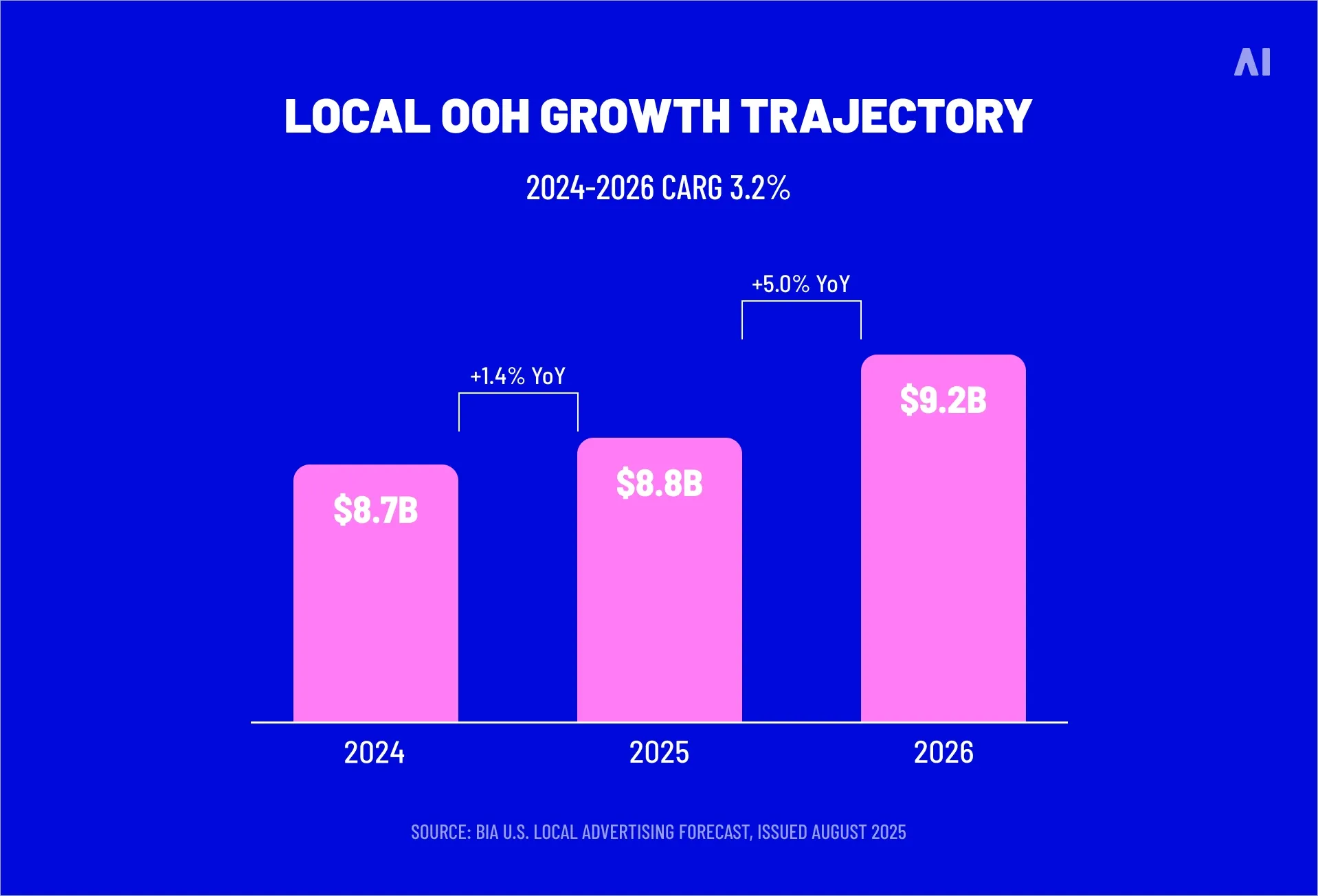
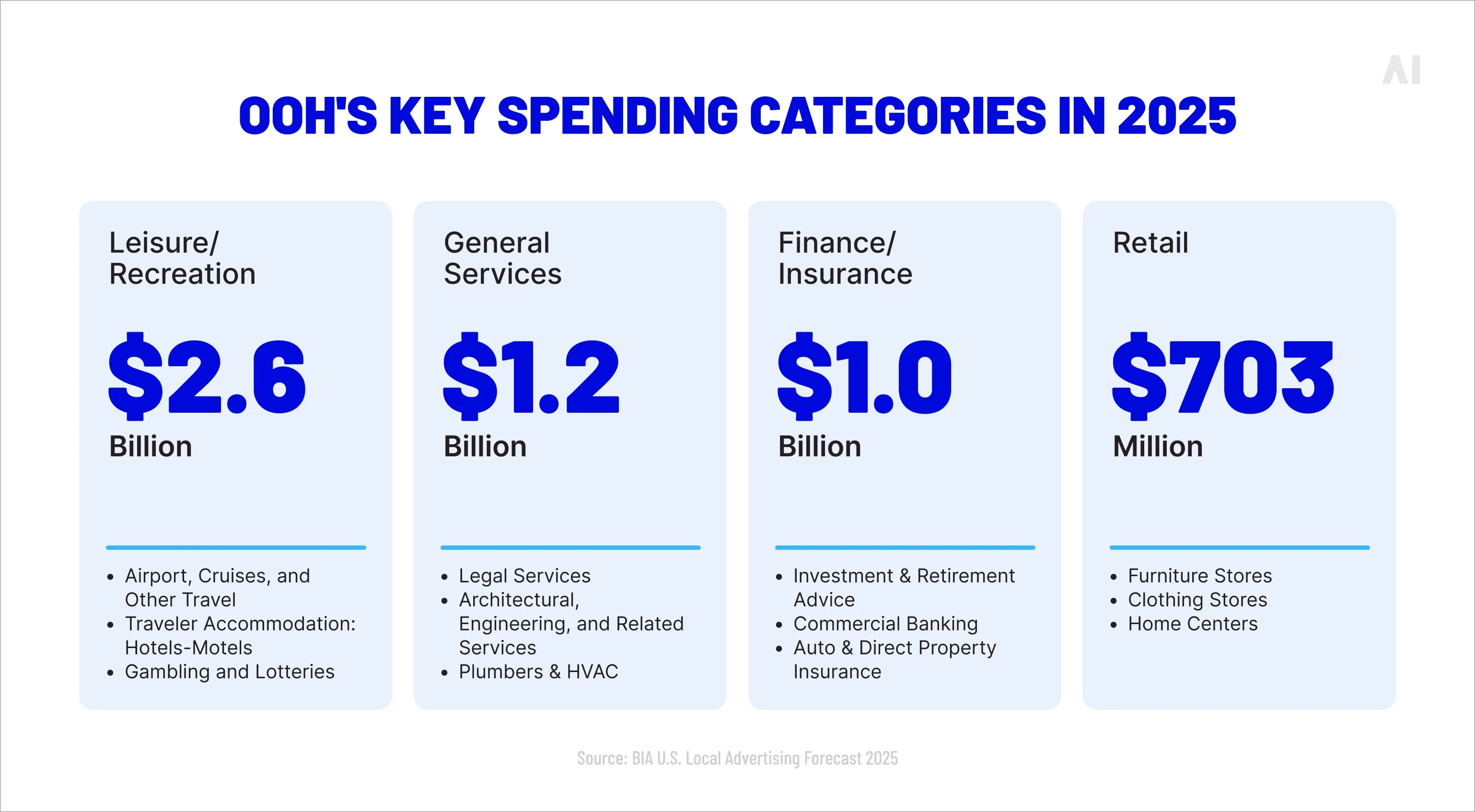
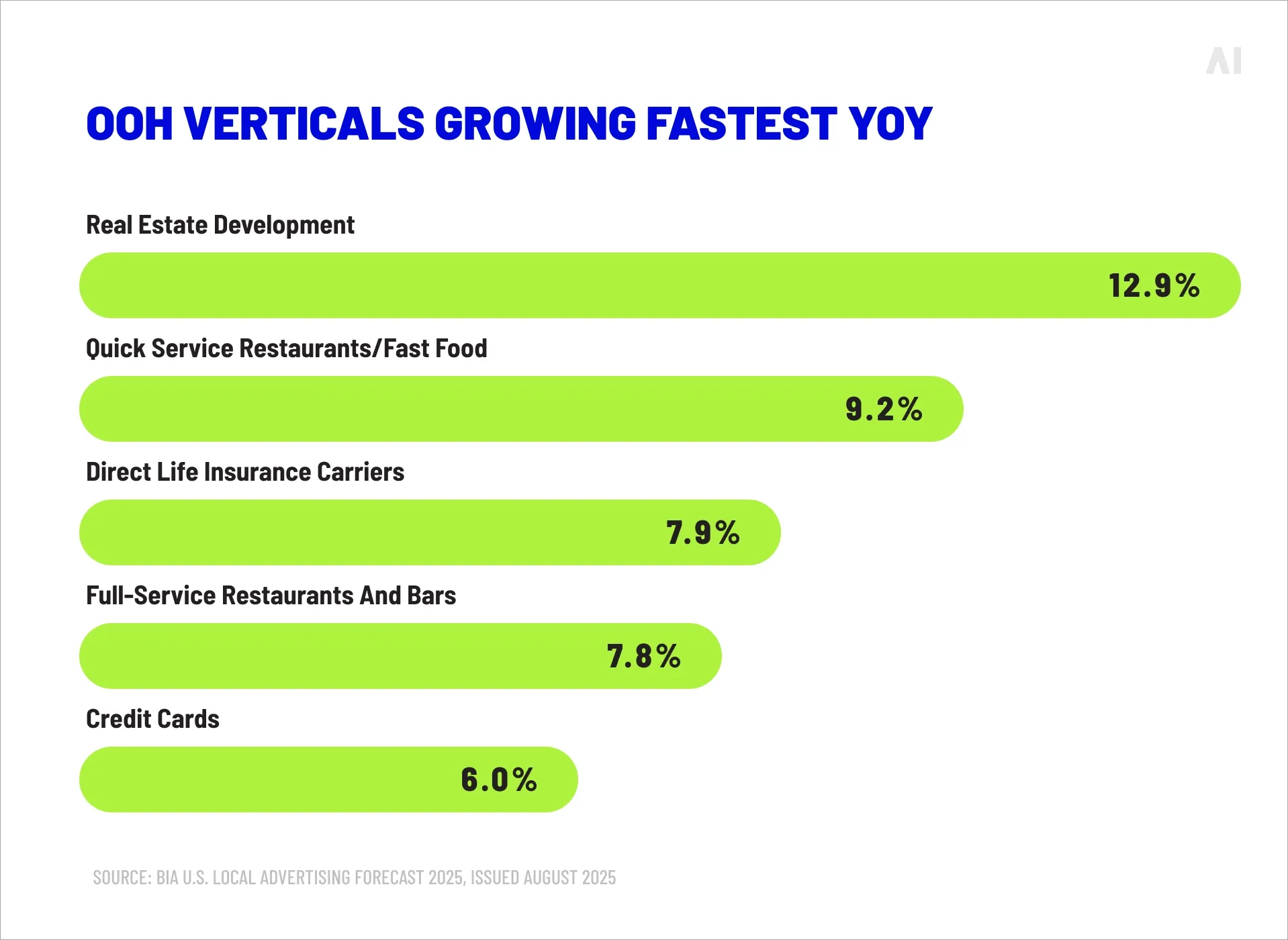
BIA’s local forecast also hints at which verticals are leaning into place-based media like OOH; it highlights strong growth in categories such as real estate development, insurance, and hospitals within local OOH spending trends.
⚡ The best verticals for location-based marketing are the ones where geography is a constraint, not a demographic.
Turning location-based marketing challenges into opportunities
This is where most teams get stuck. The upside is real, but the programs that win in 2026 are the ones that operationalize the hard parts.
Improving data accuracy
Accuracy is not a single number. It’s fitness for purpose.
Practical steps that raise quality:
Prefer polygons and POI matching over simple radii
Use dwell-time thresholds to filter noise
Audit POI lists (bad addresses create false “visits”)
Validate patterns against real business truth (store hours, traffic peaks, known seasonality)
Opportunity framing: accuracy work is not overhead. It’s what turns location-based marketing from “interesting” into “financeable.”
Ensuring privacy and consent
Location data deserves stricter handling than most marketers instinctively give it, because it can reveal sensitive patterns.
What “good” looks like in 2026:
Minimize precision unless it’s necessary
Document consent and vendor sourcing
Treat sensitive locations as off-limits
Use aggregation and cohort logic wherever possible
Consumer attitudes reinforce the need for this. In a 2025 survey, CivicScience found a sizable share of Americans share their location with other people, which signals normalization, but not unlimited acceptance. More importantly, privacy literacy is uneven. IAB’s 2025 consumer privacy research found many consumers feel privacy management is complicated, and fewer understand the rights available to them.
Opportunity framing: privacy-first location marketing builds durability. Your strategy should still work when the strictest version of the rules becomes the norm.
Diagnostic metrics: reach/frequency by market, recency, overlap, suppression success
And it includes one uncomfortable discipline: define success before launch, including what would count as “no lift.”
Integrating across channels
The integration challenge is that location-based marketing often lives in fragments: mobile teams do one thing, CTV teams do another, and local teams do something else.
A 2026 integration blueprint:
One geo framework (markets, stores, service areas)
One POI strategy (including exclusions and sensitivity rules)
One creative system (localizable components, not fully custom one-offs)
One measurement plan (lift-first, channel-second)
One governance model (consent, vendor due diligence, documentation)
Opportunity framing: integration turns location-based marketing into a compounding advantage. You stop relearning the same lessons in every channel.
Conclusion: Building the future with agile, location-based marketing
Location-based marketing is not becoming a niche tactic. It’s becoming a core capability for brands that need to grow in the real world while operating under tighter privacy expectations. The direction is clear: less dependence on raw, sensitive signals, more reliance on governed location intelligence that improves decisions across channels.
If you’re building a location-based program for 2026, the most useful mindset is practical. Location is not a shortcut to certainty. It’s a way to reduce waste, improve relevance, and measure outcomes more credibly when you treat it like evidence and validate it with lift.
Here are three commitments that separate durable programs from fragile ones:
Design for privacy-first from the start. Use the least precise signal that still supports the decision. Document consent and vendor sourcing. Set “no-go” rules for sensitive locations and enforce them consistently, not selectively.
Make location intelligence a planning layer, not just a targeting trick. Build trade areas, market maps, and audience cohorts that help you allocate budget and tailor creative. Define what counts as a qualified visit, what windows you’re using, and what would invalidate a result. If you can’t explain those basics to a stakeholder, you’ll struggle to defend performance later.
Prove impact with measurement that holds up. Prioritize incrementality where possible: geo experiments, holdouts, matched market tests, and conservative definitions. Use directional metrics as diagnostics, not verdicts. When results are strong, you’ll know why they’re strong, and you’ll be able to scale without guessing.
This is exactly where many teams hit friction: the strategy is sound, but the execution gets fragmented across platforms, vendors, and measurement approaches. That’s when it helps to work with a partner that can connect the pieces—planning, activation, supply quality, and performance proof—without treating location as a single-channel tactic.
If you’re pressure-testing your 2026 approach, AI Digital can help you turn location signals into an accountable, privacy-aware omnichannel program. Whether you’re trying to improve local efficiency, scale store-visit impact across channels, or build a measurement plan that leadership will trust, the goal is the same: location intelligence that’s usable, governable, and measurable.
In short, reach out if you want to sanity-check your current setup or map a roadmap for 2026.
Blind spot
Key issues
Business impact
AI Digital solution
Lack of transparency in AI models
• Platforms own AI models and train on proprietary data • Brands have little visibility into decision-making • "Walled gardens" restrict data access
• Inefficient ad spend • Limited strategic control • Eroded consumer trust • Potential budget mismanagement
Open Garden framework providing: • Complete transparency • DSP-agnostic execution • Cross-platform data & insights
Optimizing ads vs. optimizing impact
• AI excels at short-term metrics but may struggle with brand building • Consumers can detect AI-generated content • Efficiency might come at cost of authenticity
• Short-term gains at expense of brand health • Potential loss of authentic connection • Reduced effectiveness in storytelling
Smart Supply offering: • Human oversight of AI recommendations • Custom KPI alignment beyond clicks • Brand-safe inventory verification
The illusion of personalization
• Segment optimization rebranded as personalization • First-party data infrastructure challenges • Personalization vs. surveillance concerns
• Potential mismatch between promise and reality • Privacy concerns affecting consumer trust • Cost barriers for smaller businesses
Elevate platform features: • Real-time AI + human intelligence • First-party data activation • Ethical personalization strategies
AI-Driven efficiency vs. decision-making
• AI shifting from tool to decision-maker • Black box optimization like Google Performance Max • Human oversight limitations
• Strategic control loss • Difficulty questioning AI outputs • Inability to measure granular impact • Potential brand damage from mistakes
Managed Service with: • Human strategists overseeing AI • Custom KPI optimization • Complete campaign transparency
Fig. 1. Summary of AI blind spots in advertising
Dimension
Walled garden advantage
Walled garden limitation
Strategic impact
Audience access
Massive, engaged user bases
Limited visibility beyond platform
Reach without understanding
Data control
Sophisticated targeting tools
Data remains siloed within platform
Fragmented customer view
Measurement
Detailed in-platform metrics
Inconsistent cross-platform standards
Difficult performance comparison
Intelligence
Platform-specific insights
Limited data portability
Restricted strategic learning
Optimization
Powerful automated tools
Black-box algorithms
Reduced marketer control
Fig. 2. Strategic trade-offs in walled garden advertising.
Core issue
Platform priority
Walled garden limitation
Real-world example
Attribution opacity
Claiming maximum credit for conversions
Limited visibility into true conversion paths
Meta and TikTok's conflicting attribution models after iOS privacy updates
Data restrictions
Maintaining proprietary data control
Inability to combine platform data with other sources
Amazon DSP's limitations on detailed performance data exports
Cross-channel blindspots
Keeping advertisers within ecosystem
Fragmented view of customer journey
YouTube/DV360 campaigns lacking integration with non-Google platforms
Black box algorithms
Optimizing for platform revenue
Reduced control over campaign execution
Self-serve platforms using opaque ML models with little advertiser input
Performance reporting
Presenting platform in best light
Discrepancies between platform-reported and independently measured results
Consistently higher performance metrics in platform reports vs. third-party measurement
Fig. 1. The Walled garden misalignment: Platform interests vs. advertiser needs.
Key dimension
Challenge
Strategic imperative
ROAS volatility
Softer returns across digital channels
Shift from soft KPIs to measurable revenue impact
Media planning
Static plans no longer effective
Develop agile, modular approaches adaptable to changing conditions
Brand/performance
Traditional division dissolving
Create full-funnel strategies balancing long-term equity with short-term conversion
Capability
Key features
Benefits
Performance data
Elevate forecasting tool
• Vertical-specific insights • Historical data from past economic turbulence • "Cascade planning" functionality • Real-time adaptation
• Provides agility to adjust campaign strategy based on performance • Shows which media channels work best to drive efficient and effective performance • Confident budget reallocation • Reduces reaction time to market shifts
• Dataset from 10,000+ campaigns • Cuts response time from weeks to minutes
• Reaches people most likely to buy • Avoids wasted impressions and budgets on poor-performing placements • Context-aligned messaging
• 25+ billion bid requests analyzed daily • 18% improvement in working media efficiency • 26% increase in engagement during recessions
Full-funnel accountability
• Links awareness campaigns to lower funnel outcomes • Tests if ads actually drive new business • Measures brand perception changes • "Ask Elevate" AI Chat Assistant
• Upper-funnel to outcome connection • Sentiment shift tracking • Personalized messaging • Helps balance immediate sales vs. long-term brand building
• Natural language data queries • True business impact measurement
Open Garden approach
• Cross-platform and channel planning • Not locked into specific platforms • Unified cross-platform reach • Shows exactly where money is spent
• Reduces complexity across channels • Performance-based ad placement • Rapid budget reallocation • Eliminates platform-specific commitments and provides platform-based optimization and agility
• Coverage across all inventory sources • Provides full visibility into spending • Avoids the inability to pivot across platform as you’re not in a singular platform
Fig. 1. How AI Digital helps during economic uncertainty.
Trend
What it means for marketers
Supply & demand lines are blurring
Platforms from Google (P-Max) to Microsoft are merging optimization and inventory in one opaque box. Expect more bundled “best available” media where the algorithm, not the trader, decides channel and publisher mix.
Walled gardens get taller
Microsoft’s O&O set now spans Bing, Xbox, Outlook, Edge and LinkedIn, which just launched revenue-sharing video programs to lure creators and ad dollars. (Business Insider)
Retail & commerce media shape strategy
Microsoft’s Curate lets retailers and data owners package first-party segments, an echo of Amazon’s and Walmart’s approaches. Agencies must master seller-defined audiences as well as buyer-side tactics.
AI oversight becomes critical
Closed AI bidding means fewer levers for traders. Independent verification, incrementality testing and commercial guardrails rise in importance.
Fig. 1. Platform trends and their implications.
Metric
Connected TV (CTV)
Linear TV
Video Completion Rate
94.5%
70%
Purchase Rate After Ad
23%
12%
Ad Attention Rate
57% (prefer CTV ads)
54.5%
Viewer Reach (U.S.)
85% of households
228 million viewers
Retail Media Trends 2025
Access Complete consumer behaviour analyses and competitor benchmarks.
Identify and categorize audience groups based on behaviors, preferences, and characteristics
Michaels Stores: Implemented a genAI platform that increased email personalization from 20% to 95%, leading to a 41% boost in SMS click through rates and a 25% increase in engagement.
Estée Lauder: Partnered with Google Cloud to leverage genAI technologies for real-time consumer feedback monitoring and analyzing consumer sentiment across various channels.
High
Medium
Automated ad campaigns
Automate ad creation, placement, and optimization across various platforms
Showmax: Partnered with AI firms toautomate ad creation and testing, reducing production time by 70% while streamlining their quality assurance process.
Headway: Employed AI tools for ad creation and optimization, boosting performance by 40% and reaching 3.3 billion impressions while incorporating AI-generated content in 20% of their paid campaigns.
High
High
Brand sentiment tracking
Monitor and analyze public opinion about a brand across multiple channels in real time
L’Oréal: Analyzed millions of online comments, images, and videos to identify potential product innovation opportunities, effectively tracking brand sentiment and consumer trends.
Kellogg Company: Used AI to scan trending recipes featuring cereal, leveraging this data to launch targeted social campaigns that capitalize on positive brand sentiment and culinary trends.
High
Low
Campaign strategy optimization
Analyze data to predict optimal campaign approaches, channels, and timing
DoorDash: Leveraged Google’s AI-powered Demand Gen tool, which boosted its conversion rate by 15 times and improved cost per action efficiency by 50% compared with previous campaigns.
Kitsch: Employed Meta’s Advantage+ shopping campaigns with AI-powered tools to optimize campaigns, identifying and delivering top-performing ads to high-value consumers.
High
High
Content strategy
Generate content ideas, predict performance, and optimize distribution strategies
JPMorgan Chase: Collaborated with Persado to develop LLMs for marketing copy, achieving up to 450% higher clickthrough rates compared with human-written ads in pilot tests.
Hotel Chocolat: Employed genAI for concept development and production of its Velvetiser TV ad, which earned the highest-ever System1 score for adomestic appliance commercial.
High
High
Personalization strategy development
Create tailored messaging and experiences for consumers at scale
Stitch Fix: Uses genAI to help stylists interpret customer feedback and provide product recommendations, effectively personalizing shopping experiences.
Instacart: Uses genAI to offer customers personalized recipes, mealplanning ideas, and shopping lists based on individual preferences and habits.
Medium
Medium
Share article
Url copied to clipboard
No items found.
Subscribe to our Newsletter
THANK YOU FOR YOUR SUBSCRIPTION
Oops! Something went wrong while submitting the form.
Questions? We have answers
How location-based marketing differs from proximity marketing?
Location-based marketing is the broader umbrella. It covers targeting, messaging, and measurement based on where people are, where they’ve been, or which places signal intent across channels like mobile, social, CTV, and DOOH. Proximity marketing is narrower and usually refers to close-range tactics that trigger messaging when someone is very near a specific location, often in-store or at the edge of a venue.
Why is location-based marketing important for businesses?
Because it ties marketing decisions to real-world demand. Location-based advertising helps businesses prioritize the right markets, reduce wasted spend outside service areas, make creative more locally relevant, and connect campaigns to outcomes like store visits, calls, appointments, and in-store sales.
Is location-based marketing safe and privacy-compliant?
It can be, if it’s built with privacy-first guardrails. The safest approach uses consented data, avoids sensitive locations and vulnerable audiences, relies on aggregation where possible, and documents how audiences are built and how measurement is done. If a program depends on overly precise tracking without clear consent and governance, it’s higher risk.
Which industries benefit most from location-based marketing?
Industries where geography drives purchase behavior tend to benefit most, including retail and grocery, QSR and convenience, automotive dealer networks, home services, real estate, travel and tourism, events and entertainment, and many local healthcare providers when targeting stays within strict compliance boundaries.
What is location-based marketing technology?
It’s the stack that turns location signals into usable marketing inputs. That typically includes mobile and in-app signals (where permitted), mapping and POI databases, audience modeling, activation platforms (DSPs, social, CTV), and measurement methods that estimate outcomes such as visit lift or incremental impact.
How to do location-based marketing?
Start by defining the business outcome and the geographic reality of your business, like service areas, store trade zones, and competitive locations. Then choose the right tactic (geotargeting for markets, geofencing for places, location-based advertising for omnichannel reach), align creative to local context, and set measurement rules upfront so you can judge performance without guessing.
What are the main benefits of location-based marketing?
The main benefits are stronger relevance, more efficient local spend, better control over where ads run, improved ability to reach high-intent audiences near key places, and clearer links between marketing activity and offline outcomes when measurement is designed carefully.
Have other questions?
If you have more questions, contact us so we can help.
Questions? We have answers
This is some text inside of a div block.
Lorem ipsum dolor sit amet, consectetur adipiscing elit. Suspendisse varius enim in eros elementum tristique. Duis cursus, mi quis viverra ornare, eros dolor interdum nulla, ut commodo diam libero vitae erat. Aenean faucibus nibh et justo cursus id rutrum lorem imperdiet. Nunc ut sem vitae risus tristique posuere.
This is some text inside of a div block.
Lorem ipsum dolor sit amet, consectetur adipiscing elit. Suspendisse varius enim in eros elementum tristique. Duis cursus, mi quis viverra ornare, eros dolor interdum nulla, ut commodo diam libero vitae erat. Aenean faucibus nibh et justo cursus id rutrum lorem imperdiet. Nunc ut sem vitae risus tristique posuere.
This is some text inside of a div block.
Lorem ipsum dolor sit amet, consectetur adipiscing elit. Suspendisse varius enim in eros elementum tristique. Duis cursus, mi quis viverra ornare, eros dolor interdum nulla, ut commodo diam libero vitae erat. Aenean faucibus nibh et justo cursus id rutrum lorem imperdiet. Nunc ut sem vitae risus tristique posuere.
This is some text inside of a div block.
Lorem ipsum dolor sit amet, consectetur adipiscing elit. Suspendisse varius enim in eros elementum tristique. Duis cursus, mi quis viverra ornare, eros dolor interdum nulla, ut commodo diam libero vitae erat. Aenean faucibus nibh et justo cursus id rutrum lorem imperdiet. Nunc ut sem vitae risus tristique posuere.
This is some text inside of a div block.
Lorem ipsum dolor sit amet, consectetur adipiscing elit. Suspendisse varius enim in eros elementum tristique. Duis cursus, mi quis viverra ornare, eros dolor interdum nulla, ut commodo diam libero vitae erat. Aenean faucibus nibh et justo cursus id rutrum lorem imperdiet. Nunc ut sem vitae risus tristique posuere.
This is some text inside of a div block.
Lorem ipsum dolor sit amet, consectetur adipiscing elit. Suspendisse varius enim in eros elementum tristique. Duis cursus, mi quis viverra ornare, eros dolor interdum nulla, ut commodo diam libero vitae erat. Aenean faucibus nibh et justo cursus id rutrum lorem imperdiet. Nunc ut sem vitae risus tristique posuere.
This is some text inside of a div block.
Lorem ipsum dolor sit amet, consectetur adipiscing elit. Suspendisse varius enim in eros elementum tristique. Duis cursus, mi quis viverra ornare, eros dolor interdum nulla, ut commodo diam libero vitae erat. Aenean faucibus nibh et justo cursus id rutrum lorem imperdiet. Nunc ut sem vitae risus tristique posuere.

.svg)
.svg)