Incrementality testing is the practice of proving which sales, sign-ups, or customers a campaign actually caused, rather than the ones it merely took credit for. This article explains how incrementality measurement works, why platform-reported performance keeps overstating real business impact, and where causal testing fits inside a modern marketing intelligence approach built around profit and budget efficiency.
For the better part of a decade, the advertising industry braced for the death of the third-party cookie, treating it as the event that would finally force a reckoning with measurement. The reckoning arrived; the cookie did not die. Google confirmed in April 2025 that it would keep third-party cookies in Chrome rather than introduce a new opt-out prompt, then retired the remaining Privacy Sandbox APIs in October 2025, ending six years of work on a cookie replacement. Marketers who had spent that decade preparing for a clean break were left with the messier truth: the data feeding their measurement was already unreliable, and a reprieve on cookies did nothing to fix it.
That unreliability is the reason incrementality testing has moved from the margins of data science into the center of how serious marketers measure. The gap is no longer subtle. According to Haus's 2026 Marketing Decision Confidence Index, 78% of US senior decision-makers believe at least 10% of their marketing spend is wasted because of insufficient measurement, and 7% put that figure at 30% or more. The waste is not caused by bad campaigns alone. It is caused by measurement systems that count conversions a brand would have won regardless and present them as proof that the advertising worked.
Incrementality marketing addresses that directly. Instead of asking which touchpoints preceded a conversion, it asks a harder and more useful question: would this conversion have happened anyway? Answering it changes how budgets get defended, how channels get funded, and how growth gets forecast.
What follows is a practical account of incrementality in marketing—what it measures, how to test for it, where it complements attribution and media mix modeling, and how AI and supply-side discipline are making continuous experimentation realistic for teams that once treated it as a quarterly luxury.
What is incrementality testing?
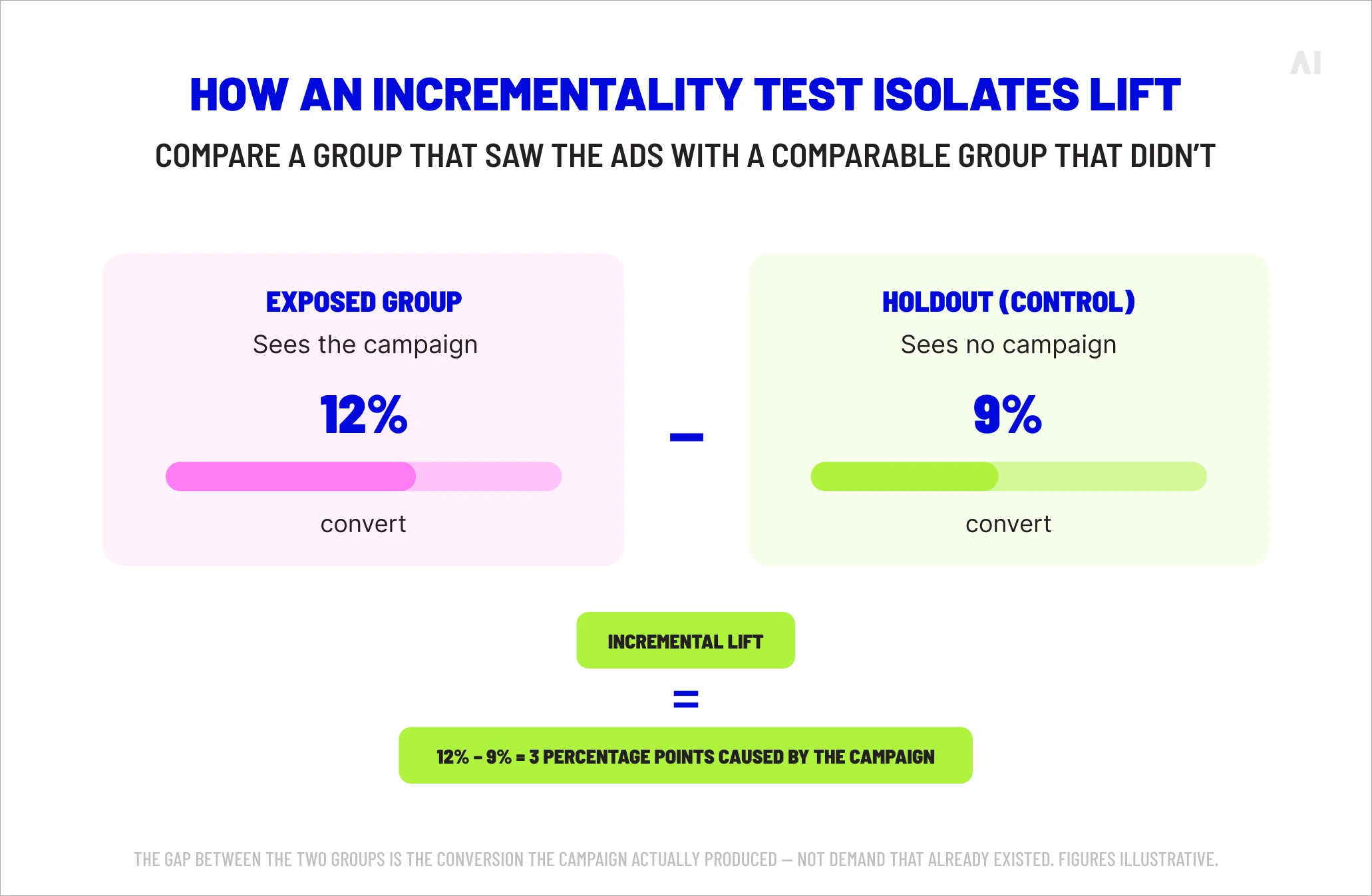
Incrementality testing is a measurement method that isolates the additional conversions, revenue, or customer growth generated by a marketing activity—the outcomes that would not have occurred without it. It works by comparing a group exposed to advertising against a comparable group that was not, and reading the difference between them as the genuine lift the campaign produced.
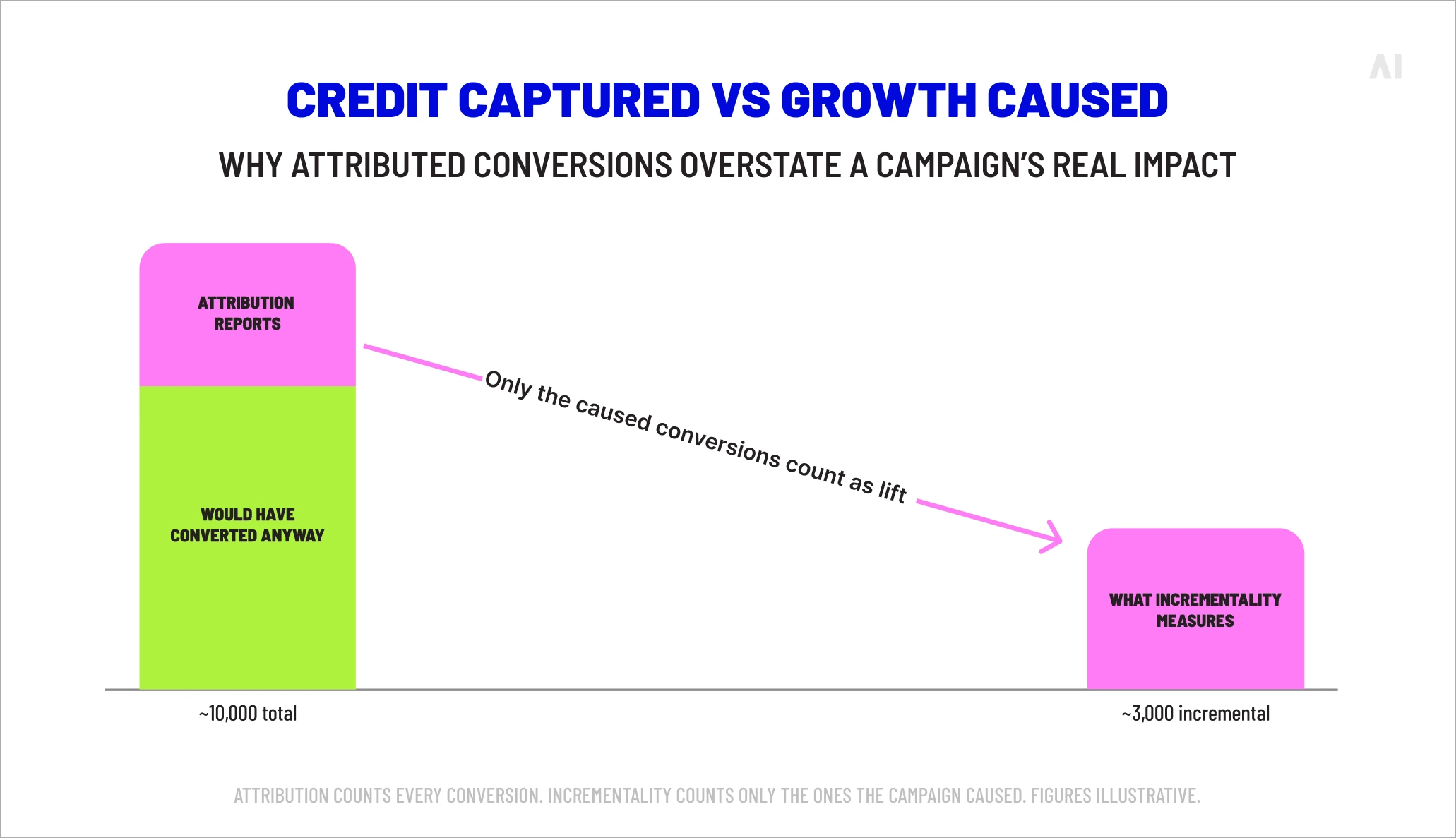
The distinction it draws is between two numbers that look identical in a report but mean very different things. A platform can tell you it drove 10,000 conversions. Incrementality measurement tells you how many of those 10,000 are net-new, and how many would have arrived through search, word of mouth, or existing intent if the ad had never run. The first number flatters the channel. The second is the one a finance team can act on.
This is why incrementality testing functions less like a tool and more like a standard of proof. It does not produce a prettier dashboard; it produces a defensible claim. When a head of growth says a channel returned three dollars for every one spent, incrementality is what separates that statement from a coincidence dressed up as a result.
Attribution assigns credit. It looks at the conversions that occurred and distributes responsibility for them across the touchpoints a customer encountered, whether by last click, first click, or some weighted model in between. It is good at describing the path a converting customer took. It is silent on whether that path caused the conversion.
Real business impact is a different measurement entirely. It is the slice of outcomes that exists because of the marketing and would vanish without it. A retargeting campaign that shows ads to people already heading to checkout will earn enormous credit in any attribution model, because those people do convert, and they do see the ads first. Strip the campaign away, though, and most of them convert anyway. The attributed conversions are real; the incremental ones are close to zero. Incrementality testing is how a marketer tells those two situations apart before reallocating a budget on the strength of a number that was never causal to begin with.
Credit captured vs growth caused
Why reported performance can mislead
Reported performance misleads for a structural reason: most of it comes from the platforms being measured. A demand-side platform optimizing toward its own reported conversions has every incentive to find conversions to report, and the easiest conversions to find are the ones that were going to happen regardless. The result is a system in which the channels closest to the point of purchase consistently look like the strongest performers, while the upper-funnel activity that created the demand in the first place looks weak.
⚡ A channel can top every performance report and still add almost nothing—credit captured is not the same as growth caused.
Self-reported success compounds when budgets follow it. Money flows toward the channels with the best-looking numbers, those channels harvest even more existing demand, their reported returns climb higher, and the brand slowly defunds the activity that was actually generating customers. Incrementality testing interrupts that loop by measuring cause rather than accepting correlation, which is precisely the evidence an attribution report cannot supply on its own.
Incrementality in a modern measurement strategy
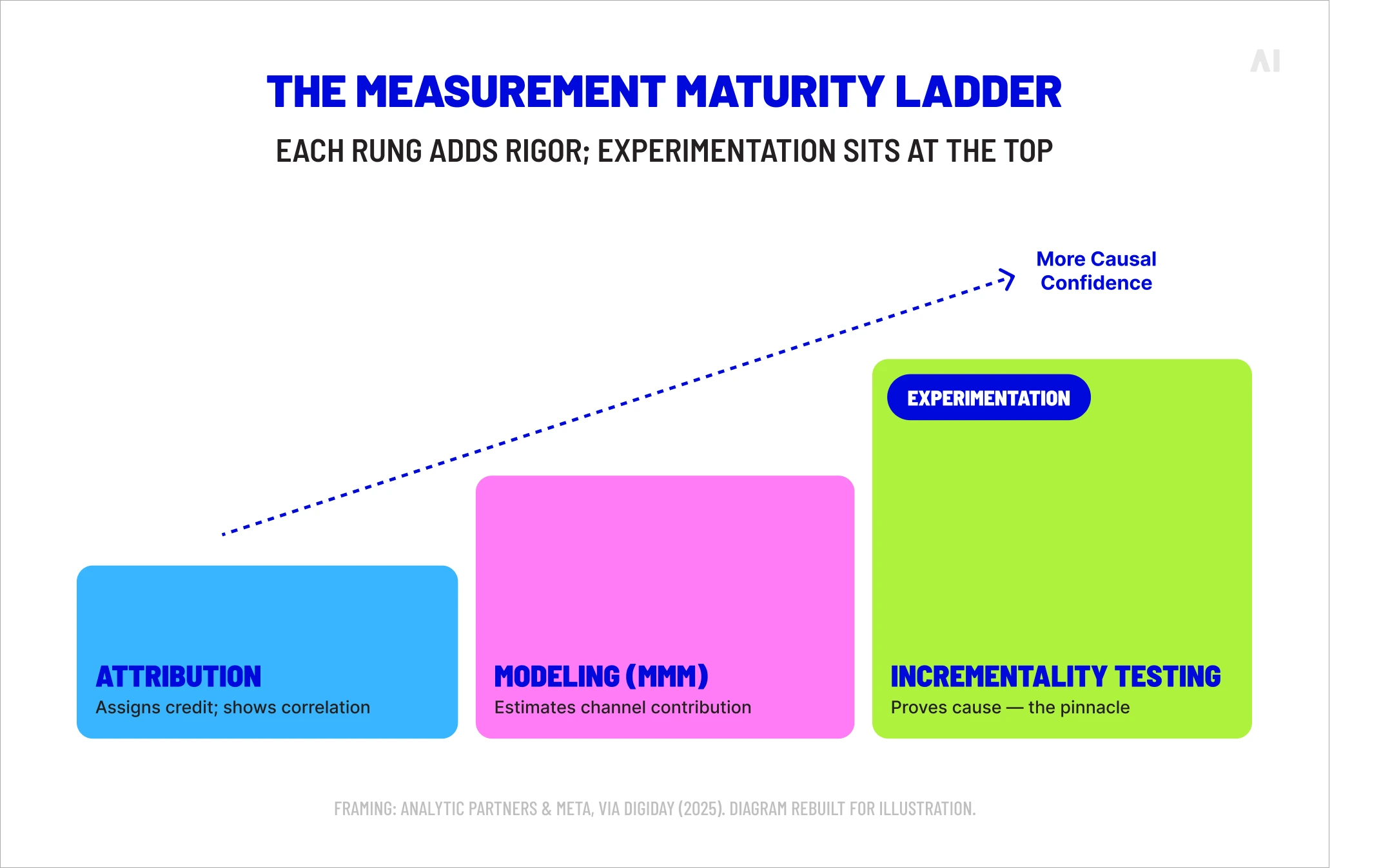
Incrementality does not replace the rest of a measurement program. It calibrates it. The most effective approach treats attribution, media mix modeling, and incrementality testing as three instruments answering three different questions, then uses incrementality as the causal check on the other two.
The measurement maturity ladder
The movement toward causal measurement has been accelerated by everything that made user-level tracking less dependable: privacy regulation, browser and operating-system restrictions, walled-garden data silos, and customer journeys that now span more devices and channels than any single tracking layer can follow. None of those pressures eased when Google kept the cookie alive. If anything, the reprieve confirmed that no platform-led replacement was coming to rescue measurement, and that brands would need methods resilient enough to work without clean identifiers. Causal testing is the most direct of those methods.
Attribution and incrementality testing sit at opposite ends of a trade-off between reach and rigor.
Attribution observes every conversion continuously and assigns credit across the journey, which makes it a strong operational instrument for tactical, week-to-week decisions about creative and channel mix. Its weakness is that it can only describe association: it sees that a touchpoint preceded a conversion, not that it produced one.
Incrementality testing inverts that profile. It tests one hypothesis at a time under controlled conditions and returns a clean causal read—this campaign drove this much additional revenue—but it cannot watch the entire funnel at once, and a well-run test takes time and discipline to execute.
The two are complements. Attribution provides the granular daily view; incrementality periodically establishes which of the conversions attribution is crediting are genuinely caused by the advertising. Run together, they produce a program that is responsive to live performance while staying honest about what that performance represents.
Media mix modeling answers questions at the level of the whole business. It analyzes aggregated, time-series data—total spend, total outcomes, seasonality, pricing, competitor activity—to estimate how each channel contributes to revenue over months or years. Because it works on aggregate data, MMM is unaffected by signal loss and can see offline and brand activity that digital tracking never captures, which makes it well suited to setting next quarter's budget.
Incrementality testing operates at a finer grain and a faster cadence. Where MMM estimates contribution statistically across a long horizon, an incrementality test measures a specific campaign's lift through direct experimentation, often in weeks. MMM tells a marketer roughly how much each channel is worth at a strategic level; incrementality confirms whether a particular investment is paying off in practice. Mature programs increasingly use incrementality experiments to validate and recalibrate the assumptions inside their models, turning two imperfect methods into one more reliable picture.
No single method produces the complete truth, and treating any one of them as a sole source of truth is the most common way measurement programs go wrong.
Attribution overstates lower-funnel channels.
MMM lacks the granularity for tactical calls.
Incrementality testing is rigorous but narrow.
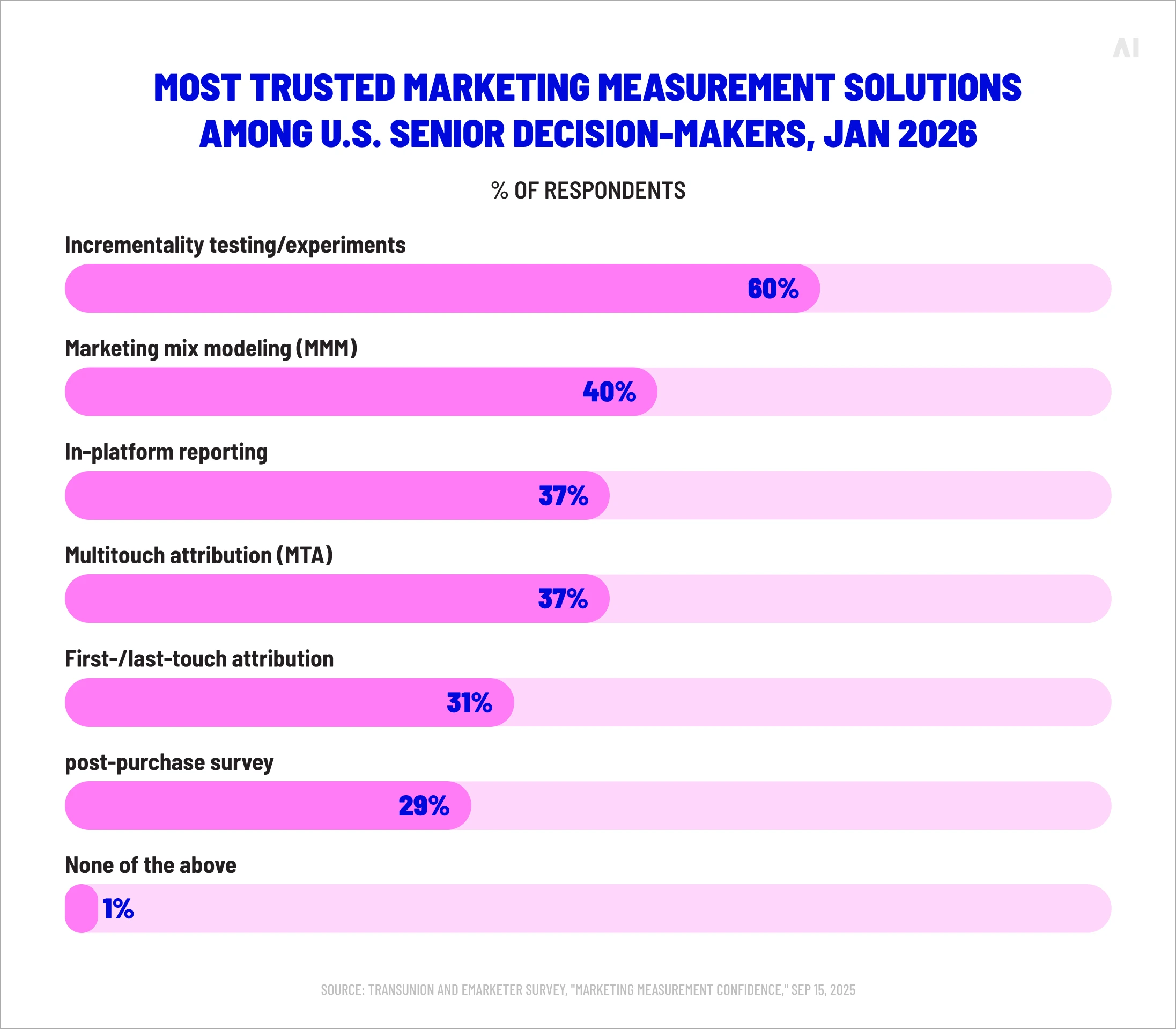
The reliable answer comes from triangulating between them, and senior marketers now say as much: in the Haus survey, 60% of US decision-makers trust independent incrementality testing more than any other measurement method, 20 points ahead of media mix modeling at 40% and nearly double in-platform reporting at 37%. Incrementality is becoming the arbiter the other methods get checked against, not a stand-alone replacement for them.
Incrementality is the most-trusted method (Source).
Benefits of incrementality testing for modern marketers
The case for incrementality testing comes down to moving an organization from claiming results to proving them. That move pays off in four ways that compound over time: it exposes channels taking undeserved credit, recovers wasted spend, sharpens acquisition economics, and finally gives upper-funnel work the recognition attribution denies it.
Uncovering overstated channel performance
The first and most uncomfortable benefit is that incrementality testing reveals which channels have been coasting on borrowed credit. Branded search and retargeting are the usual suspects: both intercept customers who already intended to buy, both convert reliably, and both therefore dominate attribution reports. A holdout test frequently shows their true incremental contribution to be a fraction of their attributed one. That finding is rarely welcome, but it is the prerequisite for spending the next dollar where it produces something new rather than where it photographs well in a report.
Reducing wasted ad spend
Incrementality measurement is also the most direct route to cutting the waste that erodes returns. Once a marketer can see incremental rather than attributed performance, the sources of waste become legible: saturation, where additional spend in a channel buys diminishing real lift; over-frequency, where the same audience is paid for repeatedly past the point of persuasion; and inefficient targeting that reaches people who were already converting. Each of those is invisible in a standard performance report and obvious in an incrementality test, which is why catching them is where the method earns its keep against the spend leakage senior marketers already suspect is there.
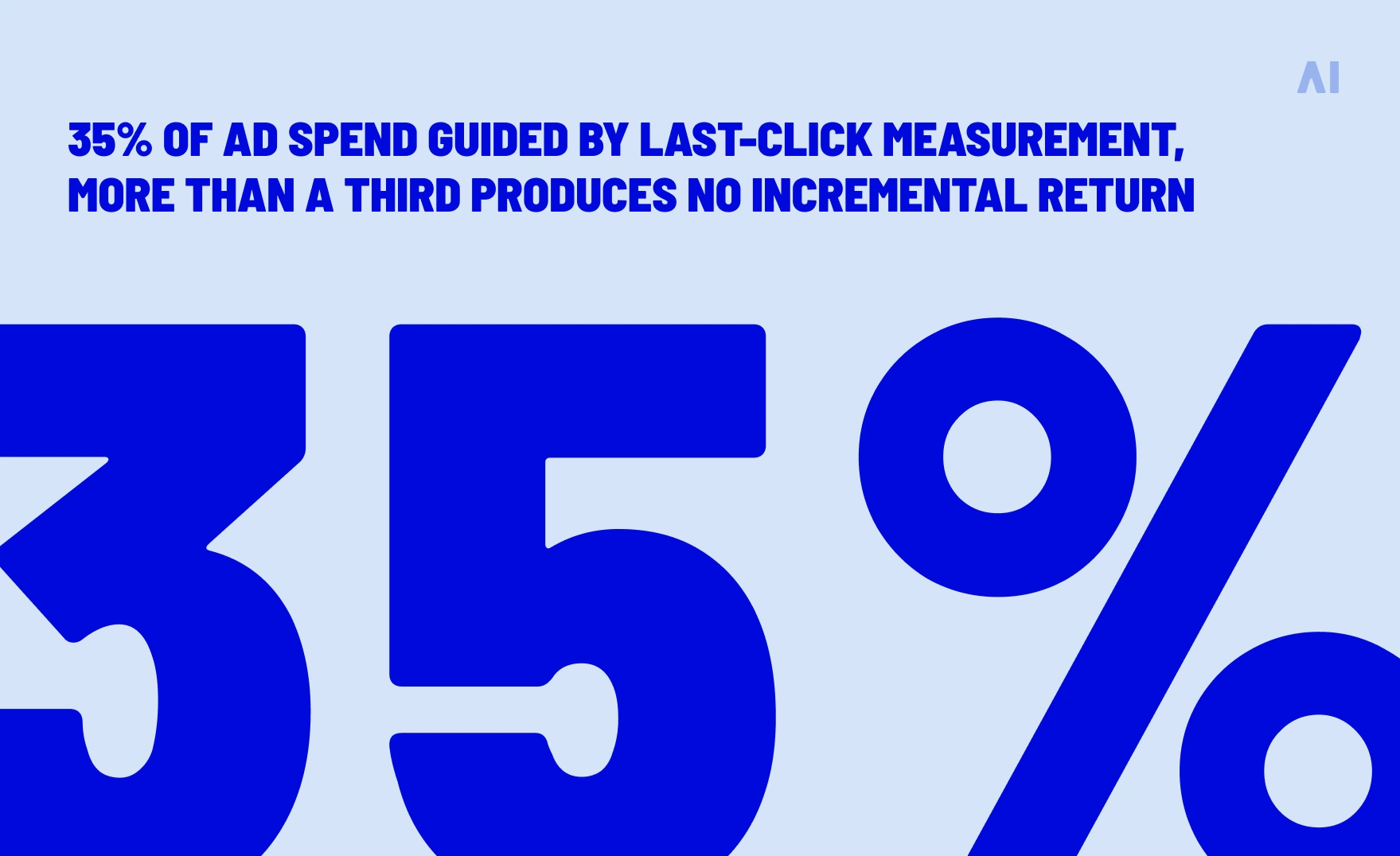
More than a third of last-click spend is wasted
Improving customer acquisition efficiency
Acquisition metrics built on attribution tend to be optimistic in exactly the wrong way. A platform-reported cost per acquisition counts customers who would have come anyway, which makes the number look lower than the real cost of winning a new buyer. Incremental cost per acquisition and incremental return on ad spend correct that distortion by counting only the customers the campaign actually added. The corrected figures are usually less flattering, and far more useful for deciding how aggressively a channel can be scaled before its real economics turn unfavorable.
Measuring upper-funnel business impact
The activity that suffers most under attribution is the activity that builds future demand: awareness campaigns, video, connected TV, and other formats that influence a purchase weeks before it happens and rarely earn the last click. Attribution models systematically undervalue them, which tempts teams to defund the very work that fills the pipeline. Incrementality testing, particularly geo-based designs, can measure the lift these campaigns generate even when no clean conversion path connects exposure to sale. That makes it the one method capable of defending upper-funnel investment with evidence rather than faith.
⚡ The campaigns that build tomorrow's demand are the ones attribution punishes hardest. Incrementality is how they get defended with numbers instead of conviction.
Standard attribution metrics describe activity. Incremental metrics describe consequence. The difference becomes practical the moment a budget decision rests on the number, because optimizing toward an attributed figure and optimizing toward an incremental one will often point in opposite directions.
Four measures carry most of the weight in marketing incrementality.
Incremental return on ad spend (iROAS) reports the revenue produced only by purchases that would not have happened without exposure, which routinely lands well below headline ROAS once existing demand is stripped out.
Incremental cost per acquisition reframes acquisition cost around net-new customers rather than all attributed ones.
Profit lift goes a step further than revenue, measuring the additional margin a campaign generated and guarding against the trap of scaling a high-revenue, thin-margin channel.
Incremental customer lifetime value asks whether the customers a campaign added are worth keeping, separating durable acquisition from one-time buyers who churn within a quarter.
There is no single way to run an incrementality test. The right approach depends on budget, scale, the geography a brand operates in, and how much clean data it can bring to bear. Three methods cover the large majority of programs, and many mature teams rotate between them depending on the question at hand.
Holdout tests
A holdout test withholds advertising from a randomly chosen group that closely resembles the audience that does see the ads, then compares conversion rates between the two. Because assignment is random and the groups are otherwise alike, the difference in outcomes can be read as the campaign's incremental effect. Holdouts are the cleanest design available to a brand with enough volume to split its audience without distorting either group, and they work across most digital channels where audience-level control is possible.
Geo testing
Geo testing measures lift across regions rather than across individuals. A campaign runs in a set of test markets while a matched set of control markets receives nothing, and the difference in sales, store visits, or sign-ups between them estimates the incremental impact. Its great advantage is that it needs no user-level tracking at all, which makes it the method of choice for channels where individual data is thin or unavailable—connected TV, audio, out-of-home, and broad upper-funnel video among them. The discipline it demands is in the matching: test and control markets have to be genuinely comparable for the read to hold.
Meta, Google, and other large platforms offer built-in conversion-lift environments that run a holdout inside their own inventory and report the resulting lift. These studies are convenient and fast, and for a quick read on a single platform they have real value. Their limitation is one of independence: the platform designs the experiment, selects the control, and reports the result, which is the same conflict of interest that makes self-reported performance unreliable in the first place. Platform lift studies are best treated as a useful input, validated where the stakes are high against an independent test the brand controls.
How to design an incrementality test for reliable results
A test is only as trustworthy as its design. Poorly constructed experiments produce confident-looking numbers that fall apart under scrutiny, which does more damage than not testing at all. Five principles separate a reliable incrementality test from a misleading one, and they apply whether a team is running its first holdout or its fiftieth geo experiment.
How an incrementality test isolates lift.
1. Start with a business question
Effective tests begin with a decision the business actually needs to make, not a metric that happens to be available. "Should we keep funding branded search at its current level?" is a testable business question. "What is our return on ad spend?" is a reporting output. Framing the test around a real decision keeps the design focused, makes the result actionable, and prevents the common failure of running an elaborate experiment that proves something no one was going to act on.
2. Choose the right KPI
The metric a test optimizes toward should reflect profitability and durable growth, not platform-friendly proxies. Measuring incremental revenue or incremental new customers will steer decisions toward business outcomes; measuring impressions or clicks will steer them toward activity that looks busy and proves little. The KPI chosen at the design stage determines what the entire experiment is capable of telling you, which is why it deserves more deliberation than it usually gets.
3. Build valid control groups
The control group is the experiment. If the people or markets withheld from advertising differ systematically from those exposed to it, the measured lift reflects that difference rather than the campaign. Randomized assignment, adequate sample sizes, and genuinely comparable test and control populations are what make the result causal rather than coincidental. A test with a weak control is not a conservative test; it is an invalid one.
4. Set test duration and budget
Runtime and spend both shape reliability. A test that ends before the full conversion window has closed will undercount lift, especially for considered purchases with long sales cycles, while one that runs across an unrepresentative period will absorb seasonal noise into its result. Budget has to be sufficient to reach statistical significance; an underpowered test produces a number too uncertain to act on. Planning duration and spend around the conversion cycle and the volume needed for confidence is what keeps the read honest.
5. Avoid audience overlap
Contamination invalidates more tests than any other error, and it rarely announces itself. When the control group is inadvertently exposed to the campaign—through overlapping audiences, cross-device reach, or retargeting pools that leak across the boundary—the difference between test and control collapses, and the measured lift understates reality. Keeping the two groups genuinely separate, and auditing for overlap before trusting a result, is the unglamorous discipline that determines whether the whole exercise was worth running.
When businesses outgrow traditional attribution
Most organizations do not abandon attribution on principle; they outgrow it under specific conditions, and recognizing those conditions early saves a great deal of misallocated budget. The clearest signals tend to arrive together.
Ad budgets scale to the point where small percentage errors in measurement translate into large absolute waste.
Customer journeys fragment across more channels and devices than the tracking layer can follow.
Attribution accuracy visibly degrades as signal loss erodes the user-level data the models depend on.
And pressure mounts, usually from finance, to prove that marketing produces real business results rather than reported ones.
That last pressure is intensifying fastest in the channels growing fastest. US retail media spending will reach $60.81 billion in 2025, adding roughly $29.2 billion in new dollars—more growth than Meta and Alphabet will see combined. When that much new budget enters channels positioned right at the point of purchase, the question of how much of the attributed sales would have happened regardless stops being academic. Brands pouring money into those environments are precisely the ones discovering that attribution alone can no longer justify the investment, and that incrementality testing is what replaces faith with evidence.
For all its rigor, incrementality testing is not easy to do well, and the obstacles are as much organizational as technical.
Small datasets undermine statistical power, leaving tests too uncertain to drive decisions.
Short testing windows truncate the conversion cycle and understate lift, especially for considered purchases.
Fragmented measurement environments make it hard to assemble clean exposed and control groups in the first place, particularly across channels that do not share identifiers.
The most stubborn obstacle, though, is human. Incrementality tests have an awkward habit of contradicting the numbers teams have been reporting to leadership for years, and findings that shrink a favored channel's contribution meet resistance that has nothing to do with statistics. A result showing that a celebrated campaign added little net-new revenue is politically inconvenient, and inconvenient results are easy to question, delay, or set aside.
⚡ The hardest part of incrementality is rarely the math. It is telling a team that the channel they have championed for years was being credited for demand it never created.
Treating incrementality as an operating discipline rather than a one-off study is what carries an organization past that resistance. The teams that succeed build testing into their planning cadence, agree on definitions in advance, and commit to acting on results before they know what those results will say.
How AI and automation are changing incrementality testing
Artificial intelligence is making continuous experimentation realistic for teams that once treated incrementality as an occasional, resource-heavy project. AI-driven optimization, predictive modeling, and marketing intelligence platforms now handle the parts of testing that used to require scarce statistical expertise — designing control groups, forecasting outcomes, and reallocating spend on the strength of incremental rather than reported signals.
The caveat is that adoption has run ahead of impact. Broad use of AI has not yet translated into measurable results for most organizations: Adobe's 2026 research found that only 7% of marketing teams have embedded AI in ways that deliver measurable business outcomes. The gap between using AI and profiting from it is, in large part, a measurement gap — which is exactly the ground incrementality testing occupies.
Automated budget shifts
The clearest application is in how budgets get reallocated. AI-powered optimization platforms can now move spend toward the placements, audiences, and creatives generating genuine incremental lift, rather than chasing the platform-reported conversions that reward demand harvesting. Platforms such as Elevate combine predictive planning, KPI-focused optimization, and cross-channel insight so that reallocation decisions track real business outcomes instead of vanity metrics. The effect is to make incremental performance a live input to budgeting rather than a quarterly post-mortem.
Cleaner inventory produces cleaner measurement. Every unnecessary intermediary in the supply path adds cost, latency, and noise, and noisy delivery makes incremental lift harder to read with confidence. Supply-path optimization and curated inventory strip out that interference, which is part of what makes them a measurement advantage and not only an efficiency one. AI Digital's Smart Supplyapproach concentrates on efficient, transparent programmatic execution — removing midstream bid hops and low-quality traffic — so that the environment a test runs in is stable enough for the result to be trusted.
Fragmentation is the enemy of cross-channel incrementality analysis, because lift measured inside one platform's walls says nothing about how that channel interacts with the rest of the mix. Interoperable, vendor-neutral frameworks let marketers connect platforms, inventory sources, and datasets into a single measurement environment where causal analysis can span channels rather than stopping at each platform's edge. The Open Garden framework is one example of a KPI-first, neutral model built for fragmented ecosystems, designed so that measurement and activation answer to the brand's objectives rather than to any platform's preferences.
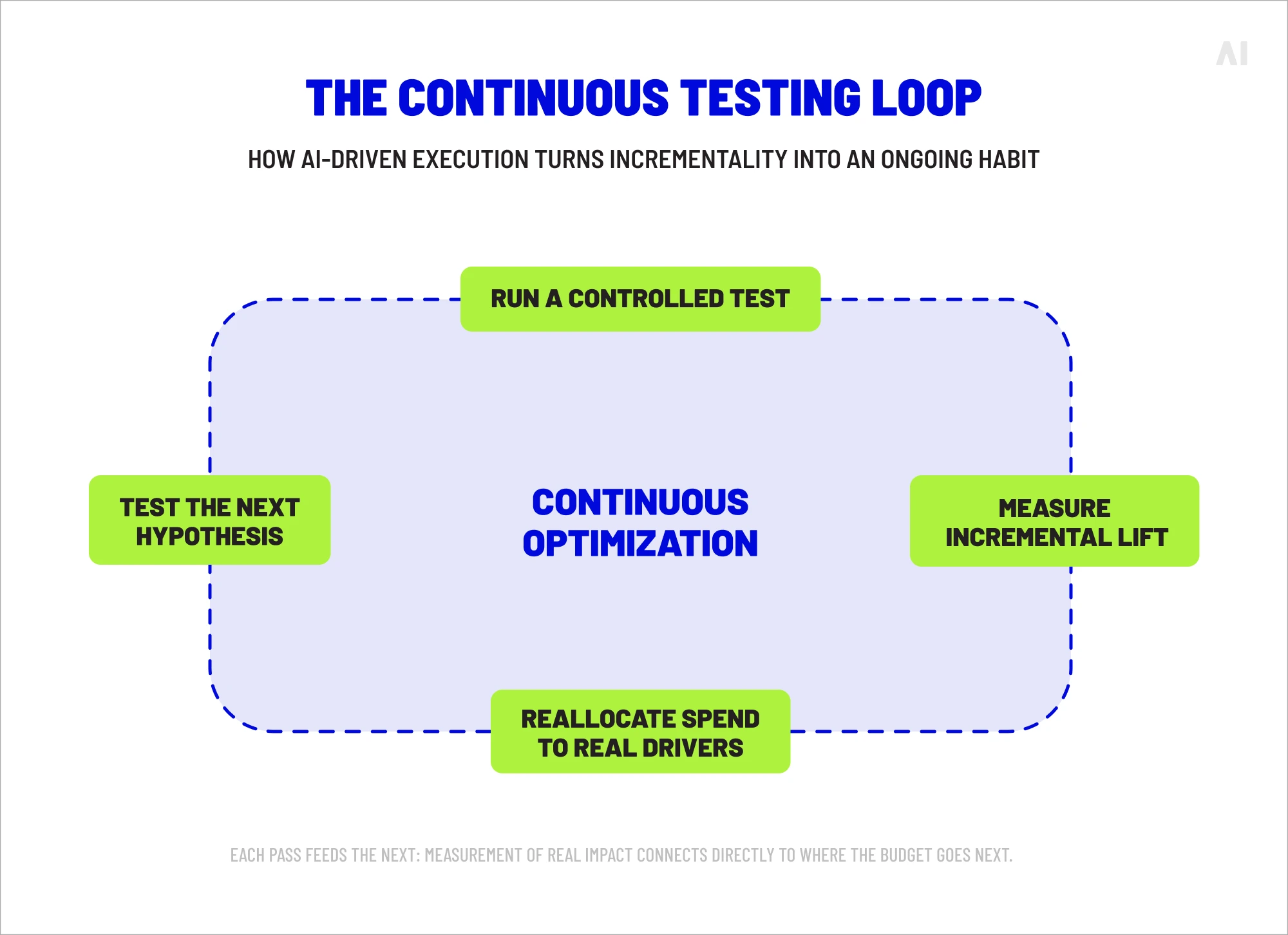
Continuous experimentation needs an execution layer that connects measurement to activation, so that what a test learns can be acted on without rebuilding the campaign by hand. Centralized, intelligence-led media execution turns incrementality from a periodic study into an ongoing loop: test, read the lift, reallocate, test again. AI Digital's broader programmatic and media execution capabilities exist to close that loop, joining the measurement of real impact to the machinery that delivers against it across channels.
The continuous testing loop.
Incrementality testing tools and platforms
The tooling available for incrementality measurement has expanded quickly, and the options fall into three broad categories that suit different levels of independence and ambition. Most organizations use more than one, pairing the convenience of platform-native tools with the rigor of independent measurement.
Platform-native testing tools
Google and Meta provide built-in conversion-lift and incrementality testing capabilities inside their own environments, and for teams working primarily within a single platform they offer a fast, low-friction starting point. Their value is immediacy; their limitation, as with platform lift studies generally, is that the platform measuring the lift also stands to benefit from a favorable result. They are most useful as a first read rather than a final verdict.
Marketing measurement and experimentation platforms
A growing category of specialist platforms exists specifically for incrementality testing, causal measurement, and cross-channel performance analysis, independent of the media owners being measured. These tools handle the design and statistics of experiments at scale — geo testing, holdouts, matched-market analysis — and their independence is the point: a result produced by a party with no stake in the outcome carries more weight in a budget conversation than one produced by the platform selling the inventory.
The most integrated option combines experimentation, forecasting, optimization, and measurement into a single decision-making environment. Rather than running incrementality as a separate exercise, these platforms fold causal measurement into planning and activation, so that a test result feeds directly into the next budget decision. For organizations trying to make continuous testing a habit rather than an event, unifying the workflow in one intelligence layer removes most of the operational friction that keeps incrementality marketing from scaling.
Integrate incrementality into modern marketing measurement
Incrementality testing earns its place because it answers the one question every other method leaves open: of all the outcomes a brand reports, which ones did the marketing actually cause? In fragmented, privacy-pressured advertising environments — where the cookie survived but reliable measurement did not — that question only grows more valuable. Incrementality measurement improves the accuracy of every other number a team reports, sharpens budget allocation toward what genuinely grows the business, and gives marketers the evidence to make confident decisions instead of defensible-sounding guesses. Used alongside attribution and media mix modeling rather than in place of them, it gives a measurement program the causal backbone the others lack.
AI Digital helps brands and agencies build that backbone, joining causal measurement to the execution that acts on it. Through the Elevate marketing intelligence platform, Smart Supply curation, the vendor-neutral Open Garden framework, and full-service media execution, the aim is to connect what a test proves to what a campaign does next. If proving the real impact of your marketing has become the decision your budget now turns on,get in touch.
Blind spot
Key issues
Business impact
AI Digital solution
Lack of transparency in AI models
• Platforms own AI models and train on proprietary data • Brands have little visibility into decision-making • "Walled gardens" restrict data access
• Inefficient ad spend • Limited strategic control • Eroded consumer trust • Potential budget mismanagement
Open Garden framework providing: • Complete transparency • DSP-agnostic execution • Cross-platform data & insights
Optimizing ads vs. optimizing impact
• AI excels at short-term metrics but may struggle with brand building • Consumers can detect AI-generated content • Efficiency might come at cost of authenticity
• Short-term gains at expense of brand health • Potential loss of authentic connection • Reduced effectiveness in storytelling
Smart Supply offering: • Human oversight of AI recommendations • Custom KPI alignment beyond clicks • Brand-safe inventory verification
The illusion of personalization
• Segment optimization rebranded as personalization • First-party data infrastructure challenges • Personalization vs. surveillance concerns
• Potential mismatch between promise and reality • Privacy concerns affecting consumer trust • Cost barriers for smaller businesses
Elevate platform features: • Real-time AI + human intelligence • First-party data activation • Ethical personalization strategies
AI-Driven efficiency vs. decision-making
• AI shifting from tool to decision-maker • Black box optimization like Google Performance Max • Human oversight limitations
• Strategic control loss • Difficulty questioning AI outputs • Inability to measure granular impact • Potential brand damage from mistakes
Managed Service with: • Human strategists overseeing AI • Custom KPI optimization • Complete campaign transparency
Fig. 1. Summary of AI blind spots in advertising
Dimension
Walled garden advantage
Walled garden limitation
Strategic impact
Audience access
Massive, engaged user bases
Limited visibility beyond platform
Reach without understanding
Data control
Sophisticated targeting tools
Data remains siloed within platform
Fragmented customer view
Measurement
Detailed in-platform metrics
Inconsistent cross-platform standards
Difficult performance comparison
Intelligence
Platform-specific insights
Limited data portability
Restricted strategic learning
Optimization
Powerful automated tools
Black-box algorithms
Reduced marketer control
Fig. 2. Strategic trade-offs in walled garden advertising.
Core issue
Platform priority
Walled garden limitation
Real-world example
Attribution opacity
Claiming maximum credit for conversions
Limited visibility into true conversion paths
Meta and TikTok's conflicting attribution models after iOS privacy updates
Data restrictions
Maintaining proprietary data control
Inability to combine platform data with other sources
Amazon DSP's limitations on detailed performance data exports
Cross-channel blindspots
Keeping advertisers within ecosystem
Fragmented view of customer journey
YouTube/DV360 campaigns lacking integration with non-Google platforms
Black box algorithms
Optimizing for platform revenue
Reduced control over campaign execution
Self-serve platforms using opaque ML models with little advertiser input
Performance reporting
Presenting platform in best light
Discrepancies between platform-reported and independently measured results
Consistently higher performance metrics in platform reports vs. third-party measurement
Fig. 1. The Walled garden misalignment: Platform interests vs. advertiser needs.
Key dimension
Challenge
Strategic imperative
ROAS volatility
Softer returns across digital channels
Shift from soft KPIs to measurable revenue impact
Media planning
Static plans no longer effective
Develop agile, modular approaches adaptable to changing conditions
Brand/performance
Traditional division dissolving
Create full-funnel strategies balancing long-term equity with short-term conversion
Capability
Key features
Benefits
Performance data
Elevate forecasting tool
• Vertical-specific insights • Historical data from past economic turbulence • "Cascade planning" functionality • Real-time adaptation
• Provides agility to adjust campaign strategy based on performance • Shows which media channels work best to drive efficient and effective performance • Confident budget reallocation • Reduces reaction time to market shifts
• Dataset from 10,000+ campaigns • Cuts response time from weeks to minutes
• Reaches people most likely to buy • Avoids wasted impressions and budgets on poor-performing placements • Context-aligned messaging
• 25+ billion bid requests analyzed daily • 18% improvement in working media efficiency • 26% increase in engagement during recessions
Full-funnel accountability
• Links awareness campaigns to lower funnel outcomes • Tests if ads actually drive new business • Measures brand perception changes • "Ask Elevate" AI Chat Assistant
• Upper-funnel to outcome connection • Sentiment shift tracking • Personalized messaging • Helps balance immediate sales vs. long-term brand building
• Natural language data queries • True business impact measurement
Open Garden approach
• Cross-platform and channel planning • Not locked into specific platforms • Unified cross-platform reach • Shows exactly where money is spent
• Reduces complexity across channels • Performance-based ad placement • Rapid budget reallocation • Eliminates platform-specific commitments and provides platform-based optimization and agility
• Coverage across all inventory sources • Provides full visibility into spending • Avoids the inability to pivot across platform as you’re not in a singular platform
Fig. 1. How AI Digital helps during economic uncertainty.
Trend
What it means for marketers
Supply & demand lines are blurring
Platforms from Google (P-Max) to Microsoft are merging optimization and inventory in one opaque box. Expect more bundled “best available” media where the algorithm, not the trader, decides channel and publisher mix.
Walled gardens get taller
Microsoft’s O&O set now spans Bing, Xbox, Outlook, Edge and LinkedIn, which just launched revenue-sharing video programs to lure creators and ad dollars. (Business Insider)
Retail & commerce media shape strategy
Microsoft’s Curate lets retailers and data owners package first-party segments, an echo of Amazon’s and Walmart’s approaches. Agencies must master seller-defined audiences as well as buyer-side tactics.
AI oversight becomes critical
Closed AI bidding means fewer levers for traders. Independent verification, incrementality testing and commercial guardrails rise in importance.
Fig. 1. Platform trends and their implications.
Metric
Connected TV (CTV)
Linear TV
Video Completion Rate
94.5%
70%
Purchase Rate After Ad
23%
12%
Ad Attention Rate
57% (prefer CTV ads)
54.5%
Viewer Reach (U.S.)
85% of households
228 million viewers
Retail Media Trends 2025
Access Complete consumer behaviour analyses and competitor benchmarks.
Identify and categorize audience groups based on behaviors, preferences, and characteristics
Michaels Stores: Implemented a genAI platform that increased email personalization from 20% to 95%, leading to a 41% boost in SMS click through rates and a 25% increase in engagement.
Estée Lauder: Partnered with Google Cloud to leverage genAI technologies for real-time consumer feedback monitoring and analyzing consumer sentiment across various channels.
High
Medium
Automated ad campaigns
Automate ad creation, placement, and optimization across various platforms
Showmax: Partnered with AI firms toautomate ad creation and testing, reducing production time by 70% while streamlining their quality assurance process.
Headway: Employed AI tools for ad creation and optimization, boosting performance by 40% and reaching 3.3 billion impressions while incorporating AI-generated content in 20% of their paid campaigns.
High
High
Brand sentiment tracking
Monitor and analyze public opinion about a brand across multiple channels in real time
L’Oréal: Analyzed millions of online comments, images, and videos to identify potential product innovation opportunities, effectively tracking brand sentiment and consumer trends.
Kellogg Company: Used AI to scan trending recipes featuring cereal, leveraging this data to launch targeted social campaigns that capitalize on positive brand sentiment and culinary trends.
High
Low
Campaign strategy optimization
Analyze data to predict optimal campaign approaches, channels, and timing
DoorDash: Leveraged Google’s AI-powered Demand Gen tool, which boosted its conversion rate by 15 times and improved cost per action efficiency by 50% compared with previous campaigns.
Kitsch: Employed Meta’s Advantage+ shopping campaigns with AI-powered tools to optimize campaigns, identifying and delivering top-performing ads to high-value consumers.
High
High
Content strategy
Generate content ideas, predict performance, and optimize distribution strategies
JPMorgan Chase: Collaborated with Persado to develop LLMs for marketing copy, achieving up to 450% higher clickthrough rates compared with human-written ads in pilot tests.
Hotel Chocolat: Employed genAI for concept development and production of its Velvetiser TV ad, which earned the highest-ever System1 score for adomestic appliance commercial.
High
High
Personalization strategy development
Create tailored messaging and experiences for consumers at scale
Stitch Fix: Uses genAI to help stylists interpret customer feedback and provide product recommendations, effectively personalizing shopping experiences.
Instacart: Uses genAI to offer customers personalized recipes, mealplanning ideas, and shopping lists based on individual preferences and habits.
Medium
Medium
Share article
Url copied to clipboard
No items found.
Subscribe to our Newsletter
THANK YOU FOR YOUR SUBSCRIPTION
Oops! Something went wrong while submitting the form.
Questions? We have answers
What is incrementality testing in marketing?
Incrementality testing in marketing is a method for proving how many conversions, sales, or new customers a campaign actually caused—the ones that would not have happened without it. It works by comparing a group exposed to the advertising against a comparable group that was held out, and reading the difference between them as the campaign's true lift. Rather than assigning credit to whichever touchpoint came before a conversion, as attribution does, it answers the harder question of whether that conversion would have occurred anyway. That makes it the most reliable way to separate genuine, ad-driven growth from demand a brand would have captured regardless.
When should businesses start using incrementality testing?
The right moment usually announces itself through a combination of signals: ad budgets large enough that measurement error becomes expensive, customer journeys too fragmented for attribution to follow, declining confidence in platform-reported numbers, and pressure to prove marketing's real contribution. A brand does not need a sophisticated program to begin. Starting with a single high-stakes channel—branded search or retargeting are common first tests—and a clean holdout or geo design is enough to learn whether the reported performance survives a causal check.
Why is incrementality testing more reliable than attribution?
Attribution can only show association: it sees which touchpoints preceded a conversion, not which ones caused it. Incrementality testing measures cause directly, by comparing an exposed group against a comparable control and reading the difference as genuine lift. Because it isolates the outcomes that would not have happened otherwise, it does not get fooled by demand a brand would have captured regardless—which is the systematic blind spot in every attribution model.
How do marketers measure incremental lift?
Lift is measured by comparing outcomes between an audience or market exposed to advertising and a comparable one that was held out. The difference in conversions, revenue, or new customers between the two groups, once they are genuinely comparable and large enough for statistical confidence, represents the incremental effect of the campaign. The same logic underlies holdout tests, geo experiments, and platform lift studies; they differ mainly in whether the comparison is drawn across individuals or across regions.
Which marketing channels benefit most from incrementality testing?
Two kinds of channel gain the most. Lower-funnel channels that intercept existing demand—branded search and retargeting above all—benefit because incrementality reveals how much of their celebrated performance is genuinely additional. Upper-funnel channels such as connected TV, video, and audio benefit for the opposite reason: attribution chronically undervalues them, and geo-based incrementality testing can measure the demand they create even without a clean conversion path.
How can incrementality testing reduce wasted ad spend?
By exposing the waste that performance reports conceal. Incrementality measurement makes saturation, over-frequency, and inefficient targeting visible, and it identifies channels earning credit for conversions that required no advertising. With those revealed, a marketer can redirect spend away from demand harvesting and toward activity that produces net-new customers—which is where reallocating budget on incremental evidence recovers returns that attributed metrics steadily bleed away.
Why is incrementality testing important in privacy-first advertising?
Because it does not depend on the user-level tracking privacy changes have eroded. Incrementality testing works by comparing groups and reading aggregate differences in outcomes, so it remains reliable even where cookies, cross-device identifiers, and deterministic tracking have broken down. When Google kept third-party cookies and then retired its cookie replacement, it confirmed that no platform-led fix for measurement was coming—leaving causal methods that work without clean identifiers as the most dependable way to prove what advertising actually achieves.
Have other questions?
If you have more questions, contact us so we can help.
Questions? We have answers
This is some text inside of a div block.
Lorem ipsum dolor sit amet, consectetur adipiscing elit. Suspendisse varius enim in eros elementum tristique. Duis cursus, mi quis viverra ornare, eros dolor interdum nulla, ut commodo diam libero vitae erat. Aenean faucibus nibh et justo cursus id rutrum lorem imperdiet. Nunc ut sem vitae risus tristique posuere.
This is some text inside of a div block.
Lorem ipsum dolor sit amet, consectetur adipiscing elit. Suspendisse varius enim in eros elementum tristique. Duis cursus, mi quis viverra ornare, eros dolor interdum nulla, ut commodo diam libero vitae erat. Aenean faucibus nibh et justo cursus id rutrum lorem imperdiet. Nunc ut sem vitae risus tristique posuere.
This is some text inside of a div block.
Lorem ipsum dolor sit amet, consectetur adipiscing elit. Suspendisse varius enim in eros elementum tristique. Duis cursus, mi quis viverra ornare, eros dolor interdum nulla, ut commodo diam libero vitae erat. Aenean faucibus nibh et justo cursus id rutrum lorem imperdiet. Nunc ut sem vitae risus tristique posuere.
This is some text inside of a div block.
Lorem ipsum dolor sit amet, consectetur adipiscing elit. Suspendisse varius enim in eros elementum tristique. Duis cursus, mi quis viverra ornare, eros dolor interdum nulla, ut commodo diam libero vitae erat. Aenean faucibus nibh et justo cursus id rutrum lorem imperdiet. Nunc ut sem vitae risus tristique posuere.
This is some text inside of a div block.
Lorem ipsum dolor sit amet, consectetur adipiscing elit. Suspendisse varius enim in eros elementum tristique. Duis cursus, mi quis viverra ornare, eros dolor interdum nulla, ut commodo diam libero vitae erat. Aenean faucibus nibh et justo cursus id rutrum lorem imperdiet. Nunc ut sem vitae risus tristique posuere.
This is some text inside of a div block.
Lorem ipsum dolor sit amet, consectetur adipiscing elit. Suspendisse varius enim in eros elementum tristique. Duis cursus, mi quis viverra ornare, eros dolor interdum nulla, ut commodo diam libero vitae erat. Aenean faucibus nibh et justo cursus id rutrum lorem imperdiet. Nunc ut sem vitae risus tristique posuere.
This is some text inside of a div block.
Lorem ipsum dolor sit amet, consectetur adipiscing elit. Suspendisse varius enim in eros elementum tristique. Duis cursus, mi quis viverra ornare, eros dolor interdum nulla, ut commodo diam libero vitae erat. Aenean faucibus nibh et justo cursus id rutrum lorem imperdiet. Nunc ut sem vitae risus tristique posuere.

.svg)
.svg)